By
Dr. LALAWMPUIA CHHANGTE
DIABETOLOGIST
 GDM is defined as impaired glucose tolerance (IGT) with
onset or first recognition during pregnancy. National
guideline for diagnosis and management of GDM
endorse the single step test. Recommendation by WHO
using 75 gm of glucose by OGTT. Irrespective of the last
meal with a threshold value of 2 hour blood sugar >
140 ml/dl.
Guildlines advocate universal screening of all
pregnant women at 1st ANC. If the first stage is
negative2 test should be done at 24 to 28 weeks of
gestation. GDM pregnant should be manage by MNT,
exercise, insulin or metformin.
In the post partum period OGTT should be repeated at
six weeks after delivery, if sugar is less than 140
ml/dl the women is advice to check PPBS annually.
World Wide, one in ten pregnancies is associated with
diabetes 90 percent of which are GDM.
◦ Undiagnosed or in adequately treated GDM can lead to
signicifant maternal and fetal complications. Moreover
women with GDM and their offspring are at the risk of
developing type 2 DM in later life.
◦ In India rate of GDM are estimated to be 10 to 14.3 % which
is much higher than the west.
◦ As of 2010, there were an estimated 22 millions women
with diabetes at 20 - 39 age group and additional fifty four
million women in this age group with IGT , Potential to
develop GDM if they become pregnant.
◦ The incidence of GDM is expected to increase to 20 % i.e
one in every five pregnancy is likely to have GDM.
◦ To address the urgent need to prevent and minimize
maternal and fetal morbidity associated with GDM. Ministry
of H&FW release a national guidelines for provisions of
Universal screening and Management of GDM as a part of
antenatal package.
 Maternal risks Fetal risk
 Abortion Sponteneous abortion
 Polyhydromnios Intra uterine death
 Pre-eclampsia Stillbirth
 Prolonges labour Congenital malformation
 Obstructed labour Shoulder dystocia
 Cesarean section Bath injury
 Ulterine atony Neonatal hypoglycemia
 Postpartum hemorrhage IRDS
 Infection Macrosomia
 PREVENTION AND CONTROL
 EXERCISE AND DIET
 DPP, DPS Intensive LSM Prevent development of IGT by 58
%
 BENEFITS OF EXERCISE :
 Improvement of insulin sensitivity
 Reduction of BP
 Reduction in weight
 Improvement in lipid profile
 Improvement of CV function
 Improvement in quality of life
DIET :
 Carbohydrates – 60 %
 Protein – 20 %
 Fibres – 30 - 40 gm
 Fats – 10 %
 GDM – requires additional 350 calories high protein diet from
second trimester.
GDM
MNT + EXERCISE
2hr PPBS
< 120 mg/dl
MNT + EXERCISE
>120 mg/dl
OHA or INSULIN
MONITOR 2hr PPBS
MONITOR FBS AND PPBS
EVERY 3 DAYS FOR INSULIN
AND TWICE WEELKY FOR
METFORMIN
 Metformin or insulin therapy is the accepted
medical management.
 Metformin should not be given before 20 weeks of
pregnancy.
 Maximum dose of metformin is 2gm per day.
 Less weight gain and pedal edema with metformin.
 If insulin is required in high dose metformin may
be added.
 Patient may be refer to higher centre if blood sugar
not control.
 A pregnant women with insulin should kept
glucose powder handy.
 Common side effects of metformin – diarrhoea ,
nausea, stomach pain, heart burn.
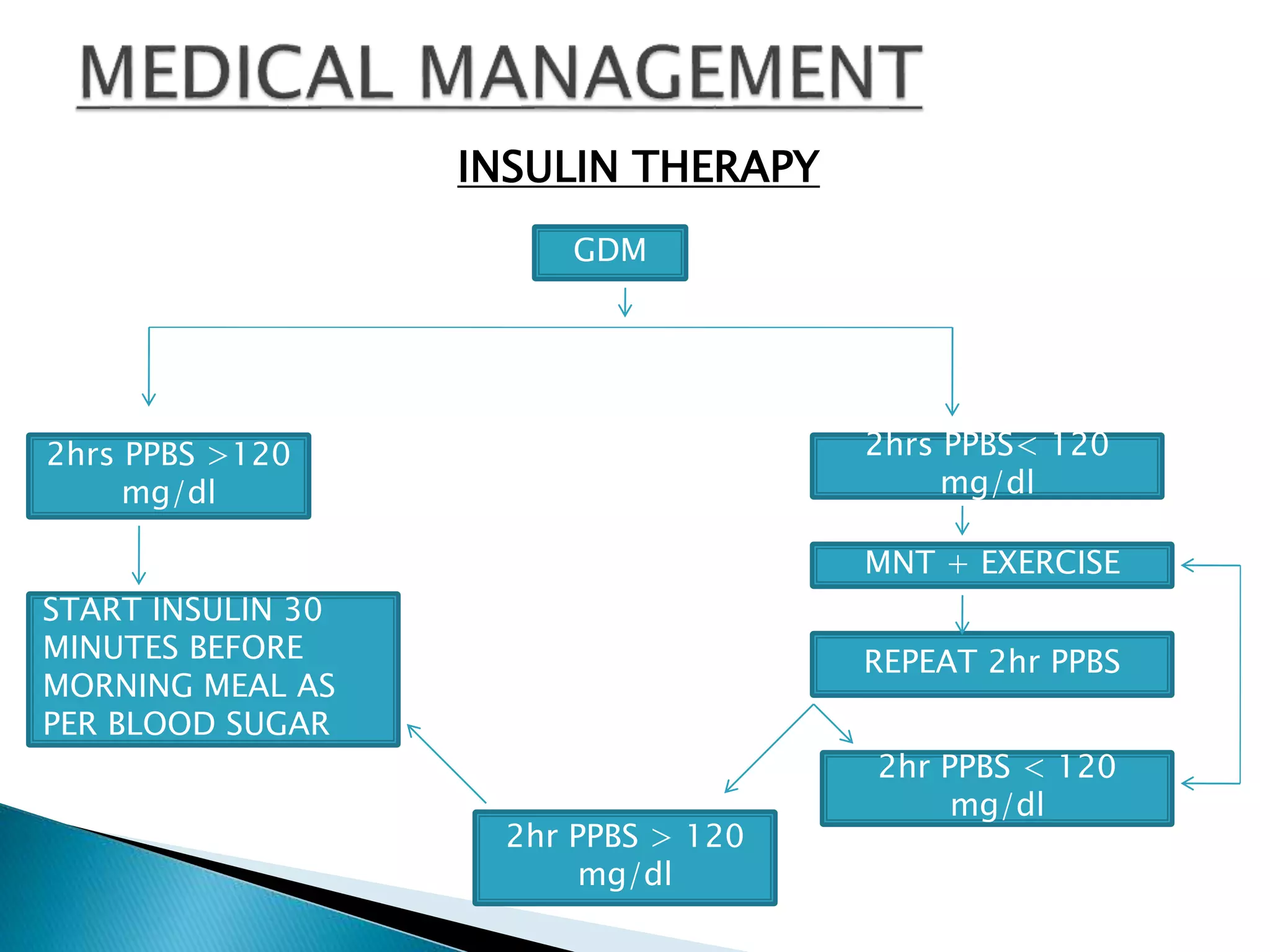
INSULIN THERAPY
GDM
2hrs PPBS >120
mg/dl
2hrs PPBS< 120
mg/dl
START INSULIN 30
MINUTES BEFORE
MORNING MEAL AS
PER BLOOD SUGAR
MNT + EXERCISE
REPEAT 2hr PPBS
2hr PPBS < 120
mg/dl
2hr PPBS > 120
mg/dl
BLOOD SUGAR LEVEL DOSES OF
INSULIN
120 – 160 mg/dl 4 units
160 – 200 mg/dl 6 units
200 and above 8 units
SITE OF INJECTION
 Abdomen
 Thigh
 Upper arm
Hypoglycaemia – blood sugar < 70 mg/dl
Symptoms :
Early symptoms : Tremors, sweating, palpitation,
hunger, easy fatique, headache,mood change,
irritability.
Severe : Confusion, abnormal behaviour, visual
disturbances, nervousnes, anxiety.
Uncommon : Seizure and loss of consciousness.
Management :
 3 tsf of glucose in a glass of water, if not sugar, fruit
juice, honey etc.
 If persist, give glucose again. In very severe cases
infuse 25 % dextrose followed by slow infusion of 10
% dextrose.
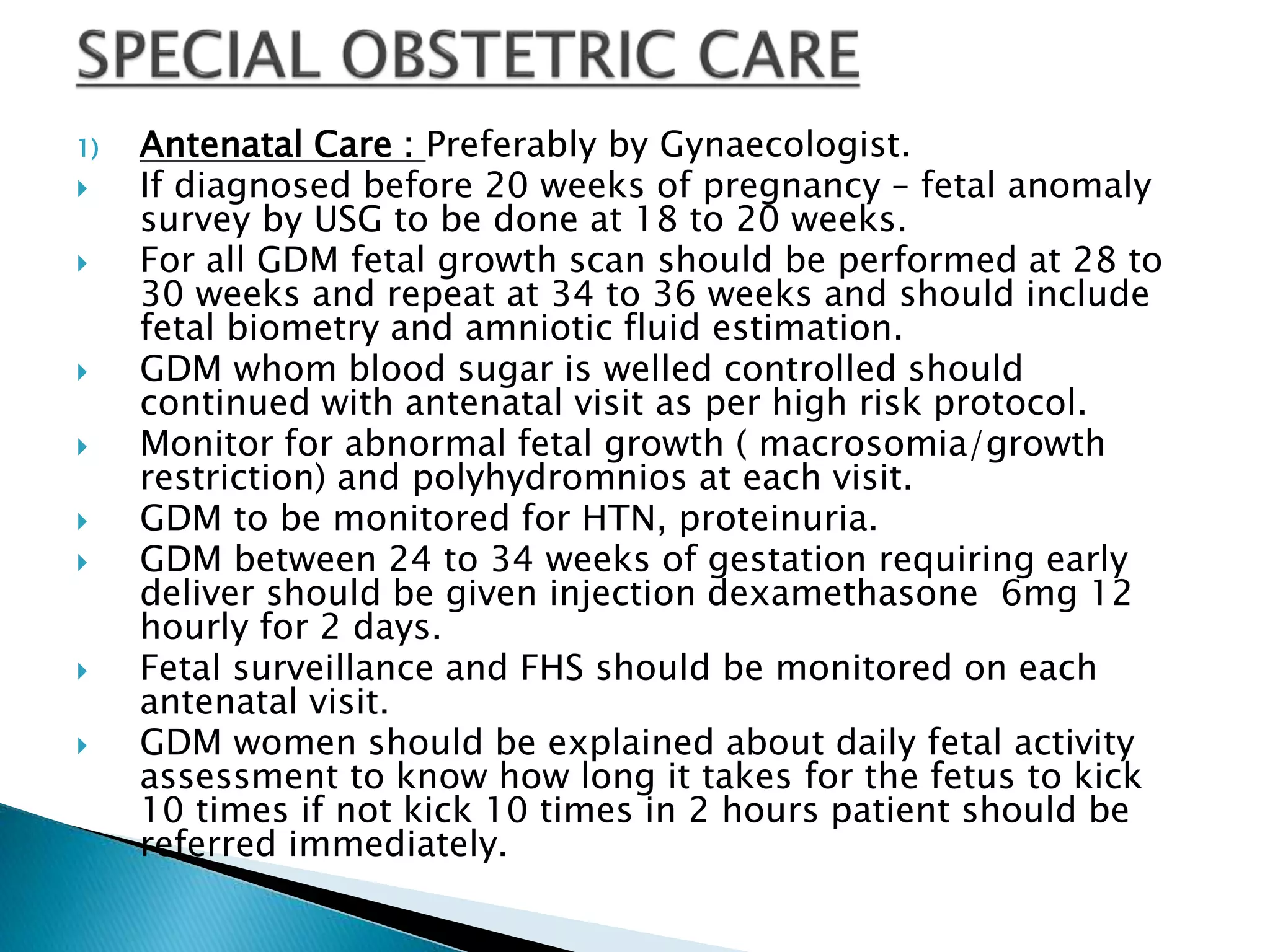
1) Antenatal Care : Preferably by Gynaecologist.
 If diagnosed before 20 weeks of pregnancy – fetal anomaly
survey by USG to be done at 18 to 20 weeks.
 For all GDM fetal growth scan should be performed at 28 to
30 weeks and repeat at 34 to 36 weeks and should include
fetal biometry and amniotic fluid estimation.
 GDM whom blood sugar is welled controlled should
continued with antenatal visit as per high risk protocol.
 Monitor for abnormal fetal growth ( macrosomia/growth
restriction) and polyhydromnios at each visit.
 GDM to be monitored for HTN, proteinuria.
 GDM between 24 to 34 weeks of gestation requiring early
deliver should be given injection dexamethasone 6mg 12
hourly for 2 days.
 Fetal surveillance and FHS should be monitored on each
antenatal visit.
 GDM women should be explained about daily fetal activity
assessment to know how long it takes for the fetus to kick
10 times if not kick 10 times in 2 hours patient should be
referred immediately.
2) Labour and Delivery :
GDM with good blood sugar control i.e 2 hours PPBS < 120
mg/dl may deliver at the respective health facility.
 Poor controlled GDM should be referred to higher centre at
34 to 36 weeks.
 Timing of delivery since GDM is associated with delay in lung
maturity of the fetus so routine delivery prior to 39 weeks is
not recommended.
Incase of macrosomia where estimated fetal weight is > 4kg
consideration should be given for primary CS at 39 weeks to
avoid shoulder dystocia.
3) During labour : Blood sugar monitoring should be done.
 Morning dose of insulin or metformin to be withhold on the
day of labour with 2 hourly monitoring of blood sugar
 IV infusion with NS with regular Insulin
90 -120 mg/dl – nil – 100ml/hour (16 drops/ minute)
120 – 140 mg/dl – 4 units – 100ml/hour
140 – 180 mg/dl - 6 units
>180 mg/dl – 8 units
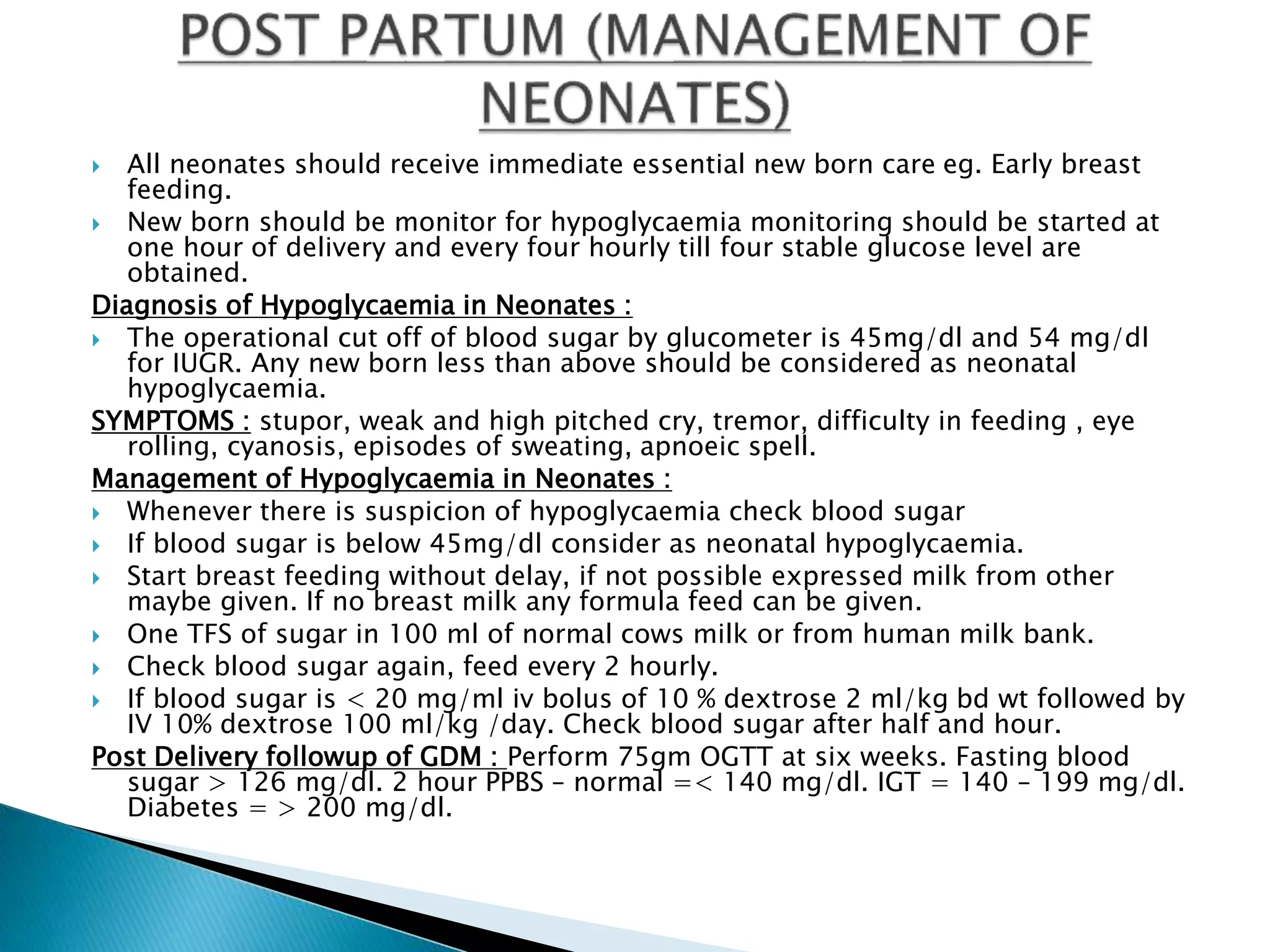
 All neonates should receive immediate essential new born care eg. Early breast
feeding.
 New born should be monitor for hypoglycaemia monitoring should be started at
one hour of delivery and every four hourly till four stable glucose level are
obtained.
Diagnosis of Hypoglycaemia in Neonates :
 The operational cut off of blood sugar by glucometer is 45mg/dl and 54 mg/dl
for IUGR. Any new born less than above should be considered as neonatal
hypoglycaemia.
SYMPTOMS : stupor, weak and high pitched cry, tremor, difficulty in feeding , eye
rolling, cyanosis, episodes of sweating, apnoeic spell.
Management of Hypoglycaemia in Neonates :
 Whenever there is suspicion of hypoglycaemia check blood sugar
 If blood sugar is below 45mg/dl consider as neonatal hypoglycaemia.
 Start breast feeding without delay, if not possible expressed milk from other
maybe given. If no breast milk any formula feed can be given.
 One TFS of sugar in 100 ml of normal cows milk or from human milk bank.
 Check blood sugar again, feed every 2 hourly.
 If blood sugar is < 20 mg/ml iv bolus of 10 % dextrose 2 ml/kg bd wt followed by
IV 10% dextrose 100 ml/kg /day. Check blood sugar after half and hour.
Post Delivery followup of GDM : Perform 75gm OGTT at six weeks. Fasting blood
sugar > 126 mg/dl. 2 hour PPBS – normal =< 140 mg/dl. IGT = 140 – 199 mg/dl.
Diabetes = > 200 mg/dl.
 GDM can be easily controlled by diet and exercise.
 In few cases, GDM may need metformin or insulin.
 Metformin and insulin does not cause any harm to
fetus.
 Medication are required during pregnancy only.
 Injection over abdomen does not cause any harm.
 Sweets should be avoided completely.
 If blood sugar is controlled, you and your baby are
safe. If not it may harm both mother and baby.
 If you take insulin always keep sugar with you.
 Women with GDM should deliver at health facilities.
 Energy requirement (kcal/day) = BMR x PAL.
 BMR = Basal Metabolic Rate. PAL = Physical Activity Level.
 BMR (kcal/day) for adult female 18 – 30 years = 14 x bw
(kg) + 471
 BMR (kcal/day) for adult female 30 – 60 years = 8.3 x bw
(kg) +788
Calorie Requirement : eg. Pregnant women age 28, sedentary
active, height = 153 cm, wt = 60 kg, pre pregnant weight =
54 kg
 First calculate BMI = wt in kg divided by height in meter
square = 54/1.53 x 1.53 = 23.6 kg/m2
 BMR = 14 x 54 + 471 = 1227 kcal. Sedentary level = 1.53
= 1227 x 1.53 = 1877 kcal. Total requirement = 1877 +
350 = 2227 kcal/day
GESTATIONAL DIABETES MELLITUS (GDM).pptx

GESTATIONAL DIABETES MELLITUS (GDM).pptx

  • 1.
  • 2.
     GDM isdefined as impaired glucose tolerance (IGT) with onset or first recognition during pregnancy. National guideline for diagnosis and management of GDM endorse the single step test. Recommendation by WHO using 75 gm of glucose by OGTT. Irrespective of the last meal with a threshold value of 2 hour blood sugar > 140 ml/dl. Guildlines advocate universal screening of all pregnant women at 1st ANC. If the first stage is negative2 test should be done at 24 to 28 weeks of gestation. GDM pregnant should be manage by MNT, exercise, insulin or metformin. In the post partum period OGTT should be repeated at six weeks after delivery, if sugar is less than 140 ml/dl the women is advice to check PPBS annually.
  • 3.
    World Wide, onein ten pregnancies is associated with diabetes 90 percent of which are GDM. ◦ Undiagnosed or in adequately treated GDM can lead to signicifant maternal and fetal complications. Moreover women with GDM and their offspring are at the risk of developing type 2 DM in later life. ◦ In India rate of GDM are estimated to be 10 to 14.3 % which is much higher than the west. ◦ As of 2010, there were an estimated 22 millions women with diabetes at 20 - 39 age group and additional fifty four million women in this age group with IGT , Potential to develop GDM if they become pregnant. ◦ The incidence of GDM is expected to increase to 20 % i.e one in every five pregnancy is likely to have GDM. ◦ To address the urgent need to prevent and minimize maternal and fetal morbidity associated with GDM. Ministry of H&FW release a national guidelines for provisions of Universal screening and Management of GDM as a part of antenatal package.
  • 4.
     Maternal risksFetal risk  Abortion Sponteneous abortion  Polyhydromnios Intra uterine death  Pre-eclampsia Stillbirth  Prolonges labour Congenital malformation  Obstructed labour Shoulder dystocia  Cesarean section Bath injury  Ulterine atony Neonatal hypoglycemia  Postpartum hemorrhage IRDS  Infection Macrosomia
  • 5.
     PREVENTION ANDCONTROL  EXERCISE AND DIET  DPP, DPS Intensive LSM Prevent development of IGT by 58 %  BENEFITS OF EXERCISE :  Improvement of insulin sensitivity  Reduction of BP  Reduction in weight  Improvement in lipid profile  Improvement of CV function  Improvement in quality of life DIET :  Carbohydrates – 60 %  Protein – 20 %  Fibres – 30 - 40 gm  Fats – 10 %  GDM – requires additional 350 calories high protein diet from second trimester.
  • 6.
    GDM MNT + EXERCISE 2hrPPBS < 120 mg/dl MNT + EXERCISE >120 mg/dl OHA or INSULIN MONITOR 2hr PPBS MONITOR FBS AND PPBS EVERY 3 DAYS FOR INSULIN AND TWICE WEELKY FOR METFORMIN
  • 7.
     Metformin orinsulin therapy is the accepted medical management.  Metformin should not be given before 20 weeks of pregnancy.  Maximum dose of metformin is 2gm per day.  Less weight gain and pedal edema with metformin.  If insulin is required in high dose metformin may be added.  Patient may be refer to higher centre if blood sugar not control.  A pregnant women with insulin should kept glucose powder handy.  Common side effects of metformin – diarrhoea , nausea, stomach pain, heart burn.
  • 8.
    INSULIN THERAPY GDM 2hrs PPBS>120 mg/dl 2hrs PPBS< 120 mg/dl START INSULIN 30 MINUTES BEFORE MORNING MEAL AS PER BLOOD SUGAR MNT + EXERCISE REPEAT 2hr PPBS 2hr PPBS < 120 mg/dl 2hr PPBS > 120 mg/dl
  • 9.
    BLOOD SUGAR LEVELDOSES OF INSULIN 120 – 160 mg/dl 4 units 160 – 200 mg/dl 6 units 200 and above 8 units SITE OF INJECTION  Abdomen  Thigh  Upper arm
  • 10.
    Hypoglycaemia – bloodsugar < 70 mg/dl Symptoms : Early symptoms : Tremors, sweating, palpitation, hunger, easy fatique, headache,mood change, irritability. Severe : Confusion, abnormal behaviour, visual disturbances, nervousnes, anxiety. Uncommon : Seizure and loss of consciousness. Management :  3 tsf of glucose in a glass of water, if not sugar, fruit juice, honey etc.  If persist, give glucose again. In very severe cases infuse 25 % dextrose followed by slow infusion of 10 % dextrose.
  • 11.
    1) Antenatal Care: Preferably by Gynaecologist.  If diagnosed before 20 weeks of pregnancy – fetal anomaly survey by USG to be done at 18 to 20 weeks.  For all GDM fetal growth scan should be performed at 28 to 30 weeks and repeat at 34 to 36 weeks and should include fetal biometry and amniotic fluid estimation.  GDM whom blood sugar is welled controlled should continued with antenatal visit as per high risk protocol.  Monitor for abnormal fetal growth ( macrosomia/growth restriction) and polyhydromnios at each visit.  GDM to be monitored for HTN, proteinuria.  GDM between 24 to 34 weeks of gestation requiring early deliver should be given injection dexamethasone 6mg 12 hourly for 2 days.  Fetal surveillance and FHS should be monitored on each antenatal visit.  GDM women should be explained about daily fetal activity assessment to know how long it takes for the fetus to kick 10 times if not kick 10 times in 2 hours patient should be referred immediately.
  • 12.
    2) Labour andDelivery : GDM with good blood sugar control i.e 2 hours PPBS < 120 mg/dl may deliver at the respective health facility.  Poor controlled GDM should be referred to higher centre at 34 to 36 weeks.  Timing of delivery since GDM is associated with delay in lung maturity of the fetus so routine delivery prior to 39 weeks is not recommended. Incase of macrosomia where estimated fetal weight is > 4kg consideration should be given for primary CS at 39 weeks to avoid shoulder dystocia. 3) During labour : Blood sugar monitoring should be done.  Morning dose of insulin or metformin to be withhold on the day of labour with 2 hourly monitoring of blood sugar  IV infusion with NS with regular Insulin 90 -120 mg/dl – nil – 100ml/hour (16 drops/ minute) 120 – 140 mg/dl – 4 units – 100ml/hour 140 – 180 mg/dl - 6 units >180 mg/dl – 8 units
  • 13.
     All neonatesshould receive immediate essential new born care eg. Early breast feeding.  New born should be monitor for hypoglycaemia monitoring should be started at one hour of delivery and every four hourly till four stable glucose level are obtained. Diagnosis of Hypoglycaemia in Neonates :  The operational cut off of blood sugar by glucometer is 45mg/dl and 54 mg/dl for IUGR. Any new born less than above should be considered as neonatal hypoglycaemia. SYMPTOMS : stupor, weak and high pitched cry, tremor, difficulty in feeding , eye rolling, cyanosis, episodes of sweating, apnoeic spell. Management of Hypoglycaemia in Neonates :  Whenever there is suspicion of hypoglycaemia check blood sugar  If blood sugar is below 45mg/dl consider as neonatal hypoglycaemia.  Start breast feeding without delay, if not possible expressed milk from other maybe given. If no breast milk any formula feed can be given.  One TFS of sugar in 100 ml of normal cows milk or from human milk bank.  Check blood sugar again, feed every 2 hourly.  If blood sugar is < 20 mg/ml iv bolus of 10 % dextrose 2 ml/kg bd wt followed by IV 10% dextrose 100 ml/kg /day. Check blood sugar after half and hour. Post Delivery followup of GDM : Perform 75gm OGTT at six weeks. Fasting blood sugar > 126 mg/dl. 2 hour PPBS – normal =< 140 mg/dl. IGT = 140 – 199 mg/dl. Diabetes = > 200 mg/dl.
  • 14.
     GDM canbe easily controlled by diet and exercise.  In few cases, GDM may need metformin or insulin.  Metformin and insulin does not cause any harm to fetus.  Medication are required during pregnancy only.  Injection over abdomen does not cause any harm.  Sweets should be avoided completely.  If blood sugar is controlled, you and your baby are safe. If not it may harm both mother and baby.  If you take insulin always keep sugar with you.  Women with GDM should deliver at health facilities.
  • 15.
     Energy requirement(kcal/day) = BMR x PAL.  BMR = Basal Metabolic Rate. PAL = Physical Activity Level.  BMR (kcal/day) for adult female 18 – 30 years = 14 x bw (kg) + 471  BMR (kcal/day) for adult female 30 – 60 years = 8.3 x bw (kg) +788 Calorie Requirement : eg. Pregnant women age 28, sedentary active, height = 153 cm, wt = 60 kg, pre pregnant weight = 54 kg  First calculate BMI = wt in kg divided by height in meter square = 54/1.53 x 1.53 = 23.6 kg/m2  BMR = 14 x 54 + 471 = 1227 kcal. Sedentary level = 1.53 = 1227 x 1.53 = 1877 kcal. Total requirement = 1877 + 350 = 2227 kcal/day