LACTATION MANAGEMENT
MRs PURNIMA SAHOO
Asst professor
Kalinga Institute of Nursing Sciences
KIIT Deemed To Be University
L LACTATION MANAGEMENT
lactation management is the science and art of assisting women and
infants with breastfeeding . Because the mother-infant pair is
dynamically interrelated for breastfeeding, it is imperative to
consider both individuals when attempting to assess and “manage”
breastfeeding.
Objectives of
Lactation
management
1.Review public health impact of
breastfeeding.
2. Understand physiology of lactation.
3.Identify the differential diagnosis
and treatment for common
breastfeeding problems
• » Low milk supply,
• » Mastitis,
• » Breast abscess.
AAP
Recommendations Exclusivebreastfeeding for the first six
months of life
 Continued breastfeeding for at least one
year,
 As long as is mutually desired
by mother and child
Exclusive
breast
feeding
• Exclusive breast feeding
means feeding the baby with
breast milk soon after birth and
continuing it until 6 month of
age without giving baby any
other food
• The baby is given only breast
milk and nothing else
whenever the baby is hungry
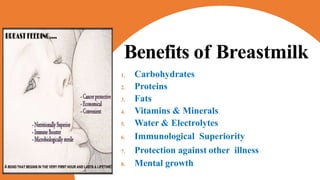
Benefits of Breastmilk
1. Carbohydrates
2. Proteins
3. Fats
4. Vitamins & Minerals
5. Water & Electrolytes
6. Immunological Superiority
7. Protection against other illness
8. Mental growth
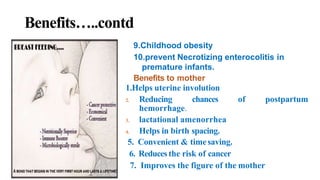
Benefits…..contd
9.Childhood obesity
10.prevent Necrotizing enterocolitis in
premature infants.
Benefits to mother
1.Helps uterine involution
2. Reducing chances of postpartum
hemorrhage.
3. lactational amenorrhea
4. Helps in birth spacing.
5. Convenient & timesaving.
6. Reduces the risk of cancer
7. Improves the figure of the mother
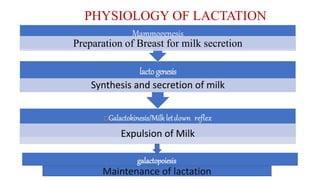
PHYSIOLOGY OF LACTATION
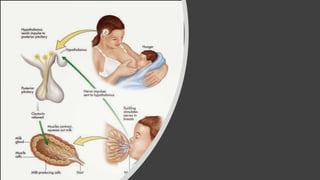
Galactokinesis/Milk letdown reflex
Expulsion of Milk
lactogenesis
Synthesis and secretion of milk
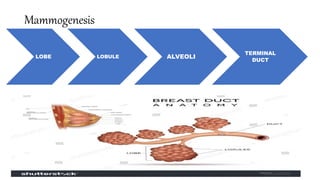
Mammogenesis
Preparation of Breast for milk secretion
galactopoiesis
Maintenance of lactation
Mammogenesis
LOBE LOBULE ALVEOLI
TERMINAL
DUCT
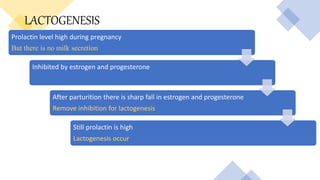
LACTOGENESIS
Prolactin level high during pregnancy
But there is no milk secretion
Inhibited by estrogen and progesterone
After parturition there is sharp fall in estrogen and progesterone
Remove inhibition for lactogenesis
Still prolactin is high
Lactogenesis occur
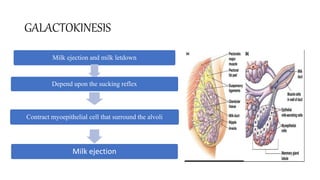
GALACTOKINESIS
Milk ejection and milk letdown
Depend upon the sucking reflex
Contract myoepithelial cell that surround the alvoli
Milk ejection
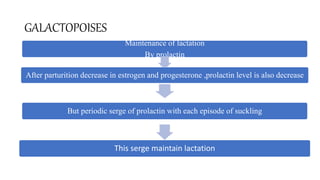
GALACTOPOISES
Maintenance of lactation
By prolactin
After parturition decrease in estrogen and progesterone ,prolactin level is also decrease
But periodic serge of prolactin with each episode of suckling
This serge maintain lactation
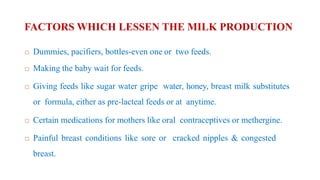
FACTORS WHICH LESSEN THE MILK PRODUCTION
 Dummies, pacifiers, bottles-even one or two feeds.
 Making the baby wait for feeds.
 Giving feeds like sugar water gripe water, honey, breast milk substitutes
or formula, either as pre-lacteal feeds or at anytime.
 Certain medications for mothers like oral contraceptives or methergine.
 Painful breast conditions like sore or cracked nipples & congested
breast.
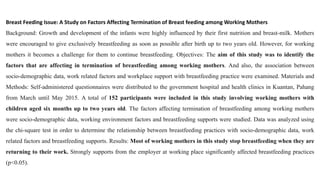
Breast Feeding Issue: A Study on Factors Affecting Termination of Breast feeding among Working Mothers
Background: Growth and development of the infants were highly influenced by their first nutrition and breast-milk. Mothers
were encouraged to give exclusively breastfeeding as soon as possible after birth up to two years old. However, for working
mothers it becomes a challenge for them to continue breastfeeding. Objectives: The aim of this study was to identify the
factors that are affecting in termination of breastfeeding among working mothers. And also, the association between
socio-demographic data, work related factors and workplace support with breastfeeding practice were examined. Materials and
Methods: Self-administered questionnaires were distributed to the government hospital and health clinics in Kuantan, Pahang
from March until May 2015. A total of 152 participants were included in this study involving working mothers with
children aged six months up to two years old. The factors affecting termination of breastfeeding among working mothers
were socio-demographic data, working environment factors and breastfeeding supports were studied. Data was analyzed using
the chi-square test in order to determine the relationship between breastfeeding practices with socio-demographic data, work
related factors and breastfeeding supports. Results: Most of working mothers in this study stop breastfeeding when they are
returning to their work. Strongly supports from the employer at working place significantly affected breastfeeding practices
(p<0.05).
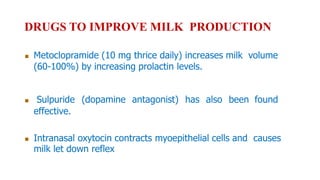
DRUGS TO IMPROVE MILK PRODUCTION
 Metoclopramide (10 mg thrice daily) increases milk volume
(60-100%) by increasing prolactin levels.
 Sulpuride (dopamine antagonist) has also been found
effective.
 Intranasal oxytocin contracts myoepithelial cells and causes
milk let down reflex
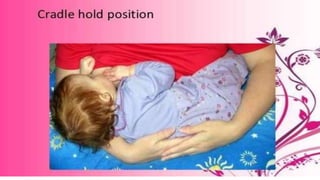
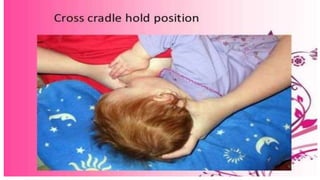
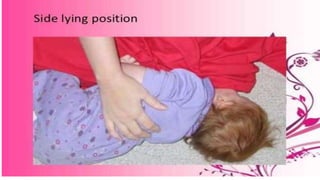
POSITIONS OF BREAST FEEDING
 Baby’s head & body straight.
 Baby’s body turned towards the mother, nose opposite the nipple.
 Baby’s body touching mother’s abdomen.
 Baby’s whole body well supported not just neck or shoulders.
 Mother should support her breast with her finger flat against her chest
wall under her breast.
CONTRAINDICATION OF BREAST FEEDING
In Mother
1. Chronic disease such as active TB, leprosy, AIDS etc.
2. Mothers addicted to alcohol or heavy doses of some drugs.
3. Psychosis
4. Local condition like breast abscess, cracked nipples
5. The mother should give adequate attention to her diet, personal
hygiene and health and should have sufficient rest.
In infant:-
1.Gross prematurity of baby or other conditions in which the newborn cannot
suckle.
2. Inborn errors such as phenylketonuria, lactose intolerance
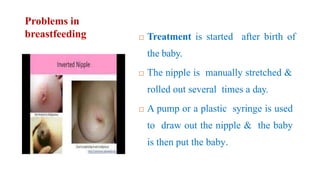
Problems in
breastfeeding  Treatment is started after birth of
the baby.
 The nipple is manually stretched &
rolled out several times a day.
 A pump or a plastic syringe is used
to draw out the nipple & the baby
is then put the baby.
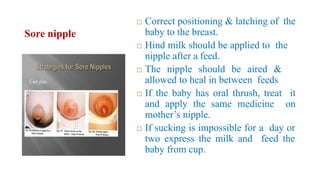
Sore nipple
 Correct positioning & latching of the
baby to the breast.
 Hind milk should be applied to the
nipple after a feed.
 The nipple should be aired &
allowed to heal in between feeds
 If the baby has oral thrush, treat it
and apply the same medicine on
mother’s nipple.
 If sucking is impossible for a day or
two express the milk and feed the
baby from cup.
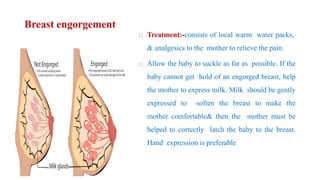
Breast engorgement
 Treatment:-consists of local warm water packs,
& analgesics to the mother to relieve the pain.
 Allow the baby to suckle as far as possible. If the
baby cannot get hold of an engorged breast, help
the mother to express milk. Milk should be gently
expressed to soften the breast to make the
mother comfortable& then the mother must be
helped to correctly latch the baby to the breast.
Hand expression is preferable
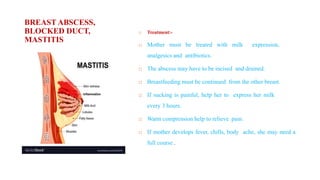
BREAST ABSCESS,
BLOCKED DUCT,
MASTITIS
 Treatment:-
 Mother must be treated with milk expression,
analgesics and antibiotics.
 The abscess may have to be incised and drained.
 Breastfeeding must be continued from the other breast.
 If sucking is painful, help her to express her milk
every 3 hours.
 Warm compression help to relieve pain.
 If mother develops fever, chills, body ache, she may need a
full course .
5. Menstruation and pregnancy:-
Mother can feed during menstruation and half way through pregnancy. If
she is eating well, breast feeding can continue throughout the
pregnancy.
6. Maternal illness:-
Most maternal illness does not require discontinuation of breastfeeding. It
is recommended with mastitis, Breast abscess, UTI, TB, hepatitis,
typhoid, leprosy.
Expressed Breast milk
If a mother is not in a position to feed her baby (e.g., ill mother, preterm baby,
working mother etc.) or has engorged breasts, she should express her milk in a
clean wide mouthed container and this milk should be fed to her baby.
Expressed breast milk can be stored at room temperature for 10 hours, in a
refrigerator for 20 hours and a freezer at -20˚C for 3 months.
 Tropic Feeds:-
Trophic feeds are small amount of expressed breastmilk (often less than
4mL/kg) fed to the preterm neonates by tubeTrophic feeds often consists of
just 1-3mL of expressed breastmilk given once to four times a day.
 Shared nursing:-
A woman who is engaged to breastfeed another's baby is known as a wet
nurse. Shared nursing can sometimes provoke negative reactions.
 Tandem nursing:-
Feeding two children at the same time who are not twins or multiples is
called tandem nursing.
RESEARCH STUDY
Breastfeeding problems: an analysis of secondary data from Lactation Management Unit at the national referral hospital in
Bhutan from 2014 to 2016
Kencho Zangmo1 , Diki Wangmo2 , Tashi Tobgay3 , Mongal S Gurung4 1 Jigme Dorji Wangchuck National Referral Hospital,
Thimphu, Bhutan. 2,3Khesar Gyalpo University of Medical Sciences, Thimphu, Bhutan. 4 Ministry of Health, Thimphu, Bhutan.
This descriptive study is aimed at examining breastfeeding problems among women visiting Lactation Management Unit
[LMU] at Bhutan’s national referral hospital in Thimphu. Methods: Data of all 2751 women-infant pair visiting Lactation
management unit of Jigme Dorji Wangchuck National Referral Hospital with breastfeeding problems were double entered into
Epi Data (version 3.1). Using STATA, descriptive statistical analyses were carried to examine common breastfeeding
problems among the lactating mothers. Exclusive breastfeeding rates were also examined among the group. Results: The
commonest types of breastfeeding problem were nipple sore (60.8%), incorrect breastfeeding techniques (12.9%), and
nipple problems (8.2%). Teenage, first timers, caesarean delivery, preterm infants, underweight infants, and mothers
with full time paid job were more likely to suffer from breastfeeding problems. Conclusion: Breastfeeding interventions
for timely correction of breastfeeding techniques early in postnatal units could warrant prevention of up to 73.7%
breastfeeding problems and thus, promoting exclusive breastfeeding and preventing early termination of breastfeeding.
Human milk bank
A human milk bank is a
service
•which collects, screens,
processes, and dispenses by
prescription human milk donated
by nursing mothers who are not
biologically related.
Donor’s requirement:-
1. Be healthy
2. Be in the process of
lactation
3. Undertake a chest x- ray
4. Have a negative
VDRL
5. No evidence of
Hepatitis
conclusion
According to some authorities, increasing evidence suggests that
early skin-to-skin contact (also called kangaroo care) between
mother and baby stimulates breastfeeding behaviour in the baby.
Newborns who are immediately placed on their mother’s skin
have a natural instinct to latch on to the breast and start
nursing.According to studies cited by UNICEF, babies naturally
follow a process which leads to a first breastfeed. Initially after
birth the baby cries with its first breaths. Shortly after, it relaxes
and makes small movements of the arms, shoulders and head.
The baby crawls towards the breast and begins to feed. After
feeding, it is normal for a baby to remain latched to the breast
while resting. This is sometimes mistaken for lack of appetite.
Lactation management

Lactation management

  • 1.
    LACTATION MANAGEMENT MRs PURNIMASAHOO Asst professor Kalinga Institute of Nursing Sciences KIIT Deemed To Be University
  • 2.
    L LACTATION MANAGEMENT lactationmanagement is the science and art of assisting women and infants with breastfeeding . Because the mother-infant pair is dynamically interrelated for breastfeeding, it is imperative to consider both individuals when attempting to assess and “manage” breastfeeding.
  • 3.
    Objectives of Lactation management 1.Review publichealth impact of breastfeeding. 2. Understand physiology of lactation. 3.Identify the differential diagnosis and treatment for common breastfeeding problems • » Low milk supply, • » Mastitis, • » Breast abscess.
  • 4.
    AAP Recommendations Exclusivebreastfeeding forthe first six months of life  Continued breastfeeding for at least one year,  As long as is mutually desired by mother and child
  • 5.
    Exclusive breast feeding • Exclusive breastfeeding means feeding the baby with breast milk soon after birth and continuing it until 6 month of age without giving baby any other food • The baby is given only breast milk and nothing else whenever the baby is hungry
  • 6.
    Benefits of Breastmilk 1.Carbohydrates 2. Proteins 3. Fats 4. Vitamins & Minerals 5. Water & Electrolytes 6. Immunological Superiority 7. Protection against other illness 8. Mental growth
  • 7.
    Benefits…..contd 9.Childhood obesity 10.prevent Necrotizingenterocolitis in premature infants. Benefits to mother 1.Helps uterine involution 2. Reducing chances of postpartum hemorrhage. 3. lactational amenorrhea 4. Helps in birth spacing. 5. Convenient & timesaving. 6. Reduces the risk of cancer 7. Improves the figure of the mother
  • 8.
    PHYSIOLOGY OF LACTATION Galactokinesis/Milkletdown reflex Expulsion of Milk lactogenesis Synthesis and secretion of milk Mammogenesis Preparation of Breast for milk secretion galactopoiesis Maintenance of lactation
  • 9.
  • 10.
    LACTOGENESIS Prolactin level highduring pregnancy But there is no milk secretion Inhibited by estrogen and progesterone After parturition there is sharp fall in estrogen and progesterone Remove inhibition for lactogenesis Still prolactin is high Lactogenesis occur
  • 11.
    GALACTOKINESIS Milk ejection andmilk letdown Depend upon the sucking reflex Contract myoepithelial cell that surround the alvoli Milk ejection
  • 13.
    GALACTOPOISES Maintenance of lactation Byprolactin After parturition decrease in estrogen and progesterone ,prolactin level is also decrease But periodic serge of prolactin with each episode of suckling This serge maintain lactation
  • 14.
    FACTORS WHICH LESSENTHE MILK PRODUCTION  Dummies, pacifiers, bottles-even one or two feeds.  Making the baby wait for feeds.  Giving feeds like sugar water gripe water, honey, breast milk substitutes or formula, either as pre-lacteal feeds or at anytime.  Certain medications for mothers like oral contraceptives or methergine.  Painful breast conditions like sore or cracked nipples & congested breast.
  • 15.
    Breast Feeding Issue:A Study on Factors Affecting Termination of Breast feeding among Working Mothers Background: Growth and development of the infants were highly influenced by their first nutrition and breast-milk. Mothers were encouraged to give exclusively breastfeeding as soon as possible after birth up to two years old. However, for working mothers it becomes a challenge for them to continue breastfeeding. Objectives: The aim of this study was to identify the factors that are affecting in termination of breastfeeding among working mothers. And also, the association between socio-demographic data, work related factors and workplace support with breastfeeding practice were examined. Materials and Methods: Self-administered questionnaires were distributed to the government hospital and health clinics in Kuantan, Pahang from March until May 2015. A total of 152 participants were included in this study involving working mothers with children aged six months up to two years old. The factors affecting termination of breastfeeding among working mothers were socio-demographic data, working environment factors and breastfeeding supports were studied. Data was analyzed using the chi-square test in order to determine the relationship between breastfeeding practices with socio-demographic data, work related factors and breastfeeding supports. Results: Most of working mothers in this study stop breastfeeding when they are returning to their work. Strongly supports from the employer at working place significantly affected breastfeeding practices (p<0.05).
  • 16.
    DRUGS TO IMPROVEMILK PRODUCTION  Metoclopramide (10 mg thrice daily) increases milk volume (60-100%) by increasing prolactin levels.  Sulpuride (dopamine antagonist) has also been found effective.  Intranasal oxytocin contracts myoepithelial cells and causes milk let down reflex
  • 17.
    POSITIONS OF BREASTFEEDING  Baby’s head & body straight.  Baby’s body turned towards the mother, nose opposite the nipple.  Baby’s body touching mother’s abdomen.  Baby’s whole body well supported not just neck or shoulders.  Mother should support her breast with her finger flat against her chest wall under her breast.
  • 23.
    CONTRAINDICATION OF BREASTFEEDING In Mother 1. Chronic disease such as active TB, leprosy, AIDS etc. 2. Mothers addicted to alcohol or heavy doses of some drugs. 3. Psychosis 4. Local condition like breast abscess, cracked nipples 5. The mother should give adequate attention to her diet, personal hygiene and health and should have sufficient rest. In infant:- 1.Gross prematurity of baby or other conditions in which the newborn cannot suckle. 2. Inborn errors such as phenylketonuria, lactose intolerance
  • 24.
    Problems in breastfeeding Treatment is started after birth of the baby.  The nipple is manually stretched & rolled out several times a day.  A pump or a plastic syringe is used to draw out the nipple & the baby is then put the baby.
  • 25.
    Sore nipple  Correctpositioning & latching of the baby to the breast.  Hind milk should be applied to the nipple after a feed.  The nipple should be aired & allowed to heal in between feeds  If the baby has oral thrush, treat it and apply the same medicine on mother’s nipple.  If sucking is impossible for a day or two express the milk and feed the baby from cup.
  • 26.
    Breast engorgement  Treatment:-consistsof local warm water packs, & analgesics to the mother to relieve the pain.  Allow the baby to suckle as far as possible. If the baby cannot get hold of an engorged breast, help the mother to express milk. Milk should be gently expressed to soften the breast to make the mother comfortable& then the mother must be helped to correctly latch the baby to the breast. Hand expression is preferable
  • 27.
    BREAST ABSCESS, BLOCKED DUCT, MASTITIS Treatment:-  Mother must be treated with milk expression, analgesics and antibiotics.  The abscess may have to be incised and drained.  Breastfeeding must be continued from the other breast.  If sucking is painful, help her to express her milk every 3 hours.  Warm compression help to relieve pain.  If mother develops fever, chills, body ache, she may need a full course .
  • 28.
    5. Menstruation andpregnancy:- Mother can feed during menstruation and half way through pregnancy. If she is eating well, breast feeding can continue throughout the pregnancy. 6. Maternal illness:- Most maternal illness does not require discontinuation of breastfeeding. It is recommended with mastitis, Breast abscess, UTI, TB, hepatitis, typhoid, leprosy.
  • 29.
    Expressed Breast milk Ifa mother is not in a position to feed her baby (e.g., ill mother, preterm baby, working mother etc.) or has engorged breasts, she should express her milk in a clean wide mouthed container and this milk should be fed to her baby. Expressed breast milk can be stored at room temperature for 10 hours, in a refrigerator for 20 hours and a freezer at -20˚C for 3 months.  Tropic Feeds:- Trophic feeds are small amount of expressed breastmilk (often less than 4mL/kg) fed to the preterm neonates by tubeTrophic feeds often consists of just 1-3mL of expressed breastmilk given once to four times a day.  Shared nursing:- A woman who is engaged to breastfeed another's baby is known as a wet nurse. Shared nursing can sometimes provoke negative reactions.  Tandem nursing:- Feeding two children at the same time who are not twins or multiples is called tandem nursing.
  • 30.
    RESEARCH STUDY Breastfeeding problems:an analysis of secondary data from Lactation Management Unit at the national referral hospital in Bhutan from 2014 to 2016 Kencho Zangmo1 , Diki Wangmo2 , Tashi Tobgay3 , Mongal S Gurung4 1 Jigme Dorji Wangchuck National Referral Hospital, Thimphu, Bhutan. 2,3Khesar Gyalpo University of Medical Sciences, Thimphu, Bhutan. 4 Ministry of Health, Thimphu, Bhutan. This descriptive study is aimed at examining breastfeeding problems among women visiting Lactation Management Unit [LMU] at Bhutan’s national referral hospital in Thimphu. Methods: Data of all 2751 women-infant pair visiting Lactation management unit of Jigme Dorji Wangchuck National Referral Hospital with breastfeeding problems were double entered into Epi Data (version 3.1). Using STATA, descriptive statistical analyses were carried to examine common breastfeeding problems among the lactating mothers. Exclusive breastfeeding rates were also examined among the group. Results: The commonest types of breastfeeding problem were nipple sore (60.8%), incorrect breastfeeding techniques (12.9%), and nipple problems (8.2%). Teenage, first timers, caesarean delivery, preterm infants, underweight infants, and mothers with full time paid job were more likely to suffer from breastfeeding problems. Conclusion: Breastfeeding interventions for timely correction of breastfeeding techniques early in postnatal units could warrant prevention of up to 73.7% breastfeeding problems and thus, promoting exclusive breastfeeding and preventing early termination of breastfeeding.
  • 31.
    Human milk bank Ahuman milk bank is a service •which collects, screens, processes, and dispenses by prescription human milk donated by nursing mothers who are not biologically related. Donor’s requirement:- 1. Be healthy 2. Be in the process of lactation 3. Undertake a chest x- ray 4. Have a negative VDRL 5. No evidence of Hepatitis
  • 32.
    conclusion According to someauthorities, increasing evidence suggests that early skin-to-skin contact (also called kangaroo care) between mother and baby stimulates breastfeeding behaviour in the baby. Newborns who are immediately placed on their mother’s skin have a natural instinct to latch on to the breast and start nursing.According to studies cited by UNICEF, babies naturally follow a process which leads to a first breastfeed. Initially after birth the baby cries with its first breaths. Shortly after, it relaxes and makes small movements of the arms, shoulders and head. The baby crawls towards the breast and begins to feed. After feeding, it is normal for a baby to remain latched to the breast while resting. This is sometimes mistaken for lack of appetite.