By: DR. LATA CHANDRA
JUNIOR RESIDENT
ANMMCH GAYA
GESTATIONAL DIABETES
MELLITUS
INTRODUCTION
• Any degree of glucose intolerance that either
commences or is first diagnosed in pregnancy.
• Prevalence - 18%
• Increase in prevalence due to life style, dietary
habits, older age at first conception, PCOD,
obesity etc.,
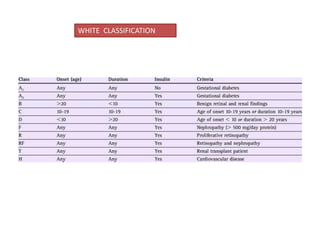
WHITE CLASSIFICATION
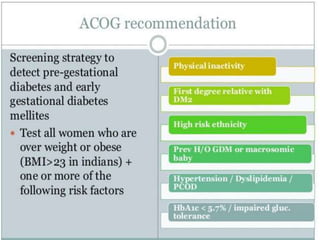
EARLY GDM
 ACOG introduced a new term called early
gestational diabetes mellitus in 2017.
 This classifies the patients who are high risk
for developing gestational diabetes.
 These patients are screened early leading to
early and effective treatment.
 This also reduces maternal and fetal
complications to a great extent.
EPIDEMIOLOGY
• GDM happens in about 7 of every 100
pregnancies.
• The recent data on the prevalence of GDM in
India was 16.55% by WHO criteria of 2 hr PG ≥
140 mg/dl .
• Significant disturbances in carbohydrate
metabolism occur in about 1 % pregnancies .
• The incidence of GDM increases by approximately
8 times for pregnant women aged 35 years and
over compared with women aged 25 years or
under.
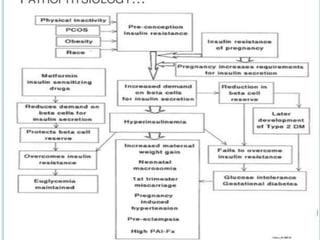
PATHOPHYSIOLOGY
 The maternal metabolic adaptation is to maintain the
mean fasting plasma glucose of 74.5 ± 11 mg/dl and
the post prandial peak of 108.7 ± 16.9mg/dl.
 This fine tuning of glycemic level during pregnancy is
possible due to the compensatory hyperinsulinaemia,
as the normal pregnancy is characterized by:-
 Increased insulin resistance and
 Decreased insulin sensitivity.
 A pregnant woman who is not able to increase her
insulin secretion to overcome the insulin resistance
that occurs even during normal pregnancy develops
gestational diabetes.
INCREASED INSULIN RESISTANCE
 Due to hormones secreted by the placenta
that are “diabetogenic”: -
 Growth hormone
 Human placental lactogen
 Progesterone
 Corticotropin releasing hormone
Transient maternal hyperglycemia occurs after meals
because of increased insulin resistance.
RELATIVE BASELINE HYPOGLYCAEMIA
 Proliferation of pancreatic beta cells (insulin-
secreting cells) leads to increased insulin
secretion.
 Insulin levels are higher than in pregnant than
nonpregnant women in fasting and postprandial
states.
 Hypoglycemia between meals and at night
because of continuous fetal draw
Blood glucose levels are 10-20% lower.
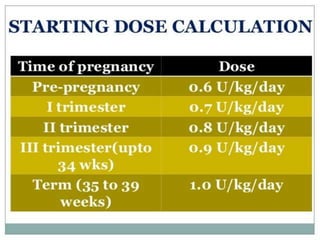
 24-hour insulin requirement before conception is
approximately 0.6 units / kg.
 In the first trimester, the insulin requirement rises to
0.7units / kg of the pregnant weight – more unstable
glycemia with a tendency to low fasting plasma glucose
and high postprandial excursions and the occurrence of
nocturnal hypoglycemia.
 By the second trimester, the insulin requirement is 0.8
units per kilogram. From 24th wk onwards steady
increase in insulin requirement and glycemia stabilizes.
 By third trimester the insulin requirement is 0.9 - 1.0
unit /kg pregnant weight per day.
 Last month – may be a decrease in insulin and
hypoglycemia especially nocturnal.
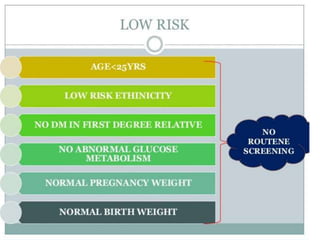
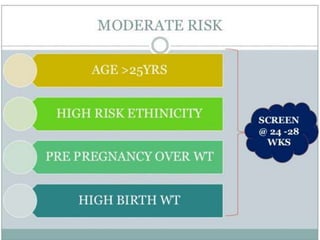
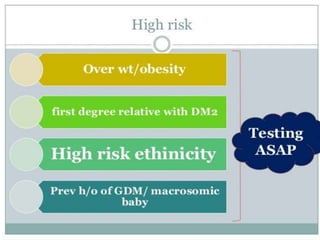
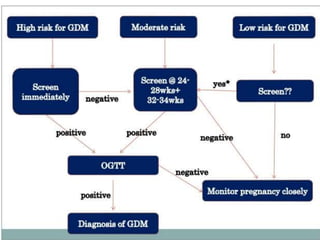
SCREENING OF GDM
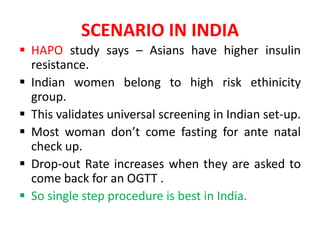
SCENARIO IN INDIA
 HAPO study says – Asians have higher insulin
resistance.
 Indian women belong to high risk ethinicity
group.
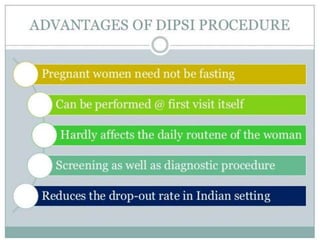
 This validates universal screening in Indian set-up.
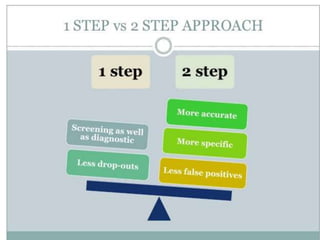
 Most woman don’t come fasting for ante natal
check up.
 Drop-out Rate increases when they are asked to
come back for an OGTT .
 So single step procedure is best in India.
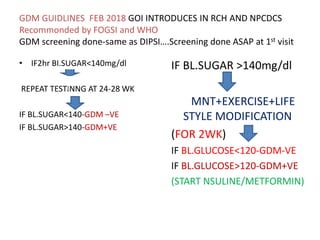
GDM GUIDLINES FEB 2018 GOI INTRODUCES IN RCH AND NPCDCS
Recommonded by FOGSI and WHO
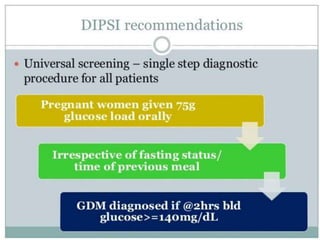
GDM screening done-same as DIPSI….Screening done ASAP at 1st visit
• IF2hr BI.SUGAR<140mg/dl
REPEAT TESTINNG AT 24-28 WK
IF BL.SUGAR<140-GDM –VE
IF BL.SUGAR>140-GDM+VE
v
n
m
m
e
m
IF BL.SUGAR >140mg/dl
MNT+EXERCISE+LIFE
STYLE MODIFICATION
(FOR 2WK)
IF BL.GLUCOSE<120-GDM-VE
IF BL.GLUCOSE>120-GDM+VE
(START NSULINE/METFORMIN)
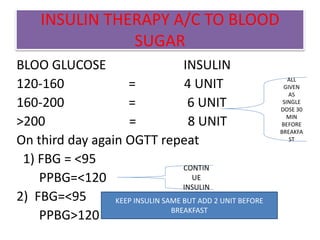
INSULIN THERAPY A/C TO BLOOD
SUGAR
BLOO GLUCOSE INSULIN
120-160 = 4 UNIT
160-200 = 6 UNIT
>200 = 8 UNIT
On third day again OGTT repeat
1) FBG = <95
PPBG=<120
2) FBG=<95
PPBG>120
ALL
GIVEN
AS
SINGLE
DOSE 30
MIN
BEFORE
BREAKFA
ST
CONTIN
UE
INSULIN
KEEP INSULIN SAME BUT ADD 2 UNIT BEFORE
BREAKFAST
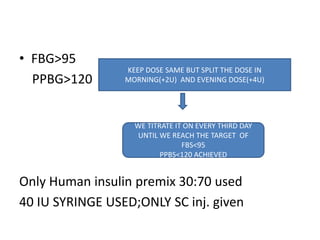
• FBG>95
PPBG>120
Only Human insulin premix 30:70 used
40 IU SYRINGE USED;ONLY SC inj. given
KEEP DOSE SAME BUT SPLIT THE DOSE IN
MORNING(+2U) AND EVENING DOSE(+4U)
WE TITRATE IT ON EVERY THIRD DAY
UNTIL WE REACH THE TARGET OF
FBS<95
PPBS<120 ACHIEVED
MANAGEMENT
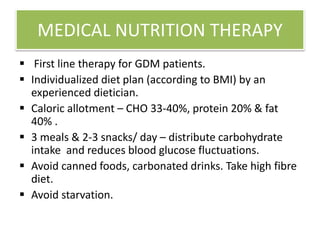
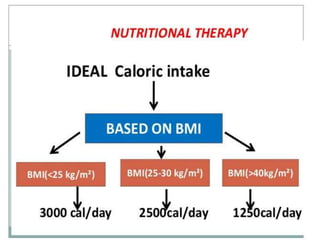
MEDICAL NUTRITION THERAPY
 First line therapy for GDM patients.
 Individualized diet plan (according to BMI) by an
experienced dietician.
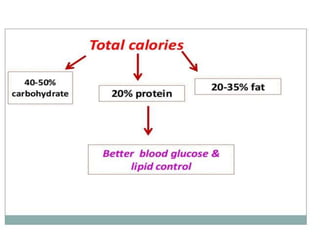
 Caloric allotment – CHO 33-40%, protein 20% & fat
40% .
 3 meals & 2-3 snacks/ day – distribute carbohydrate
intake and reduces blood glucose fluctuations.
 Avoid canned foods, carbonated drinks. Take high fibre
diet.
 Avoid starvation.
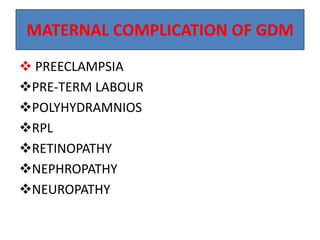
MATERNAL COMPLICATION OF GDM
 PREECLAMPSIA
PRE-TERM LABOUR
POLYHYDRAMNIOS
RPL
RETINOPATHY
NEPHROPATHY
NEUROPATHY
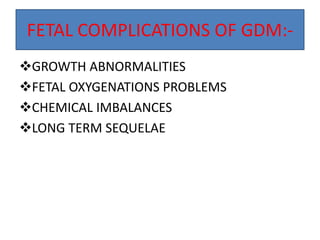
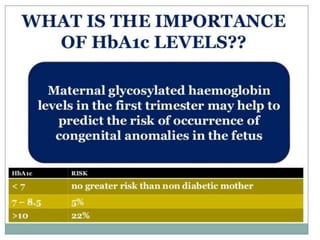
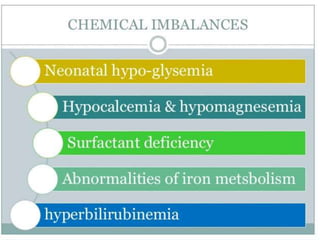
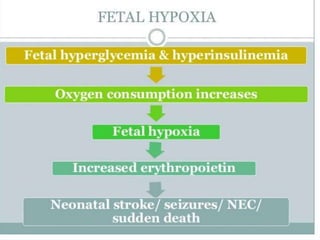
FETAL COMPLICATIONS OF GDM:-
GROWTH ABNORMALITIES
FETAL OXYGENATIONS PROBLEMS
CHEMICAL IMBALANCES
LONG TERM SEQUELAE
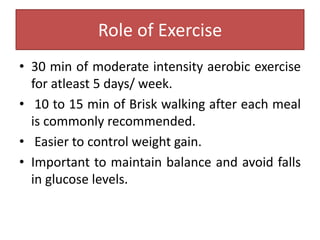
Role of Exercise
• 30 min of moderate intensity aerobic exercise
for atleast 5 days/ week.
• 10 to 15 min of Brisk walking after each meal
is commonly recommended.
• Easier to control weight gain.
• Important to maintain balance and avoid falls
in glucose levels.
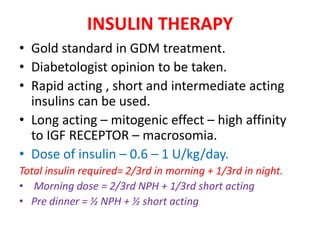
INSULIN THERAPY
• Gold standard in GDM treatment.
• Diabetologist opinion to be taken.
• Rapid acting , short and intermediate acting
insulins can be used.
• Long acting – mitogenic effect – high affinity
to IGF RECEPTOR – macrosomia.
• Dose of insulin – 0.6 – 1 U/kg/day.
Total insulin required= 2/3rd in morning + 1/3rd in night.
• Morning dose = 2/3rd NPH + 1/3rd short acting
• Pre dinner = ½ NPH + ½ short acting
ROLE OF ORAL HYPOGLYCAEMIC
DRUG IN GDM
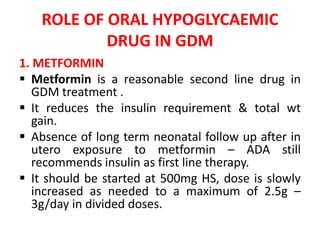
1. METFORMIN
 Metformin is a reasonable second line drug in
GDM treatment .
 It reduces the insulin requirement & total wt
gain.
 Absence of long term neonatal follow up after in
utero exposure to metformin – ADA still
recommends insulin as first line therapy.
 It should be started at 500mg HS, dose is slowly
increased as needed to a maximum of 2.5g –
3g/day in divided doses.
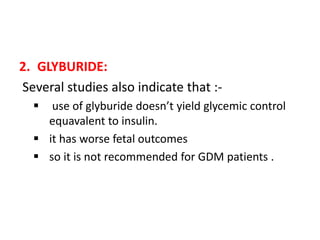
2. GLYBURIDE:
Several studies also indicate that :-
 use of glyburide doesn’t yield glycemic control
equavalent to insulin.
 it has worse fetal outcomes
 so it is not recommended for GDM patients .
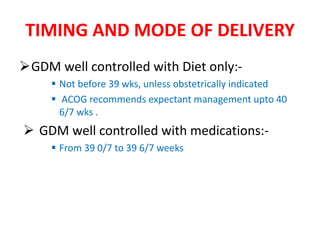
TIMING AND MODE OF DELIVERY
GDM well controlled with Diet only:-
 Not before 39 wks, unless obstetrically indicated
 ACOG recommends expectant management upto 40
6/7 wks .
 GDM well controlled with medications:-
 From 39 0/7 to 39 6/7 weeks
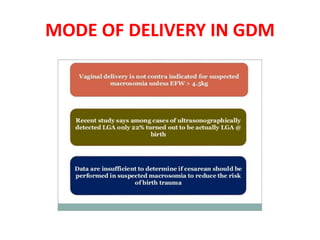
MODE OF DELIVERY IN GDM
PRECAUTION TAKEN DURING LABOUR
• Consent to be taken regarding the need for.
• Instrumentation and emergency section if
needed.
• Monitor vitals , fluid intake & output, urine
ketones and blood sugar levels 1-2 hrly.
• Fetal heart should be monitored and partograph
is charted.
• Instrumental delivery, if needed, should be under
taken with care.
• Traumatic & atonic PPH should be watched for.
INTRAPARTUM MONITORING
• High risk Consent taken.
• Aim is to keep glucose level b/w 72 and 126 mg/dL
• Two I.V lines to be secured.
• If glucose level is not maintained then dextrose-insulin
neutralizing drip is started.
• 50 units of regular insulin in 50ml of normal saline in
one line.
• 10% dextrose drip @ 125mL/hr is given through other
line.
• Attempts for instrumentation should be undertaken
with care.
• Prepare for both traumatic & atonic PPH.
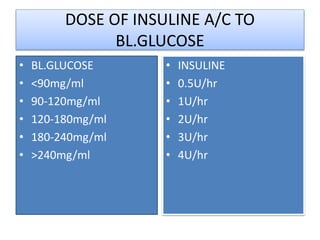
DOSE OF INSULINE A/C TO
BL.GLUCOSE
• BL.GLUCOSE
• <90mg/ml
• 90-120mg/ml
• 120-180mg/ml
• 180-240mg/ml
• >240mg/ml
• INSULINE
• 0.5U/hr
• 1U/hr
• 2U/hr
• 3U/hr
• 4U/hr
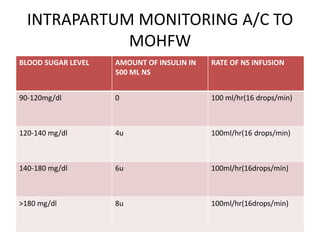
INTRAPARTUM MONITORING A/C TO
MOHFW
BLOOD SUGAR LEVEL AMOUNT OF INSULIN IN
500 ML NS
RATE OF NS INFUSION
90-120mg/dl 0 100 ml/hr(16 drops/min)
120-140 mg/dl 4u 100ml/hr(16 drops/min)
140-180 mg/dl 6u 100ml/hr(16drops/min)
>180 mg/dl 8u 100ml/hr(16drops/min)
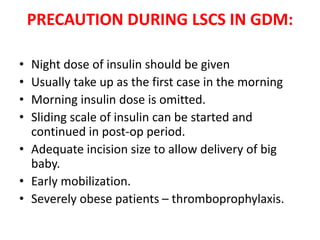
PRECAUTION DURING LSCS IN GDM:
• Night dose of insulin should be given
• Usually take up as the first case in the morning
• Morning insulin dose is omitted.
• Sliding scale of insulin can be started and
continued in post-op period.
• Adequate incision size to allow delivery of big
baby.
• Early mobilization.
• Severely obese patients – thromboprophylaxis.
Gestational diabetes mellitus (2)

Gestational diabetes mellitus (2)

  • 1.
    By: DR. LATACHANDRA JUNIOR RESIDENT ANMMCH GAYA GESTATIONAL DIABETES MELLITUS
  • 2.
    INTRODUCTION • Any degreeof glucose intolerance that either commences or is first diagnosed in pregnancy. • Prevalence - 18% • Increase in prevalence due to life style, dietary habits, older age at first conception, PCOD, obesity etc.,
  • 4.
  • 5.
    EARLY GDM  ACOGintroduced a new term called early gestational diabetes mellitus in 2017.  This classifies the patients who are high risk for developing gestational diabetes.  These patients are screened early leading to early and effective treatment.  This also reduces maternal and fetal complications to a great extent.
  • 6.
    EPIDEMIOLOGY • GDM happensin about 7 of every 100 pregnancies. • The recent data on the prevalence of GDM in India was 16.55% by WHO criteria of 2 hr PG ≥ 140 mg/dl . • Significant disturbances in carbohydrate metabolism occur in about 1 % pregnancies . • The incidence of GDM increases by approximately 8 times for pregnant women aged 35 years and over compared with women aged 25 years or under.
  • 7.
    PATHOPHYSIOLOGY  The maternalmetabolic adaptation is to maintain the mean fasting plasma glucose of 74.5 ± 11 mg/dl and the post prandial peak of 108.7 ± 16.9mg/dl.  This fine tuning of glycemic level during pregnancy is possible due to the compensatory hyperinsulinaemia, as the normal pregnancy is characterized by:-  Increased insulin resistance and  Decreased insulin sensitivity.  A pregnant woman who is not able to increase her insulin secretion to overcome the insulin resistance that occurs even during normal pregnancy develops gestational diabetes.
  • 8.
    INCREASED INSULIN RESISTANCE Due to hormones secreted by the placenta that are “diabetogenic”: -  Growth hormone  Human placental lactogen  Progesterone  Corticotropin releasing hormone Transient maternal hyperglycemia occurs after meals because of increased insulin resistance.
  • 9.
    RELATIVE BASELINE HYPOGLYCAEMIA Proliferation of pancreatic beta cells (insulin- secreting cells) leads to increased insulin secretion.  Insulin levels are higher than in pregnant than nonpregnant women in fasting and postprandial states.  Hypoglycemia between meals and at night because of continuous fetal draw Blood glucose levels are 10-20% lower.
  • 10.
     24-hour insulinrequirement before conception is approximately 0.6 units / kg.  In the first trimester, the insulin requirement rises to 0.7units / kg of the pregnant weight – more unstable glycemia with a tendency to low fasting plasma glucose and high postprandial excursions and the occurrence of nocturnal hypoglycemia.  By the second trimester, the insulin requirement is 0.8 units per kilogram. From 24th wk onwards steady increase in insulin requirement and glycemia stabilizes.  By third trimester the insulin requirement is 0.9 - 1.0 unit /kg pregnant weight per day.  Last month – may be a decrease in insulin and hypoglycemia especially nocturnal.
  • 12.
  • 22.
    SCENARIO IN INDIA HAPO study says – Asians have higher insulin resistance.  Indian women belong to high risk ethinicity group.  This validates universal screening in Indian set-up.  Most woman don’t come fasting for ante natal check up.  Drop-out Rate increases when they are asked to come back for an OGTT .  So single step procedure is best in India.
  • 25.
    GDM GUIDLINES FEB2018 GOI INTRODUCES IN RCH AND NPCDCS Recommonded by FOGSI and WHO GDM screening done-same as DIPSI….Screening done ASAP at 1st visit • IF2hr BI.SUGAR<140mg/dl REPEAT TESTINNG AT 24-28 WK IF BL.SUGAR<140-GDM –VE IF BL.SUGAR>140-GDM+VE v n m m e m IF BL.SUGAR >140mg/dl MNT+EXERCISE+LIFE STYLE MODIFICATION (FOR 2WK) IF BL.GLUCOSE<120-GDM-VE IF BL.GLUCOSE>120-GDM+VE (START NSULINE/METFORMIN)
  • 26.
    INSULIN THERAPY A/CTO BLOOD SUGAR BLOO GLUCOSE INSULIN 120-160 = 4 UNIT 160-200 = 6 UNIT >200 = 8 UNIT On third day again OGTT repeat 1) FBG = <95 PPBG=<120 2) FBG=<95 PPBG>120 ALL GIVEN AS SINGLE DOSE 30 MIN BEFORE BREAKFA ST CONTIN UE INSULIN KEEP INSULIN SAME BUT ADD 2 UNIT BEFORE BREAKFAST
  • 27.
    • FBG>95 PPBG>120 Only Humaninsulin premix 30:70 used 40 IU SYRINGE USED;ONLY SC inj. given KEEP DOSE SAME BUT SPLIT THE DOSE IN MORNING(+2U) AND EVENING DOSE(+4U) WE TITRATE IT ON EVERY THIRD DAY UNTIL WE REACH THE TARGET OF FBS<95 PPBS<120 ACHIEVED
  • 28.
  • 29.
    MEDICAL NUTRITION THERAPY First line therapy for GDM patients.  Individualized diet plan (according to BMI) by an experienced dietician.  Caloric allotment – CHO 33-40%, protein 20% & fat 40% .  3 meals & 2-3 snacks/ day – distribute carbohydrate intake and reduces blood glucose fluctuations.  Avoid canned foods, carbonated drinks. Take high fibre diet.  Avoid starvation.
  • 30.
    MATERNAL COMPLICATION OFGDM  PREECLAMPSIA PRE-TERM LABOUR POLYHYDRAMNIOS RPL RETINOPATHY NEPHROPATHY NEUROPATHY
  • 32.
    FETAL COMPLICATIONS OFGDM:- GROWTH ABNORMALITIES FETAL OXYGENATIONS PROBLEMS CHEMICAL IMBALANCES LONG TERM SEQUELAE
  • 38.
    Role of Exercise •30 min of moderate intensity aerobic exercise for atleast 5 days/ week. • 10 to 15 min of Brisk walking after each meal is commonly recommended. • Easier to control weight gain. • Important to maintain balance and avoid falls in glucose levels.
  • 39.
    INSULIN THERAPY • Goldstandard in GDM treatment. • Diabetologist opinion to be taken. • Rapid acting , short and intermediate acting insulins can be used. • Long acting – mitogenic effect – high affinity to IGF RECEPTOR – macrosomia. • Dose of insulin – 0.6 – 1 U/kg/day. Total insulin required= 2/3rd in morning + 1/3rd in night. • Morning dose = 2/3rd NPH + 1/3rd short acting • Pre dinner = ½ NPH + ½ short acting
  • 41.
    ROLE OF ORALHYPOGLYCAEMIC DRUG IN GDM 1. METFORMIN  Metformin is a reasonable second line drug in GDM treatment .  It reduces the insulin requirement & total wt gain.  Absence of long term neonatal follow up after in utero exposure to metformin – ADA still recommends insulin as first line therapy.  It should be started at 500mg HS, dose is slowly increased as needed to a maximum of 2.5g – 3g/day in divided doses.
  • 42.
    2. GLYBURIDE: Several studiesalso indicate that :-  use of glyburide doesn’t yield glycemic control equavalent to insulin.  it has worse fetal outcomes  so it is not recommended for GDM patients .
  • 45.
    TIMING AND MODEOF DELIVERY GDM well controlled with Diet only:-  Not before 39 wks, unless obstetrically indicated  ACOG recommends expectant management upto 40 6/7 wks .  GDM well controlled with medications:-  From 39 0/7 to 39 6/7 weeks
  • 47.
  • 48.
    PRECAUTION TAKEN DURINGLABOUR • Consent to be taken regarding the need for. • Instrumentation and emergency section if needed. • Monitor vitals , fluid intake & output, urine ketones and blood sugar levels 1-2 hrly. • Fetal heart should be monitored and partograph is charted. • Instrumental delivery, if needed, should be under taken with care. • Traumatic & atonic PPH should be watched for.
  • 49.
    INTRAPARTUM MONITORING • Highrisk Consent taken. • Aim is to keep glucose level b/w 72 and 126 mg/dL • Two I.V lines to be secured. • If glucose level is not maintained then dextrose-insulin neutralizing drip is started. • 50 units of regular insulin in 50ml of normal saline in one line. • 10% dextrose drip @ 125mL/hr is given through other line. • Attempts for instrumentation should be undertaken with care. • Prepare for both traumatic & atonic PPH.
  • 50.
    DOSE OF INSULINEA/C TO BL.GLUCOSE • BL.GLUCOSE • <90mg/ml • 90-120mg/ml • 120-180mg/ml • 180-240mg/ml • >240mg/ml • INSULINE • 0.5U/hr • 1U/hr • 2U/hr • 3U/hr • 4U/hr
  • 51.
    INTRAPARTUM MONITORING A/CTO MOHFW BLOOD SUGAR LEVEL AMOUNT OF INSULIN IN 500 ML NS RATE OF NS INFUSION 90-120mg/dl 0 100 ml/hr(16 drops/min) 120-140 mg/dl 4u 100ml/hr(16 drops/min) 140-180 mg/dl 6u 100ml/hr(16drops/min) >180 mg/dl 8u 100ml/hr(16drops/min)
  • 53.
    PRECAUTION DURING LSCSIN GDM: • Night dose of insulin should be given • Usually take up as the first case in the morning • Morning insulin dose is omitted. • Sliding scale of insulin can be started and continued in post-op period. • Adequate incision size to allow delivery of big baby. • Early mobilization. • Severely obese patients – thromboprophylaxis.

Editor's Notes

  • #5 White classification