Changes before thechange:
Changes before the change:
Perimenopausal Bleeding
Perimenopausal Bleeding
World Menopause Day 2017
World Menopause Day 2017
2.
IMS theme Series:Perimenopausal Bleeding
World Menopause Day 2017
Abnormal Uterine Bleeding (AUB) -
Definition
Bleeding that is unlike normal menstrual flow in terms
of frequency, duration and quantity. It includes
infrequent or frequent bleeding, heavy menstrual
bleeding or intermenstrual bleeding
AUB is a leading cause for gynecological consultations
in the peri- and post-menopausal age groups.
3.
AUB subsets inthe Perimenopause
Ovulatory AUB
Ovulatory bleeding may be heavy and can be
associated with typical premenstrual symptoms
and painful periods.
IMS theme Series: Perimenopausal Bleeding
World Menopause Day 2017
4.
World Menopause Day2017
Anovulatory AUB
Anovulatory bleeding, which is found more frequently during
the perimenopause compared to the premenopause, is often
linked to prolonged periods, heavier flow and an irregular
cycle. If prolonged (e.g. in PCOS or associated with obesity),
anovulatory bleeding has a stronger link to endometrial
cancer and endometrial hyperplasia
IMS theme Series: Perimenopausal Bleeding
AUB subsets in the Perimenopause
5.
Abnormal Uterine Bleeding- Etiology
1. Hormonal Changes
2. Benign Anatomic Changes
Uterine Polyps
Uterine Fibroids
Adenomyosis
Low Thyroid Function
Other medical conditions, i.e. coagulopathy
3. Cancer
Primarily endometrial, but also cervical.
IMS theme Series: Perimenopausal Bleeding
World Menopause Day 2017
6.
The goal ofdiagnosis is to distinguish women with
anatomic causes from women with normal anatomy.
Identifying endometrial malignancy, although
uncommon among the AUB etiologies, is often the
main purpose of the investigations.
Abnormal Uterine Bleeding -
Diagnosis
IMS theme Series: Perimenopausal Bleeding
World Menopause Day 2017
7.
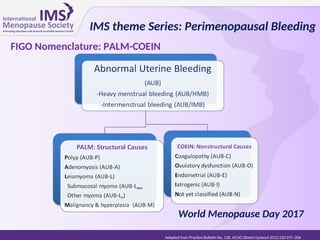
FIGO Nomenclature: PALM-COEIN
Adaptedfrom Practice Bulletin No. 128. ACOG Obstet Gynecol 2012;120:197–206
IMS theme Series: Perimenopausal Bleeding
World Menopause Day 2017
8.
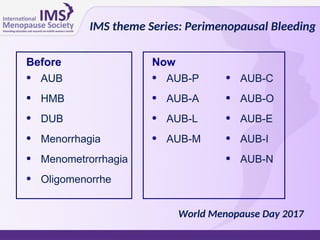
Before
• AUB
• HMB
•DUB
• Menorrhagia
• Menometrorrhagia
• Oligomenorrhe
Now
• AUB-P
• AUB-A
• AUB-L
• AUB-M
• AUB-C
• AUB-O
• AUB-E
• AUB-I
• AUB-N
IMS theme Series: Perimenopausal Bleeding
World Menopause Day 2017
9.
Assessment of abnormaluterine
bleeding
General assessment
History and bleeding pattern
Physical, pelvic and speculum examination
Laboratory tests including:
Full blood count, iron studies, (thyroid, hCG – if indicated)
Disorders of hemostasis (if indicated)
Evaluate pelvic organs and endometrium
ultrasound scan
Hysteroscopy
MRI (if indicated)
IMS theme Series: Perimenopausal Bleeding
World Menopause Day 2017
10.
Imaging Techniques
The primaryimaging test for the evaluation of abnormal
uterine bleeding is transvaginal ultrasound. This maybe more
difficult in cases of co-existing myomas, previous surgery,
marked obesity, axial uterus or adenomyosis. In such cases
SIS - saline infusion sono-hysterography can be helpful.
Hysteroscopy as a diagnostic tool may also be employed if
intra-uterine pathology is suspected. It can be done in an
outpatients setting using small telescopes and usually
requires no analgesia. An inpatient procedure will be
required in 15-20%
IMS theme Series: Perimenopausal Bleeding
World Menopause Day 2017
11.
Endometrial Sampling
Endometrial samplingis required to diagnose endometrial
abnormality.
This can be done, usually after an ultrasound or
hysteroscopy, with a vacuum aspiration system, e.g. Pipelle.
However, this will only sample a small proportion of the
cavity and there is a high incidence of false negative results,
and cancer may be missed. AUB will often require further
evaluation.
IMS theme Series: Perimenopausal Bleeding
World Menopause Day 2017
12.
Treatment of abnormaluterine bleeding
Treatment goals for patients with AUB include regulation of
menstrual cycles, minimization of blood loss and improvement
in quality of life.
Treatment options include pharmacological approaches (either
hormonal or non-hormonal), and surgical or radiological
procedures.
Awareness, reassurance and keeping a healthy lifestyle will
contribute to the treatment options for AUB.
IMS theme Series: Perimenopausal Bleeding
World Menopause Day 2017
13.
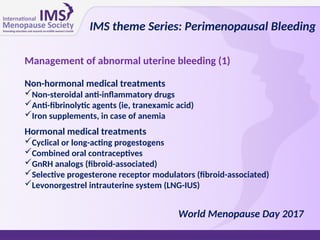
Management of abnormaluterine bleeding (1)
Non-hormonal medical treatments
Non-steroidal anti-inflammatory drugs
Anti-fibrinolytic agents (ie, tranexamic acid)
Iron supplements, in case of anemia
Hormonal medical treatments
Cyclical or long-acting progestogens
Combined oral contraceptives
GnRH analogs (fibroid-associated)
Selective progesterone receptor modulators (fibroid-associated)
Levonorgestrel intrauterine system (LNG-IUS)
IMS theme Series: Perimenopausal Bleeding
World Menopause Day 2017
14.
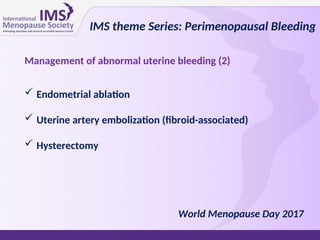
Endometrial ablation
Uterine artery embolization (fibroid-associated)
Hysterectomy
IMS theme Series: Perimenopausal Bleeding
World Menopause Day 2017
Management of abnormal uterine bleeding (2)

![ABNORMAL_UTERINE[1] DR SS NANda abnormal DA.pptx](https://cdn.slidesharecdn.com/ss_thumbnails/abnormaluterine1drssnanda-250706172120-db732f7a-thumbnail.jpg?width=640&height=640&fit=bounds)


