Management of
Gestational Diabetes
mellitus
Kapila Gunawardana
Definition
Gestational diabetes is
commonly defined as
glucose intolerance
first recognized during
pregnancy
Glucose metabolism &
pregnancy
 Due to placental production of anti-insulin
hormones, there is a state of insulin
resistance
 hPL , cotisol ,prolactin, GH ,estrogen and
progesterone
 Compare to non pregnant women
 Low FBS with high PPBS
 Low renal threshold for glucose & ↑ GFR leads to
glycosuria
 Increased production of insulin and high fasting
insulin may lead to functional failure of the
Pancreas
Risk factors
1. Obesity
2. Previous history of GDM
3. Family history of diabetes
4. Racial origin
Asian and African-Caribbean
5. Maternal age more than 25
6. Previous macrosomic baby
7. Polycystic ovary syndrome
8. Multiple pregnancy
Screening & Diagnoses
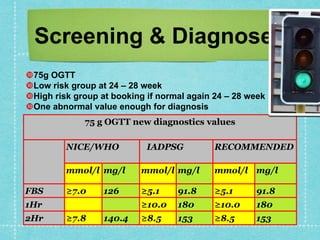
75 g OGTT new diagnostics values
NICE/WHO IADPSG RECOMMENDED
mmol/l mg/l mmol/l mg/l mmol/l mg/l
FBS ≥7.0 126 ≥5.1 91.8 ≥5.1 91.8
1Hr ≥10.0 180 ≥10.0 180
2Hr ≥7.8 140.4 ≥8.5 153 ≥8.5 153
75g OGTT
Low risk group at 24 – 28 week
High risk group at booking if normal again 24 – 28 week
One abnormal value enough for diagnosis
Maternal complications
 Cesarean section/Operative
deliveries/Trauma
 Pre-eclampsia
 Psychological morbidity.
 Recurrence risk of GDM is
30-50%
 30-60% lifetime risk in
developing , IGT or type 2
diabetes
Fetal complications
 The accepted pathological mechanism by which GDM leads to
complications is known as the Pedersen hypothesis
 Macrosomia
shoulder dystocia, birth trauma
and related complications
 Unexplained IUD
 Polyhydramnios and PPROM or PROM
 Metabolic complications
Hypoglycemia, hypothermia,
Ca2+, Mg2+, Polycythemia & Jaundice
Rationale of treatment
o Its' treatment is also controversial.
o No clear guidelines and universally
accepted treatment plans available.
o However randomized trials show
benefits
o in treating the GDM
o The Australian Carbohydrate Intolerance Study
(ACHOIS) was published in 2005
o National Institute of Child Health and Human
development (NICHD) trial – USA 2009
Treatment plan
 Multi disciplinary approach
 Close monitoring & treatment of
GDM are very important for
mother & baby
 Lifestyle modification
 Pharmacotherapy
Multi-disciplinary
approach
 Obstetrician
 Endocrinologist
 Physician
 Dietician
 Paediatrician
 Diabetic nurse.
Monitoring
FBS 1hr PPBS 2hr PPBS
mmol/l mg/l mmol/l mg/l mmol/l mg/l
NICE UK 3.5-5.9 63-106 7.8 140
ACOG 5.3 95 7.2 130 6.7 120
5th international
GDM workshop
(2007)
5.3 95 7.8 140 6.7 120
 You may have to test four times a day:
1. Fasting
2. 1 or 2 hours after breakfast
3. 1 or 2 hours after lunch
4. 1 or 2 hours after dinner
Lifestyle modification
Dietary recommendations
Dietary pattern & calorie distributions
Breakfast- 10%
Lunch- 30%
Dinner- 30%
Bed time snack- 30%
Calorie -2000-2200kcal/day
Normal weight:30kcal/kg
Lean 35kcal/kg
Obese:25kcal/kg)
Composition:
Carbohydrate - 40-50% complex, high fiber;
Protein - 20%;
Fat - 30-40%(<10%saturated)
 A healthy diet is one that includes a balance of foods from all the food groups, giving the nutrients,
 vitamins, and minerals necessary for a healthy pregnancy
Lifestyle modification
Exercise
 Women with gestational diabetes
often need regular, moderate
physical activity to help control
their blood sugar levels by
allowing insulin to work better.
 Walking
 Prenatal aerobics classes
 Swimming
 However, a consultation and
approval by a health care provider
is needed before beginning any
physical activity during
pregnancy.
Pharmacotherapy-
Insulin
• When diet and lifestyle modifications fail to control blood glucose within 1 to 2 weeks then
pharmacological treatment should be commenced.
Pharmacotherapy-Insulin
regime
RCT found basal bolus regime gives better control
compared to twice daily regime.
Pharmacotherapy -OHA
 Metformin-(MIG Trial
Metfor. Vs Insulin in GDM)
& Glibenclamide (both
drugs safe in pregnancy,
both cross the
placenta but no short term
and intermediate fetal
adverse outcomes.)
 30-45% of patients in OHA
need supplementary insulin
to control their blood sugar.
Antenatal care
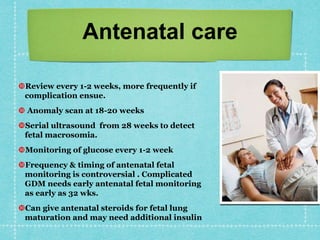
Review every 1-2 weeks, more frequently if
complication ensue.
 Anomaly scan at 18-20 weeks
Serial ultrasound from 28 weeks to detect
fetal macrosomia.
Monitoring of glucose every 1-2 week
Frequency & timing of antenatal fetal
monitoring is controversial . Complicated
GDM needs early antenatal fetal monitoring
as early as 32 wks.
Can give antenatal steroids for fetal lung
maturation and may need additional insulin
Antenatal care
Timing of delivery is controversial and if
uncomplicated can go up to 40wks.
However, decision should be made
according to the available informations.
Mode of delivery will depend on the
clinical as well as ultrasonographic
evidence available.
Diabetes should not be a
contraindication for VBAC
Intra natal care
GDM requiring pharmacological
therapy are best managed
intravenous insulin drips and
glucose monitoring hourly .
Others need only blood glucose
monitoring during labour.
Target blood sugar range 4-7mmol
per l(72-126mg per l)
Continuous fetal heart monitoring
is advisable during labour.
Postpartum care
Exclude persisting hyperglycaemia before
discharge ( FBS or PPBS)
Breast feeding should be encouraged & neonate
blood sugar to be check 2–4 hours after birth.
Lifestyle advice (including weight control, diet
and exercise).
OGTT at the 6 week.
Every three year thereafter.
Early screening for diabetes in future
pregnancies.
Contraception & preconception care.
GDM

GDM

  • 1.
  • 2.
    Definition Gestational diabetes is commonlydefined as glucose intolerance first recognized during pregnancy
  • 3.
    Glucose metabolism & pregnancy Due to placental production of anti-insulin hormones, there is a state of insulin resistance  hPL , cotisol ,prolactin, GH ,estrogen and progesterone  Compare to non pregnant women  Low FBS with high PPBS  Low renal threshold for glucose & ↑ GFR leads to glycosuria  Increased production of insulin and high fasting insulin may lead to functional failure of the Pancreas
  • 4.
    Risk factors 1. Obesity 2.Previous history of GDM 3. Family history of diabetes 4. Racial origin Asian and African-Caribbean 5. Maternal age more than 25 6. Previous macrosomic baby 7. Polycystic ovary syndrome 8. Multiple pregnancy
  • 5.
    Screening & Diagnoses 75g OGTT new diagnostics values NICE/WHO IADPSG RECOMMENDED mmol/l mg/l mmol/l mg/l mmol/l mg/l FBS ≥7.0 126 ≥5.1 91.8 ≥5.1 91.8 1Hr ≥10.0 180 ≥10.0 180 2Hr ≥7.8 140.4 ≥8.5 153 ≥8.5 153 75g OGTT Low risk group at 24 – 28 week High risk group at booking if normal again 24 – 28 week One abnormal value enough for diagnosis
  • 6.
    Maternal complications  Cesareansection/Operative deliveries/Trauma  Pre-eclampsia  Psychological morbidity.  Recurrence risk of GDM is 30-50%  30-60% lifetime risk in developing , IGT or type 2 diabetes
  • 7.
    Fetal complications  Theaccepted pathological mechanism by which GDM leads to complications is known as the Pedersen hypothesis  Macrosomia shoulder dystocia, birth trauma and related complications  Unexplained IUD  Polyhydramnios and PPROM or PROM  Metabolic complications Hypoglycemia, hypothermia, Ca2+, Mg2+, Polycythemia & Jaundice
  • 8.
    Rationale of treatment oIts' treatment is also controversial. o No clear guidelines and universally accepted treatment plans available. o However randomized trials show benefits o in treating the GDM o The Australian Carbohydrate Intolerance Study (ACHOIS) was published in 2005 o National Institute of Child Health and Human development (NICHD) trial – USA 2009
  • 9.
    Treatment plan  Multidisciplinary approach  Close monitoring & treatment of GDM are very important for mother & baby  Lifestyle modification  Pharmacotherapy
  • 10.
    Multi-disciplinary approach  Obstetrician  Endocrinologist Physician  Dietician  Paediatrician  Diabetic nurse.
  • 11.
    Monitoring FBS 1hr PPBS2hr PPBS mmol/l mg/l mmol/l mg/l mmol/l mg/l NICE UK 3.5-5.9 63-106 7.8 140 ACOG 5.3 95 7.2 130 6.7 120 5th international GDM workshop (2007) 5.3 95 7.8 140 6.7 120  You may have to test four times a day: 1. Fasting 2. 1 or 2 hours after breakfast 3. 1 or 2 hours after lunch 4. 1 or 2 hours after dinner
  • 12.
    Lifestyle modification Dietary recommendations Dietarypattern & calorie distributions Breakfast- 10% Lunch- 30% Dinner- 30% Bed time snack- 30% Calorie -2000-2200kcal/day Normal weight:30kcal/kg Lean 35kcal/kg Obese:25kcal/kg) Composition: Carbohydrate - 40-50% complex, high fiber; Protein - 20%; Fat - 30-40%(<10%saturated)  A healthy diet is one that includes a balance of foods from all the food groups, giving the nutrients,  vitamins, and minerals necessary for a healthy pregnancy
  • 13.
    Lifestyle modification Exercise  Womenwith gestational diabetes often need regular, moderate physical activity to help control their blood sugar levels by allowing insulin to work better.  Walking  Prenatal aerobics classes  Swimming  However, a consultation and approval by a health care provider is needed before beginning any physical activity during pregnancy.
  • 14.
    Pharmacotherapy- Insulin • When dietand lifestyle modifications fail to control blood glucose within 1 to 2 weeks then pharmacological treatment should be commenced.
  • 15.
    Pharmacotherapy-Insulin regime RCT found basalbolus regime gives better control compared to twice daily regime.
  • 16.
    Pharmacotherapy -OHA  Metformin-(MIGTrial Metfor. Vs Insulin in GDM) & Glibenclamide (both drugs safe in pregnancy, both cross the placenta but no short term and intermediate fetal adverse outcomes.)  30-45% of patients in OHA need supplementary insulin to control their blood sugar.
  • 17.
    Antenatal care Review every1-2 weeks, more frequently if complication ensue.  Anomaly scan at 18-20 weeks Serial ultrasound from 28 weeks to detect fetal macrosomia. Monitoring of glucose every 1-2 week Frequency & timing of antenatal fetal monitoring is controversial . Complicated GDM needs early antenatal fetal monitoring as early as 32 wks. Can give antenatal steroids for fetal lung maturation and may need additional insulin
  • 18.
    Antenatal care Timing ofdelivery is controversial and if uncomplicated can go up to 40wks. However, decision should be made according to the available informations. Mode of delivery will depend on the clinical as well as ultrasonographic evidence available. Diabetes should not be a contraindication for VBAC
  • 19.
    Intra natal care GDMrequiring pharmacological therapy are best managed intravenous insulin drips and glucose monitoring hourly . Others need only blood glucose monitoring during labour. Target blood sugar range 4-7mmol per l(72-126mg per l) Continuous fetal heart monitoring is advisable during labour.
  • 20.
    Postpartum care Exclude persistinghyperglycaemia before discharge ( FBS or PPBS) Breast feeding should be encouraged & neonate blood sugar to be check 2–4 hours after birth. Lifestyle advice (including weight control, diet and exercise). OGTT at the 6 week. Every three year thereafter. Early screening for diabetes in future pregnancies. Contraception & preconception care.