REPUBLICA BOLIVARIANA DE VENEZUELA
UNIVERSIDAD YACAMBU
MORA-LARA
Gerunds and Infinitives
Teacher: Luis Chavez
Section: MA04TOS
Student: Guadalupe Garces
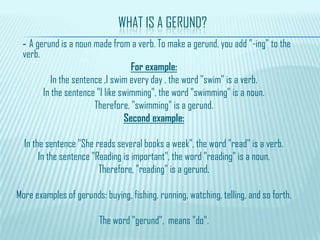
WHAT IS A GERUND?
- A gerund is a noun made from a verb. To make a gerund, you add "-ing" to the
verb.
For example:
In the sentence ,I swim every day , the word "swim" is a verb.
In the sentence "I like swimming", the word "swimming" is a noun.
Therefore, "swimming" is a gerund.
Second example:
In the sentence "She reads several books a week", the word "read" is a verb.
In the sentence "Reading is important", the word "reading" is a noun.
Therefore, "reading" is a gerund.
More examples of gerunds: buying, fishing, running, watching, telling, and so forth.
The word "gerund", means "do".
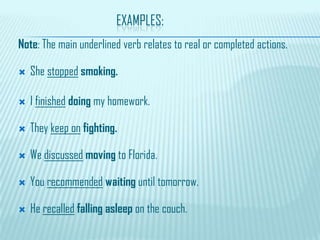
EXAMPLES:
Note: The main underlined verb relates to real or completed actions.
 She stopped smoking.
 I finished doing my homework.
 They keep on fighting.
 We discussed moving to Florida.
 You recommended waiting until tomorrow.
 He recalled falling asleep on the couch.
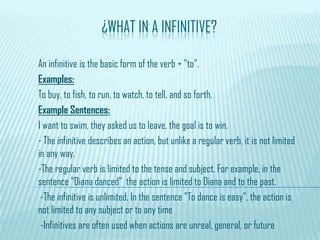
¿WHAT IN A INFINITIVE?
An infinitive is the basic form of the verb + "to".
Examples:
To buy, to fish, to run, to watch, to tell, and so forth.
Example Sentences:
I want to swim, they asked us to leave, the goal is to win.
- The infinitive describes an action, but unlike a regular verb, it is not limited
in any way.
-The regular verb is limited to the tense and subject. For example, in the
sentence "Diana danced" the action is limited to Diana and to the past.
-The infinitive is unlimited. In the sentence "To dance is easy", the action is
not limited to any subject or to any time
-Infinitives are often used when actions are unreal, general, or future
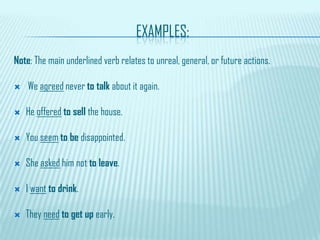
EXAMPLES:
Note: The main underlined verb relates to unreal, general, or future actions.
 We agreed never to talk about it again.
 He offered to sell the house.
 You seem to be disappointed.
 She asked him not to leave.
 I want to drink.
 They need to get up early.

Gerunds and infinitives

  • 1.
    REPUBLICA BOLIVARIANA DEVENEZUELA UNIVERSIDAD YACAMBU MORA-LARA Gerunds and Infinitives Teacher: Luis Chavez Section: MA04TOS Student: Guadalupe Garces
  • 2.
    WHAT IS AGERUND? - A gerund is a noun made from a verb. To make a gerund, you add "-ing" to the verb. For example: In the sentence ,I swim every day , the word "swim" is a verb. In the sentence "I like swimming", the word "swimming" is a noun. Therefore, "swimming" is a gerund. Second example: In the sentence "She reads several books a week", the word "read" is a verb. In the sentence "Reading is important", the word "reading" is a noun. Therefore, "reading" is a gerund. More examples of gerunds: buying, fishing, running, watching, telling, and so forth. The word "gerund", means "do".
  • 3.
    EXAMPLES: Note: The mainunderlined verb relates to real or completed actions.  She stopped smoking.  I finished doing my homework.  They keep on fighting.  We discussed moving to Florida.  You recommended waiting until tomorrow.  He recalled falling asleep on the couch.
  • 4.
    ¿WHAT IN AINFINITIVE? An infinitive is the basic form of the verb + "to". Examples: To buy, to fish, to run, to watch, to tell, and so forth. Example Sentences: I want to swim, they asked us to leave, the goal is to win. - The infinitive describes an action, but unlike a regular verb, it is not limited in any way. -The regular verb is limited to the tense and subject. For example, in the sentence "Diana danced" the action is limited to Diana and to the past. -The infinitive is unlimited. In the sentence "To dance is easy", the action is not limited to any subject or to any time -Infinitives are often used when actions are unreal, general, or future
  • 5.
    EXAMPLES: Note: The mainunderlined verb relates to unreal, general, or future actions.  We agreed never to talk about it again.  He offered to sell the house.  You seem to be disappointed.  She asked him not to leave.  I want to drink.  They need to get up early.