What (the h***)is the
gerund?
• A gerund is the ING form of the verb.
• Examples:
• Playing
• Swimming
• Going
• Running
• Being
3.
When do weuse the
GERUND?
• After certain verbs
• Instead of a noun
• After prepositions
4.
1. After certainverbs
• Enjoy
• I enjoy reading
• I was enjoying reading
• She has enjoyed reading
• You will enjoy reading
• We have been enjoying reading
5.
Certain verbs arefollowed
by the gerund
• After ‘enjoy’ ‘fancy’ ‘discuss’ ‘dislike’ ‘finish’
• The second verb is ALWAYS in the gerund
• I enjoy reading
• I fancy watching movies
• We discussed going on holiday together
• I dislike waiting for buses
• We’ve finished preparing for the meeting
6.
Certain verbs are
followedby the
gerund
• Mind
I don’t mind coming early
• Suggest
• He suggested staying home (NOT suggested to)
• Recommend
• He recommended meeting earlier
• Kept
• He kept working although he felt ill.
• Avoid
• She avoided talking to her boss
7.
Another way weuse a
gerund
• After certain verbs
• Instead of a noun
• After prepositions
A third wayto use gerunds
• After certain verbs
• Instead of a noun
• After prepositions
10.
Examples
• I dranka cup of coffee before leaving.
• It’s a good idea to brush your teeth after
eating
11.
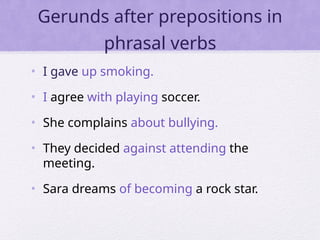
Gerunds after prepositionsin
phrasal verbs
• I gave up smoking.
• I agree with playing soccer.
• She complains about bullying.
• They decided against attending the
meeting.
• Sara dreams of becoming a rock star.
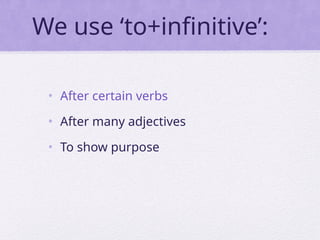
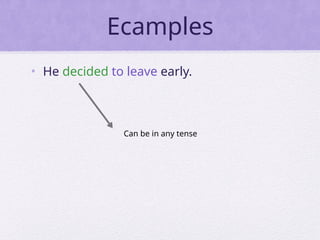
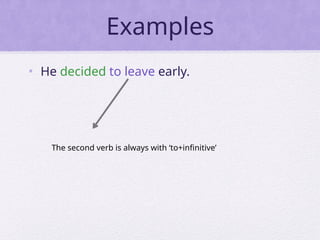
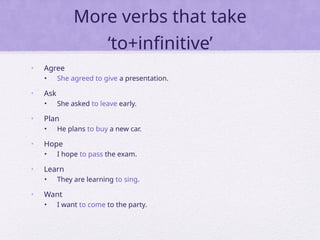
More verbs thattake
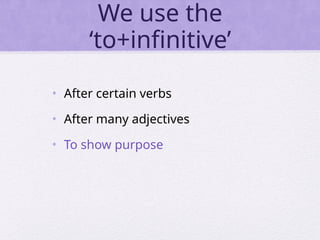
‘to+infinitive’
• Agree
• She agreed to give a presentation.
• Ask
• She asked to leave early.
• Plan
• He plans to buy a new car.
• Hope
• I hope to pass the exam.
• Learn
• They are learning to sing.
• Want
• I want to come to the party.
16.
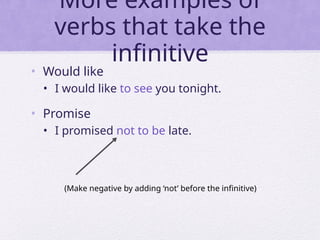
More examples of
verbsthat take the
infinitive
• Would like
• I would like to see you tonight.
• Promise
• I promised not to be late.
(Make negative by adding ‘not’ before the infinitive)
17.
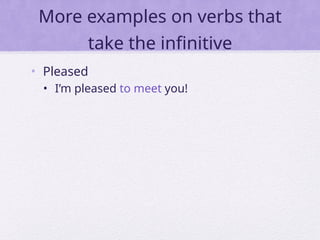
More examples onverbs that
take the infinitive
• Pleased
• I’m pleased to meet you!
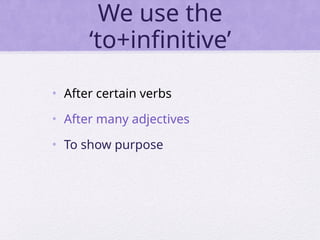
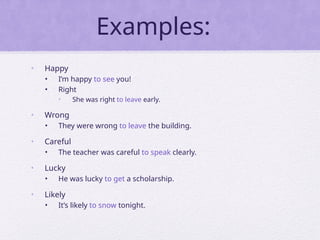
Examples:
• Happy
• I’mhappy to see you!
• Right
• She was right to leave early.
• Wrong
• They were wrong to leave the building.
• Careful
• The teacher was careful to speak clearly.
• Lucky
• He was lucky to get a scholarship.
• Likely
• It’s likely to snow tonight.
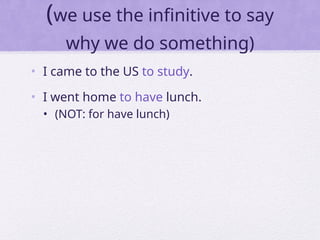
(we use theinfinitive to say
why we do something)
• I came to the US to study.
• I went home to have lunch.
• (NOT: for have lunch)
22.
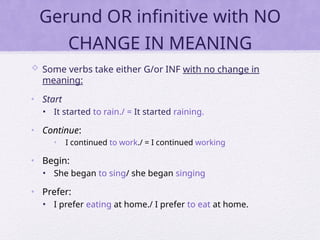
Gerund OR infinitivewith NO
CHANGE IN MEANING
Some verbs take either G/or INF with no change in
meaning:
• Start
• It started to rain./ = It started raining.
• Continue:
• I continued to work./ = I continued working
• Begin:
• She began to sing/ she began singing
• Prefer:
• I prefer eating at home./ I prefer to eat at home.
23.
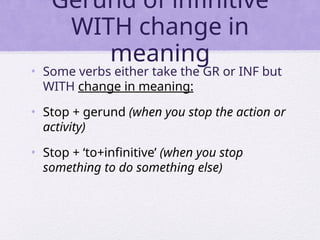
Gerund of infinitive
WITHchange in
meaning
• Some verbs either take the GR or INF but
WITH change in meaning:
• Stop + gerund (when you stop the action or
activity)
• Stop + ‘to+infinitive’ (when you stop
something to do something else)
24.
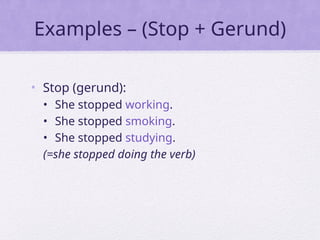
Examples – (Stop+ Gerund)
• Stop (gerund):
• She stopped working.
• She stopped smoking.
• She stopped studying.
(=she stopped doing the verb)
25.
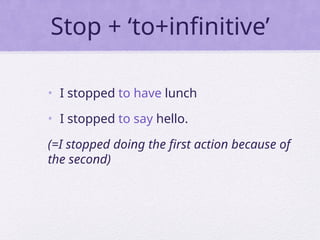
Stop + ‘to+infinitive’
•I stopped to have lunch
• I stopped to say hello.
(=I stopped doing the first action because of
the second)
26.
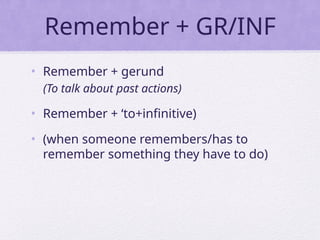
Remember + GR/INF
•Remember + gerund
(To talk about past actions)
• Remember + ‘to+infinitive)
• (when someone remembers/has to
remember something they have to do)
27.
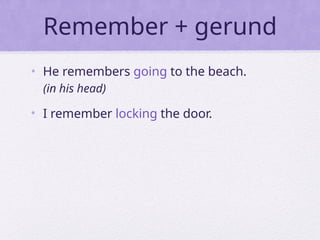
Remember + gerund
•He remembers going to the beach.
(in his head)
• I remember locking the door.
28.
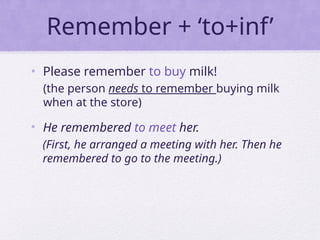
Remember + ‘to+inf’
•Please remember to buy milk!
(the person needs to remember buying milk
when at the store)
• He remembered to meet her.
(First, he arranged a meeting with her. Then he
remembered to go to the meeting.)
29.
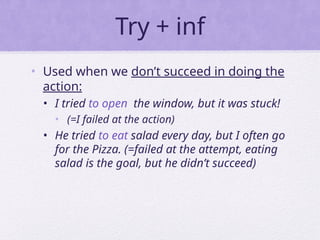
Try + inf
•Used when we don’t succeed in doing the
action:
• I tried to open the window, but it was stuck!
• (=I failed at the action)
• He tried to eat salad every day, but I often go
for the Pizza. (=failed at the attempt, eating
salad is the goal, but he didn’t succeed)
30.
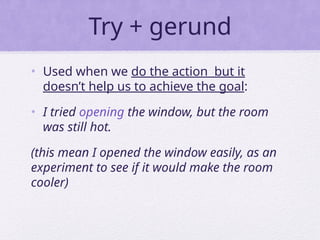
Try + gerund
•Used when we do the action but it
doesn’t help us to achieve the goal:
• I tried opening the window, but the room
was still hot.
(this mean I opened the window easily, as an
experiment to see if it would make the room
cooler)