PRESENT CONTONOUS
 Introduction
 Thepresent continuous tense (also called
 the present progressive tense) is commonly
 used in English for actions happening right
 now, or in the future.
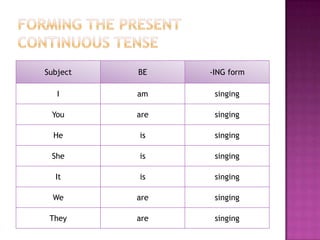
Subject   BE    -ING form

   I      am     singing

 You      are    singing

  He      is     singing

 She      is     singing

  It      is     singing

  We      are    singing

 They     are    singing
How to make the -ING
Verb ending in...                                       Examples
                                form

                                                        swim - swimming
                                Double the consonant,
one vowel + one consonant                               hit - hitting
                                then add -ING
                                                        get - getting

                                                        come - coming
                                Remove E, then add -
one vowel + one consonant + E                           lose - losing
                                ING
                                                        live - living

                                                        say - saying
[anything else]                 Add -ING                go - going
                                                        walk - walking
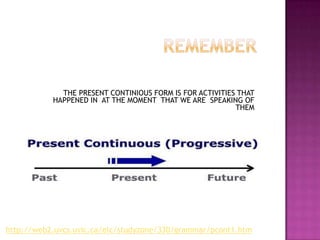
THE PRESENT CONTINIOUS FORM IS FOR ACTIVITIES THAT
           HAPPENED IN AT THE MOMENT THAT WE ARE SPEAKING OF
                                                          THEM


http://web2.uvcs.uvic.ca/elc/studyzone/330/grammar/pcont1.htm
To play = playing

Nota:
 1. Cuando el infinitivo termina en
 consonante precedida de una vocal, la
 consonante ultima se duplica.
 To sit            sitting
2. Cuanto el infinitivo termina en –e muda
desaparece.
       To write              writing

 3. Cuando el infinitivo termina en –ie cambia a
“y” + -ing.

       To lie             lying
 Comosujeto en una expresión.
  Reading English is easier than speaking it.

 Enalgunas expresiones de prohibición.
   No smoking.
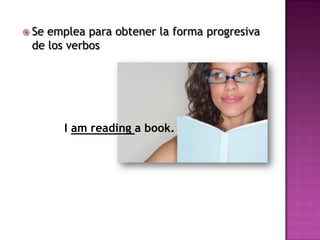
 Seemplea para obtener la forma progresiva
 de los verbos


       I am reading a book.
 Cuandoa un verbo le sigue de forma
 inmediata una preposición, se utiliza la
 forma de gerundio.

  After swimming I felt cold.

  They hade difficulty in finding a parking
 place
 Como   complemento de un verbo.

  His hobby is painting.

 Seutiliza frecuentemente después de los
 verbos “to go” y “to come”.

   Come sailing with us next Saturday.
Gerundio/ Presente progressivo

Gerundio/ Presente progressivo

  • 1.
  • 2.
     Introduction  Thepresentcontinuous tense (also called the present progressive tense) is commonly used in English for actions happening right now, or in the future.
  • 3.
    Subject BE -ING form I am singing You are singing He is singing She is singing It is singing We are singing They are singing
  • 4.
    How to makethe -ING Verb ending in... Examples form swim - swimming Double the consonant, one vowel + one consonant hit - hitting then add -ING get - getting come - coming Remove E, then add - one vowel + one consonant + E lose - losing ING live - living say - saying [anything else] Add -ING go - going walk - walking
  • 5.
    THE PRESENT CONTINIOUSFORM IS FOR ACTIVITIES THAT HAPPENED IN AT THE MOMENT THAT WE ARE SPEAKING OF THEM http://web2.uvcs.uvic.ca/elc/studyzone/330/grammar/pcont1.htm
  • 6.
    To play =playing Nota: 1. Cuando el infinitivo termina en consonante precedida de una vocal, la consonante ultima se duplica. To sit sitting
  • 7.
    2. Cuanto elinfinitivo termina en –e muda desaparece. To write writing 3. Cuando el infinitivo termina en –ie cambia a “y” + -ing. To lie lying
  • 8.
     Comosujeto enuna expresión. Reading English is easier than speaking it.  Enalgunas expresiones de prohibición. No smoking.
  • 9.
     Seemplea paraobtener la forma progresiva de los verbos I am reading a book.
  • 10.
     Cuandoa unverbo le sigue de forma inmediata una preposición, se utiliza la forma de gerundio. After swimming I felt cold. They hade difficulty in finding a parking place
  • 11.
     Como complemento de un verbo. His hobby is painting.  Seutiliza frecuentemente después de los verbos “to go” y “to come”. Come sailing with us next Saturday.