16 TENSES IN
ENGLISH
BE DONE BY; LENA MAFALDA
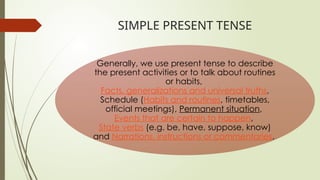
SIMPLE PRESENT TENSE
Generally, we use present tense to describe
the present activities or to talk about routines
or habits,
Facts, generalizations and universal truths,
Schedule (Habits and routines, timetables,
official meetings), Permanent situation,
Events that are certain to happen,
State verbs (e.g. be, have, suppose, know)
and Narrations, instructions or commentaries.
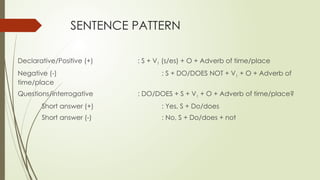
SENTENCE PATTERN
Declarative/Positive (+) : S + V1 (s/es) + O + Adverb of time/place
Negative (-) : S + DO/DOES NOT + V1 + O + Adverb of
time/place
Questions/interrogative : DO/DOES + S + V1 + O + Adverb of time/place?
Short answer (+) : Yes, S + Do/does
Short answer (-) : No, S + Do/does + not
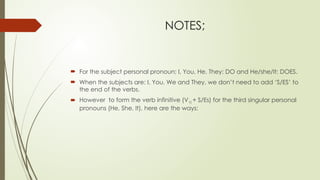
NOTES;
 For the subject personal pronoun; I, You, He, They: DO and He/she/It: DOES.
 When the subjects are: I, You, We and They, we don’t need to add ‘S/ES’ to
the end of the verbs.
 However to form the verb infinitive (V1) + S/Es) for the third singular personal
pronouns (He, She, It), here are the ways:
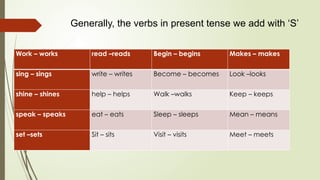
Generally, the verbs in present tense we add with ‘S’
Work – works read –reads Begin – begins Makes – makes
sing – sings write – writes Become – becomes Look –looks
shine – shines help – helps Walk –walks Keep – keeps
speak – speaks eat – eats Sleep – sleeps Mean – means
set –sets Sit – sits Visit – visits Meet – meets
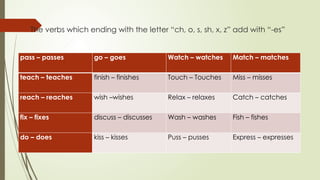
The verbs which ending with the letter “ch, o, s, sh, x, z” add with “-es”
pass – passes go – goes Watch – watches Match – matches
teach – teaches finish – finishes Touch – Touches Miss – misses
reach – reaches wish –wishes Relax – relaxes Catch – catches
fix – fixes discuss – discusses Wash – washes Fish – fishes
do – does kiss – kisses Puss – pusses Express – expresses
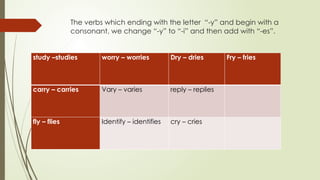
The verbs which ending with the letter “-y” and begin with a
consonant, we change “-y” to “-i” and then add with “-es”.
study –studies worry – worries Dry – dries Fry – fries
carry – carries Vary – varies reply – replies
fly – flies Identify – identifies cry – cries
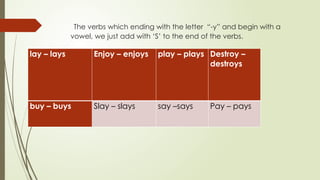
The verbs which ending with the letter “-y” and begin with a
vowel, we just add with ‘S’ to the end of the verbs.
lay – lays Enjoy – enjoys play – plays Destroy –
destroys
buy – buys Slay – slays say –says Pay – pays
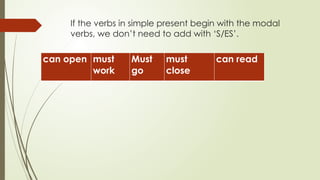
If the verbs in simple present begin with the modal
verbs, we don’t need to add with ‘S/ES’.
can open must
work
Must
go
must
close
can read
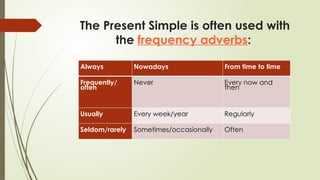
The Present Simple is often used with
the frequency adverbs:
Always Nowadays From time to time
Frequently/
often
Never Every now and
then
Usually Every week/year Regularly
Seldom/rarely Sometimes/occasionally Often
EXAMPLE
1. Declarative/Positive (+) : I eat corn every Monday.
Negative (-) : I do not (don’t) eat corn every Monday.
Questions/interrogative : Do I eat corn every Monday?
Short answer (+) : Yes, you do // Short answer (-) : No, you do not (don’t)
2. Declarative/Positive (+) : You eat corn every Monday.
Negative (-) : You do not (don’t) eat corn every Monday.
Questions/interrogative : Do you eat corn every Monday?
Short answer (+) : Yes, I do. // Short answer (-) : No, I do not (don’t).

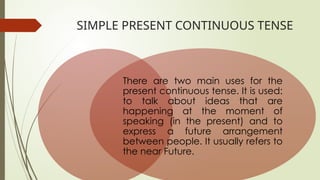
SIMPLE PRESENT CONTINUOUS TENSE
There are two main uses for the
present continuous tense. It is used:
to talk about ideas that are
happening at the moment of
speaking (in the present) and to
express a future arrangement
between people. It usually refers to
the near Future.
SENTENCE PATTERN
Declarative/Positive (+) : S + AM/IS/ARE +Ving + O + Adverb of
time/place
Negative (-) : S + AM/IS/ARE + NOT + Ving
+ O + Ad. of time/place Questions/interrogative : AM/IS/ARE + S +
Ving + O + Ad. of time/place?
Short answer (+) : Yes, S + AM/IS/ARE
Short answer (-) : No, S + AM/IS/ARE/ not
NOTE;
 The way to use auxiliary verb (AM/IS/ARE):
 Subject; I = Am
 You/we/they = Are
 He/She/It = Is
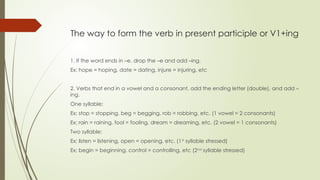
The way to form the verb in present participle or V1+ing
1. If the word ends in –e, drop the –e and add –ing.
Ex; hope = hoping, date = dating, injure = injuring, etc
2. Verbs that end in a vowel and a consonant, add the ending letter (double), and add –
ing.
One syllable:
Ex; stop = stopping, beg = begging, rob = robbing, etc. (1 vowel = 2 consonants)
Ex; rain = raining, fool = fooling, dream = dreaming, etc. (2 vowel = 1 consonants)
Two syllable:
Ex; listen = listening, open = opening, etc. (1st
syllable stressed)
Ex; begin = beginning, control = controlling, etc (2nd
syllable stressed)
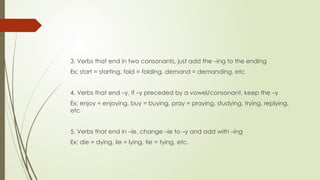
3. Verbs that end in two consonants, just add the –ing to the ending
Ex; start = starting, fold = folding, demand = demanding, etc
4. Verbs that end –y, if –y preceded by a vowel/consonant, keep the –y
Ex; enjoy = enjoying, buy = buying, pray = praying, studying, trying, replying,
etc
5. Verbs that end in –ie, change –ie to –y and add with –ing
Ex; die = dying, lie = lying, tie = tying, etc.
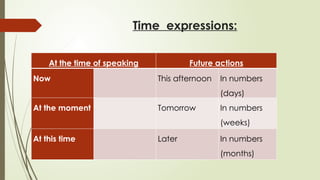
Time expressions:
At the time of speaking Future actions
Now This afternoon In numbers
(days)
At the moment Tomorrow In numbers
(weeks)
At this time Later In numbers
(months)
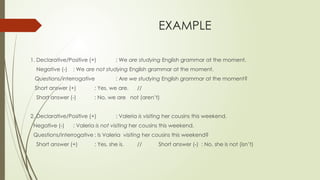
EXAMPLE
1. Declarative/Positive (+) : We are studying English grammar at the moment.
Negative (-) : We are not studying English grammar at the moment.
Questions/interrogative : Are we studying English grammar at the moment?
Short answer (+) : Yes, we are. //
Short answer (-) : No, we are not (aren’t)
2. Declarative/Positive (+) : Valeria is visiting her cousins this weekend.
Negative (-) : Valeria is not visiting her cousins this weekend.
Questions/interrogative : Is Valeria visiting her cousins this weekend?
Short answer (+) : Yes, she is. // Short answer (-) : No, she is not (isn’t)

tenses-writing-creative-writing-tasks_90499.pptx

  • 1.
    16 TENSES IN ENGLISH BEDONE BY; LENA MAFALDA
  • 2.
    SIMPLE PRESENT TENSE Generally,we use present tense to describe the present activities or to talk about routines or habits, Facts, generalizations and universal truths, Schedule (Habits and routines, timetables, official meetings), Permanent situation, Events that are certain to happen, State verbs (e.g. be, have, suppose, know) and Narrations, instructions or commentaries.
  • 3.
    SENTENCE PATTERN Declarative/Positive (+): S + V1 (s/es) + O + Adverb of time/place Negative (-) : S + DO/DOES NOT + V1 + O + Adverb of time/place Questions/interrogative : DO/DOES + S + V1 + O + Adverb of time/place? Short answer (+) : Yes, S + Do/does Short answer (-) : No, S + Do/does + not
  • 4.
    NOTES;  For thesubject personal pronoun; I, You, He, They: DO and He/she/It: DOES.  When the subjects are: I, You, We and They, we don’t need to add ‘S/ES’ to the end of the verbs.  However to form the verb infinitive (V1) + S/Es) for the third singular personal pronouns (He, She, It), here are the ways:
  • 5.
    Generally, the verbsin present tense we add with ‘S’ Work – works read –reads Begin – begins Makes – makes sing – sings write – writes Become – becomes Look –looks shine – shines help – helps Walk –walks Keep – keeps speak – speaks eat – eats Sleep – sleeps Mean – means set –sets Sit – sits Visit – visits Meet – meets
  • 6.
    The verbs whichending with the letter “ch, o, s, sh, x, z” add with “-es” pass – passes go – goes Watch – watches Match – matches teach – teaches finish – finishes Touch – Touches Miss – misses reach – reaches wish –wishes Relax – relaxes Catch – catches fix – fixes discuss – discusses Wash – washes Fish – fishes do – does kiss – kisses Puss – pusses Express – expresses
  • 7.
    The verbs whichending with the letter “-y” and begin with a consonant, we change “-y” to “-i” and then add with “-es”. study –studies worry – worries Dry – dries Fry – fries carry – carries Vary – varies reply – replies fly – flies Identify – identifies cry – cries
  • 8.
    The verbs whichending with the letter “-y” and begin with a vowel, we just add with ‘S’ to the end of the verbs. lay – lays Enjoy – enjoys play – plays Destroy – destroys buy – buys Slay – slays say –says Pay – pays
  • 9.
    If the verbsin simple present begin with the modal verbs, we don’t need to add with ‘S/ES’. can open must work Must go must close can read
  • 10.
    The Present Simpleis often used with the frequency adverbs: Always Nowadays From time to time Frequently/ often Never Every now and then Usually Every week/year Regularly Seldom/rarely Sometimes/occasionally Often
  • 11.
    EXAMPLE 1. Declarative/Positive (+): I eat corn every Monday. Negative (-) : I do not (don’t) eat corn every Monday. Questions/interrogative : Do I eat corn every Monday? Short answer (+) : Yes, you do // Short answer (-) : No, you do not (don’t) 2. Declarative/Positive (+) : You eat corn every Monday. Negative (-) : You do not (don’t) eat corn every Monday. Questions/interrogative : Do you eat corn every Monday? Short answer (+) : Yes, I do. // Short answer (-) : No, I do not (don’t). 
  • 12.
    SIMPLE PRESENT CONTINUOUSTENSE There are two main uses for the present continuous tense. It is used: to talk about ideas that are happening at the moment of speaking (in the present) and to express a future arrangement between people. It usually refers to the near Future.
  • 13.
    SENTENCE PATTERN Declarative/Positive (+): S + AM/IS/ARE +Ving + O + Adverb of time/place Negative (-) : S + AM/IS/ARE + NOT + Ving + O + Ad. of time/place Questions/interrogative : AM/IS/ARE + S + Ving + O + Ad. of time/place? Short answer (+) : Yes, S + AM/IS/ARE Short answer (-) : No, S + AM/IS/ARE/ not
  • 14.
    NOTE;  The wayto use auxiliary verb (AM/IS/ARE):  Subject; I = Am  You/we/they = Are  He/She/It = Is
  • 15.
    The way toform the verb in present participle or V1+ing 1. If the word ends in –e, drop the –e and add –ing. Ex; hope = hoping, date = dating, injure = injuring, etc 2. Verbs that end in a vowel and a consonant, add the ending letter (double), and add – ing. One syllable: Ex; stop = stopping, beg = begging, rob = robbing, etc. (1 vowel = 2 consonants) Ex; rain = raining, fool = fooling, dream = dreaming, etc. (2 vowel = 1 consonants) Two syllable: Ex; listen = listening, open = opening, etc. (1st syllable stressed) Ex; begin = beginning, control = controlling, etc (2nd syllable stressed)
  • 16.
    3. Verbs thatend in two consonants, just add the –ing to the ending Ex; start = starting, fold = folding, demand = demanding, etc 4. Verbs that end –y, if –y preceded by a vowel/consonant, keep the –y Ex; enjoy = enjoying, buy = buying, pray = praying, studying, trying, replying, etc 5. Verbs that end in –ie, change –ie to –y and add with –ing Ex; die = dying, lie = lying, tie = tying, etc.
  • 17.
    Time expressions: At thetime of speaking Future actions Now This afternoon In numbers (days) At the moment Tomorrow In numbers (weeks) At this time Later In numbers (months)
  • 18.
    EXAMPLE 1. Declarative/Positive (+): We are studying English grammar at the moment. Negative (-) : We are not studying English grammar at the moment. Questions/interrogative : Are we studying English grammar at the moment? Short answer (+) : Yes, we are. // Short answer (-) : No, we are not (aren’t) 2. Declarative/Positive (+) : Valeria is visiting her cousins this weekend. Negative (-) : Valeria is not visiting her cousins this weekend. Questions/interrogative : Is Valeria visiting her cousins this weekend? Short answer (+) : Yes, she is. // Short answer (-) : No, she is not (isn’t)