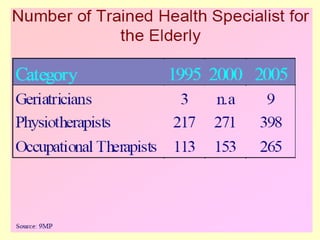
Geriatric Health

Dr Nik Nor Ronaidi bin
      Nik Mahdi
Outlines
• Definition
• Demographic changes
• Common health (including sexual health), social
  & economic problems/ implications
• National policy for older person
• Health care programme for elderly in Malaysia
  (objective, strategies, medical, health &
  institutional care, agencies involved)
• Social & economic supportive program
• Programs for older person in other countries
Definitions
Definition
• Geriatrics
 A branch of medicine that deals with the
  problems of aging and the diseases of the
  elderly


• Gerontology
 A branch of study that look into the social
  aspect of ageing including its related
  policy
• What is ageing?
 A progressive state beginning from
  conception and ending with death.
  Associated with it are certain physical,
  social and psychological changes.
• Terminology
  – Elderly
  – The aged
  – Older people
  – Senior citizen
  – ‘Wargatua’
  – ‘Orang tua’
  – ‘Warga emas’
• Elderly:
- WHO defines old age as those who are
  ≥60 years ( developing countries) or ≥65
  years (developed countries).
Demographic Changes
Why older people?
Ageing population:
Global phenomenon
A phenomenon occurring both in developed and
 developing countries
Challenge of increase longevity but compressed
 morbidity
 Major sources of population ageing include:
  • declining fertility and mortality rate
  • improved health and life expectancy
Ageing population
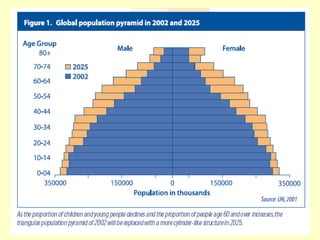
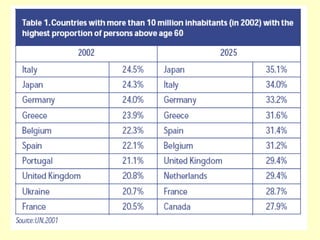
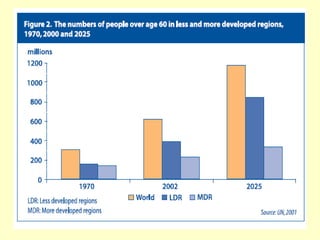
• Today, there are 600 million people in the world
  aged 60 years and over.
• This figure is expected to double by 2025 and to
  reach 2 billion by 2050.
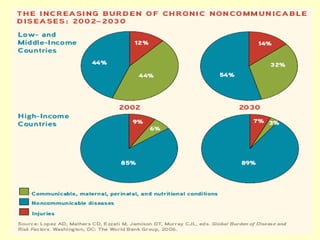
• Population ageing is characteristically
  accompanied by an increase in the burden of
  chronic noncommunicable diseases (NCDs)
  such as cardiovascular diseases, diabetes,
  Alzheimer's disease and other ageing-associated
  mental health conditions, cancers, chronic
  obstructive pulmonary disease and
  musculoskeletal problems.
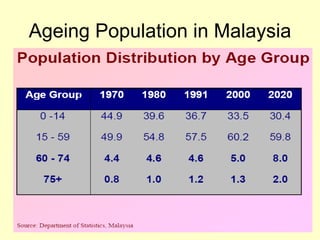
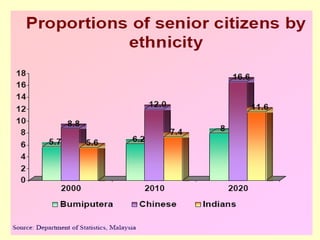
Ageing Population in Malaysia
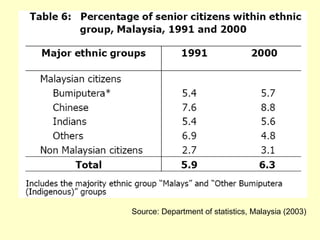
Source: Department of statistics, Malaysia (2003)
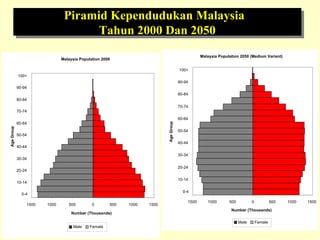
Piramid Kependudukan Malaysia
                                     Tahun 2000 Dan 2050
                                                                                                Malaysia Population 2050 (Medium Variant)
                              Malaysia Population 2000

                                                                                     100+
            100+
                                                                                     90-94
            90-94
                                                                                     80-84
            80-84
                                                                                     70-74
            70-74
                                                                                     60-64
            60-64


                                                                         Age Group
Age Group


                                                                                     50-54
            50-54
                                                                                     40-44
            40-44

                                                                                     30-34
            30-34

                                                                                     20-24
            20-24

                                                                                     10-14
            10-14

                                                                                       0-4
              0-4
                                                                                         1500      1000       500          0            500   1000   1500
                1500   1000      500         0       500   1000   1500
                                                                                                               Number (Thousands)
                                  Number (Thousands)

                                                                                                                    Male       Female
                                   Male     Female
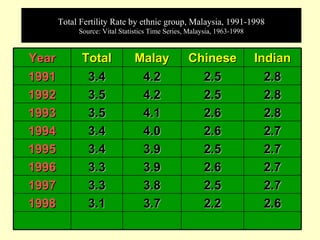
Total Fertility Rate by ethnic group, Malaysia, 1991-1998
            Source: Vital Statistics Time Series, Malaysia, 1963-1998


Year         Total             Malay             Chinese                Indian
1991          3.4               4.2                2.5                    2.8
1992          3.5               4.2                2.5                    2.8
1993          3.5               4.1                2.6                    2.8
1994          3.4               4.0                2.6                    2.7
1995          3.4               3.9                2.5                    2.7
1996          3.3               3.9                2.6                    2.7
1997          3.3               3.8                2.5                    2.7
1998          3.1               3.7                2.2                    2.6
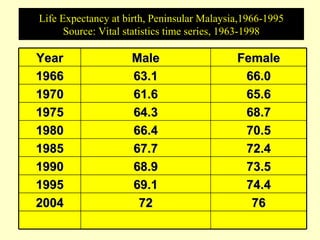
Life Expectancy at birth, Peninsular Malaysia,1966-1995
      Source: Vital statistics time series, 1963-1998

Year                Male                    Female
1966                63.1                     66.0
1970                61.6                     65.6
1975                64.3                     68.7
1980                66.4                     70.5
1985                67.7                     72.4
1990                68.9                     73.5
1995                69.1                     74.4
2004                 72                       76
Illness and Older People
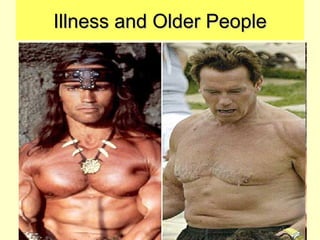
• Growing old is a life long process
  – Does not occur suddenly
• Involves physiological, psychological
  changes and physical changes
• Involves senses and all the systems
  – Skin – less elastic and wrinkles
  – Eyes, hearing, taste, smell – less sensitive
  – Physical – loss height, stooping walk
•   Bones – brittle and prone to fracture
•   Muscle – loss bulk
•   Immune function - compromised
•   Nutrition - malnutrition and under nutrition
    are common
• Sexuality
  – Studies show that 74% of married men and
    56% of married women over 60 years of age
    remain sexually active. (Diokno AC et al)
  – Common problems : arthritis, diabetes, fatigue,
    fear of precipitating a MI and side effects from
    prescription drugs
• Brain function
  – cognitive decline and depression.
GIANTS OF GERIATRIC (Bernard Isaacs, 1975)

• Bernard Isaacs described the "giants" of geriatrics:
  incontinence, immobility, impaired cognitive
  function and instability.
• He asserted that if we look closely enough, all
  common problems with older people relate back to
  one of these giants.
• The GIANTS are disabilities that lower the quality
  of living.
• In common: multiple causes, chronic nature,
  reduced independence, no simple cure.
• The ‘final pathway’ that affect elderly with
  diminished ability to recover, make them
  DEPENDANT on others.
1. Incontinence
   - Urinary & Fecal

2. Instability/Immobility
    - Risk of fall & Osteoporotic fracture

3. Impaired cognitive function
    - Dementia/depression
•A study by the Public Health Institute, Malaysia in 1995
showed:-
      - 81.4% suffered from at least from one chronic
            medical illness.
      - 12.7% had 3 or more chronic diseases.
•The commonest medical illness:-
      - joint paint              50.1%
      - eyesight problem         40%
      - hearing problem          21%
      - hypertension             26%
      - heart diseases           16.3%
      - diabetes                 11.6%
Socio- economic implications
1. Social security
  • In Malaysia, the social security covers
    only employees in the formal sector.
      •   Pension scheme for civil servants while the EPF
          for private sector employees.
  •   Only 61.8% of total employed persons
      covered by these two schemes leaving the
      remaining 38.2 per cent without known
      source of coverage. (Labor Force Survey Report, 1998)
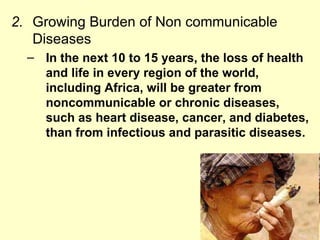
2. Growing Burden of Non communicable
   Diseases
  – In the next 10 to 15 years, the loss of health
    and life in every region of the world,
    including Africa, will be greater from
    noncommunicable or chronic diseases,
    such as heart disease, cancer, and diabetes,
    than from infectious and parasitic diseases.
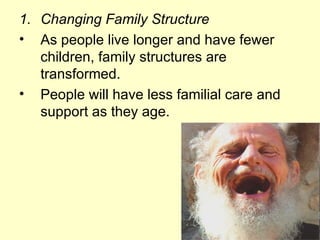
1. Changing Family Structure
• As people live longer and have fewer
   children, family structures are
   transformed.
• People will have less familial care and
   support as they age.
4. Financing for Health Care
• Increase health care expenditures
• On the average, Malaysian’s visit to the
   public and private primary care service
   sector is about 2.3 visits per year. The
   elderly made an average of 6 visits per
   year (Chin 1996)
National policy for older person in
               Malaysia

• Approved in October 1995
• Malaysia one of the earliest countries in the
  Asia Pacific region to have policy for older
  person.
The policy statement…

“To ensure the social status, dignity and
      well-being of older persons as
  members of family, society and nation
  by enabling them to optimize their self
       potential, have access to all
   opportunities and have provision for
           care and protection”
Objectives
• To establish and develop the dignity and
  respect for the elderly in the family,
  community and country.
• To develop the potential among the elderly
  to maintain their activeness and
  productivity in the process of developing
  the country.
• Encouraging to create facilities to ensure
  care and protection for the elderly towards
  a better living.
Strategies
• Respect and dignity
  – Enable older people to live with respect and self
    worth, safe and free from exploitation and abuse
  – Ensure older people are given fair and equal
    treatment irrespective of age, sex, ethnicity,
    religion, disability or their ability to contribute
  – Enable older people to optimize their potential
  – Enable older people to have access to
    educational, cultural, spiritual and recreational
    resources in society.
Strategies
• Self reliance
  – Able to fulfill their basic needs through income
    sources, family and societal support and self effort.
  – Have access to opportunities to continue to serve and
    contribute.
  – Enjoy an environment that is safe and conducive in
    accordance to their needs and changing capacities
  – Able to reside within their community without having to
    resort to institutional care
  – Able to make early preparation to plan their
    continuous contributions towards national
    development based on their expertise and capabilities.
Strategies
• Participation
  – Enable OP to play a role in society and be actively
    involved in the formulation and implementation of
    policies relating to their well-being and to pass on
    their knowledge and skills to younger generations
  – Provide opportunities to OP to voluntarily contribute to
    society in accordance with their abilities and interest
  – Encourage OP to establish associations and
    organizations that conduct activities for their own well-
    being.
Strategies
• Care and protection
  – Establish facilities for care and protection within the
    family and society in line with local socio-cultural
    systems
  – Enable OP to have access to health care to enable
    them to maintain or restore their optimum physical,
    mental and emotional health and prevention of
    ailment.
  – Access to services of institutions that provide care,
    protection and social and mental stimulation in a safe
    and comfortable environment
• Access to social and legal services
  towards advancement of their individual
  rights, protection and care
• Enjoy the basic rights of individuals while
  in care and under treatment by taking into
  consideration their self-respect, beliefs
  and needs
• Establish a comprehensive Social Security
  System to ensure the financial security
  and welfare of OP.
Research and development
• Encourage research on OP for the
  purposes of compiling information for use
  in planning programs for their
  development

• Establish a National Advisory and
  Consultative Council for OP to identify and
  coordinate the programs and activities for
  OP
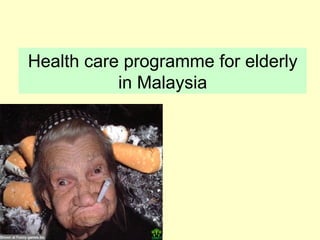
Health care programme for elderly
           in Malaysia
Health Care Program for the
             Elderly
• Introduced in 1995 - aimed at improving
  and maintaining the health and functional
  outcome of the elderly with the ultimate
  objective of promoting quality of life as
  well as forging productive ageing among
  the elderly.
• Specific objectives:
  – To improve the health of the elderly to enable
    them to lead and enjoy full and active life through
    promotive and preventive health care;
  – To establish Geriatric Specialist Services at the
    regional and state levels
  – To develop a comprehensive plan of action on
    training and research needs in the care of the
    elderly
  – To provide quality health care for the elderly
    using community-based approaches to enable
    them to live as independently as possible within
    the community
Strategies
1. Promotive and preventive health care
  •   information dissemination regarding the pathologies
      and disabilities related to age.
  •   Screening programs
2. Medical and rehabilitative care
  •   strengthening of care to the elderly at primary,
      secondary and tertiary level
  •   provide holistic specialized medical, psychological,
      social and rehabilitative geriatric services in selected
      hospitals using a multidisciplinary team approach.
  •   Private Hospital Act, 1971 and Private Hospital
      Regulations, 1973, will be enforced to ensure quality
      care to the elderly.
Strategies
1. Training and research
  •   to formulate and strengthen the existing curricula on
      care of the elderly for basic, post-basic and continuing
      medical education.
  •   Training in specialized areas relating to health care of
      the elderly is planned.
2. Program planning, monitoring, coordination and
   evaluation
  •   proper data collection in hospitals and health centers in
      order to obtain more accurate information about the
      elderly people.
  •   setting up a special Unit on Health Care for the Elderly
      in the Family Health Development Division of the
      Ministry of Health.
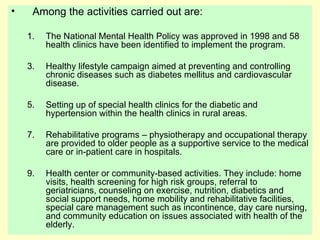
•    Among the activities carried out are:

    1.   The National Mental Health Policy was approved in 1998 and 58
         health clinics have been identified to implement the program.

    3.   Healthy lifestyle campaign aimed at preventing and controlling
         chronic diseases such as diabetes mellitus and cardiovascular
         disease.

    5.   Setting up of special health clinics for the diabetic and
         hypertension within the health clinics in rural areas.

    7.   Rehabilitative programs – physiotherapy and occupational therapy
         are provided to older people as a supportive service to the medical
         care or in-patient care in hospitals.

    9.   Health center or community-based activities. They include: home
         visits, health screening for high risk groups, referral to
         geriatricians, counseling on exercise, nutrition, diabetics and
         social support needs, home mobility and rehabilitative facilities,
         special care management such as incontinence, day care nursing,
         and community education on issues associated with health of the
         elderly.
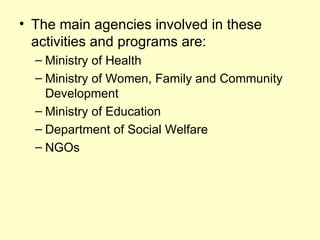
• The main agencies involved in these
  activities and programs are:
  – Ministry of Health
  – Ministry of Women, Family and Community
    Development
  – Ministry of Education
  – Department of Social Welfare
  – NGOs
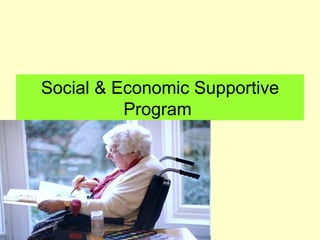
Social & Economic Supportive
          Program
SOCIAL WELFARE
            DEPARTMENT
• The care and protection for older persons
  through institutional service provides health
  care, guidance, counseling, recreation and
  religious teachings.
• Other programmes included:
  – Financial Assistance
  – Day Care Centre for Older Persons
  – Homes for Older Persons Without Next of Kin
  – Programs and activities undertaken by NGOs
  – National Celebration Day For Older Persons
Homes for the Older Persons
• The objective is to provide a proper care and
  protection for the needy elderly to ensure their
  security, treatment and getting better quality of
  life.
PROCESS OF ADMISSION:
• All application will be investigated and will be
  considered base on the following criteria:
   –   Needy elderly, aged 60 years and above
   –   Not suffering from contagious diseases
   –   Not having relatives or guardians
   –   No permanent shelter
   –   Able to look after him/herself
• The Old Persons’ Home provides various
  services or facilities as follow:
  – Care and protection
  – Counseling and Guidance
  – Occupational Therapy
  – Religious Facilities
  – Recreation
  – Medical Care
THE ROLE OF NGOs
• NGOs play a complementary role in helping
  the Government to meet the social needs of
  older persons
• Based on data from the Registrar of
  Societies, there were 30,907 NGOs
  registered in May 2000, of which 3,218
  were welfare related.
• The majority of NGOs provide institutional
  care and shelter for older persons in need.
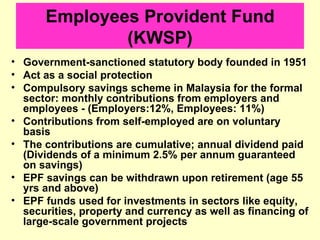
Employees Provident Fund
              (KWSP)
• Government-sanctioned statutory body founded in 1951
• Act as a social protection
• Compulsory savings scheme in Malaysia for the formal
  sector: monthly contributions from employers and
  employees - (Employers:12%, Employees: 11%)
• Contributions from self-employed are on voluntary
  basis
• The contributions are cumulative; annual dividend paid
  (Dividends of a minimum 2.5% per annum guaranteed
  on savings)
• EPF savings can be withdrawn upon retirement (age 55
  yrs and above)
• EPF funds used for investments in sectors like equity,
  securities, property and currency as well as financing of
  large-scale government projects
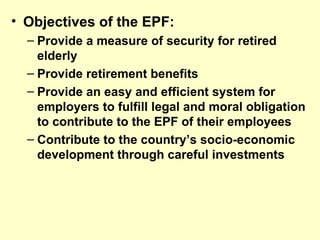
• Objectives of the EPF:
  – Provide a measure of security for retired
    elderly
  – Provide retirement benefits
  – Provide an easy and efficient system for
    employers to fulfill legal and moral obligation
    to contribute to the EPF of their employees
  – Contribute to the country’s socio-economic
    development through careful investments
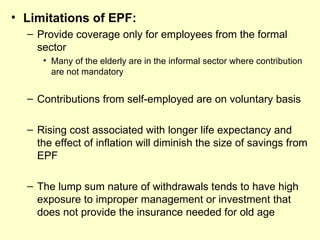
• Limitations of EPF:
  – Provide coverage only for employees from the formal
    sector
     • Many of the elderly are in the informal sector where contribution
       are not mandatory


  – Contributions from self-employed are on voluntary basis

  – Rising cost associated with longer life expectancy and
    the effect of inflation will diminish the size of savings from
    EPF

  – The lump sum nature of withdrawals tends to have high
    exposure to improper management or investment that
    does not provide the insurance needed for old age
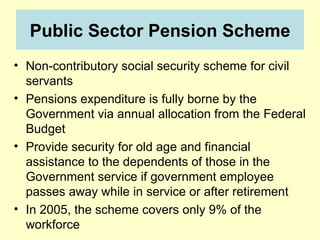
Public Sector Pension Scheme
• Non-contributory social security scheme for civil
  servants
• Pensions expenditure is fully borne by the
  Government via annual allocation from the Federal
  Budget
• Provide security for old age and financial
  assistance to the dependents of those in the
  Government service if government employee
  passes away while in service or after retirement
• In 2005, the scheme covers only 9% of the
  workforce
Recommendation to improve our
       current services
1. Census-type information will have to be
   gathered to facilitate the formulation and
   implementation of policies and programs.
2. Continuous monitoring of activities as guided by
   the National Policy for the Elderly
3. Training of manpower in the health sector
4. Education and retraining for the elderly
  •   Education to prepare the elderly to face the
      challenges of ageing can be introduced as a pre-
      retirement course. Retraining should be introduced to
      promote productive ageing.
Programs for older person in other
           countries
Programs for older person in other
   countries – Mississippi, USA
Division of Aging and Adult Services
Programs:
  – Senior transportation programs
     • Continued independence of older adults in the state is
       facilitated by transportation services offered in their
       communities.
     • Senior transportation programs make it possible for
       individuals who do not drive and cannot use public
       transportation to obtain rides for essential trips, such
       as medical appointments.
     • Nearly 300 vehicles (from vans to mini-buses) provide
       transportation service to older riders
– Elderly Nutrition Program (ENP)
   • The ENP provides funding for two senior nutrition programs:
     congregate meals and home-delivered meals.
   • Congregate meals
       – They are offered at social and community centers such as senior
         centers, and churches
       – provide seniors with social interaction and stimulation, and the
         chance to get involved in the community.
   • Home-delivered meals
       – meals are delivered to homebound seniors who are unable to travel
         to a congregate meal site.
       – during a meal delivery the volunteers are able to monitor the health
         of the homebound seniors and make sure that they are getting the
         help they need.
   • Both of these services are offered to seniors at no cost.
   • The meals must provide recipients with at least one third of their
     daily recommended dietary allowances, and are cooked to take
     into account special senior nutrition considerations (such as low-
     fat, low-sodium diets).
   • ENP volunteers also provide nutrition screening, nutrition
     education, and meal-planning counseling.
– Legal services programs
  • Legal advice, consultation or representation, legal
    assistance may be obtained from lawyers or
    paralegals who have agreed to provide services to
    the state's elderly
  • Many of the services are available without charge or
    reduced fees for referred elderly clients.
– Senior Community Service Employment
  Program (SCSEP)
  • The program identifies employment opportunities for
    older persons whose incomes place them at or below
    the federal poverty level; who are unemployed or
    underemployed; or who have difficulty finding a job.
  • Adults in the program generally work an average of
    20 hours a week, receiving at least minimum wage.
– The Homemaker program
  • The program gives older citizens the option of having
    homemakers perform the housekeeping tasks they can
    no longer do or need assistance in doing.
  • Homemakers perform routine household tasks such as
    cooking, cleaning, grocery shopping, laundry,
    consumer education, bathing, dressing, safety
    education and oral hygiene assistance.
  • This service is provided at no cost to the older person
– Adult Day Care
  • Adult day care centers specialize in supervised care
    for functionally impaired elderly adults.
  • Their programs focus on health maintenance,
    prevention/intervention and rehabilitation needs of
    older adults capable of only limited self-care.
Geriatric health

Geriatric health

  • 1.
    Geriatric Health Dr NikNor Ronaidi bin Nik Mahdi
  • 2.
    Outlines • Definition • Demographicchanges • Common health (including sexual health), social & economic problems/ implications • National policy for older person • Health care programme for elderly in Malaysia (objective, strategies, medical, health & institutional care, agencies involved) • Social & economic supportive program • Programs for older person in other countries
  • 3.
  • 4.
    Definition • Geriatrics  Abranch of medicine that deals with the problems of aging and the diseases of the elderly • Gerontology  A branch of study that look into the social aspect of ageing including its related policy
  • 5.
    • What isageing?  A progressive state beginning from conception and ending with death. Associated with it are certain physical, social and psychological changes.
  • 6.
    • Terminology – Elderly – The aged – Older people – Senior citizen – ‘Wargatua’ – ‘Orang tua’ – ‘Warga emas’
  • 7.
    • Elderly: - WHOdefines old age as those who are ≥60 years ( developing countries) or ≥65 years (developed countries).
  • 8.
  • 9.
    Why older people? Ageingpopulation: Global phenomenon A phenomenon occurring both in developed and developing countries Challenge of increase longevity but compressed morbidity  Major sources of population ageing include: • declining fertility and mortality rate • improved health and life expectancy
  • 10.
    Ageing population • Today,there are 600 million people in the world aged 60 years and over. • This figure is expected to double by 2025 and to reach 2 billion by 2050. • Population ageing is characteristically accompanied by an increase in the burden of chronic noncommunicable diseases (NCDs) such as cardiovascular diseases, diabetes, Alzheimer's disease and other ageing-associated mental health conditions, cancers, chronic obstructive pulmonary disease and musculoskeletal problems.
  • 14.
  • 15.
    Source: Department ofstatistics, Malaysia (2003)
  • 17.
    Piramid Kependudukan Malaysia Tahun 2000 Dan 2050 Malaysia Population 2050 (Medium Variant) Malaysia Population 2000 100+ 100+ 90-94 90-94 80-84 80-84 70-74 70-74 60-64 60-64 Age Group Age Group 50-54 50-54 40-44 40-44 30-34 30-34 20-24 20-24 10-14 10-14 0-4 0-4 1500 1000 500 0 500 1000 1500 1500 1000 500 0 500 1000 1500 Number (Thousands) Number (Thousands) Male Female Male Female
  • 18.
    Total Fertility Rateby ethnic group, Malaysia, 1991-1998 Source: Vital Statistics Time Series, Malaysia, 1963-1998 Year Total Malay Chinese Indian 1991 3.4 4.2 2.5 2.8 1992 3.5 4.2 2.5 2.8 1993 3.5 4.1 2.6 2.8 1994 3.4 4.0 2.6 2.7 1995 3.4 3.9 2.5 2.7 1996 3.3 3.9 2.6 2.7 1997 3.3 3.8 2.5 2.7 1998 3.1 3.7 2.2 2.6
  • 19.
    Life Expectancy atbirth, Peninsular Malaysia,1966-1995 Source: Vital statistics time series, 1963-1998 Year Male Female 1966 63.1 66.0 1970 61.6 65.6 1975 64.3 68.7 1980 66.4 70.5 1985 67.7 72.4 1990 68.9 73.5 1995 69.1 74.4 2004 72 76
  • 21.
  • 22.
    Illness and OlderPeople • Growing old is a life long process – Does not occur suddenly • Involves physiological, psychological changes and physical changes • Involves senses and all the systems – Skin – less elastic and wrinkles – Eyes, hearing, taste, smell – less sensitive – Physical – loss height, stooping walk
  • 23.
    Bones – brittle and prone to fracture • Muscle – loss bulk • Immune function - compromised • Nutrition - malnutrition and under nutrition are common
  • 24.
    • Sexuality – Studies show that 74% of married men and 56% of married women over 60 years of age remain sexually active. (Diokno AC et al) – Common problems : arthritis, diabetes, fatigue, fear of precipitating a MI and side effects from prescription drugs • Brain function – cognitive decline and depression.
  • 25.
    GIANTS OF GERIATRIC(Bernard Isaacs, 1975) • Bernard Isaacs described the "giants" of geriatrics: incontinence, immobility, impaired cognitive function and instability. • He asserted that if we look closely enough, all common problems with older people relate back to one of these giants. • The GIANTS are disabilities that lower the quality of living. • In common: multiple causes, chronic nature, reduced independence, no simple cure. • The ‘final pathway’ that affect elderly with diminished ability to recover, make them DEPENDANT on others.
  • 26.
    1. Incontinence - Urinary & Fecal 2. Instability/Immobility - Risk of fall & Osteoporotic fracture 3. Impaired cognitive function - Dementia/depression
  • 27.
    •A study bythe Public Health Institute, Malaysia in 1995 showed:- - 81.4% suffered from at least from one chronic medical illness. - 12.7% had 3 or more chronic diseases. •The commonest medical illness:- - joint paint 50.1% - eyesight problem 40% - hearing problem 21% - hypertension 26% - heart diseases 16.3% - diabetes 11.6%
  • 28.
    Socio- economic implications 1.Social security • In Malaysia, the social security covers only employees in the formal sector. • Pension scheme for civil servants while the EPF for private sector employees. • Only 61.8% of total employed persons covered by these two schemes leaving the remaining 38.2 per cent without known source of coverage. (Labor Force Survey Report, 1998)
  • 29.
    2. Growing Burdenof Non communicable Diseases – In the next 10 to 15 years, the loss of health and life in every region of the world, including Africa, will be greater from noncommunicable or chronic diseases, such as heart disease, cancer, and diabetes, than from infectious and parasitic diseases.
  • 31.
    1. Changing FamilyStructure • As people live longer and have fewer children, family structures are transformed. • People will have less familial care and support as they age.
  • 32.
    4. Financing forHealth Care • Increase health care expenditures • On the average, Malaysian’s visit to the public and private primary care service sector is about 2.3 visits per year. The elderly made an average of 6 visits per year (Chin 1996)
  • 33.
    National policy forolder person in Malaysia • Approved in October 1995 • Malaysia one of the earliest countries in the Asia Pacific region to have policy for older person.
  • 34.
    The policy statement… “Toensure the social status, dignity and well-being of older persons as members of family, society and nation by enabling them to optimize their self potential, have access to all opportunities and have provision for care and protection”
  • 35.
    Objectives • To establishand develop the dignity and respect for the elderly in the family, community and country. • To develop the potential among the elderly to maintain their activeness and productivity in the process of developing the country. • Encouraging to create facilities to ensure care and protection for the elderly towards a better living.
  • 36.
    Strategies • Respect anddignity – Enable older people to live with respect and self worth, safe and free from exploitation and abuse – Ensure older people are given fair and equal treatment irrespective of age, sex, ethnicity, religion, disability or their ability to contribute – Enable older people to optimize their potential – Enable older people to have access to educational, cultural, spiritual and recreational resources in society.
  • 37.
    Strategies • Self reliance – Able to fulfill their basic needs through income sources, family and societal support and self effort. – Have access to opportunities to continue to serve and contribute. – Enjoy an environment that is safe and conducive in accordance to their needs and changing capacities – Able to reside within their community without having to resort to institutional care – Able to make early preparation to plan their continuous contributions towards national development based on their expertise and capabilities.
  • 38.
    Strategies • Participation – Enable OP to play a role in society and be actively involved in the formulation and implementation of policies relating to their well-being and to pass on their knowledge and skills to younger generations – Provide opportunities to OP to voluntarily contribute to society in accordance with their abilities and interest – Encourage OP to establish associations and organizations that conduct activities for their own well- being.
  • 39.
    Strategies • Care andprotection – Establish facilities for care and protection within the family and society in line with local socio-cultural systems – Enable OP to have access to health care to enable them to maintain or restore their optimum physical, mental and emotional health and prevention of ailment. – Access to services of institutions that provide care, protection and social and mental stimulation in a safe and comfortable environment
  • 40.
    • Access tosocial and legal services towards advancement of their individual rights, protection and care • Enjoy the basic rights of individuals while in care and under treatment by taking into consideration their self-respect, beliefs and needs • Establish a comprehensive Social Security System to ensure the financial security and welfare of OP.
  • 41.
    Research and development •Encourage research on OP for the purposes of compiling information for use in planning programs for their development • Establish a National Advisory and Consultative Council for OP to identify and coordinate the programs and activities for OP
  • 42.
    Health care programmefor elderly in Malaysia
  • 43.
    Health Care Programfor the Elderly • Introduced in 1995 - aimed at improving and maintaining the health and functional outcome of the elderly with the ultimate objective of promoting quality of life as well as forging productive ageing among the elderly.
  • 44.
    • Specific objectives: – To improve the health of the elderly to enable them to lead and enjoy full and active life through promotive and preventive health care; – To establish Geriatric Specialist Services at the regional and state levels – To develop a comprehensive plan of action on training and research needs in the care of the elderly – To provide quality health care for the elderly using community-based approaches to enable them to live as independently as possible within the community
  • 45.
    Strategies 1. Promotive andpreventive health care • information dissemination regarding the pathologies and disabilities related to age. • Screening programs 2. Medical and rehabilitative care • strengthening of care to the elderly at primary, secondary and tertiary level • provide holistic specialized medical, psychological, social and rehabilitative geriatric services in selected hospitals using a multidisciplinary team approach. • Private Hospital Act, 1971 and Private Hospital Regulations, 1973, will be enforced to ensure quality care to the elderly.
  • 46.
    Strategies 1. Training andresearch • to formulate and strengthen the existing curricula on care of the elderly for basic, post-basic and continuing medical education. • Training in specialized areas relating to health care of the elderly is planned. 2. Program planning, monitoring, coordination and evaluation • proper data collection in hospitals and health centers in order to obtain more accurate information about the elderly people. • setting up a special Unit on Health Care for the Elderly in the Family Health Development Division of the Ministry of Health.
  • 48.
    Among the activities carried out are: 1. The National Mental Health Policy was approved in 1998 and 58 health clinics have been identified to implement the program. 3. Healthy lifestyle campaign aimed at preventing and controlling chronic diseases such as diabetes mellitus and cardiovascular disease. 5. Setting up of special health clinics for the diabetic and hypertension within the health clinics in rural areas. 7. Rehabilitative programs – physiotherapy and occupational therapy are provided to older people as a supportive service to the medical care or in-patient care in hospitals. 9. Health center or community-based activities. They include: home visits, health screening for high risk groups, referral to geriatricians, counseling on exercise, nutrition, diabetics and social support needs, home mobility and rehabilitative facilities, special care management such as incontinence, day care nursing, and community education on issues associated with health of the elderly.
  • 49.
    • The mainagencies involved in these activities and programs are: – Ministry of Health – Ministry of Women, Family and Community Development – Ministry of Education – Department of Social Welfare – NGOs
  • 50.
    Social & EconomicSupportive Program
  • 51.
    SOCIAL WELFARE DEPARTMENT • The care and protection for older persons through institutional service provides health care, guidance, counseling, recreation and religious teachings. • Other programmes included: – Financial Assistance – Day Care Centre for Older Persons – Homes for Older Persons Without Next of Kin – Programs and activities undertaken by NGOs – National Celebration Day For Older Persons
  • 52.
    Homes for theOlder Persons • The objective is to provide a proper care and protection for the needy elderly to ensure their security, treatment and getting better quality of life. PROCESS OF ADMISSION: • All application will be investigated and will be considered base on the following criteria: – Needy elderly, aged 60 years and above – Not suffering from contagious diseases – Not having relatives or guardians – No permanent shelter – Able to look after him/herself
  • 53.
    • The OldPersons’ Home provides various services or facilities as follow: – Care and protection – Counseling and Guidance – Occupational Therapy – Religious Facilities – Recreation – Medical Care
  • 54.
    THE ROLE OFNGOs • NGOs play a complementary role in helping the Government to meet the social needs of older persons • Based on data from the Registrar of Societies, there were 30,907 NGOs registered in May 2000, of which 3,218 were welfare related. • The majority of NGOs provide institutional care and shelter for older persons in need.
  • 55.
    Employees Provident Fund (KWSP) • Government-sanctioned statutory body founded in 1951 • Act as a social protection • Compulsory savings scheme in Malaysia for the formal sector: monthly contributions from employers and employees - (Employers:12%, Employees: 11%) • Contributions from self-employed are on voluntary basis • The contributions are cumulative; annual dividend paid (Dividends of a minimum 2.5% per annum guaranteed on savings) • EPF savings can be withdrawn upon retirement (age 55 yrs and above) • EPF funds used for investments in sectors like equity, securities, property and currency as well as financing of large-scale government projects
  • 56.
    • Objectives ofthe EPF: – Provide a measure of security for retired elderly – Provide retirement benefits – Provide an easy and efficient system for employers to fulfill legal and moral obligation to contribute to the EPF of their employees – Contribute to the country’s socio-economic development through careful investments
  • 57.
    • Limitations ofEPF: – Provide coverage only for employees from the formal sector • Many of the elderly are in the informal sector where contribution are not mandatory – Contributions from self-employed are on voluntary basis – Rising cost associated with longer life expectancy and the effect of inflation will diminish the size of savings from EPF – The lump sum nature of withdrawals tends to have high exposure to improper management or investment that does not provide the insurance needed for old age
  • 58.
    Public Sector PensionScheme • Non-contributory social security scheme for civil servants • Pensions expenditure is fully borne by the Government via annual allocation from the Federal Budget • Provide security for old age and financial assistance to the dependents of those in the Government service if government employee passes away while in service or after retirement • In 2005, the scheme covers only 9% of the workforce
  • 59.
    Recommendation to improveour current services 1. Census-type information will have to be gathered to facilitate the formulation and implementation of policies and programs. 2. Continuous monitoring of activities as guided by the National Policy for the Elderly 3. Training of manpower in the health sector 4. Education and retraining for the elderly • Education to prepare the elderly to face the challenges of ageing can be introduced as a pre- retirement course. Retraining should be introduced to promote productive ageing.
  • 60.
    Programs for olderperson in other countries
  • 61.
    Programs for olderperson in other countries – Mississippi, USA Division of Aging and Adult Services Programs: – Senior transportation programs • Continued independence of older adults in the state is facilitated by transportation services offered in their communities. • Senior transportation programs make it possible for individuals who do not drive and cannot use public transportation to obtain rides for essential trips, such as medical appointments. • Nearly 300 vehicles (from vans to mini-buses) provide transportation service to older riders
  • 62.
    – Elderly NutritionProgram (ENP) • The ENP provides funding for two senior nutrition programs: congregate meals and home-delivered meals. • Congregate meals – They are offered at social and community centers such as senior centers, and churches – provide seniors with social interaction and stimulation, and the chance to get involved in the community. • Home-delivered meals – meals are delivered to homebound seniors who are unable to travel to a congregate meal site. – during a meal delivery the volunteers are able to monitor the health of the homebound seniors and make sure that they are getting the help they need. • Both of these services are offered to seniors at no cost. • The meals must provide recipients with at least one third of their daily recommended dietary allowances, and are cooked to take into account special senior nutrition considerations (such as low- fat, low-sodium diets). • ENP volunteers also provide nutrition screening, nutrition education, and meal-planning counseling.
  • 63.
    – Legal servicesprograms • Legal advice, consultation or representation, legal assistance may be obtained from lawyers or paralegals who have agreed to provide services to the state's elderly • Many of the services are available without charge or reduced fees for referred elderly clients. – Senior Community Service Employment Program (SCSEP) • The program identifies employment opportunities for older persons whose incomes place them at or below the federal poverty level; who are unemployed or underemployed; or who have difficulty finding a job. • Adults in the program generally work an average of 20 hours a week, receiving at least minimum wage.
  • 64.
    – The Homemakerprogram • The program gives older citizens the option of having homemakers perform the housekeeping tasks they can no longer do or need assistance in doing. • Homemakers perform routine household tasks such as cooking, cleaning, grocery shopping, laundry, consumer education, bathing, dressing, safety education and oral hygiene assistance. • This service is provided at no cost to the older person – Adult Day Care • Adult day care centers specialize in supervised care for functionally impaired elderly adults. • Their programs focus on health maintenance, prevention/intervention and rehabilitation needs of older adults capable of only limited self-care.