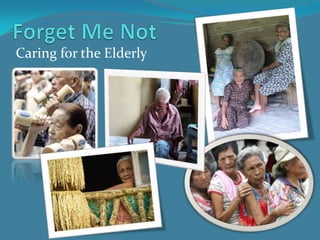
Caring for the Elderly
…..generally begins at the age of
                            60


People in this age group are called…

 …..Senior Citizens
According to the World Health Organization….
                                     ….there are almost
                    700 million people over the age 60
                              living in the world today.

                           …among those 13% are over
                                        80 years old.

                          …it is expected that by 2050
                            this number will be almost
                                          2 billion and
                         the number of elderly will be
                   higher than the number of children
In the Philippines….
                                         According to the
                                 National Statistics Office,
                      the total number of Senior Citizens
        (60 years old and above) is 4,565,560 as of 2009


 ….this number comprises 5.97% of the total Philippine
 population.
More Statistics…
           At this time elderly population is growing by
                                     800,0000 a month
Did you know that…
China has the most number of elderly in the world…
                      …..about 88 million
What are the Elderly Like?
Physical
visual and hearing problems
smell and taste losses
susceptibility to illnesses

                          Leading Cause of
                               Death

    heart diseases
                                  pneumonia
                     cancer
What are the Elderly Like?
Cognitive
decline in mental processes – may
 experience memory lapses or
 disorientation.

                Spotlight on:
              ALZHEIMER’s Disease
…is a progressive irreversible brain disorder that is
characterized by gradual deterioration of memory,
reasoning, language and physical functioning.

..WHO reports as of 2009 that almost 35 million elderly
suffers from this kind of disease.
What are the Elderly Like?


                  Spotlight on:
                ALZHEIMER’s Disease
 … this disease has no cure and the cause is unknown, as
 such people do not know how to prevent it although some
 doctors reported that it could be alleviated with some form
 of diet and memory training games.

 Alzheimer’s is a sad disease – the elderly cannot
 remember the people and place in their lives. They need
 consistent care because they could walk away or get lost
 …
What are the Elderly Like?
Social
because of their declining health and limited
mobility, most elderly have the tendency to
withdraw from the society – spending most of
their time looking back – reflecting on what they
have made out of their lives.

             Social Theories of Aging
    Disengagement Theory
    Activity Theory
    Social breakdown Reconstruction Theory
What are the Elderly Like?


             Social Theories of Aging
   Disengagement Theory – as older adults slow
   down, they gradually withdraw from the society.

   Disengagement is a mutual activity in which the
   elderly not only disengaged in the society, but the
   society disengages from the older adult.

   The elderly develops greater self-preoccupation
   and decrease emotional ties with people and
   reduced interest in social activities. Such social
   withdrawal and increased self-absorption was
   thought to increase life satisfaction among them.
What are the Elderly Like?

                Social Theories of Aging
  Activity Theory– as opposed to the disengagement
  theory, this theory argues that the more active and
  involved the elderly are, the more likely that they are
  satisfied with their lives.

  It is therefore important to find substitute activities for
  them after their retirement.
What are the Elderly Like?

  Social Theories of Aging
  Social Breakdown -Reconstruction
    Theory

  This theory states that aging is promoted through
  negative psychological functioning brought about by
  the negative views of the society about elderly and
  inadequate provision of services for them.

  Social reconstruction can occur by changing the
  society’s view of the elderly and by providing
  adequate social services for them.
What are the Elderly Like?
  Society views elderly as          Society develops label for the
  incompetent; obsolete          elderly: useless; ineffective; helpless


    Society provides inadequate support services, and funds
                         for the elderly.


                   Elderly’s skills deteriorate


                     Elderly labels self as
                        incompetent
What are the Elderly Like?
                                   Society develops positive label for
   Society views elderly as       the elderly: helpers; self-controlled;
   competent; important                     wise; competent


      Society provides support systems for the elderly: family
      support; housing; health services; economics; nutrition
                        and social services.


                    Elderly’s skills improve


                     Elderly labels self as
                         competent
Issues Facing the Elderly

    ABUSE

•It can happen in the family
•It can happen in nursing homes
•It could be physical or psychological (like verbal
abuse) – when they are named called or threatened,
or taken advantage because of their memory
problems.

•One form is NEGLECT! When people who are
suppose to care for them ignore their needs and
concerns
Issues Facing the Elderly
    ABUSE


  “Having someone else look
  after aging parents is a
  tough decision to make, and
  is made even tougher by
  fact that one of four nursing
  homes has been blamed for
  the death or serious injury
  to a resident each year,
  according to government
  figures.”
Issues Facing the Elderly
     LONELINESS
•Death of a husband or wife and many friends.
•
•Children are busy with work and may not even come
  to visit them. Grandchildren are busy with school.

•Physically weak elderly may feel that they are
burden so they try to stay away even if people are
around.

•Loneliness leads to depression – they feel alone and
unproductive.
Issues Facing the Elderly
      POVERTY


•They cannot earn anymore and they do not have
money.

•May receive retirement pension but may not also be
enough because of their increasing medical needs.

•As such many even try to continue working even
after reaching the retirement age.
Issues Facing the Elderly
       HEALTH

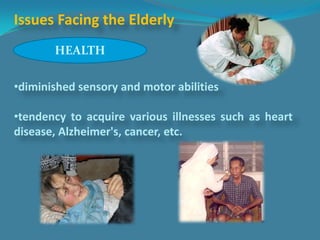
•diminished sensory and motor abilities

•tendency to acquire various illnesses such as heart
disease, Alzheimer's, cancer, etc.
Issues Facing the Elderly
      DISCRIMINATION

•Job discrimination – employers
 prefer younger applicants because

….inexperienced workers have cheaper salaries

…employers believe that the elders could only stay in
work for a short time because of their declining
physical condition

….elderly are thought of as slower and less capable.
Issues Facing the Elderly
       DISCRIMINATION


•Social discrimination – maybe excluded from family
or community services because they are seen as
incapable.

Medical Discrimination - Some doctors treat them
without much care because they think they don’t
deserve such because they are already old.

Caring for the Elderly

  • 1.
  • 2.
    …..generally begins atthe age of 60 People in this age group are called… …..Senior Citizens
  • 3.
    According to theWorld Health Organization…. ….there are almost 700 million people over the age 60 living in the world today. …among those 13% are over 80 years old. …it is expected that by 2050 this number will be almost 2 billion and the number of elderly will be higher than the number of children
  • 4.
    In the Philippines…. According to the National Statistics Office, the total number of Senior Citizens (60 years old and above) is 4,565,560 as of 2009 ….this number comprises 5.97% of the total Philippine population.
  • 5.
    More Statistics… At this time elderly population is growing by 800,0000 a month Did you know that… China has the most number of elderly in the world… …..about 88 million
  • 6.
    What are theElderly Like? Physical visual and hearing problems smell and taste losses susceptibility to illnesses Leading Cause of Death heart diseases pneumonia cancer
  • 7.
    What are theElderly Like? Cognitive decline in mental processes – may experience memory lapses or disorientation. Spotlight on: ALZHEIMER’s Disease …is a progressive irreversible brain disorder that is characterized by gradual deterioration of memory, reasoning, language and physical functioning. ..WHO reports as of 2009 that almost 35 million elderly suffers from this kind of disease.
  • 8.
    What are theElderly Like? Spotlight on: ALZHEIMER’s Disease … this disease has no cure and the cause is unknown, as such people do not know how to prevent it although some doctors reported that it could be alleviated with some form of diet and memory training games. Alzheimer’s is a sad disease – the elderly cannot remember the people and place in their lives. They need consistent care because they could walk away or get lost …
  • 9.
    What are theElderly Like? Social because of their declining health and limited mobility, most elderly have the tendency to withdraw from the society – spending most of their time looking back – reflecting on what they have made out of their lives. Social Theories of Aging Disengagement Theory Activity Theory Social breakdown Reconstruction Theory
  • 10.
    What are theElderly Like? Social Theories of Aging Disengagement Theory – as older adults slow down, they gradually withdraw from the society. Disengagement is a mutual activity in which the elderly not only disengaged in the society, but the society disengages from the older adult. The elderly develops greater self-preoccupation and decrease emotional ties with people and reduced interest in social activities. Such social withdrawal and increased self-absorption was thought to increase life satisfaction among them.
  • 11.
    What are theElderly Like? Social Theories of Aging Activity Theory– as opposed to the disengagement theory, this theory argues that the more active and involved the elderly are, the more likely that they are satisfied with their lives. It is therefore important to find substitute activities for them after their retirement.
  • 12.
    What are theElderly Like? Social Theories of Aging Social Breakdown -Reconstruction Theory This theory states that aging is promoted through negative psychological functioning brought about by the negative views of the society about elderly and inadequate provision of services for them. Social reconstruction can occur by changing the society’s view of the elderly and by providing adequate social services for them.
  • 13.
    What are theElderly Like? Society views elderly as Society develops label for the incompetent; obsolete elderly: useless; ineffective; helpless Society provides inadequate support services, and funds for the elderly. Elderly’s skills deteriorate Elderly labels self as incompetent
  • 14.
    What are theElderly Like? Society develops positive label for Society views elderly as the elderly: helpers; self-controlled; competent; important wise; competent Society provides support systems for the elderly: family support; housing; health services; economics; nutrition and social services. Elderly’s skills improve Elderly labels self as competent
  • 15.
    Issues Facing theElderly ABUSE •It can happen in the family •It can happen in nursing homes •It could be physical or psychological (like verbal abuse) – when they are named called or threatened, or taken advantage because of their memory problems. •One form is NEGLECT! When people who are suppose to care for them ignore their needs and concerns
  • 16.
    Issues Facing theElderly ABUSE “Having someone else look after aging parents is a tough decision to make, and is made even tougher by fact that one of four nursing homes has been blamed for the death or serious injury to a resident each year, according to government figures.”
  • 17.
    Issues Facing theElderly LONELINESS •Death of a husband or wife and many friends. • •Children are busy with work and may not even come to visit them. Grandchildren are busy with school. •Physically weak elderly may feel that they are burden so they try to stay away even if people are around. •Loneliness leads to depression – they feel alone and unproductive.
  • 18.
    Issues Facing theElderly POVERTY •They cannot earn anymore and they do not have money. •May receive retirement pension but may not also be enough because of their increasing medical needs. •As such many even try to continue working even after reaching the retirement age.
  • 19.
    Issues Facing theElderly HEALTH •diminished sensory and motor abilities •tendency to acquire various illnesses such as heart disease, Alzheimer's, cancer, etc.
  • 20.
    Issues Facing theElderly DISCRIMINATION •Job discrimination – employers prefer younger applicants because ….inexperienced workers have cheaper salaries …employers believe that the elders could only stay in work for a short time because of their declining physical condition ….elderly are thought of as slower and less capable.
  • 21.
    Issues Facing theElderly DISCRIMINATION •Social discrimination – maybe excluded from family or community services because they are seen as incapable. Medical Discrimination - Some doctors treat them without much care because they think they don’t deserve such because they are already old.