Postural Instability
and Falls in the
Aging Population
Heather Smith, SPTA
LaGuardia Community College
Spring 2016
Overview
• Definitions
• Prevalence and cost of falls
• Summary of risk factors for falls
• Defining postural instability
• Relationship between postural instability and falls
• Resources required for postural stability
• Cognition and postural stability
• Evaluation and assessment
• Evidence-based interventions
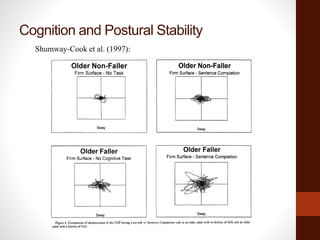
• Conclusion
• References
Definitions
• FALL
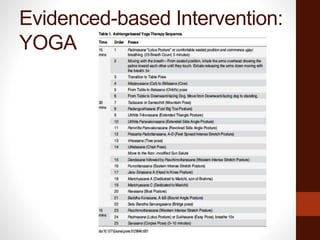
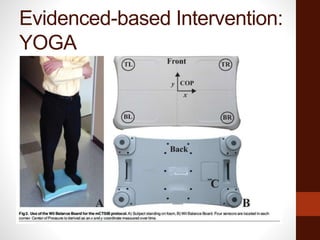
• Variations in definitions among medical professionals.
• The Prevention of Falls Network Europe (ProFANE) defined a fall
as “an unexpected event in which the participant comes to rest
on the ground, floor, or lower back.”
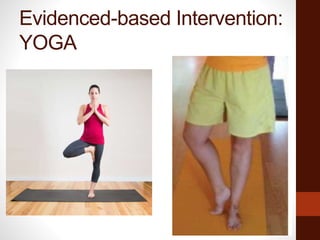
• Similar definitions were later put forward by the Kellogg
International Working Group and the Frailty and Injuries Cooperative
Studies of Intervention Techniques.
Definitions
• AGING
• 65+ years old.
• Roughly one-third of community dwelling adults older than 65
fall each year.
• 40% of elderly patients in hospitals, STR, SNF
• Rate of falls for adults 85 and older is nearly 4 times higher than
for individuals between 65 and 84 years old.
• Why?
• Increased Risk Factors
• Increased reporting of falls.
Prevalence and Cost of Falls
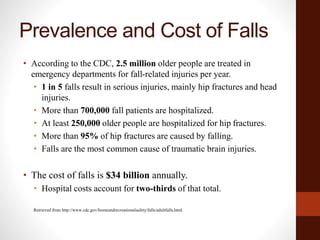
• According to the CDC, 2.5 million older people are treated in
emergency departments for fall-related injuries per year.
• 1 in 5 falls result in serious injuries, mainly hip fractures and head
injuries.
• More than 700,000 fall patients are hospitalized.
• At least 250,000 older people are hospitalized for hip fractures.
• More than 95% of hip fractures are caused by falling.
• Falls are the most common cause of traumatic brain injuries.
• The cost of falls is $34 billion annually.
• Hospital costs account for two-thirds of that total.
Retrieved from http://www.cdc.gov/homeandrecreationalsafety/falls/adultfalls.html
Summary of Fall-Risk Factors
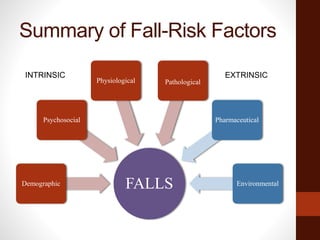
FALLSDemographic
Psychosocial
Physiological Pathological
Pharmaceutical
Environmental
INTRINSIC EXTRINSIC
Extrinsic Fall-Risk Factors
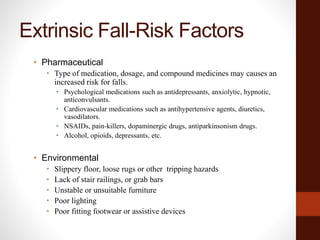
• Pharmaceutical
• Type of medication, dosage, and compound medicines may causes an
increased risk for falls.
• Psychological medications such as antidepressants, anxiolytic, hypnotic,
anticonvulsants.
• Cardiovascular medications such as antihypertensive agents, diuretics,
vasodilators.
• NSAIDs, pain-killers, dopaminergic drugs, antiparkinsonism drugs.
• Alcohol, opioids, depressants, etc.
• Environmental
• Slippery floor, loose rugs or other tripping hazards
• Lack of stair railings, or grab bars
• Unstable or unsuitable furniture
• Poor lighting
• Poor fitting footwear or assistive devices
Intrinsic Fall-Risk Factors
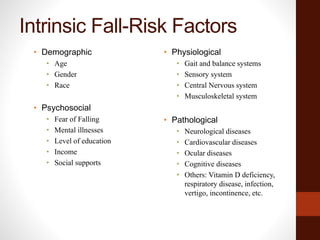
• Demographic
• Age
• Gender
• Race
• Psychosocial
• Fear of Falling
• Mental illnesses
• Level of education
• Income
• Social supports
• Physiological
• Gait and balance systems
• Sensory system
• Central Nervous system
• Musculoskeletal system
• Pathological
• Neurological diseases
• Cardiovascular diseases
• Ocular diseases
• Cognitive diseases
• Others: Vitamin D deficiency,
respiratory disease, infection,
vertigo, incontinence, etc.
What is Postural Stability?
• Postural stability is “a complex skill based on the interaction
of dynamic sensorimotor processes”
• No longer considered a function of “balance centers” in the brain
or a summation of static reflexes.
• If this was the case, it would be much easier to evaluate and treat.
• One single balance test cannot fully evaluate postural stability and
one single balance intervention cannot improve balance.
• Two main functional goals of postural behavior:
1. Postural orientation
2. Postural equilibrium
Postural Orientation and Equilibrium
• Postural orientation involves the active alignment of the trunk and
head.
• Factors in gravity, support surfaces, and the integration of
somatosensory, vestibular, and visual systems.
• Each of these inputs are “weighted” based on the goals of the
movement task within the specific environmental context.
• “up-weighting” and “down-weighting”
• Postural equilibrium involves the coordination of various
movement response strategies to stabilize the center of mass during
displacement.
• The specific strategy chosen depends on the type of displacement, as
well as the individual’s goals, expectations, and prior experiences.
• Anticipatory postural adjustments serve to maintain postural stability
by compensating for potential displacing forces.
Postural Instability and Falls
• Postural instability can develop from pathologies within any
of the multiple physiological mechanisms underlying posture.
• Damage within any of these mechanisms increases risk of falls
due to a variety of resulting deficits.
• The probability of developing specific pathologies and
impairments related to postural instability is unique to each
individual.
• The increase of fall risk with age is thus not a natural function
of aging as much as the result of an increased likelihood of
impairment within the postural system.
Resources Required for Postural Stability
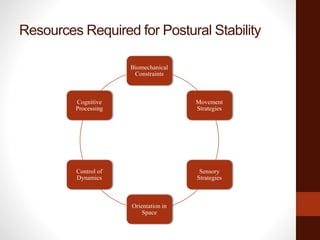
Biomechanical
Constraints
Movement
Strategies
Sensory
Strategies
Orientation in
Space
Control of
Dynamics
Cognitive
Processing
Resources Required for Postural Stability
• Biomechanical constraints:
• The size and quality of the base of support (the feet).
• Any limitations in size, strength, ROM, pain, sensation, or control of
the feet will affect balance.
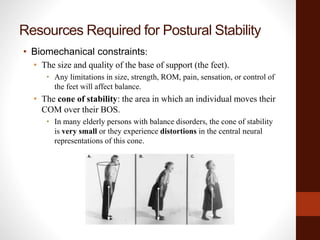
• The cone of stability: the area in which an individual moves their
COM over their BOS.
• In many elderly persons with balance disorders, the cone of stability
is very small or they experience distortions in the central neural
representations of this cone.
Resources Required for Postural Stability
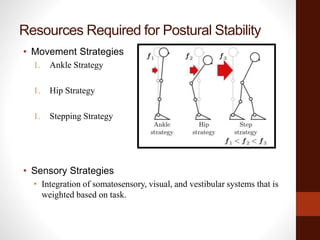
• Movement Strategies
1. Ankle Strategy
1. Hip Strategy
1. Stepping Strategy
• Sensory Strategies
• Integration of somatosensory, visual, and vestibular systems that is
weighted based on task.
Resources Required for Postural Stability
• Orientation in Space
• The ability to orient the body with respect to gravity, the support
surface, visual surround and internal references.
• Control of Dynamics
• Complex control of the body’s COM while changing from one
position to another.
• Cognitive Processing
• Postural control requires many executive cognitive resources.
• Reaction times and performance in cognitive tasks generally
decrease as the difficulty of the postural task increases.
Cognition and Postural Stability
• Research documents age-related changes in peripheral sensory
structures across all 3 postural systems.
• When postural tasks are done concurrently with another task
(dual-task), early research suggested that postural control is
given priority in young adults, but shifts with age (“posture-
first hierarchy”).
• Newer research suggests that older adults can manage dual
tasks as well as younger adults in static posture conditions, but
the addition of dynamic conditions causes a decline in either
or both tasks.
• The “posture-first hierarchy” seems to actually be multiple
potential hierarchies based on complex variables such as the
nature of the two tasks, the goal of the subject, and the
instructions.
• Thus rehabilitation must include training with many different
tasks and contexts.
Cognition and Postural Stability
Shumway-Cook et al. (1997):
Evaluation and Assessment
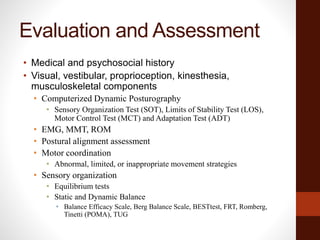
• Medical and psychosocial history
• Visual, vestibular, proprioception, kinesthesia,
musculoskeletal components
• Computerized Dynamic Posturography
• Sensory Organization Test (SOT), Limits of Stability Test (LOS),
Motor Control Test (MCT) and Adaptation Test (ADT)
• EMG, MMT, ROM
• Postural alignment assessment
• Motor coordination
• Abnormal, limited, or inappropriate movement strategies
• Sensory organization
• Equilibrium tests
• Static and Dynamic Balance
• Balance Efficacy Scale, Berg Balance Scale, BESTtest, FRT, Romberg,
Tinetti (POMA), TUG
Overview of Interventions
• Assessments as interventions!
• Static and dynamic balance activities
• Resistance training
• Coordination activities
• Reaction time training
• Virtual reality technology
• Orthotics and other assistive/adaptive devices
• Yoga*
• Tai Chi*
• Repeated variable perturbations*
• Continuous cognitive tasks*
Evidenced-based Intervention:
YOGA
YOGA
• Studies show that regular practitioners of yoga are more reliant on
internal vestibular and proprioceptive signals than external visual
cues; are more able to retain balance in an eyes-closed condition;
and demonstrate improvements in timed, one-legged balance tests.
• Jeter et al (2015):
• Ashtanga-based Yoga Therapy (AYT)
• 25 postures, 60 minute, twice weekly to visually impaired elder adults
• Modifiable for various impairments
• Found significant increase in Mean Total Velocity (MTV) for both
foam, eyes-open and foam, eyes-closed conditions.
• In comparison with other exercise, yoga was equal to or
significantly better as judged by increased Quality of Life and
decreased stress levels.
Evidenced-based Intervention:
YOGA
Evidenced-based Intervention:
YOGA
Evidenced-based Intervention:
YOGA
Evidenced-based Intervention:
YOGA
• Targeted balance training such as AYT may improve postural
stability in individuals with visual impairments by strengthening
the remaining sensory systems.
• Provides an integrated, multisensory approach that can engage the
use of compensatory sensory inputs.
• Adaptation and sensory “reweighting”.
• Emphasizing foot placement during balance activities may
generate proprioceptive learning.
• Safely executed movements in standing or semi-inverted poses
(e.g. downward-facing dog) activates the vestibular system.
• Yoga has low rate of side-effects, low injury risk, and no known
medication interactions.
Evidenced-based Intervention:
TAI CHI
Tai Chi is a balanced-based exercise shown to improve strength,
balance, and physical function and to prevent falls in older
adults.
• Li et al. (2012):
• Six Tai Chi movements integrated into an eight-form routine
specifically targeting balance and gait.
• Symmetric and diagonal movements, weight shifting, controlled
displacement of COM over BOS, ankle sways, anterior-posterior and
lateral stepping.
• In comparison with a Resistance Training Group and Stretching
Only Group, the Tai Chi Group performed consistently better in
maximum excursion and outperformed both in FRT and TUG.
• The Tai Chi Group also performed better than Stretching Only in
reducing falls and all secondary outcomes
• Stride length, knee extensor and flexor strength
Evidenced-based Intervention:
TAI CHI
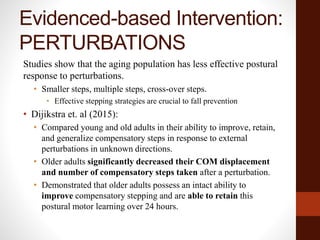
• Apparent effects of Tai Chi:
• Reduce balance impairments
• Increase functional capacity
• Reduce falls
• Tai Chi is effective as a standalone intervention to improve
postural stability in the aging population.
Evidenced-based Intervention:
PERTURBATIONS
Studies show that the aging population has less effective postural
response to perturbations.
• Smaller steps, multiple steps, cross-over steps.
• Effective stepping strategies are crucial to fall prevention
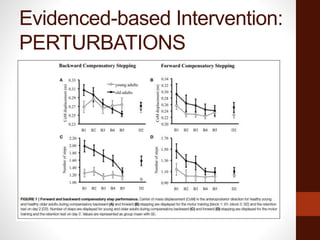
• Dijikstra et. al (2015):
• Compared young and old adults in their ability to improve, retain,
and generalize compensatory steps in response to external
perturbations in unknown directions.
• Older adults significantly decreased their COM displacement
and number of compensatory steps taken after a perturbation.
• Demonstrated that older adults possess an intact ability to
improve compensatory stepping and are able to retain this
postural motor learning over 24 hours.
Evidenced-based Intervention:
PERTURBATIONS
Evidenced-based Intervention:
CONTINUOUS COGNITIVE TASK
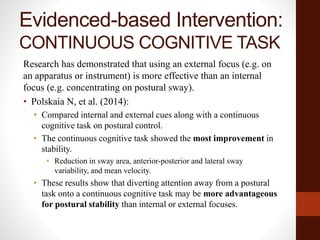
Research has demonstrated that using an external focus (e.g. on
an apparatus or instrument) is more effective than an internal
focus (e.g. concentrating on postural sway).
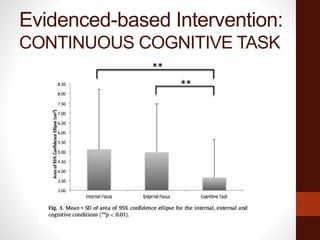
• Polskaia N, et al. (2014):
• Compared internal and external cues along with a continuous
cognitive task on postural control.
• The continuous cognitive task showed the most improvement in
stability.
• Reduction in sway area, anterior-posterior and lateral sway
variability, and mean velocity.
• These results show that diverting attention away from a postural
task onto a continuous cognitive task may be more advantageous
for postural stability than internal or external focuses.
Evidenced-based Intervention:
CONTINUOUS COGNITIVE TASK
Conclusion
• Falls are a major public health issue, especially in the aging
population.
• Postural performance is context dependent, unique to each situation
and to each individual patient.
• Balance assessments must include the integrity of the underlying
physiological systems and the compensatory strategies available to
each patient.
• Interventions should be dependent upon the resources available to
each patient as well as the unique set of system impairments
impacting their postural system.
• More research needs to be conducted to test the efficacy of various
interventions for improving postural stability in the aging population.
References
Ambrose, A. F., Paul, G., & Hausdorff, J. M. (2013). Risk factors for falls among older adults: a review of the literature.
Maturitas, 75(1), 51-61.
Boersma, D., Demontiero, O., Amiri, Z. M., Hassan, S., Suarez, H., Geisinger, D., ... & Duque, G. (2012). Vitamin D status in
relation to postural stability in the elderly. The journal of nutrition, health & aging, 16(3), 270-275.
Boisgontier, M. P., Beets, I. A., Duysens, J., Nieuwboer, A., Krampe, R. T., & Swinnen, S. P. (2013). Age-related differences in
attentional cost associated with postural dual tasks: increased recruitment of generic cognitive resources in older adults.
Neuroscience & Biobehavioral Reviews, 37(8), 1824-1837.
Dijkstra, B. W., Horak, F. B., Kamsma, Y. P., & Peterson, D. S. (2015). Older adults can improve compensatory stepping with
repeated postural perturbations. Frontiers in aging neuroscience, 7.
Donoghue, O. A., Cronin, H., Savva, G. M., O’Regan, C., & Kenny, R. A. (2013). Effects of fear of falling and activity restriction
on normal and dual task walking in community dwelling older adults. Gait & posture, 38(1), 120-124.
Horak, F. B. (2006). Postural orientation and equilibrium: what do we need to know about neural control of balance to prevent
falls?. Age and ageing, 35(suppl 2), ii7-ii11.
Horlings, C. G., van Engelen, B. G., Allum, J. H., & Bloem, B. R. (2008). A weak balance: the contribution of muscle weakness to
postural instability and falls. Nature Clinical Practice Neurology, 4(9), 504-515.
Jeter, P. E., Moonaz, S. H., Bittner, A. K., & Dagnelie, G. (2015). Ashtanga-based yoga therapy increases the sensory contribution
to postural stability in visually-impaired persons at risk for falls as measured by the Wii balance board: a pilot randomized
controlled trial. PLoS one, 10(6), e0129646.
References
Lajoie, Y., and SP2004 Gallagher. "Predicting falls within the elderly community: comparison of postural sway, reaction time, the
Berg balance scale and the Activities-specific Balance Confidence (ABC) scale for comparing fallers and non-fallers." Archives of
gerontology and geriatrics 38.1 (2004): 11-26.
Li, F., Harmer, P., Fitzgerald, K., Eckstrom, E., Stock, R., Galver, J., & Batya, S. S. (2012). Tai chi and postural stability in
patients with Parkinson's disease. New England Journal of Medicine, 366(6), 511-519.
Melzer, I., Benjuya, N., & Kaplanski, J. (2004). Postural stability in the elderly: a comparison between fallers and non-fallers. Age
and ageing, 33(6), 602-607.
Montero‐Odasso, M., Verghese, J., Beauchet, O., & Hausdorff, J. M. (2012). Gait and cognition: a complementary approach to
understanding brain function and the risk of falling. Journal of the American Geriatrics Society, 60(11), 2127-2136.
Ping, Y., & Xiaohua, W. (2012). Risk factors for accidental falls in the elderly and intervention strategy. Journal of Medical
Colleges of PLA, 27(5), 299-305.
Polskaia, N., Richer, N., Dionne, E., & Lajoie, Y. (2015). Continuous cognitive task promotes greater postural stability than an
internal or external focus of attention. Gait & posture, 41(2), 454-458.
Shumway-Cook, A., Woollacott, M., Kerns, K. A., & Baldwin, M. (1997). The effects of two types of cognitive tasks on postural
stability in older adults with and without a history of falls. The Journals of Gerontology Series A: Biological Sciences and Medical
Sciences, 52(4), M232-M240.
Skelton, D. A. (2001). Effects of physical activity on postural stability. Age and ageing, 30, 33-40.
Skelton, D. A., & Dinan, S. M. (1999). Exercise for falls management: Rationale for an exercise programme aimed at reducing
postural instability. Physiotherapy theory and practice, 15(2), 105-120.

Heather Smith, NYULMC Inservice - FINAL

  • 1.
    Postural Instability and Fallsin the Aging Population Heather Smith, SPTA LaGuardia Community College Spring 2016
  • 2.
    Overview • Definitions • Prevalenceand cost of falls • Summary of risk factors for falls • Defining postural instability • Relationship between postural instability and falls • Resources required for postural stability • Cognition and postural stability • Evaluation and assessment • Evidence-based interventions • Conclusion • References
  • 3.
    Definitions • FALL • Variationsin definitions among medical professionals. • The Prevention of Falls Network Europe (ProFANE) defined a fall as “an unexpected event in which the participant comes to rest on the ground, floor, or lower back.” • Similar definitions were later put forward by the Kellogg International Working Group and the Frailty and Injuries Cooperative Studies of Intervention Techniques.
  • 4.
    Definitions • AGING • 65+years old. • Roughly one-third of community dwelling adults older than 65 fall each year. • 40% of elderly patients in hospitals, STR, SNF • Rate of falls for adults 85 and older is nearly 4 times higher than for individuals between 65 and 84 years old. • Why? • Increased Risk Factors • Increased reporting of falls.
  • 5.
    Prevalence and Costof Falls • According to the CDC, 2.5 million older people are treated in emergency departments for fall-related injuries per year. • 1 in 5 falls result in serious injuries, mainly hip fractures and head injuries. • More than 700,000 fall patients are hospitalized. • At least 250,000 older people are hospitalized for hip fractures. • More than 95% of hip fractures are caused by falling. • Falls are the most common cause of traumatic brain injuries. • The cost of falls is $34 billion annually. • Hospital costs account for two-thirds of that total. Retrieved from http://www.cdc.gov/homeandrecreationalsafety/falls/adultfalls.html
  • 6.
    Summary of Fall-RiskFactors FALLSDemographic Psychosocial Physiological Pathological Pharmaceutical Environmental INTRINSIC EXTRINSIC
  • 7.
    Extrinsic Fall-Risk Factors •Pharmaceutical • Type of medication, dosage, and compound medicines may causes an increased risk for falls. • Psychological medications such as antidepressants, anxiolytic, hypnotic, anticonvulsants. • Cardiovascular medications such as antihypertensive agents, diuretics, vasodilators. • NSAIDs, pain-killers, dopaminergic drugs, antiparkinsonism drugs. • Alcohol, opioids, depressants, etc. • Environmental • Slippery floor, loose rugs or other tripping hazards • Lack of stair railings, or grab bars • Unstable or unsuitable furniture • Poor lighting • Poor fitting footwear or assistive devices
  • 8.
    Intrinsic Fall-Risk Factors •Demographic • Age • Gender • Race • Psychosocial • Fear of Falling • Mental illnesses • Level of education • Income • Social supports • Physiological • Gait and balance systems • Sensory system • Central Nervous system • Musculoskeletal system • Pathological • Neurological diseases • Cardiovascular diseases • Ocular diseases • Cognitive diseases • Others: Vitamin D deficiency, respiratory disease, infection, vertigo, incontinence, etc.
  • 9.
    What is PosturalStability? • Postural stability is “a complex skill based on the interaction of dynamic sensorimotor processes” • No longer considered a function of “balance centers” in the brain or a summation of static reflexes. • If this was the case, it would be much easier to evaluate and treat. • One single balance test cannot fully evaluate postural stability and one single balance intervention cannot improve balance. • Two main functional goals of postural behavior: 1. Postural orientation 2. Postural equilibrium
  • 10.
    Postural Orientation andEquilibrium • Postural orientation involves the active alignment of the trunk and head. • Factors in gravity, support surfaces, and the integration of somatosensory, vestibular, and visual systems. • Each of these inputs are “weighted” based on the goals of the movement task within the specific environmental context. • “up-weighting” and “down-weighting” • Postural equilibrium involves the coordination of various movement response strategies to stabilize the center of mass during displacement. • The specific strategy chosen depends on the type of displacement, as well as the individual’s goals, expectations, and prior experiences. • Anticipatory postural adjustments serve to maintain postural stability by compensating for potential displacing forces.
  • 11.
    Postural Instability andFalls • Postural instability can develop from pathologies within any of the multiple physiological mechanisms underlying posture. • Damage within any of these mechanisms increases risk of falls due to a variety of resulting deficits. • The probability of developing specific pathologies and impairments related to postural instability is unique to each individual. • The increase of fall risk with age is thus not a natural function of aging as much as the result of an increased likelihood of impairment within the postural system.
  • 12.
    Resources Required forPostural Stability Biomechanical Constraints Movement Strategies Sensory Strategies Orientation in Space Control of Dynamics Cognitive Processing
  • 13.
    Resources Required forPostural Stability • Biomechanical constraints: • The size and quality of the base of support (the feet). • Any limitations in size, strength, ROM, pain, sensation, or control of the feet will affect balance. • The cone of stability: the area in which an individual moves their COM over their BOS. • In many elderly persons with balance disorders, the cone of stability is very small or they experience distortions in the central neural representations of this cone.
  • 14.
    Resources Required forPostural Stability • Movement Strategies 1. Ankle Strategy 1. Hip Strategy 1. Stepping Strategy • Sensory Strategies • Integration of somatosensory, visual, and vestibular systems that is weighted based on task.
  • 15.
    Resources Required forPostural Stability • Orientation in Space • The ability to orient the body with respect to gravity, the support surface, visual surround and internal references. • Control of Dynamics • Complex control of the body’s COM while changing from one position to another. • Cognitive Processing • Postural control requires many executive cognitive resources. • Reaction times and performance in cognitive tasks generally decrease as the difficulty of the postural task increases.
  • 16.
    Cognition and PosturalStability • Research documents age-related changes in peripheral sensory structures across all 3 postural systems. • When postural tasks are done concurrently with another task (dual-task), early research suggested that postural control is given priority in young adults, but shifts with age (“posture- first hierarchy”). • Newer research suggests that older adults can manage dual tasks as well as younger adults in static posture conditions, but the addition of dynamic conditions causes a decline in either or both tasks. • The “posture-first hierarchy” seems to actually be multiple potential hierarchies based on complex variables such as the nature of the two tasks, the goal of the subject, and the instructions. • Thus rehabilitation must include training with many different tasks and contexts.
  • 17.
    Cognition and PosturalStability Shumway-Cook et al. (1997):
  • 18.
    Evaluation and Assessment •Medical and psychosocial history • Visual, vestibular, proprioception, kinesthesia, musculoskeletal components • Computerized Dynamic Posturography • Sensory Organization Test (SOT), Limits of Stability Test (LOS), Motor Control Test (MCT) and Adaptation Test (ADT) • EMG, MMT, ROM • Postural alignment assessment • Motor coordination • Abnormal, limited, or inappropriate movement strategies • Sensory organization • Equilibrium tests • Static and Dynamic Balance • Balance Efficacy Scale, Berg Balance Scale, BESTtest, FRT, Romberg, Tinetti (POMA), TUG
  • 19.
    Overview of Interventions •Assessments as interventions! • Static and dynamic balance activities • Resistance training • Coordination activities • Reaction time training • Virtual reality technology • Orthotics and other assistive/adaptive devices • Yoga* • Tai Chi* • Repeated variable perturbations* • Continuous cognitive tasks*
  • 20.
    Evidenced-based Intervention: YOGA YOGA • Studiesshow that regular practitioners of yoga are more reliant on internal vestibular and proprioceptive signals than external visual cues; are more able to retain balance in an eyes-closed condition; and demonstrate improvements in timed, one-legged balance tests. • Jeter et al (2015): • Ashtanga-based Yoga Therapy (AYT) • 25 postures, 60 minute, twice weekly to visually impaired elder adults • Modifiable for various impairments • Found significant increase in Mean Total Velocity (MTV) for both foam, eyes-open and foam, eyes-closed conditions. • In comparison with other exercise, yoga was equal to or significantly better as judged by increased Quality of Life and decreased stress levels.
  • 21.
  • 22.
  • 23.
  • 24.
    Evidenced-based Intervention: YOGA • Targetedbalance training such as AYT may improve postural stability in individuals with visual impairments by strengthening the remaining sensory systems. • Provides an integrated, multisensory approach that can engage the use of compensatory sensory inputs. • Adaptation and sensory “reweighting”. • Emphasizing foot placement during balance activities may generate proprioceptive learning. • Safely executed movements in standing or semi-inverted poses (e.g. downward-facing dog) activates the vestibular system. • Yoga has low rate of side-effects, low injury risk, and no known medication interactions.
  • 25.
    Evidenced-based Intervention: TAI CHI TaiChi is a balanced-based exercise shown to improve strength, balance, and physical function and to prevent falls in older adults. • Li et al. (2012): • Six Tai Chi movements integrated into an eight-form routine specifically targeting balance and gait. • Symmetric and diagonal movements, weight shifting, controlled displacement of COM over BOS, ankle sways, anterior-posterior and lateral stepping. • In comparison with a Resistance Training Group and Stretching Only Group, the Tai Chi Group performed consistently better in maximum excursion and outperformed both in FRT and TUG. • The Tai Chi Group also performed better than Stretching Only in reducing falls and all secondary outcomes • Stride length, knee extensor and flexor strength
  • 26.
    Evidenced-based Intervention: TAI CHI •Apparent effects of Tai Chi: • Reduce balance impairments • Increase functional capacity • Reduce falls • Tai Chi is effective as a standalone intervention to improve postural stability in the aging population.
  • 27.
    Evidenced-based Intervention: PERTURBATIONS Studies showthat the aging population has less effective postural response to perturbations. • Smaller steps, multiple steps, cross-over steps. • Effective stepping strategies are crucial to fall prevention • Dijikstra et. al (2015): • Compared young and old adults in their ability to improve, retain, and generalize compensatory steps in response to external perturbations in unknown directions. • Older adults significantly decreased their COM displacement and number of compensatory steps taken after a perturbation. • Demonstrated that older adults possess an intact ability to improve compensatory stepping and are able to retain this postural motor learning over 24 hours.
  • 28.
  • 29.
    Evidenced-based Intervention: CONTINUOUS COGNITIVETASK Research has demonstrated that using an external focus (e.g. on an apparatus or instrument) is more effective than an internal focus (e.g. concentrating on postural sway). • Polskaia N, et al. (2014): • Compared internal and external cues along with a continuous cognitive task on postural control. • The continuous cognitive task showed the most improvement in stability. • Reduction in sway area, anterior-posterior and lateral sway variability, and mean velocity. • These results show that diverting attention away from a postural task onto a continuous cognitive task may be more advantageous for postural stability than internal or external focuses.
  • 30.
  • 31.
    Conclusion • Falls area major public health issue, especially in the aging population. • Postural performance is context dependent, unique to each situation and to each individual patient. • Balance assessments must include the integrity of the underlying physiological systems and the compensatory strategies available to each patient. • Interventions should be dependent upon the resources available to each patient as well as the unique set of system impairments impacting their postural system. • More research needs to be conducted to test the efficacy of various interventions for improving postural stability in the aging population.
  • 32.
    References Ambrose, A. F.,Paul, G., & Hausdorff, J. M. (2013). Risk factors for falls among older adults: a review of the literature. Maturitas, 75(1), 51-61. Boersma, D., Demontiero, O., Amiri, Z. M., Hassan, S., Suarez, H., Geisinger, D., ... & Duque, G. (2012). Vitamin D status in relation to postural stability in the elderly. The journal of nutrition, health & aging, 16(3), 270-275. Boisgontier, M. P., Beets, I. A., Duysens, J., Nieuwboer, A., Krampe, R. T., & Swinnen, S. P. (2013). Age-related differences in attentional cost associated with postural dual tasks: increased recruitment of generic cognitive resources in older adults. Neuroscience & Biobehavioral Reviews, 37(8), 1824-1837. Dijkstra, B. W., Horak, F. B., Kamsma, Y. P., & Peterson, D. S. (2015). Older adults can improve compensatory stepping with repeated postural perturbations. Frontiers in aging neuroscience, 7. Donoghue, O. A., Cronin, H., Savva, G. M., O’Regan, C., & Kenny, R. A. (2013). Effects of fear of falling and activity restriction on normal and dual task walking in community dwelling older adults. Gait & posture, 38(1), 120-124. Horak, F. B. (2006). Postural orientation and equilibrium: what do we need to know about neural control of balance to prevent falls?. Age and ageing, 35(suppl 2), ii7-ii11. Horlings, C. G., van Engelen, B. G., Allum, J. H., & Bloem, B. R. (2008). A weak balance: the contribution of muscle weakness to postural instability and falls. Nature Clinical Practice Neurology, 4(9), 504-515. Jeter, P. E., Moonaz, S. H., Bittner, A. K., & Dagnelie, G. (2015). Ashtanga-based yoga therapy increases the sensory contribution to postural stability in visually-impaired persons at risk for falls as measured by the Wii balance board: a pilot randomized controlled trial. PLoS one, 10(6), e0129646.
  • 33.
    References Lajoie, Y., andSP2004 Gallagher. "Predicting falls within the elderly community: comparison of postural sway, reaction time, the Berg balance scale and the Activities-specific Balance Confidence (ABC) scale for comparing fallers and non-fallers." Archives of gerontology and geriatrics 38.1 (2004): 11-26. Li, F., Harmer, P., Fitzgerald, K., Eckstrom, E., Stock, R., Galver, J., & Batya, S. S. (2012). Tai chi and postural stability in patients with Parkinson's disease. New England Journal of Medicine, 366(6), 511-519. Melzer, I., Benjuya, N., & Kaplanski, J. (2004). Postural stability in the elderly: a comparison between fallers and non-fallers. Age and ageing, 33(6), 602-607. Montero‐Odasso, M., Verghese, J., Beauchet, O., & Hausdorff, J. M. (2012). Gait and cognition: a complementary approach to understanding brain function and the risk of falling. Journal of the American Geriatrics Society, 60(11), 2127-2136. Ping, Y., & Xiaohua, W. (2012). Risk factors for accidental falls in the elderly and intervention strategy. Journal of Medical Colleges of PLA, 27(5), 299-305. Polskaia, N., Richer, N., Dionne, E., & Lajoie, Y. (2015). Continuous cognitive task promotes greater postural stability than an internal or external focus of attention. Gait & posture, 41(2), 454-458. Shumway-Cook, A., Woollacott, M., Kerns, K. A., & Baldwin, M. (1997). The effects of two types of cognitive tasks on postural stability in older adults with and without a history of falls. The Journals of Gerontology Series A: Biological Sciences and Medical Sciences, 52(4), M232-M240. Skelton, D. A. (2001). Effects of physical activity on postural stability. Age and ageing, 30, 33-40. Skelton, D. A., & Dinan, S. M. (1999). Exercise for falls management: Rationale for an exercise programme aimed at reducing postural instability. Physiotherapy theory and practice, 15(2), 105-120.