GERIATRIC OPTOMETRY
Anatomical and physiologic changes in
ageing
Primary Author
Mark Swanson
University of Alabama
Peer Reviewer
Tracy Matchinski
Illinois College of Optometry
Editors
Brien Holden Vision Institute, Public Health Division
Brien Holden Vision Institute Foundation (formerly ICEE) is a Public Health division of Brien Holden Vision Institute
COPYRIGHT © 2013 Brien Holden Vision Institute. All rights reserved.
This publication is protected by laws relating to copyright. Except as permitted under applicable legislation, no part of this publication may be adapted, modified, stored in a retrieval system, transmitted or reproduced in any form or by any process, electronic or otherwise,
without the Brien Holden Vision Institute’s (The institute) prior written permission. You may, especially if you are from a not-for-profit organisation, be eligible for a free license to use and make limited copies of parts of this manual in certain limited circumstances. To see if you
are eligible for such a license, please visit http://education.brienholdenvision.org/ .
DISCLAIMER
The material and tools provided in this publication are provided for purposes of general information only. The Institute is not providing specific advice concerning the clinical management of any case or condition that may be mentioned in this publication, and the information
must not be used as a substitute for specific advice from a qualified professional.
The mention of specific companies or certain manufacturers’ products does not imply that those companies or products are endorsed or recommended by the Institute in preference to others of a similar nature that are not mentioned. The Institute makes no representation or
warranty that the information contained in this publication is complete or free of omissions or errors. To the extent permitted by law, the Institute excludes all implied warranties, including regarding merchantability and fitness for purpose, and disclaims any and all liability for
any loss or damage incurred as a result of the use of the material and tools provided.
CHAPTER CONTENTS
1. Introduction
2. Homeostasis changes
3. Skin changes
4. Musculoskeletal changes
5. Musculoskeletal disease
6. Nervous system changes
7. Cardiovascular changes
8. Cardiovascular disease
9. Stroke
10. Respiratory system changes
11. Respiratory system diseases
CHAPTER CONTENTS
12. Endocrine system changes
13. Endocrine disease
14. Gastrointestinal system changes
15. Gastrointestinal disease
16. Liver, gall bladder and pancreas changes
17. Renal function changes
18. Genito-urinary disease
19. Hemapoietic system
20. Anemia
21. Psychological changes
22. Psychological changes 2
INTRODUCTION
• Even in the absence of disease, the body
undergoes anatomical and physiologic
changes with age.
• The process varies and is influenced by
genetics, gender and environmental factors
(nutrition, exercise, access to healthcare,
cigarette smoking and alcohol).
• Beginning around age 30 the body organs
begin a progressive decline.
• Organ systems decline at different rates.
INTRODUCTION
• Significant levels of primary ageing are seen
around age 65.
• All vital organ function is decreasing linearly with
age. This is more apparent in some organs than
others.
• In addition to the degeneration of organ systems
and tissue, there is loss of functional reserve of
these systems.
• Loss of functional reserve impairs an individual’s
ability to cope with physiological challenges.
HOMEOSTASIS CHANGES
• Impaired baroreceptor reflex
• Increased basal norepinephrine
• Decreased receptor responsiveness
• Decrease in C-AMP response
• Decrease in thermoregulation
• Decrease in thirst response
SKIN CHANGES
• Skin more easily damaged
• Delayed wound healing
• Decreased protection form UV light due to
reduced melanocyte activity
• Decrease in skin thickness
• Solar lentigo
• Loss of elasticity
• Keratinosis
SKIN CHANGES
• Decrease in endocrine glands output.
• Decrease in sebaceous glands
• Decrease in moisture content and
absorption
• Nail changes (onychomychosis)
• Decreased sensitivity to pain and pressure
• Due to changes in the skin, there is an
increase in wounds and ulcers, infection
and swelling.
MUSCULOSKELETAL CHANGES
• Decrease in muscle weight to body weight
• Decrease in muscle fibers
• Enzyme systems (ATP/LDH) decrease
• Cartilage loss of protein, increase in water
• Bone loss, reduced bone mineral density
• Height declines an average of three inches
beginning at age 30. (Decline rate is 1/16
inch per year).
− The spine becomes more curved and the
vertebral discs become compacted.
MUSCULOSKELETAL CHANGES
• Shoulder width decreases leading to
reduced range of motion.
• Joint stiffness is characteristic for the elderly
due to loss of cartilage and fluid between the
joints. This results in joint inflexibility
• Grip strength decreases by 50% in men,
slightly less in women.
• Changes in gait, stature and ability to
ambulate
MUSCULOSKELETAL DISEASE
• Osteoarthritis
• Rheumatoid Arthritis
• Gout
• Osteoporosis
NERVOUS SYSTEM CHANGES
• Loss of brain weight
• Blood flow decline by 20%
• Scattered dendritic loss
• Lipofuscin deposition
• Neurotransmitter loss
• Basal ganglia atrophy
NERVOUS SYSTEM CHANGES
• Decreased dopamine and increased muscular
rigidity
• Nerve conduction velocity decreased
• Slowed reaction times
• Peripheral nervous system: decreased vibratory
sensation
• Special Senses
− Presbycusis: high frequency hearing loss
− Vestibular dysfunction
− Decrease smell
− Some loss of taste
NERVOUS SYSTEM DISEASE
• Increase risk of delirium
• Hearing loss
• Reduced position and vibration sense
• Increased risk of falls
• Cognitive impairment
− Alzheimer’s disease
− Multi-infarct dementia
− Parkinsonism
CARDIOVASCULAR CHANGES
• Increase in Peripheral Resistance
• Systolic BP Increase
• Left Ventricular Hypertrophy
• Stroke volume declines
• Maximum heart rate decline
• Decline in Ventricular Filling
• Greater Degree of Ventricular Arrhythmia
• Organ Specific Declines in Blood Flow
• Dilatation of aorta
• Reduced elasticity of conduit/capacitance vessels
CARDIOVASCULAR DISEASE
• Ischemic heart disease
− Myocardial infarction
− Angina
• Congestive Heart Failure
− Among the most common causes of hospitalization >65
• Peripheral Artery Disease
− Claudication
• Arrhythmias and conduction disorders
• Phlebitis
• Hypertension
• Hypotension
• African-Americans more than whites
− Heart Failure
− Renal Failure
− Stroke
STROKE
• Ischemic
− Thrombotic
− Embolic
• Hemorrhagic.
− Subarachnoid
− Intracerebral
• Patients who suffer a stroke may present to the
vision clinic with a variety of visual complaints. Visual
symptoms of TIA and stroke are very common and
include transient and permanent altitudinal or
hemianopic visual field loss, diplopia, and disorders
of gaze.
STROKE
• Optometrists play an integral role in
rehabilitation of stroke patients.
• Working with other members of the
rehabilitation team allow for comprehensive
and successful rehabilitation of the patient.
• Patients who experience visual field loss may
require training and rehabilitation of the field
loss to improve mobility, reading and
performance of activities of daily living (ADL)
RESPIRATORY SYSTEM CHANGES
• Cartilage calcifies
• Decreased alveolar surface area
• Loss of parenchymal elasticity
• Calcification of rib articulations
• Decrease in cilial response
• Decrease in vital capacity (the maximum
amount of oxygen brought into the lungs).
− Average decline is 50% between ages 25 and 70.
• Relative respiratory alkalosis
RESPIRATORY SYSTEM CHANGES
• Decrease in oxygen consumption
• Stable oxygen saturation
• Decreased ventilation and gas distribution.
• Loss of elastic recoil of the lungs.
• Decreased mucociliary transport.
• Weakened cough reflex and clearance
• Increased chest wall rigidity
• Reduced cough
RESPIRATORY SYSTEM DISEASES
• Chronic obstructive pulmonary disease
(COPD)
− Emphysema
− Chronic. Bronchitis
• Pneumonia
• Asthma
• Tuberculosis
ENDOCRINE SYSTEM CHANGES
• Plasma renin level decreases
• Fasting blood glucose increases with age
• T4 stays the same, TSH and T3 decline
• ACTH increases and DHEA declines
• Androgens, estrogens markedly decrease
• Deterioration in pancreatic β-cell function
ENDOCRINE DISEASE
• Metabolic syndrome
• Diabetes due to increased risk of impaired glucose
tolerance
− 25%
• Thyroid
− 9% of population
− 24% in older women
• Calcium metabolism disorders
• Menopause associated conditions
• Male Impotence
• Hyperlipidemia
GASTROINTESTINAL SYSTEM
CHANGES
• Less changes than in any other system
• Decrease in:
− GI absorptive cells
− GI motility
− Sphincter activity
− GI blood flow
− Gastric acid secretion
− Active transport
− Esophogeal peristasis
GASTROINTESTINAL SYSTEM
CHANGES
• 1/3 reduction in the volume of saliva
• 40% edentulous (all teeth lost)
• Decreased thirst perception
• Increase in gastric reflux
• Gastric atrophy
• 1/3 diverticuli
GASTROINTESTINAL DISEASE
• GERD (Gastroesophageal reflux disorder)
• Gastritis
• Ulcer
• Gallstones
• Diverticulosis
• Hiatal hernia
• Constipation or diarrhea
• Pernicious anemia due to decreased B-12
absorption
LIVER, GALL BLADDER AND
PANCREAS CHANGES
• Age related pancreatic and hepatic failure
do not occur
• Liver function tests remain stable
• Drug metabolism prolonged e.g.
benzodiazepines
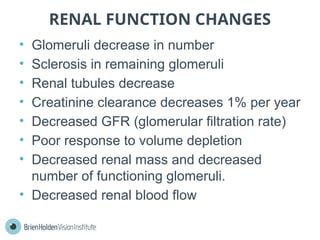
RENAL FUNCTION CHANGES
• Glomeruli decrease in number
• Sclerosis in remaining glomeruli
• Renal tubules decrease
• Creatinine clearance decreases 1% per year
• Decreased GFR (glomerular filtration rate)
• Poor response to volume depletion
• Decreased renal mass and decreased
number of functioning glomeruli.
• Decreased renal blood flow
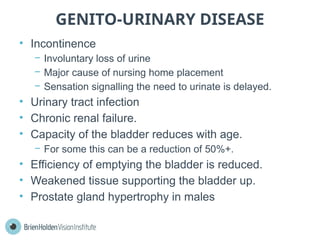
GENITO-URINARY DISEASE
• Incontinence
− Involuntary loss of urine
− Major cause of nursing home placement
− Sensation signalling the need to urinate is delayed.
• Urinary tract infection
• Chronic renal failure.
• Capacity of the bladder reduces with age.
− For some this can be a reduction of 50%+.
• Efficiency of emptying the bladder is reduced.
• Weakened tissue supporting the bladder up.
• Prostate gland hypertrophy in males
HEMAPOIETIC SYSTEM
• Blood counts stay stable
• Reserve for hemapoiesis decreases
• Anemia is pathology
ANEMIA
• Anemia of chronic disease
• Nutritional
• Folate.
• Iron deficiency
• B-12 deficiency
• Unexplained
PSYCHOLOGICAL CHANGES
• Primary(short term) memory declines
• Secondary (long term) memory intact
• Crystallized intelligence intact
• Working memory declines
• Personality often increases or magnifies
itself
− Positive person in youth will be a more positive
person with age
− Negative person in youth will be a more negative
person with age
PSYCHOLOGICAL CHANGES 2
• Attention declines
• Speed of processing declines
• Longitudinal versus cross-sectional
• Personality stays stable
• Changes in roles, relationships, health and
independence
• Physiological decline and psychological
decline can trigger each other
• Fear of loss
06 Anatomical and physiologic changes in ageing.pptx

06 Anatomical and physiologic changes in ageing.pptx

  • 1.
    GERIATRIC OPTOMETRY Anatomical andphysiologic changes in ageing
  • 2.
    Primary Author Mark Swanson Universityof Alabama Peer Reviewer Tracy Matchinski Illinois College of Optometry Editors Brien Holden Vision Institute, Public Health Division Brien Holden Vision Institute Foundation (formerly ICEE) is a Public Health division of Brien Holden Vision Institute COPYRIGHT © 2013 Brien Holden Vision Institute. All rights reserved. This publication is protected by laws relating to copyright. Except as permitted under applicable legislation, no part of this publication may be adapted, modified, stored in a retrieval system, transmitted or reproduced in any form or by any process, electronic or otherwise, without the Brien Holden Vision Institute’s (The institute) prior written permission. You may, especially if you are from a not-for-profit organisation, be eligible for a free license to use and make limited copies of parts of this manual in certain limited circumstances. To see if you are eligible for such a license, please visit http://education.brienholdenvision.org/ . DISCLAIMER The material and tools provided in this publication are provided for purposes of general information only. The Institute is not providing specific advice concerning the clinical management of any case or condition that may be mentioned in this publication, and the information must not be used as a substitute for specific advice from a qualified professional. The mention of specific companies or certain manufacturers’ products does not imply that those companies or products are endorsed or recommended by the Institute in preference to others of a similar nature that are not mentioned. The Institute makes no representation or warranty that the information contained in this publication is complete or free of omissions or errors. To the extent permitted by law, the Institute excludes all implied warranties, including regarding merchantability and fitness for purpose, and disclaims any and all liability for any loss or damage incurred as a result of the use of the material and tools provided.
  • 3.
    CHAPTER CONTENTS 1. Introduction 2.Homeostasis changes 3. Skin changes 4. Musculoskeletal changes 5. Musculoskeletal disease 6. Nervous system changes 7. Cardiovascular changes 8. Cardiovascular disease 9. Stroke 10. Respiratory system changes 11. Respiratory system diseases
  • 4.
    CHAPTER CONTENTS 12. Endocrinesystem changes 13. Endocrine disease 14. Gastrointestinal system changes 15. Gastrointestinal disease 16. Liver, gall bladder and pancreas changes 17. Renal function changes 18. Genito-urinary disease 19. Hemapoietic system 20. Anemia 21. Psychological changes 22. Psychological changes 2
  • 5.
    INTRODUCTION • Even inthe absence of disease, the body undergoes anatomical and physiologic changes with age. • The process varies and is influenced by genetics, gender and environmental factors (nutrition, exercise, access to healthcare, cigarette smoking and alcohol). • Beginning around age 30 the body organs begin a progressive decline. • Organ systems decline at different rates.
  • 6.
    INTRODUCTION • Significant levelsof primary ageing are seen around age 65. • All vital organ function is decreasing linearly with age. This is more apparent in some organs than others. • In addition to the degeneration of organ systems and tissue, there is loss of functional reserve of these systems. • Loss of functional reserve impairs an individual’s ability to cope with physiological challenges.
  • 7.
    HOMEOSTASIS CHANGES • Impairedbaroreceptor reflex • Increased basal norepinephrine • Decreased receptor responsiveness • Decrease in C-AMP response • Decrease in thermoregulation • Decrease in thirst response
  • 8.
    SKIN CHANGES • Skinmore easily damaged • Delayed wound healing • Decreased protection form UV light due to reduced melanocyte activity • Decrease in skin thickness • Solar lentigo • Loss of elasticity • Keratinosis
  • 9.
    SKIN CHANGES • Decreasein endocrine glands output. • Decrease in sebaceous glands • Decrease in moisture content and absorption • Nail changes (onychomychosis) • Decreased sensitivity to pain and pressure • Due to changes in the skin, there is an increase in wounds and ulcers, infection and swelling.
  • 10.
    MUSCULOSKELETAL CHANGES • Decreasein muscle weight to body weight • Decrease in muscle fibers • Enzyme systems (ATP/LDH) decrease • Cartilage loss of protein, increase in water • Bone loss, reduced bone mineral density • Height declines an average of three inches beginning at age 30. (Decline rate is 1/16 inch per year). − The spine becomes more curved and the vertebral discs become compacted.
  • 11.
    MUSCULOSKELETAL CHANGES • Shoulderwidth decreases leading to reduced range of motion. • Joint stiffness is characteristic for the elderly due to loss of cartilage and fluid between the joints. This results in joint inflexibility • Grip strength decreases by 50% in men, slightly less in women. • Changes in gait, stature and ability to ambulate
  • 12.
    MUSCULOSKELETAL DISEASE • Osteoarthritis •Rheumatoid Arthritis • Gout • Osteoporosis
  • 13.
    NERVOUS SYSTEM CHANGES •Loss of brain weight • Blood flow decline by 20% • Scattered dendritic loss • Lipofuscin deposition • Neurotransmitter loss • Basal ganglia atrophy
  • 14.
    NERVOUS SYSTEM CHANGES •Decreased dopamine and increased muscular rigidity • Nerve conduction velocity decreased • Slowed reaction times • Peripheral nervous system: decreased vibratory sensation • Special Senses − Presbycusis: high frequency hearing loss − Vestibular dysfunction − Decrease smell − Some loss of taste
  • 15.
    NERVOUS SYSTEM DISEASE •Increase risk of delirium • Hearing loss • Reduced position and vibration sense • Increased risk of falls • Cognitive impairment − Alzheimer’s disease − Multi-infarct dementia − Parkinsonism
  • 16.
    CARDIOVASCULAR CHANGES • Increasein Peripheral Resistance • Systolic BP Increase • Left Ventricular Hypertrophy • Stroke volume declines • Maximum heart rate decline • Decline in Ventricular Filling • Greater Degree of Ventricular Arrhythmia • Organ Specific Declines in Blood Flow • Dilatation of aorta • Reduced elasticity of conduit/capacitance vessels
  • 17.
    CARDIOVASCULAR DISEASE • Ischemicheart disease − Myocardial infarction − Angina • Congestive Heart Failure − Among the most common causes of hospitalization >65 • Peripheral Artery Disease − Claudication • Arrhythmias and conduction disorders • Phlebitis • Hypertension • Hypotension • African-Americans more than whites − Heart Failure − Renal Failure − Stroke
  • 18.
    STROKE • Ischemic − Thrombotic −Embolic • Hemorrhagic. − Subarachnoid − Intracerebral • Patients who suffer a stroke may present to the vision clinic with a variety of visual complaints. Visual symptoms of TIA and stroke are very common and include transient and permanent altitudinal or hemianopic visual field loss, diplopia, and disorders of gaze.
  • 19.
    STROKE • Optometrists playan integral role in rehabilitation of stroke patients. • Working with other members of the rehabilitation team allow for comprehensive and successful rehabilitation of the patient. • Patients who experience visual field loss may require training and rehabilitation of the field loss to improve mobility, reading and performance of activities of daily living (ADL)
  • 20.
    RESPIRATORY SYSTEM CHANGES •Cartilage calcifies • Decreased alveolar surface area • Loss of parenchymal elasticity • Calcification of rib articulations • Decrease in cilial response • Decrease in vital capacity (the maximum amount of oxygen brought into the lungs). − Average decline is 50% between ages 25 and 70. • Relative respiratory alkalosis
  • 21.
    RESPIRATORY SYSTEM CHANGES •Decrease in oxygen consumption • Stable oxygen saturation • Decreased ventilation and gas distribution. • Loss of elastic recoil of the lungs. • Decreased mucociliary transport. • Weakened cough reflex and clearance • Increased chest wall rigidity • Reduced cough
  • 22.
    RESPIRATORY SYSTEM DISEASES •Chronic obstructive pulmonary disease (COPD) − Emphysema − Chronic. Bronchitis • Pneumonia • Asthma • Tuberculosis
  • 23.
    ENDOCRINE SYSTEM CHANGES •Plasma renin level decreases • Fasting blood glucose increases with age • T4 stays the same, TSH and T3 decline • ACTH increases and DHEA declines • Androgens, estrogens markedly decrease • Deterioration in pancreatic β-cell function
  • 24.
    ENDOCRINE DISEASE • Metabolicsyndrome • Diabetes due to increased risk of impaired glucose tolerance − 25% • Thyroid − 9% of population − 24% in older women • Calcium metabolism disorders • Menopause associated conditions • Male Impotence • Hyperlipidemia
  • 25.
    GASTROINTESTINAL SYSTEM CHANGES • Lesschanges than in any other system • Decrease in: − GI absorptive cells − GI motility − Sphincter activity − GI blood flow − Gastric acid secretion − Active transport − Esophogeal peristasis
  • 26.
    GASTROINTESTINAL SYSTEM CHANGES • 1/3reduction in the volume of saliva • 40% edentulous (all teeth lost) • Decreased thirst perception • Increase in gastric reflux • Gastric atrophy • 1/3 diverticuli
  • 27.
    GASTROINTESTINAL DISEASE • GERD(Gastroesophageal reflux disorder) • Gastritis • Ulcer • Gallstones • Diverticulosis • Hiatal hernia • Constipation or diarrhea • Pernicious anemia due to decreased B-12 absorption
  • 28.
    LIVER, GALL BLADDERAND PANCREAS CHANGES • Age related pancreatic and hepatic failure do not occur • Liver function tests remain stable • Drug metabolism prolonged e.g. benzodiazepines
  • 29.
    RENAL FUNCTION CHANGES •Glomeruli decrease in number • Sclerosis in remaining glomeruli • Renal tubules decrease • Creatinine clearance decreases 1% per year • Decreased GFR (glomerular filtration rate) • Poor response to volume depletion • Decreased renal mass and decreased number of functioning glomeruli. • Decreased renal blood flow
  • 30.
    GENITO-URINARY DISEASE • Incontinence −Involuntary loss of urine − Major cause of nursing home placement − Sensation signalling the need to urinate is delayed. • Urinary tract infection • Chronic renal failure. • Capacity of the bladder reduces with age. − For some this can be a reduction of 50%+. • Efficiency of emptying the bladder is reduced. • Weakened tissue supporting the bladder up. • Prostate gland hypertrophy in males
  • 31.
    HEMAPOIETIC SYSTEM • Bloodcounts stay stable • Reserve for hemapoiesis decreases • Anemia is pathology
  • 32.
    ANEMIA • Anemia ofchronic disease • Nutritional • Folate. • Iron deficiency • B-12 deficiency • Unexplained
  • 33.
    PSYCHOLOGICAL CHANGES • Primary(shortterm) memory declines • Secondary (long term) memory intact • Crystallized intelligence intact • Working memory declines • Personality often increases or magnifies itself − Positive person in youth will be a more positive person with age − Negative person in youth will be a more negative person with age
  • 34.
    PSYCHOLOGICAL CHANGES 2 •Attention declines • Speed of processing declines • Longitudinal versus cross-sectional • Personality stays stable • Changes in roles, relationships, health and independence • Physiological decline and psychological decline can trigger each other • Fear of loss