Geothermal Energy Challenge
Fund
Johann MacDougall
Scottish Government
Scotland’s geothermal potential
• Study into the potential for deep geothermal energy
in Scotland
Volume 1
http://www.gov.scot/Publications/2013/11/2800
• Identified potential in Scotland’s minewater, hot
sedimentary aquifers, hot dry and hot wet rocks.
£250,000 Challenge Fund
• The minimum award is £10,000 and the maximum
£50,000.
• Funding will be delivered as de minimis State aid
funding or under Article 25 of the General Block
Exemption Regulation.
• Applicants must be part of a partnership or
consortium.
• Closing date for applications is 30 April 2015.
• Applicants will be notified in June 2015.
Objectives
• Support projects exploring Scotland’s potential geothermal
energy capacity to provide heat utilising minewater, hot
sedimentary aquifers, hot dry and hot wet rocks);
• Encourage the development of proposals for the utilisation of
geothermal energy to local community benefit, achieving
measurable carbon reductions (without sacrificing proper
consideration of the impacts on the local environment), which
are sustainable on a long term basis; and
• Support the development of future viable delivery models,
emphasising the requirement for projects to demonstrate
commercial viability as part of the energy solution in local
developments.
Assessment of applications
• Applications need to focus on:
– Technical aspects of locating and analysing geothermal
resource;
– Exploring the potential impact on the environment of
abstracting that resource;
– Engagement with local community; and
– Exploring commercial viability of the identified geothermal
resource.
• Applications will be assessed against the LCITP criteria and
how well they meet the Challenge Fund’s objectives,
minimum scope requirements and applicant criteria.
More information
• The data behind the conclusions of the study in
respect of the areas most likely to hold deep
geothermal resources in Scotland is available at
http://www.gov.scot/Publications/2013/11/6383
• Questions about the Challenge Fund?
Phone 0845 607 8787
Or e-mail energy.info@scotent.co.uk
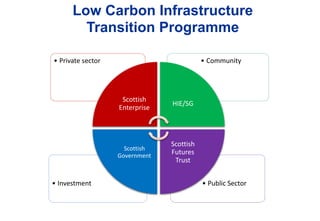
• Public Sector• Investment
• Community• Private sector
Scottish
Enterprise
HIE/SG
Scottish
Futures
Trust
Scottish
Government
Low Carbon Infrastructure
Transition Programme
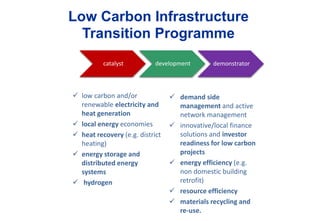
catalyst development demonstrator
 low carbon and/or
renewable electricity and
heat generation
 local energy economies
 heat recovery (e.g. district
heating)
 energy storage and
distributed energy
systems
 hydrogen
 demand side
management and active
network management
 innovative/local finance
solutions and investor
readiness for low carbon
projects
 energy efficiency (e.g.
non domestic building
retrofit)
 resource efficiency
 materials recycling and
re-use.
Low Carbon Infrastructure
Transition Programme
Low Carbon Infrastructure
Transition Programme
For further information contact:
LCITP@scotland.gsi.gov.uk
Geothermal Opportunities in Scotland
Uisdean Fraser
Managing Director
Synergie Environ Ltd
0141 263 0020
Uisdean.fraser@synergie-environ.co.uk
David Townsend
Founder & Managing Director
Town Rock Energy
0784 191 0719
david@townrockenergy.com
Background – Synergie Environ
• Glasgow based energy and engineering consultancy;
• Experience in the development of a broad range of technologies and
projects including:
 AD (whisky, food process and waste sectors);
 Biomass;
 Low carbon heat from various sources including geothermal,
waste water, process heat;
 District Heating and mapping heat demand to source.
• Cover feasibility through planning to construction and commissioning;
• Experience includes large housing, industrial, universities,
manufacturing and process, public sector.
Background – Town Rock Energy
• Edinburgh based geothermal energy consultancy;
• Experience in the identification and evaluation of
geothermal resources in Scotland, including:
 Flooded mines;
 Sedimentary aquifers (HSA’s);
 Mines and aquifers for thermal storage.
• Experience designing geothermal district heating systems
for technical and economic feasibility;
• Ideally positioned to become Scotland’s first geothermal
energy company, with export potential.
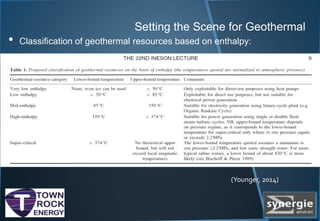
Setting the Scene for Geothermal
• Classification of geothermal resources based on enthalpy:
(Younger, 2014)
Setting the Scene for Geothermal
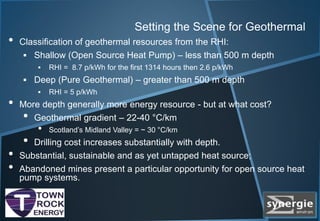
• Classification of geothermal resources from the RHI:
 Shallow (Open Source Heat Pump) – less than 500 m depth
 RHI = 8.7 p/kWh for the first 1314 hours then 2.6 p/kWh
 Deep (Pure Geothermal) – greater than 500 m depth
 RHI = 5 p/kWh
• More depth generally more energy resource - but at what cost?
• Geothermal gradient – 22-40 °C/km
• Scotland’s Midland Valley = ~ 30 °C/km
• Drilling cost increases substantially with depth.
• Substantial, sustainable and as yet untapped heat source;
• Abandoned mines present a particular opportunity for open source heat
pump systems.
Setting the Scene for Geothermal
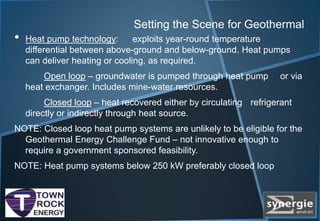
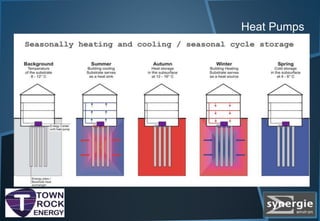
• Heat pump technology: exploits year-round temperature
differential between above-ground and below-ground. Heat pumps
can deliver heating or cooling, as required.
Open loop – groundwater is pumped through heat pump or via
heat exchanger. Includes mine-water resources.
Closed loop – heat recovered either by circulating refrigerant
directly or indirectly through heat source.
NOTE: Closed loop heat pump systems are unlikely to be eligible for the
Geothermal Energy Challenge Fund – not innovative enough to
require a government sponsored feasibility.
NOTE: Heat pump systems below 250 kW preferably closed loop
Heat pumps
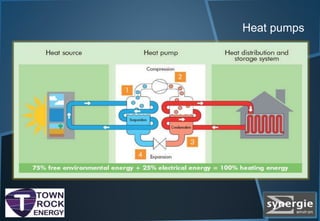
• Typical closed loop, indirect geothermal heat pump
Heat pumps
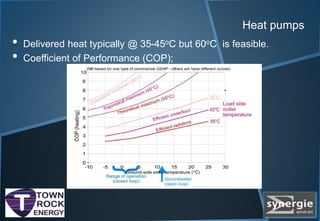
• Delivered heat typically @ 35-45oC but 60oC is feasible.
• Coefficient of Performance (COP);
Heat Pumps
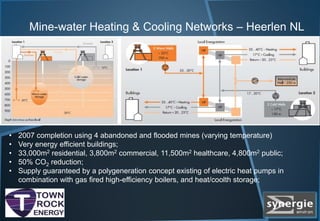
Mine-water Heating & Cooling Networks – Heerlen NL
• 2007 completion using 4 abandoned and flooded mines (varying temperature)
• Very energy efficient buildings;
• 33,000m2 residential, 3,800m2 commercial, 11,500m2 healthcare, 4,800m2 public;
• 50% CO2 reduction;
• Supply guaranteed by a polygeneration concept existing of electric heat pumps in
combination with gas fired high-efficiency boilers, and heat/coolth storage;
Scotland’s geothermal resources
• Abandoned mines:
o Depths up to 820 m;
o 4,800 km2 total mined area in Scotland;
o Sustainable abstraction at 20-100 litres / sec
o Average water temperature 17 oC but temperatures as low as 10
oC are certainly exploitable
o Indicative energy resource of 2.5 MW/km2 = 12 GW (about 40%
of Scotland’s current peak load!);
o Mine sites often re-developed – i.e. adjacent to heat loads;
o Open loop heat pump
o Correlation of mine-water resources and fuel poverty
Scotland’s geothermal resources
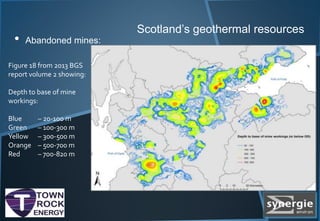
• Abandoned mines:
Figure 18 from 2013 BGS
report volume 2 showing:
Depth to base of mine
workings:
Blue – 20-100 m
Green – 100-300 m
Yellow – 300-500 m
Orange – 500-700 m
Red – 700-820 m
Scotland’s geothermal resources
• Aquifers (HSA):
o Depths up to 3km – more costly
o Water temperatures 20-90 oC
o Poorly understood / quantified energy resource – application of
Town Rock Energy exploration techniques will improve
understanding
o Limited to sedimentary rocks – significant overlap with areas of
heat demand in the central belt
o Open loop – temperatures greater than 85 oC can be considered
for electricity generation in combination with direct heat use
o None in Scotland yet (Southampton is only UK project)
o Big opportunities for long-term development – exploratory
boreholes required.
Scotland’s geothermal resources
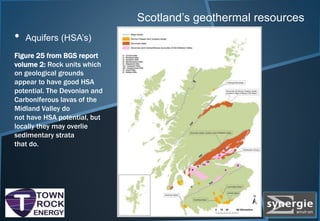
• Aquifers (HSA’s)
Figure 25 from BGS report
volume 2: Rock units which
on geological grounds
appear to have good HSA
potential. The Devonian and
Carboniferous lavas of the
Midland Valley do
not have HSA potential, but
locally they may overlie
sedimentary strata
that do.
Scotland’s geothermal resources
• Engineered Geothermal Systems (EGS):
o Depths of as much as 6km but can be shallow– even more
costly!
o Water temperatures up to 250oC;
o Poorly understood/quantified energy resource
o Applicable to any rock type – some overlap of hot (HHP)
granites with heat demand in Aberdeenshire;
o Open loop;
o No existing UK projects – proposed Cornwall electricity
generation demonstrator has been unsuccessful in raising
funds for drilling.
Scotland’s geothermal resources
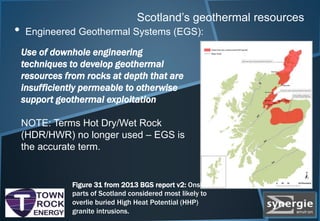
• Engineered Geothermal Systems (EGS):
Figure 31 from 2013 BGS report v2: Onshore
parts of Scotland considered most likely to
overlie buried High Heat Potential (HHP)
granite intrusions.
Use of downhole engineering
techniques to develop geothermal
resources from rocks at depth that are
insufficiently permeable to otherwise
support geothermal exploitation
NOTE: Terms Hot Dry/Wet Rock
(HDR/HWR) no longer used – EGS is
the accurate term.
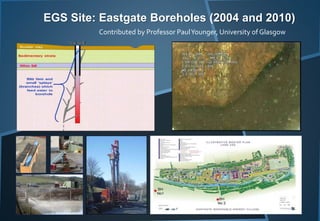
EGS Site: Eastgate Boreholes (2004 and 2010)
Contributed by Professor PaulYounger, University of Glasgow
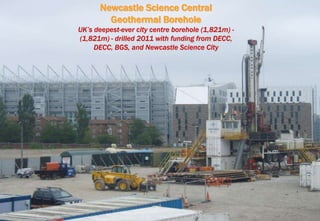
Newcastle Science Central
Geothermal Borehole
UK’s deepest-ever city centre borehole (1,821m) -
(1,821m) - drilled 2011 with funding from DECC,
DECC, BGS, and Newcastle Science City
Key Issues & Success Factors / Challenges 1
• Heat demand - site viability for large scale district heating;
• Scope of complimentary heat sources to match demand profiles;
• Planning and regulatory constraints;
• Geochemistry of mine-waters important;
• Operational temperature of district heating scheme greatly affects
heat pump COP and economics;
• Environmental constraints on mine-water disposal – re-injection the
most viable option;
• Liability implications of developing abandoned mines;
• Coal Authority is a key stakeholder.
Key Issues & Success Factors / Challenges 2
• District heat network (DHN) –
 Economies of scale,
 Integration with other energy sources,
 Marketability?
• Pre-drilling uncertainty in energy resource and overall project ‘bankability’’
• Benefits of a collaborative approach;
• Public sector heat demand best ‘starting block’ for most projects;
• Mine waters particularly attractive:
 Resource availability,
 On-going pumping costs,
 Local heating loads – correlates with areas suffering from fuel poverty
Existing scheme – Shettleston (Glasgow)
• Commissioned in 1999;
• Serves 16 residential units over 1,600m2
• Open loop configuration;
• 100m borehole pumps mine water at 12oC directly through heat pump
delivering output at 55oC, then re-injects at shallower depth
• Feeds DHW and space heating (supplemented by immersion)
• Capital grant funding was available
• Cost-competitive over gas
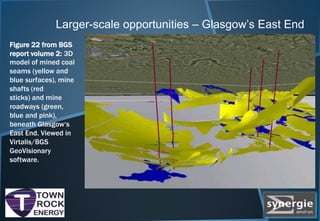
Larger-scale opportunities – Glasgow’s East End
Figure 22 from BGS
report volume 2: 3D
model of mined coal
seams (yellow and
blue surfaces), mine
shafts (red
sticks) and mine
roadways (green,
blue and pink),
beneath Glasgow‘s
East End. Viewed in
Virtalis/BGS
GeoVisionary
software.
Larger-scale opportunities - Shawfair
• 4,000 homes, 63,200m2 of commercial land, 72,800m2 of
industrial land and 7,800m2 of civic space over 18 years;
• Estimated total peak heat load of 87MW – residential element
at 3-4MW per annum
• Monktonhall mine – potential for delivered heat from
geothermal;
• Adjacent to planned major EfW facility and sewer flows;
• Potential economies of scale and integration of energy sources;
• Keen developer.
Larger-scale opportunities - Heartlands
• Former Polkemmet mine, West Lothian;
• 5,000 new homes over 20 years, 140,000m2 business park;
• Adjacent to large areas of local authority housing;
• Estimated total peak heat load of 10MW;
• Potential 34MW heat from geothermal (mine);
• Also close to planned new EfW and sewer flows;
• Potential economies of scale and integration of energy sources;
• Keen developer.
Developer concerns & potential barriers
• Carbon reduction and building standards driver;
• Risk aversion to perceived ‘novel’ technology;
• Integration with alternative heat sources integral, but benefits of
geothermal integration not well understood by developers;
• Interest in investment and ongoing ownership;
• Lack of investment to date;
• Marketability to home-builders;
• Acceptability to home owners / occupiers / buyers;
• Difficulty in engaging public sector in collaboration?
Further information
GEOTHERMAL RESOURCES IN SCOTLAND - http://www.gov.scot/Publications/2013/11/6383
MINEWATER RESOURCES IN SCOTLAND - http://www.gov.scot/resource/doc/982/0056515.pdf
TECHNOLOGY OVERVIEW -
http://www.researchgate.net/publication/233933748_Mine_water_as_a_resource_space_heating_a
nd_cooling_via_use_of_heat_pumps
EXISTING SCOTTISH SCHEMES -
http://p57313.typo3server.info/fileadmin/MIWR/content/redakteure/data/Presentations/Banks_-
_Existing_Open_Loop_Minewater-Sourced_Heatpump_Schemes_Scotland.pdf
CASE STUDY - http://www.geothermal-energy.org/pdf/IGAstandard/WGC/1995/1-jessop2.pdf
ENTHALPY CLASSIFICATION OF GEOTHERMAL RESOURCES –
YOUNGER, P. 2014. Hydrogeological challenges in a low-carbon economy. Quarterly Journal of
Engineering Geology and Hydrogeology. v.47;p7-27
www.scottish-enterprise.com
Geothermal Energy
Challenge Fund
Charles Broadfoot and
Bruce Ainsley
Innovation Specialist
Application Advice
and Guidance
www.scottish-enterprise.com
Meeting the Challenge Fund Objectives
Support feasibility studies
• Explore potential geothermal energy capacity from:
• Mine water
• Hot sedimentary aquifers
• Hot dry and hot wet rocks
• Local community benefit, sustainable on a long term basis
• Development of future viable delivery models
www.scottish-enterprise.com
Fit with Project Scope
Clear case for commercial and community benefit
• 1 or more locations
• Assessment of the baseline data
• Description of the preparation of a provisional borehole design
• Risk strategy
• Outline method and technologies to be used
• Assessment of the long term supply and demand
• Potential heat delivery models
• Performance outputs
• Indicative financial models
• Techno economic feasibility and environmental impact
Detailed description of the scope of the proposed feasibility study, reflecting the
Setting, depth, and technological complexities of the location.
www.scottish-enterprise.com
Shaping the Consortia
Teams with credible experience and access to deliver project outcomes,
will need at least two of the following:
• Community group,
• Registered charity,
• Community benefit society,
• Community interest company,
• Local authority,
• Registered social landlord,
• Academic institution,
• Heat supplier,
• Third sector business
• Commercial business
www.scottish-enterprise.com
Funding and support
1. Notified scheme - General Block
Exemption Regulation (GBER) Article 25
50% support, rising to 70% for micro SMEs
Two forms of funding support
2. De minimis State aid
Capped at €200,000 in a 3 year period
Currently £146,000.
100% intervention rate
Minimum award will be £10,000
and the maximum award will be £50,000
www.scottish-enterprise.com
Completing the application
Cover the project scope
• Provide specific detail
• Experience and credibility of the consortium
• Identify the risks and detail mitigation
• Additionality: why do you need support?
• Other funding support
• Detail the costs with supporting evidence
• Demonstrate your points
• Research the examples
• Use the links to the references
www.scottish-enterprise.com
Questions:

Geothermal Energy Challenge Fund

  • 1.
    Geothermal Energy Challenge Fund JohannMacDougall Scottish Government
  • 2.
    Scotland’s geothermal potential •Study into the potential for deep geothermal energy in Scotland Volume 1 http://www.gov.scot/Publications/2013/11/2800 • Identified potential in Scotland’s minewater, hot sedimentary aquifers, hot dry and hot wet rocks.
  • 3.
    £250,000 Challenge Fund •The minimum award is £10,000 and the maximum £50,000. • Funding will be delivered as de minimis State aid funding or under Article 25 of the General Block Exemption Regulation. • Applicants must be part of a partnership or consortium. • Closing date for applications is 30 April 2015. • Applicants will be notified in June 2015.
  • 4.
    Objectives • Support projectsexploring Scotland’s potential geothermal energy capacity to provide heat utilising minewater, hot sedimentary aquifers, hot dry and hot wet rocks); • Encourage the development of proposals for the utilisation of geothermal energy to local community benefit, achieving measurable carbon reductions (without sacrificing proper consideration of the impacts on the local environment), which are sustainable on a long term basis; and • Support the development of future viable delivery models, emphasising the requirement for projects to demonstrate commercial viability as part of the energy solution in local developments.
  • 5.
    Assessment of applications •Applications need to focus on: – Technical aspects of locating and analysing geothermal resource; – Exploring the potential impact on the environment of abstracting that resource; – Engagement with local community; and – Exploring commercial viability of the identified geothermal resource. • Applications will be assessed against the LCITP criteria and how well they meet the Challenge Fund’s objectives, minimum scope requirements and applicant criteria.
  • 6.
    More information • Thedata behind the conclusions of the study in respect of the areas most likely to hold deep geothermal resources in Scotland is available at http://www.gov.scot/Publications/2013/11/6383 • Questions about the Challenge Fund? Phone 0845 607 8787 Or e-mail energy.info@scotent.co.uk
  • 7.
    • Public Sector•Investment • Community• Private sector Scottish Enterprise HIE/SG Scottish Futures Trust Scottish Government Low Carbon Infrastructure Transition Programme
  • 8.
    catalyst development demonstrator low carbon and/or renewable electricity and heat generation  local energy economies  heat recovery (e.g. district heating)  energy storage and distributed energy systems  hydrogen  demand side management and active network management  innovative/local finance solutions and investor readiness for low carbon projects  energy efficiency (e.g. non domestic building retrofit)  resource efficiency  materials recycling and re-use. Low Carbon Infrastructure Transition Programme
  • 9.
    Low Carbon Infrastructure TransitionProgramme For further information contact: LCITP@scotland.gsi.gov.uk
  • 10.
    Geothermal Opportunities inScotland Uisdean Fraser Managing Director Synergie Environ Ltd 0141 263 0020 Uisdean.fraser@synergie-environ.co.uk David Townsend Founder & Managing Director Town Rock Energy 0784 191 0719 david@townrockenergy.com
  • 11.
    Background – SynergieEnviron • Glasgow based energy and engineering consultancy; • Experience in the development of a broad range of technologies and projects including:  AD (whisky, food process and waste sectors);  Biomass;  Low carbon heat from various sources including geothermal, waste water, process heat;  District Heating and mapping heat demand to source. • Cover feasibility through planning to construction and commissioning; • Experience includes large housing, industrial, universities, manufacturing and process, public sector.
  • 12.
    Background – TownRock Energy • Edinburgh based geothermal energy consultancy; • Experience in the identification and evaluation of geothermal resources in Scotland, including:  Flooded mines;  Sedimentary aquifers (HSA’s);  Mines and aquifers for thermal storage. • Experience designing geothermal district heating systems for technical and economic feasibility; • Ideally positioned to become Scotland’s first geothermal energy company, with export potential.
  • 13.
    Setting the Scenefor Geothermal • Classification of geothermal resources based on enthalpy: (Younger, 2014)
  • 14.
    Setting the Scenefor Geothermal • Classification of geothermal resources from the RHI:  Shallow (Open Source Heat Pump) – less than 500 m depth  RHI = 8.7 p/kWh for the first 1314 hours then 2.6 p/kWh  Deep (Pure Geothermal) – greater than 500 m depth  RHI = 5 p/kWh • More depth generally more energy resource - but at what cost? • Geothermal gradient – 22-40 °C/km • Scotland’s Midland Valley = ~ 30 °C/km • Drilling cost increases substantially with depth. • Substantial, sustainable and as yet untapped heat source; • Abandoned mines present a particular opportunity for open source heat pump systems.
  • 15.
    Setting the Scenefor Geothermal • Heat pump technology: exploits year-round temperature differential between above-ground and below-ground. Heat pumps can deliver heating or cooling, as required. Open loop – groundwater is pumped through heat pump or via heat exchanger. Includes mine-water resources. Closed loop – heat recovered either by circulating refrigerant directly or indirectly through heat source. NOTE: Closed loop heat pump systems are unlikely to be eligible for the Geothermal Energy Challenge Fund – not innovative enough to require a government sponsored feasibility. NOTE: Heat pump systems below 250 kW preferably closed loop
  • 16.
    Heat pumps • Typicalclosed loop, indirect geothermal heat pump
  • 17.
    Heat pumps • Deliveredheat typically @ 35-45oC but 60oC is feasible. • Coefficient of Performance (COP);
  • 18.
  • 19.
    Mine-water Heating &Cooling Networks – Heerlen NL • 2007 completion using 4 abandoned and flooded mines (varying temperature) • Very energy efficient buildings; • 33,000m2 residential, 3,800m2 commercial, 11,500m2 healthcare, 4,800m2 public; • 50% CO2 reduction; • Supply guaranteed by a polygeneration concept existing of electric heat pumps in combination with gas fired high-efficiency boilers, and heat/coolth storage;
  • 20.
    Scotland’s geothermal resources •Abandoned mines: o Depths up to 820 m; o 4,800 km2 total mined area in Scotland; o Sustainable abstraction at 20-100 litres / sec o Average water temperature 17 oC but temperatures as low as 10 oC are certainly exploitable o Indicative energy resource of 2.5 MW/km2 = 12 GW (about 40% of Scotland’s current peak load!); o Mine sites often re-developed – i.e. adjacent to heat loads; o Open loop heat pump o Correlation of mine-water resources and fuel poverty
  • 21.
    Scotland’s geothermal resources •Abandoned mines: Figure 18 from 2013 BGS report volume 2 showing: Depth to base of mine workings: Blue – 20-100 m Green – 100-300 m Yellow – 300-500 m Orange – 500-700 m Red – 700-820 m
  • 22.
    Scotland’s geothermal resources •Aquifers (HSA): o Depths up to 3km – more costly o Water temperatures 20-90 oC o Poorly understood / quantified energy resource – application of Town Rock Energy exploration techniques will improve understanding o Limited to sedimentary rocks – significant overlap with areas of heat demand in the central belt o Open loop – temperatures greater than 85 oC can be considered for electricity generation in combination with direct heat use o None in Scotland yet (Southampton is only UK project) o Big opportunities for long-term development – exploratory boreholes required.
  • 23.
    Scotland’s geothermal resources •Aquifers (HSA’s) Figure 25 from BGS report volume 2: Rock units which on geological grounds appear to have good HSA potential. The Devonian and Carboniferous lavas of the Midland Valley do not have HSA potential, but locally they may overlie sedimentary strata that do.
  • 24.
    Scotland’s geothermal resources •Engineered Geothermal Systems (EGS): o Depths of as much as 6km but can be shallow– even more costly! o Water temperatures up to 250oC; o Poorly understood/quantified energy resource o Applicable to any rock type – some overlap of hot (HHP) granites with heat demand in Aberdeenshire; o Open loop; o No existing UK projects – proposed Cornwall electricity generation demonstrator has been unsuccessful in raising funds for drilling.
  • 25.
    Scotland’s geothermal resources •Engineered Geothermal Systems (EGS): Figure 31 from 2013 BGS report v2: Onshore parts of Scotland considered most likely to overlie buried High Heat Potential (HHP) granite intrusions. Use of downhole engineering techniques to develop geothermal resources from rocks at depth that are insufficiently permeable to otherwise support geothermal exploitation NOTE: Terms Hot Dry/Wet Rock (HDR/HWR) no longer used – EGS is the accurate term.
  • 26.
    EGS Site: EastgateBoreholes (2004 and 2010) Contributed by Professor PaulYounger, University of Glasgow
  • 27.
    Newcastle Science Central GeothermalBorehole UK’s deepest-ever city centre borehole (1,821m) - (1,821m) - drilled 2011 with funding from DECC, DECC, BGS, and Newcastle Science City
  • 28.
    Key Issues &Success Factors / Challenges 1 • Heat demand - site viability for large scale district heating; • Scope of complimentary heat sources to match demand profiles; • Planning and regulatory constraints; • Geochemistry of mine-waters important; • Operational temperature of district heating scheme greatly affects heat pump COP and economics; • Environmental constraints on mine-water disposal – re-injection the most viable option; • Liability implications of developing abandoned mines; • Coal Authority is a key stakeholder.
  • 29.
    Key Issues &Success Factors / Challenges 2 • District heat network (DHN) –  Economies of scale,  Integration with other energy sources,  Marketability? • Pre-drilling uncertainty in energy resource and overall project ‘bankability’’ • Benefits of a collaborative approach; • Public sector heat demand best ‘starting block’ for most projects; • Mine waters particularly attractive:  Resource availability,  On-going pumping costs,  Local heating loads – correlates with areas suffering from fuel poverty
  • 30.
    Existing scheme –Shettleston (Glasgow) • Commissioned in 1999; • Serves 16 residential units over 1,600m2 • Open loop configuration; • 100m borehole pumps mine water at 12oC directly through heat pump delivering output at 55oC, then re-injects at shallower depth • Feeds DHW and space heating (supplemented by immersion) • Capital grant funding was available • Cost-competitive over gas
  • 31.
    Larger-scale opportunities –Glasgow’s East End Figure 22 from BGS report volume 2: 3D model of mined coal seams (yellow and blue surfaces), mine shafts (red sticks) and mine roadways (green, blue and pink), beneath Glasgow‘s East End. Viewed in Virtalis/BGS GeoVisionary software.
  • 32.
    Larger-scale opportunities -Shawfair • 4,000 homes, 63,200m2 of commercial land, 72,800m2 of industrial land and 7,800m2 of civic space over 18 years; • Estimated total peak heat load of 87MW – residential element at 3-4MW per annum • Monktonhall mine – potential for delivered heat from geothermal; • Adjacent to planned major EfW facility and sewer flows; • Potential economies of scale and integration of energy sources; • Keen developer.
  • 33.
    Larger-scale opportunities -Heartlands • Former Polkemmet mine, West Lothian; • 5,000 new homes over 20 years, 140,000m2 business park; • Adjacent to large areas of local authority housing; • Estimated total peak heat load of 10MW; • Potential 34MW heat from geothermal (mine); • Also close to planned new EfW and sewer flows; • Potential economies of scale and integration of energy sources; • Keen developer.
  • 34.
    Developer concerns &potential barriers • Carbon reduction and building standards driver; • Risk aversion to perceived ‘novel’ technology; • Integration with alternative heat sources integral, but benefits of geothermal integration not well understood by developers; • Interest in investment and ongoing ownership; • Lack of investment to date; • Marketability to home-builders; • Acceptability to home owners / occupiers / buyers; • Difficulty in engaging public sector in collaboration?
  • 35.
    Further information GEOTHERMAL RESOURCESIN SCOTLAND - http://www.gov.scot/Publications/2013/11/6383 MINEWATER RESOURCES IN SCOTLAND - http://www.gov.scot/resource/doc/982/0056515.pdf TECHNOLOGY OVERVIEW - http://www.researchgate.net/publication/233933748_Mine_water_as_a_resource_space_heating_a nd_cooling_via_use_of_heat_pumps EXISTING SCOTTISH SCHEMES - http://p57313.typo3server.info/fileadmin/MIWR/content/redakteure/data/Presentations/Banks_- _Existing_Open_Loop_Minewater-Sourced_Heatpump_Schemes_Scotland.pdf CASE STUDY - http://www.geothermal-energy.org/pdf/IGAstandard/WGC/1995/1-jessop2.pdf ENTHALPY CLASSIFICATION OF GEOTHERMAL RESOURCES – YOUNGER, P. 2014. Hydrogeological challenges in a low-carbon economy. Quarterly Journal of Engineering Geology and Hydrogeology. v.47;p7-27
  • 36.
    www.scottish-enterprise.com Geothermal Energy Challenge Fund CharlesBroadfoot and Bruce Ainsley Innovation Specialist Application Advice and Guidance
  • 37.
    www.scottish-enterprise.com Meeting the ChallengeFund Objectives Support feasibility studies • Explore potential geothermal energy capacity from: • Mine water • Hot sedimentary aquifers • Hot dry and hot wet rocks • Local community benefit, sustainable on a long term basis • Development of future viable delivery models
  • 38.
    www.scottish-enterprise.com Fit with ProjectScope Clear case for commercial and community benefit • 1 or more locations • Assessment of the baseline data • Description of the preparation of a provisional borehole design • Risk strategy • Outline method and technologies to be used • Assessment of the long term supply and demand • Potential heat delivery models • Performance outputs • Indicative financial models • Techno economic feasibility and environmental impact Detailed description of the scope of the proposed feasibility study, reflecting the Setting, depth, and technological complexities of the location.
  • 39.
    www.scottish-enterprise.com Shaping the Consortia Teamswith credible experience and access to deliver project outcomes, will need at least two of the following: • Community group, • Registered charity, • Community benefit society, • Community interest company, • Local authority, • Registered social landlord, • Academic institution, • Heat supplier, • Third sector business • Commercial business
  • 40.
    www.scottish-enterprise.com Funding and support 1.Notified scheme - General Block Exemption Regulation (GBER) Article 25 50% support, rising to 70% for micro SMEs Two forms of funding support 2. De minimis State aid Capped at €200,000 in a 3 year period Currently £146,000. 100% intervention rate Minimum award will be £10,000 and the maximum award will be £50,000
  • 41.
    www.scottish-enterprise.com Completing the application Coverthe project scope • Provide specific detail • Experience and credibility of the consortium • Identify the risks and detail mitigation • Additionality: why do you need support? • Other funding support • Detail the costs with supporting evidence • Demonstrate your points • Research the examples • Use the links to the references
  • 42.