
STRATIGRAPHY OF PAKISTAN
G E O T H E R M A L E N E R G Y
1
Group Members
Muhammad Haris Mahmood (01-161141-031)
Mujahid Hassan Khan(01-161141-043)
Muhammad Sharjeel Raza(01-161141-037)
GEOTHERMAL ENERGY
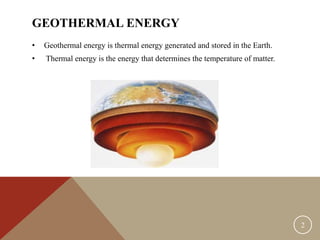
• Geothermal energy is thermal energy generated and stored in the Earth.
• Thermal energy is the energy that determines the temperature of matter.
2
HEAT GENERATORS.
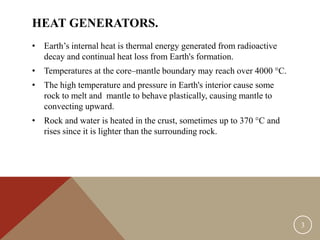
• Earth’s internal heat is thermal energy generated from radioactive
decay and continual heat loss from Earth's formation.
• Temperatures at the core–mantle boundary may reach over 4000 °C.
• The high temperature and pressure in Earth's interior cause some
rock to melt and mantle to behave plastically, causing mantle to
convecting upward.
• Rock and water is heated in the crust, sometimes up to 370 °C and
rises since it is lighter than the surrounding rock.
3
HEAT GENERATORS.
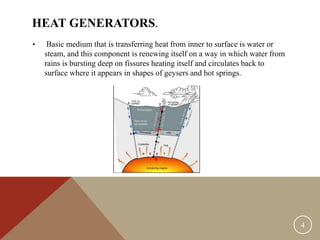
• Basic medium that is transferring heat from inner to surface is water or
steam, and this component is renewing itself on a way in which water from
rains is bursting deep on fissures heating itself and circulates back to
surface where it appears in shapes of geysers and hot springs.
4
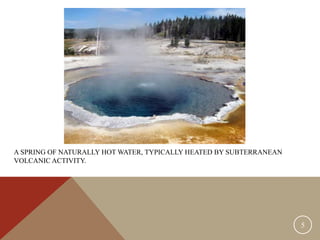
A SPRING OF NATURALLY HOT WATER, TYPICALLY HEATED BY SUBTERRANEAN
VOLCANIC ACTIVITY.
5
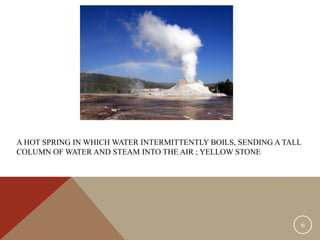
A HOT SPRING IN WHICH WATER INTERMITTENTLY BOILS, SENDING A TALL
COLUMN OF WATER AND STEAM INTO THE AIR ; YELLOW STONE
6
RING OF FIRE
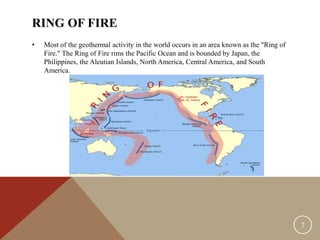
• Most of the geothermal activity in the world occurs in an area known as the "Ring of
Fire." The Ring of Fire rims the Pacific Ocean and is bounded by Japan, the
Philippines, the Aleutian Islands, North America, Central America, and South
America.
7
USES AND APPLICATIONS
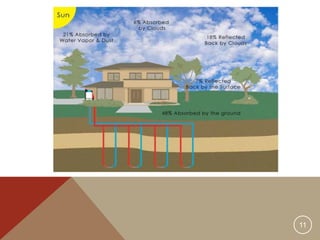
• Heat pumps are another form of using the geothermal energy. Heat pumps
are spending geothermal energy for circulation of geothermal liquid that is
later used for heating, cooling, cooking and preparation of hot water and on
this way need for electrical energy gets significantly decreased.
• There is another wide specter of geothermal energy’s use but there’s no
need to explaining it all on detailed way. Some other exploits are for
instance fish breeding, different types of industrial use, balneology – use for
recreation and healing (hot springs bathing), etc.
• There are four main kinds of geothermal resources: hydrothermal, geo-
pressured, hot dry rock, and magma. Today hydrothermal resources are the
only kind in wide use. The other three resources are still in the infant stages
of development.
8
HYDROTHERMAL RESOURCES
• Hydrothermal resources have the common ingredients of water (hydro) and
heat (thermal). These geothermal reservoirs of steam or hot water occur
naturally where magma comes close enough to the surface to heat ground
water trapped in fractured or porous rocks, or where water circulates at
great depth along faults. Hydrothermal resources are used for different
energy purposes depending on their temperature and how deep they are.
9
LOW TEMPERATURE: "DIRECT USE" OR HEATING
• When the temperature of a hydrothermal resource is around 50F and up, it
can be used directly in spas or to heat buildings, grow crops, warm fish
ponds, or for other uses. Hydrothermal resources suitable for heating occur
throughout the United States and in almost every country in the world. Most
of the people in Iceland and over 500,000 people in France use geothermal
heat for their public buildings, schools, and homes. In the United States,
geothermal heat pumps are used in 45 states to heat and cool homes and
buildings. Idaho, Oregon, Nevada, and some other states use geothermal
energy to heat entire districts.
• Heat from geothermal resources is also used to dry ceramics, lumber,
vegetables, and other products.
10
11
HIGH TEMPERATURE: PRODUCING ELECTRICITY
• When the temperature of a hydrothermal resource is around 220F and up, it
can be used to generate electricity. Most electricity-producing geothermal
resources have temperatures from 300 to 700F, but geothermal reservoirs
can reach nearly 1,000F.
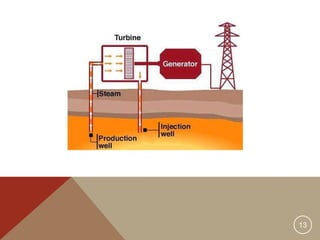
• Two main types of hydrothermal resources are used to generate electricity:
• Dry steam (vapor-dominated) reservoirs, and
• Hot water (liquid-dominated) reservoirs.
12
13
HOT WATER
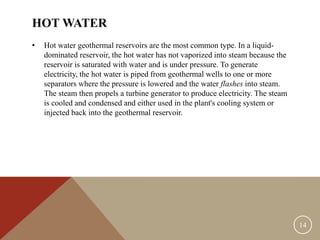
• Hot water geothermal reservoirs are the most common type. In a liquid-
dominated reservoir, the hot water has not vaporized into steam because the
reservoir is saturated with water and is under pressure. To generate
electricity, the hot water is piped from geothermal wells to one or more
separators where the pressure is lowered and the water flashes into steam.
The steam then propels a turbine generator to produce electricity. The steam
is cooled and condensed and either used in the plant's cooling system or
injected back into the geothermal reservoir.
14
ADVANTAGES
• Geothermal energy does not produce any pollution, and does not contribute
to the greenhouse effect.
• The power stations do not take up much room, so there is not much impact
on the environment.
• No fuel is needed.
• Once you've built a geothermal power station, the energy is almost free.
It may need a little energy to run a pump, but this can be taken from the
energy being generated.
15
DISADVANTAGES
• The big problem is that there are not many places where you can build a
geothermal power station.
• You need hot rocks of a suitable type, at a depth where we can drill down to
them.
• The type of rock above is also important, it must be of a type that we can
easily drill through.
• Sometimes a geothermal site may "run out of steam", perhaps for decades.
• Hazardous gases and minerals may come up from underground, and can be
difficult to safely dispose of.
16
CAN PAKISTAN USE GEOTHERMAL ENERGY
TO SATISFY ITS NEEDS???
• Pakistan, despite the enormous potential of its energy resources, remains
energy deficient and has to rely heavily on imports of hydrocarbon products
to satisfy hardly its needs.
• Pakistan has wide spectrum of high potential renewable energy sources,
conventional and as well non-conventional. Many of them have not been
adequately explored, exploited and developed. Geothermal energy is one of
them.
• Pakistan can be benefited by harnessing the geothermal option of energy
generation as substitute energy in areas where sources exist.
17
REFERENCES
Armstead, H. C. H. (1978). Geothermal energy: its past, present and future
contributions to the energy needs of man
Fridleifsson, I. B. (2001). Geothermal energy for the benefit of the
people.Renewable and sustainable energy reviews, 5(3), 299-312.
Lund, J. W., Freeston, D. H., & Boyd, T. L. (2005). Direct application of
geothermal energy: 2005 worldwide review. Geothermics, 34(6), 691-727.
18
Thankyou 
19

Geothermal energy

  • 1.
    STRATIGRAPHY OF PAKISTAN GE O T H E R M A L E N E R G Y 1 Group Members Muhammad Haris Mahmood (01-161141-031) Mujahid Hassan Khan(01-161141-043) Muhammad Sharjeel Raza(01-161141-037)
  • 2.
    GEOTHERMAL ENERGY • Geothermalenergy is thermal energy generated and stored in the Earth. • Thermal energy is the energy that determines the temperature of matter. 2
  • 3.
    HEAT GENERATORS. • Earth’sinternal heat is thermal energy generated from radioactive decay and continual heat loss from Earth's formation. • Temperatures at the core–mantle boundary may reach over 4000 °C. • The high temperature and pressure in Earth's interior cause some rock to melt and mantle to behave plastically, causing mantle to convecting upward. • Rock and water is heated in the crust, sometimes up to 370 °C and rises since it is lighter than the surrounding rock. 3
  • 4.
    HEAT GENERATORS. • Basicmedium that is transferring heat from inner to surface is water or steam, and this component is renewing itself on a way in which water from rains is bursting deep on fissures heating itself and circulates back to surface where it appears in shapes of geysers and hot springs. 4
  • 5.
    A SPRING OFNATURALLY HOT WATER, TYPICALLY HEATED BY SUBTERRANEAN VOLCANIC ACTIVITY. 5
  • 6.
    A HOT SPRINGIN WHICH WATER INTERMITTENTLY BOILS, SENDING A TALL COLUMN OF WATER AND STEAM INTO THE AIR ; YELLOW STONE 6
  • 7.
    RING OF FIRE •Most of the geothermal activity in the world occurs in an area known as the "Ring of Fire." The Ring of Fire rims the Pacific Ocean and is bounded by Japan, the Philippines, the Aleutian Islands, North America, Central America, and South America. 7
  • 8.
    USES AND APPLICATIONS •Heat pumps are another form of using the geothermal energy. Heat pumps are spending geothermal energy for circulation of geothermal liquid that is later used for heating, cooling, cooking and preparation of hot water and on this way need for electrical energy gets significantly decreased. • There is another wide specter of geothermal energy’s use but there’s no need to explaining it all on detailed way. Some other exploits are for instance fish breeding, different types of industrial use, balneology – use for recreation and healing (hot springs bathing), etc. • There are four main kinds of geothermal resources: hydrothermal, geo- pressured, hot dry rock, and magma. Today hydrothermal resources are the only kind in wide use. The other three resources are still in the infant stages of development. 8
  • 9.
    HYDROTHERMAL RESOURCES • Hydrothermalresources have the common ingredients of water (hydro) and heat (thermal). These geothermal reservoirs of steam or hot water occur naturally where magma comes close enough to the surface to heat ground water trapped in fractured or porous rocks, or where water circulates at great depth along faults. Hydrothermal resources are used for different energy purposes depending on their temperature and how deep they are. 9
  • 10.
    LOW TEMPERATURE: "DIRECTUSE" OR HEATING • When the temperature of a hydrothermal resource is around 50F and up, it can be used directly in spas or to heat buildings, grow crops, warm fish ponds, or for other uses. Hydrothermal resources suitable for heating occur throughout the United States and in almost every country in the world. Most of the people in Iceland and over 500,000 people in France use geothermal heat for their public buildings, schools, and homes. In the United States, geothermal heat pumps are used in 45 states to heat and cool homes and buildings. Idaho, Oregon, Nevada, and some other states use geothermal energy to heat entire districts. • Heat from geothermal resources is also used to dry ceramics, lumber, vegetables, and other products. 10
  • 11.
  • 12.
    HIGH TEMPERATURE: PRODUCINGELECTRICITY • When the temperature of a hydrothermal resource is around 220F and up, it can be used to generate electricity. Most electricity-producing geothermal resources have temperatures from 300 to 700F, but geothermal reservoirs can reach nearly 1,000F. • Two main types of hydrothermal resources are used to generate electricity: • Dry steam (vapor-dominated) reservoirs, and • Hot water (liquid-dominated) reservoirs. 12
  • 13.
  • 14.
    HOT WATER • Hotwater geothermal reservoirs are the most common type. In a liquid- dominated reservoir, the hot water has not vaporized into steam because the reservoir is saturated with water and is under pressure. To generate electricity, the hot water is piped from geothermal wells to one or more separators where the pressure is lowered and the water flashes into steam. The steam then propels a turbine generator to produce electricity. The steam is cooled and condensed and either used in the plant's cooling system or injected back into the geothermal reservoir. 14
  • 15.
    ADVANTAGES • Geothermal energydoes not produce any pollution, and does not contribute to the greenhouse effect. • The power stations do not take up much room, so there is not much impact on the environment. • No fuel is needed. • Once you've built a geothermal power station, the energy is almost free. It may need a little energy to run a pump, but this can be taken from the energy being generated. 15
  • 16.
    DISADVANTAGES • The bigproblem is that there are not many places where you can build a geothermal power station. • You need hot rocks of a suitable type, at a depth where we can drill down to them. • The type of rock above is also important, it must be of a type that we can easily drill through. • Sometimes a geothermal site may "run out of steam", perhaps for decades. • Hazardous gases and minerals may come up from underground, and can be difficult to safely dispose of. 16
  • 17.
    CAN PAKISTAN USEGEOTHERMAL ENERGY TO SATISFY ITS NEEDS??? • Pakistan, despite the enormous potential of its energy resources, remains energy deficient and has to rely heavily on imports of hydrocarbon products to satisfy hardly its needs. • Pakistan has wide spectrum of high potential renewable energy sources, conventional and as well non-conventional. Many of them have not been adequately explored, exploited and developed. Geothermal energy is one of them. • Pakistan can be benefited by harnessing the geothermal option of energy generation as substitute energy in areas where sources exist. 17
  • 18.
    REFERENCES Armstead, H. C.H. (1978). Geothermal energy: its past, present and future contributions to the energy needs of man Fridleifsson, I. B. (2001). Geothermal energy for the benefit of the people.Renewable and sustainable energy reviews, 5(3), 299-312. Lund, J. W., Freeston, D. H., & Boyd, T. L. (2005). Direct application of geothermal energy: 2005 worldwide review. Geothermics, 34(6), 691-727. 18
  • 19.