Some introductory words
about Geothermal Energy
 Tapping heat from the earth core is
nothing new. It dates back to 20,000 years
ago. Health spas were already enjoyed
by different populations across the
globe, romans, paleo-indians etc...
 Heat pump technology took a little bit
more to develop.
 Industrial uses quickly generalized during
the 20th century.
Marisa Gil Lapetra
1
Geothermal Essentials
 Geothermal energy is heat contained
and discharged from the Earth’s nucleus
that can be used for generating
electricity and providing direct heat for
numerous applications. The use of energy
extracted from constant sources at
shallow depths by means of a Ground
Source Heat Pump is also referred to as
Geothermal Energy.
Marisa Gil Lapetra
2
Advantages
 No seasonal variation and immunity of
weather effects and climate change
impacts.
 Compatibility with both centralized and
distributed energy generation.
 Resource availability in all world regions.
Marisa Gil Lapetra
3
Barriers
 High capital cost (upfront
costs, exploratory, drilling…)
 Resource development risk
 Lack of awareness about geothermal
energy and perceived environmental
issues.
Marisa Gil Lapetra
4
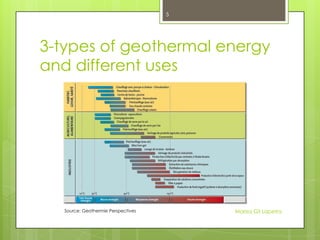
3-types of geothermal energy
and different uses
Marisa Gil Lapetra
5
Source: Geothermie Perspectives
Geothermal Ground Source Energy
High versus Low temperature geothermal
applications
(Very) Low-
temperature
geothermal energy
 Shallow depths (35m to 50m)
and low temperatures up to
30C
 Sanitary hot water , heating
and cooling by means of
Geothermal Ground Source
Heat Pumps (GSHP’s)
 Local exploitation
 Micro level: individual projects,
home owners and small
business
 Public-Private financing
 SME nurturing
High-temperature
geothermal energy
 Deep wells (over 1000 m
depth) with temperatures over
150C
 Can be used for both
electricity generation and
direct heat
 Global exploitation
 Macro level: large scale
projects involving public
administrations and industries
 Public financing only
 Involves Multinational
Corporations
Marisa Gil Lapetra
6
Global resources
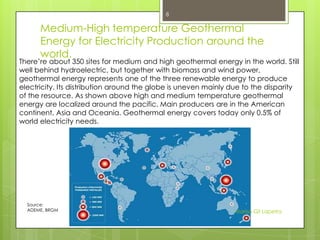
• Red areas represent high-temp geothermal energy (over 150 C, 1500m to 2000m deep)
for direct use, mainly industrial and electricity generation
• Green areas are medium-temp energy (around 90C to 150 C at lower than 1000 m)
• Grey areas are low -temp geothermal energy (lower than 90c down to 300m deep).
Generally speaking all the earth area is susceptible to be exploited for geothermal
energy by means of a GSHP (very low temperature up to 30 C).
Marisa Gil Lapetra
7
Source: ADEME, BRGM
Medium-High temperature Geothermal
Energy for Electricity Production around the
world.
There’re about 350 sites for medium and high geothermal energy in the world. Still
well behind hydroelectric, but together with biomass and wind power,
geothermal energy represents one of the three renewable energy to produce
electricity. Its distribution around the globe is uneven mainly due to the disparity
of the resource. As shown above high and medium temperature geothermal
energy are localized around the pacific. Main producers are in the American
continent, Asia and Oceania. Geothermal energy covers today only 0.5% of
world electricity needs.
Marisa Gil Lapetra
8
Source:
ADEME, BRGM
Electricity production Direct use (including GSHP)
COUNTRY GWH/year COUNTRY GWH/year
United States 16,603 China 20,932
Philippines 10,311 United States 15,710
Indonesia 9,600 Sweden 12,585
Mexico 7,047 Turkey 10,247
Italy 5,520 Japan 7,139
Iceland 4,597 Norway 7,000
New Zealand 4,055 Iceland 6,768
Japan 3,064 France 3,592
Kenya 1,430 Germany 3,546
El Salvador 1,422 Netherlands 2,972
Costa Rica 1,131 Italy 2,762
Turkey 490 Hungary 2,713
Papua New Guinea 450 New
Zealand
2,654
Russia 441 Canada 2,465
Nicaragua 310 Finland 2,325
Market Status
Geothermal Electricity
Generation and Direct
use.
Top 15 countries using
geothermal energy.
Geothermal power
provides a significant
share of total
electricity demand in
Iceland (25%), El
Salvador (22%), Kenya
and the Philippines
(each 17%) and Costa
Rica (13%)
Data: Bertani, WGC 2010; Lund et
al, WGC 2010 Marisa Gil Lapetra
9
Geothermal outlook
(according to the IEA)
 Global geothermal energy installed capacity was 10.7
GWe in 2010, generating 67.2 TWh electricity.
 Geothermal power production could increase to more
than 1000 TWh by 2050 (upper scenario).
 GSHP market worldwide represents about 2.9 million units
today with over 35 GWth capacity of heat production.
 Technology advancements in GSHP are expected to
improve the performance and lower the costs (key
components are compressors and heat exchangers). The
number of units could multiply by a factor increasing the
capacity to 700 GWth of heat production.
 (1TWh=103 GWh)
Marisa Gil Lapetra
10
TODAY
3 pieces fitting 1 puzzle:
(1) Finance
 Medium-High-temperature geothermal
energy receives most of the public finance
attention.
 (Very)Low-temperature geothermal energy
(GSHP) requires public granting up to at least
35% of total investment costs to be attractive.
 Limited finance resources.
 While H-T is seeing incremental resources
being allocated to its cause, L-T public
participation is decreasing just as any other
public subsidy, due to the crisis.
Marisa Gil Lapetra
11
TODAY
3 pieces fitting 1 puzzle:
(2) Recipients
 While Medium-High temperature
Geothermal projects are large-scale
investments for industrial purposes or
electricity generation with a large base of
recipients…
 (Very) Low temperature geothermal is
indicated mainly for individual use
(households) or small units of heating
consumption (hotels, schools, clinics,
libraries..)
Marisa Gil Lapetra
12
TODAY
3 pieces fitting 1 puzzle:
(3) Awareness
 International Organizations take care of
promoting Green Energies, amongst which
Geothermal (World Bank, African Dev. Bank,
,Asian Dev. Bank, European Inv. Bank and
Interamerican Dev. Bank) and financing
projects
 Central Governments subsidizes renewable
energies with decreasing resources and
private banking proposes low-interest rates for
green investments under very tight criteria.
Marisa Gil Lapetra
13
WHAT DO WE
HAVE TODAY
Geothermal Energy - Electricity
production – World Bank panacea
for developing countries.
 WB calls for a Global Geothermal Development Plan (GGDP) to bring geothermal power,
what is now a marginal renewable energy source into the mainstream, to deliver power to
millions in developing countries.
 GGDP aims at putting together donors and multilateral lenders around an investment plan
to scale up geothermal power in the developing world. The Plan focuses on exploratory test
drilling, with the goal of developing a pipeline of commercially-viable projects that are
ready for private investment.
 Once it’s running it’s clean, reliable, locally-produced power, it is cheap and virtually
endless. Goals are universal access to modern energy services, and doubling the share of
renewable energy in the global energy mix.
 The Plan will identify promising sites. Initial target is to mobilize US$500 million, in 2013. Donors
can participate by identifying viable projects, and through bilateral assistance, as well as by
contributing to existing channels such as the Climate Investment Funds (CIFs) or the Global
Environment Facility (GEF). The GGDP will be managed by the World Bank’s longstanding
Energy Sector Management Assistance Program (ESMAP).
 The Bank Group’s financing for geothermal development began in the 1970s and has
increased from $73 million in 2007 to $336 million in 2012. It now represents almost 10 percent
of the Bank’s total renewable energy lending.
 Geothermal is the energy source with the smallest land footprint per kilowatt hour, making it
especially attractive in developing countries where population densities are high and land is
at a premium.
Marisa Gil Lapetra
15
Geothermal Ground Source
Heat Pump History
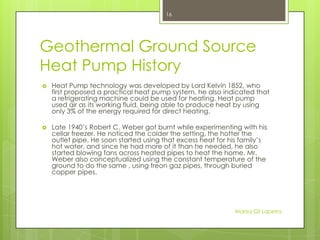
 Heat Pump technology was developed by Lord Kelvin 1852, who
first proposed a practical heat pump system, he also indicated that
a refrigerating machine could be used for heating. Heat pump
used air as its working fluid, being able to produce heat by using
only 3% of the energy required for direct heating.
 Late 1940’s Robert C. Weber got burnt while experimenting with his
cellar freezer. He noticed the colder the setting, the hotter the
outlet pipe. He soon started using that excess heat for his family’s
hot water, and since he had more of it than he needed, he also
started blowing fans across heated pipes to heat the home. Mr.
Weber also conceptualized using the constant temperature of the
ground to do the same , using freon gaz pipes, through buried
copper pipes.
Marisa Gil Lapetra
16
 Ground source heat
pumps (GSHPs) are
electrically powered
systems that tap the
stored energy of the
greatest solar collector in
existence: the earth.
These systems use the
earth's relatively constant
temperature to provide
heating, cooling, and
hot water for homes and
commercial buildings.
What is a
ground
source
heat
pump?
Marisa Gil Lapetra
17
How do ground source heat
pumps work?
 GSHP’s are closed or open loops, and loops can be installed:
horizontally, vertically, or in a pond/lake, depending on the available
land areas and the soil and rock type at the installation site.
 Closed loop systems: water or antifreeze solution is circulated through
plastic pipes buried beneath the earth's surface. During the winter, the
fluid collects heat from the earth and carries it through the system and
into the building. During the summer, the system reverses itself to cool
the building by pulling heat from the building, carrying it through the
system and placing it in the ground. This process creates free hot water
in the summer and delivers substantial hot water savings in the winter.
 Open loop systems operate on the same principle as closed loop
systems and can be installed where an adequate supply of suitable
water is available and open discharge is feasible. Benefits similar to the
closed loop system are obtained.
Marisa Gil Lapetra
18
Application uses of GSHP’s
 Residential
 GSHP distribute uniform and
gentle heat using any kind of
heating system: under floor,
radiators, fan coil units.
Technology can be reversed
during the summer and be used
as a cooling system.
 A GSHP system can be installed
in a residential structure of any
size, anywhere, whether it is
single-family or multi-family.
GSHPs can be installed on
almost any size lot: under lawns,
landscaped areas, driveways,
or the house itself. An existing
house can be retrofitted with a
GSHP using the ductwork that is
already there.
 Commercial
 Cost effective, energy efficient,
and environmentally friendly.
GSHPs are appropriate for new
construction as well as retrofits of
older buildings.
 Their flexible design requirements
make them a good choice for
schools, high-rises, government
buildings, apartments, and
restaurants--almost any
commercial property. Lower
operating and maintenance
costs, durability, and energy
conservation make GSHP’s the
smart choice for commercial
applications. Marisa Gil Lapetra
19
GSHP and its application to
local economies.
 Exemple
 Beynes, a small municipality 40km away
from Paris.
 8% total charges local subsidies
 15% population aged > 65 years
 50% all subsidies reserved to helping
elderly low resource population pay
energy bills for heating purposes.
Marisa Gil Lapetra
20
Source: Mairie de Beynes, 2012
North-of-Loire France, rural
areas
 80% heating equipment: old, inefficient,
polluting fuel-oil furnaces
 From 2009 to 2012 fuel-oil prices went up
by 65%
 Alternatives to fuel-oil are gaz or electric
furnaces, whose primary energy prices will
keep rising in the coming years.
Marisa Gil Lapetra
21
Public Subsidies to Environmental
friendly household/firms retrofit
investments
 From central government agencies and
European Union, managed through
diverse government levels (national,
regional, local..)
 December 2011 Financial Act: ceiling to
cumulated subsidies/grants to 80% total
investment costs for over 65 years
recipients!
 Still big barrier: RED TAPE
Marisa Gil Lapetra
22
SOLUTIONS
 Technical assistance to public local
governments and grants’ recipients.
 Private banks have also accommodated
to this new demand by providing low
interest rates to green projects, even
when amortization periods are over 15
years. Yet eligibility criteria are so tight
that prospects quit before even
completing investment plans. Soften
conditions.
Marisa Gil Lapetra
23
SOLUTIONS cont’d
 Re-evaluate the distributions of public
subsidies to environmental-friendly
investments taking into account long-term
sustainability rather than pay-back period.
 Implementing and encouraging Public-
Private-Partnerships with the SME:
constructors, installers, contractors..
Marisa Gil Lapetra
24

Geothermal ground source energy

  • 1.
    Some introductory words aboutGeothermal Energy  Tapping heat from the earth core is nothing new. It dates back to 20,000 years ago. Health spas were already enjoyed by different populations across the globe, romans, paleo-indians etc...  Heat pump technology took a little bit more to develop.  Industrial uses quickly generalized during the 20th century. Marisa Gil Lapetra 1
  • 2.
    Geothermal Essentials  Geothermalenergy is heat contained and discharged from the Earth’s nucleus that can be used for generating electricity and providing direct heat for numerous applications. The use of energy extracted from constant sources at shallow depths by means of a Ground Source Heat Pump is also referred to as Geothermal Energy. Marisa Gil Lapetra 2
  • 3.
    Advantages  No seasonalvariation and immunity of weather effects and climate change impacts.  Compatibility with both centralized and distributed energy generation.  Resource availability in all world regions. Marisa Gil Lapetra 3
  • 4.
    Barriers  High capitalcost (upfront costs, exploratory, drilling…)  Resource development risk  Lack of awareness about geothermal energy and perceived environmental issues. Marisa Gil Lapetra 4
  • 5.
    3-types of geothermalenergy and different uses Marisa Gil Lapetra 5 Source: Geothermie Perspectives
  • 6.
    Geothermal Ground SourceEnergy High versus Low temperature geothermal applications (Very) Low- temperature geothermal energy  Shallow depths (35m to 50m) and low temperatures up to 30C  Sanitary hot water , heating and cooling by means of Geothermal Ground Source Heat Pumps (GSHP’s)  Local exploitation  Micro level: individual projects, home owners and small business  Public-Private financing  SME nurturing High-temperature geothermal energy  Deep wells (over 1000 m depth) with temperatures over 150C  Can be used for both electricity generation and direct heat  Global exploitation  Macro level: large scale projects involving public administrations and industries  Public financing only  Involves Multinational Corporations Marisa Gil Lapetra 6
  • 7.
    Global resources • Redareas represent high-temp geothermal energy (over 150 C, 1500m to 2000m deep) for direct use, mainly industrial and electricity generation • Green areas are medium-temp energy (around 90C to 150 C at lower than 1000 m) • Grey areas are low -temp geothermal energy (lower than 90c down to 300m deep). Generally speaking all the earth area is susceptible to be exploited for geothermal energy by means of a GSHP (very low temperature up to 30 C). Marisa Gil Lapetra 7 Source: ADEME, BRGM
  • 8.
    Medium-High temperature Geothermal Energyfor Electricity Production around the world. There’re about 350 sites for medium and high geothermal energy in the world. Still well behind hydroelectric, but together with biomass and wind power, geothermal energy represents one of the three renewable energy to produce electricity. Its distribution around the globe is uneven mainly due to the disparity of the resource. As shown above high and medium temperature geothermal energy are localized around the pacific. Main producers are in the American continent, Asia and Oceania. Geothermal energy covers today only 0.5% of world electricity needs. Marisa Gil Lapetra 8 Source: ADEME, BRGM
  • 9.
    Electricity production Directuse (including GSHP) COUNTRY GWH/year COUNTRY GWH/year United States 16,603 China 20,932 Philippines 10,311 United States 15,710 Indonesia 9,600 Sweden 12,585 Mexico 7,047 Turkey 10,247 Italy 5,520 Japan 7,139 Iceland 4,597 Norway 7,000 New Zealand 4,055 Iceland 6,768 Japan 3,064 France 3,592 Kenya 1,430 Germany 3,546 El Salvador 1,422 Netherlands 2,972 Costa Rica 1,131 Italy 2,762 Turkey 490 Hungary 2,713 Papua New Guinea 450 New Zealand 2,654 Russia 441 Canada 2,465 Nicaragua 310 Finland 2,325 Market Status Geothermal Electricity Generation and Direct use. Top 15 countries using geothermal energy. Geothermal power provides a significant share of total electricity demand in Iceland (25%), El Salvador (22%), Kenya and the Philippines (each 17%) and Costa Rica (13%) Data: Bertani, WGC 2010; Lund et al, WGC 2010 Marisa Gil Lapetra 9
  • 10.
    Geothermal outlook (according tothe IEA)  Global geothermal energy installed capacity was 10.7 GWe in 2010, generating 67.2 TWh electricity.  Geothermal power production could increase to more than 1000 TWh by 2050 (upper scenario).  GSHP market worldwide represents about 2.9 million units today with over 35 GWth capacity of heat production.  Technology advancements in GSHP are expected to improve the performance and lower the costs (key components are compressors and heat exchangers). The number of units could multiply by a factor increasing the capacity to 700 GWth of heat production.  (1TWh=103 GWh) Marisa Gil Lapetra 10
  • 11.
    TODAY 3 pieces fitting1 puzzle: (1) Finance  Medium-High-temperature geothermal energy receives most of the public finance attention.  (Very)Low-temperature geothermal energy (GSHP) requires public granting up to at least 35% of total investment costs to be attractive.  Limited finance resources.  While H-T is seeing incremental resources being allocated to its cause, L-T public participation is decreasing just as any other public subsidy, due to the crisis. Marisa Gil Lapetra 11
  • 12.
    TODAY 3 pieces fitting1 puzzle: (2) Recipients  While Medium-High temperature Geothermal projects are large-scale investments for industrial purposes or electricity generation with a large base of recipients…  (Very) Low temperature geothermal is indicated mainly for individual use (households) or small units of heating consumption (hotels, schools, clinics, libraries..) Marisa Gil Lapetra 12
  • 13.
    TODAY 3 pieces fitting1 puzzle: (3) Awareness  International Organizations take care of promoting Green Energies, amongst which Geothermal (World Bank, African Dev. Bank, ,Asian Dev. Bank, European Inv. Bank and Interamerican Dev. Bank) and financing projects  Central Governments subsidizes renewable energies with decreasing resources and private banking proposes low-interest rates for green investments under very tight criteria. Marisa Gil Lapetra 13
  • 14.
  • 15.
    Geothermal Energy -Electricity production – World Bank panacea for developing countries.  WB calls for a Global Geothermal Development Plan (GGDP) to bring geothermal power, what is now a marginal renewable energy source into the mainstream, to deliver power to millions in developing countries.  GGDP aims at putting together donors and multilateral lenders around an investment plan to scale up geothermal power in the developing world. The Plan focuses on exploratory test drilling, with the goal of developing a pipeline of commercially-viable projects that are ready for private investment.  Once it’s running it’s clean, reliable, locally-produced power, it is cheap and virtually endless. Goals are universal access to modern energy services, and doubling the share of renewable energy in the global energy mix.  The Plan will identify promising sites. Initial target is to mobilize US$500 million, in 2013. Donors can participate by identifying viable projects, and through bilateral assistance, as well as by contributing to existing channels such as the Climate Investment Funds (CIFs) or the Global Environment Facility (GEF). The GGDP will be managed by the World Bank’s longstanding Energy Sector Management Assistance Program (ESMAP).  The Bank Group’s financing for geothermal development began in the 1970s and has increased from $73 million in 2007 to $336 million in 2012. It now represents almost 10 percent of the Bank’s total renewable energy lending.  Geothermal is the energy source with the smallest land footprint per kilowatt hour, making it especially attractive in developing countries where population densities are high and land is at a premium. Marisa Gil Lapetra 15
  • 16.
    Geothermal Ground Source HeatPump History  Heat Pump technology was developed by Lord Kelvin 1852, who first proposed a practical heat pump system, he also indicated that a refrigerating machine could be used for heating. Heat pump used air as its working fluid, being able to produce heat by using only 3% of the energy required for direct heating.  Late 1940’s Robert C. Weber got burnt while experimenting with his cellar freezer. He noticed the colder the setting, the hotter the outlet pipe. He soon started using that excess heat for his family’s hot water, and since he had more of it than he needed, he also started blowing fans across heated pipes to heat the home. Mr. Weber also conceptualized using the constant temperature of the ground to do the same , using freon gaz pipes, through buried copper pipes. Marisa Gil Lapetra 16
  • 17.
     Ground sourceheat pumps (GSHPs) are electrically powered systems that tap the stored energy of the greatest solar collector in existence: the earth. These systems use the earth's relatively constant temperature to provide heating, cooling, and hot water for homes and commercial buildings. What is a ground source heat pump? Marisa Gil Lapetra 17
  • 18.
    How do groundsource heat pumps work?  GSHP’s are closed or open loops, and loops can be installed: horizontally, vertically, or in a pond/lake, depending on the available land areas and the soil and rock type at the installation site.  Closed loop systems: water or antifreeze solution is circulated through plastic pipes buried beneath the earth's surface. During the winter, the fluid collects heat from the earth and carries it through the system and into the building. During the summer, the system reverses itself to cool the building by pulling heat from the building, carrying it through the system and placing it in the ground. This process creates free hot water in the summer and delivers substantial hot water savings in the winter.  Open loop systems operate on the same principle as closed loop systems and can be installed where an adequate supply of suitable water is available and open discharge is feasible. Benefits similar to the closed loop system are obtained. Marisa Gil Lapetra 18
  • 19.
    Application uses ofGSHP’s  Residential  GSHP distribute uniform and gentle heat using any kind of heating system: under floor, radiators, fan coil units. Technology can be reversed during the summer and be used as a cooling system.  A GSHP system can be installed in a residential structure of any size, anywhere, whether it is single-family or multi-family. GSHPs can be installed on almost any size lot: under lawns, landscaped areas, driveways, or the house itself. An existing house can be retrofitted with a GSHP using the ductwork that is already there.  Commercial  Cost effective, energy efficient, and environmentally friendly. GSHPs are appropriate for new construction as well as retrofits of older buildings.  Their flexible design requirements make them a good choice for schools, high-rises, government buildings, apartments, and restaurants--almost any commercial property. Lower operating and maintenance costs, durability, and energy conservation make GSHP’s the smart choice for commercial applications. Marisa Gil Lapetra 19
  • 20.
    GSHP and itsapplication to local economies.  Exemple  Beynes, a small municipality 40km away from Paris.  8% total charges local subsidies  15% population aged > 65 years  50% all subsidies reserved to helping elderly low resource population pay energy bills for heating purposes. Marisa Gil Lapetra 20 Source: Mairie de Beynes, 2012
  • 21.
    North-of-Loire France, rural areas 80% heating equipment: old, inefficient, polluting fuel-oil furnaces  From 2009 to 2012 fuel-oil prices went up by 65%  Alternatives to fuel-oil are gaz or electric furnaces, whose primary energy prices will keep rising in the coming years. Marisa Gil Lapetra 21
  • 22.
    Public Subsidies toEnvironmental friendly household/firms retrofit investments  From central government agencies and European Union, managed through diverse government levels (national, regional, local..)  December 2011 Financial Act: ceiling to cumulated subsidies/grants to 80% total investment costs for over 65 years recipients!  Still big barrier: RED TAPE Marisa Gil Lapetra 22
  • 23.
    SOLUTIONS  Technical assistanceto public local governments and grants’ recipients.  Private banks have also accommodated to this new demand by providing low interest rates to green projects, even when amortization periods are over 15 years. Yet eligibility criteria are so tight that prospects quit before even completing investment plans. Soften conditions. Marisa Gil Lapetra 23
  • 24.
    SOLUTIONS cont’d  Re-evaluatethe distributions of public subsidies to environmental-friendly investments taking into account long-term sustainability rather than pay-back period.  Implementing and encouraging Public- Private-Partnerships with the SME: constructors, installers, contractors.. Marisa Gil Lapetra 24