THE POTENTIAL OF GEOTHERMAL
ENERGY
A ONCE AND FUTURE FOCUS
OF
THE BUREAU OF ECONOMIC GEOLOGY
Bruce L. Cutright
THE POTENTIAL OF GEOTHERMAL ENERGY
Summary
 An underestimated and largely untapped resource
 Not Geographically limited, as hydrothermal sites are
 Less costly than solar or wind, in ¢ per KWhr
 Largest return on investment of R&D Dollars
 Renewable, small footprint, negligible emissions
 BEG’s skills in reservoir characterization, flow
modeling and carbon sequestration are directly
applicable to geothermal energy assessment and
development.
Bruce L. Cutright
THE POTENTIAL OF GEOTHERMAL ENERGY
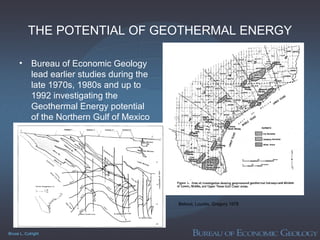
• Bureau of Economic Geology
lead earlier studies during the
late 1970s, 1980s and up to
1992 investigating the
Geothermal Energy potential
of the Northern Gulf of Mexico
Bebout, Loucks, Gregory 1978
Bruce L. Cutright
THE POTENTIAL OF GEOTHERMAL ENERGY
What Changed from 1980 to
Today?
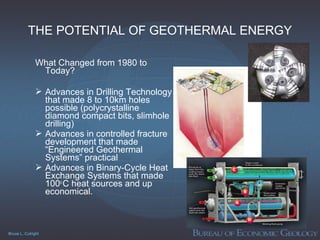
 Advances in Drilling Technology
that made 8 to 10km holes
possible (polycrystalline
diamond compact bits, slimhole
drilling)
 Advances in controlled fracture
development that made
“Engineered Geothermal
Systems” practical
 Advances in Binary-Cycle Heat
Exchange Systems that made
100o
C heat sources and up
economical.
Bruce L. Cutright
• Leveraging the Past to Define the Future
The basics:
Geology
Stratigraphy
Structural geology; fractures, stress fields
Fluid flow
Heat flow
Reservoir Characterization
Yield, Thermal Characteristics, Future Predictions
Reservoir Management, Restoration and Maintenance
Economics.
Bruce L. Cutright
THE POTENTIAL OF GEOTHERMAL ENERGY
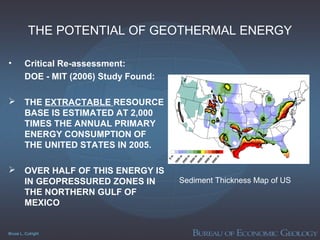
• Critical Re-assessment:
DOE - MIT (2006) Study Found:
 THE EXTRACTABLE RESOURCE
BASE IS ESTIMATED AT 2,000
TIMES THE ANNUAL PRIMARY
ENERGY CONSUMPTION OF
THE UNITED STATES IN 2005.
 OVER HALF OF THIS ENERGY IS
IN GEOPRESSURED ZONES IN
THE NORTHERN GULF OF
MEXICO
Sediment Thickness Map of US
Bruce L. Cutright
THE POTENTIAL OF GEOTHERMAL ENERGY
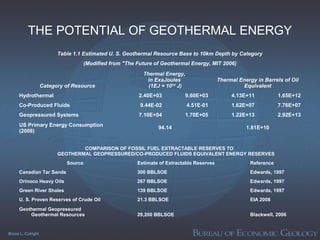
Table 1.1 Estimated U. S. Geothermal Resource Base to 10km Depth by Category
(Modified from "The Future of Geothermal Energy, MIT 2006)
Category of Resource
Thermal Energy,
in ExaJoules
(1EJ = 1018
J)
Thermal Energy in Barrels of Oil
Equivalent
Hydrothermal 2.40E+03 9.60E+03 4.13E+11 1.65E+12
Co-Produced Fluids 9.44E-02 4.51E-01 1.62E+07 7.76E+07
Geopressured Systems 7.10E+04 1.70E+05 1.22E+13 2.92E+13
US Primary Energy Consumption
(2008)
94.14 1.81E+10
COMPARISON OF FOSSIL FUEL EXTRACTABLE RESERVES TO
GEOTHERMAL GEOPRESSURED/CO-PRODUCED FLUIDS EQUIVALENT ENERGY RESERVES
Source Estimate of Extractable Reserves Reference
Canadian Tar Sands 300 BBLSOE Edwards, 1997
Orinoco Heavy Oils 267 BBLSOE Edwards, 1997
Green River Shales 139 BBLSOE Edwards, 1997
U. S. Proven Reserves of Crude Oil 21.3 BBLSOE EIA 2008
Geothermal Geopressured
Geothermal Resources 29,200 BBLSOE Blackwell, 2006
Bruce L. Cutright
THE POTENTIAL OF GEOTHERMAL ENERGY
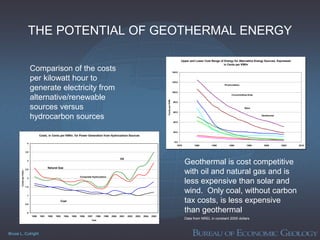
Comparison of the costs
per kilowatt hour to
generate electricity from
alternative/renewable
sources versus
hydrocarbon sources
Upper and Lower Cost Range of Energy for Alternative Energy Sources, Expressed
in Cents per KWhr
0.0
20.0
40.0
60.0
80.0
100.0
120.0
140.0
1975 1980 1985 1990 1995 2000 2005 2010
CentsperKWh
Photovoltaics
Concentrating Solar
Wind
Geothermal
Costs, in Cents per KWhr, for Power Generation from Hydrocarbon Sources
0
0.5
1
1.5
2
2.5
3
3.5
4
1990 1991 1992 1993 1994 1995 1996 1997 1998 1999 2000 2001 2002 2003 2004 2005
Year
CentsperKwhr
Oil
Natural Gas
Coal
Composite Hydrocarbon
Geothermal is cost competitive
with oil and natural gas and is
less expensive than solar and
wind. Only coal, without carbon
tax costs, is less expensive
than geothermal
Data from NREL in constant 2005 dollars
Bruce L. Cutright
What Our Partners are doing
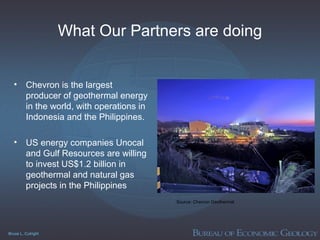
• Chevron is the largest
producer of geothermal energy
in the world, with operations in
Indonesia and the Philippines.
• US energy companies Unocal
and Gulf Resources are willing
to invest US$1.2 billion in
geothermal and natural gas
projects in the Philippines
Source: Chevron Geothermal
Bruce L. Cutright
What are our Industrial Partners Seeing?
The Classical, but limited, hydrothermal/magmatic resource
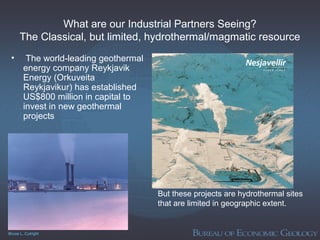
• The world-leading geothermal
energy company Reykjavik
Energy (Orkuveita
Reykjavikur) has established
US$800 million in capital to
invest in new geothermal
projects
But these projects are hydrothermal sites
that are limited in geographic extent.
Bruce L. Cutright
What Our Partners are doing
Binary Cycle Rankine Engine
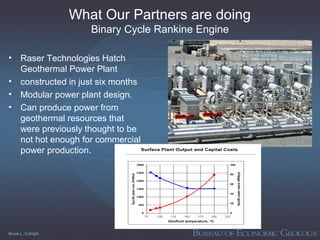
• Raser Technologies Hatch
Geothermal Power Plant
• constructed in just six months
• Modular power plant design.
• Can produce power from
geothermal resources that
were previously thought to be
not hot enough for commercial
power production.
Bruce L. Cutright
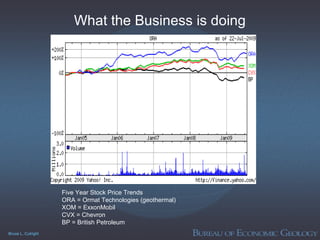
Five Year Stock Price Trends
ORA = Ormat Technologies (geothermal)
XOM = ExxonMobil
CVX = Chevron
BP = British Petroleum
What the Business is doing
Bruce L. Cutright
Why Geothermal?
Why Now?
 The Economics have changed
 geothermal is now cost-competitive with petroleum, and
lower cost than solar and wind.
 The Resource Base has changed
 no longer only hydrothermal-magmatic but widely
distributed geothermal heat flow
 The extractable resource is 2000 times the annual demand
of the US.
 The regulations have, or will change
 Favoring non-CO2 emitting energy sources
Bruce L. Cutright
Sponsored Research Opportunities
 Geothermal Energy – Sponsored Opportunities
 The American Recovery and Reinvestment Act: $350 million new
investment in this technology.
• Geothermal Demonstration Projects = $140 Million
• Enhanced Geothermal Systems Technology Research and
Development = $80 Million
• Innovative Exploration Techniques = $100 Million.
• National Geothermal Data System, Resource Assessment, and
Classification System = $30 Million
 Private funding opportunities for BEG, at this time, equal or
exceed the federal or state opportunities.
Bruce L. Cutright
The Bureau’s Immediate Opportunities
$11.6 Million over 3 years
• Technology Interface System, $3.6 Million over 2 years
• Towards Field Testing of CO2 as Operating Fluid for
EGS, $4.9 Million over 2 years
• Geothermal Energy from Coproduced Fluids, $452,791
for 1 yr. (potential for $MM over 5 years)
• Geothermal Energy From Geopressured Resources
$361,191 for 1 yr. (potential for $MM over 5 yr)
• Geothermal Data Development, Collection and
Maintenance, $2.28 Million over 3 years
Bruce L. Cutright
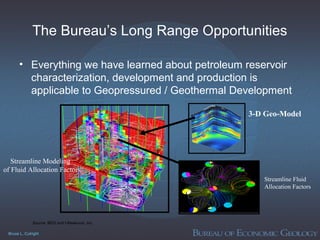
The Bureau’s Long Range Opportunities
• Everything we have learned about petroleum reservoir
characterization, development and production is
applicable to Geopressured / Geothermal Development
Streamline Modeling
of Fluid Allocation Factors
3-D Geo-Model
Streamline Fluid
Allocation Factors
Source: BEG and I-Reservoir, Inc.
Bruce L. Cutright
Where is the Cutting Edge?
 Primary Focus is on Geopressured Zones having
Thermal-Kinetic-Chemical Energy Content
 Combining geothermal heat extraction using supercritical
carbon dioxide
 Links geologic sequestration of CO2 with non-polluting,
renewable energy production
 Results in improvement of heat extraction efficiency by 40% to
180% (Pruess, K. 2006)
 Provides a methodology for coal fired power plants to recover
the energy penalty incurred in CO2 capture
 Metal – Organic heat carriers (MOHC) offer
additional improvements in efficiency, at a cost.
Bruce L. Cutright
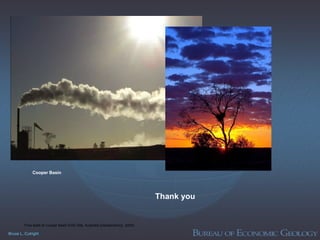
Flow tests at Cooper Basin EGS Site, Australia (Geodynamics, 2005)
Cooper Basin
Thank you

Geothermal energy

  • 1.
    THE POTENTIAL OFGEOTHERMAL ENERGY A ONCE AND FUTURE FOCUS OF THE BUREAU OF ECONOMIC GEOLOGY
  • 2.
    Bruce L. Cutright THEPOTENTIAL OF GEOTHERMAL ENERGY Summary  An underestimated and largely untapped resource  Not Geographically limited, as hydrothermal sites are  Less costly than solar or wind, in ¢ per KWhr  Largest return on investment of R&D Dollars  Renewable, small footprint, negligible emissions  BEG’s skills in reservoir characterization, flow modeling and carbon sequestration are directly applicable to geothermal energy assessment and development.
  • 3.
    Bruce L. Cutright THEPOTENTIAL OF GEOTHERMAL ENERGY • Bureau of Economic Geology lead earlier studies during the late 1970s, 1980s and up to 1992 investigating the Geothermal Energy potential of the Northern Gulf of Mexico Bebout, Loucks, Gregory 1978
  • 4.
    Bruce L. Cutright THEPOTENTIAL OF GEOTHERMAL ENERGY What Changed from 1980 to Today?  Advances in Drilling Technology that made 8 to 10km holes possible (polycrystalline diamond compact bits, slimhole drilling)  Advances in controlled fracture development that made “Engineered Geothermal Systems” practical  Advances in Binary-Cycle Heat Exchange Systems that made 100o C heat sources and up economical.
  • 5.
    Bruce L. Cutright •Leveraging the Past to Define the Future The basics: Geology Stratigraphy Structural geology; fractures, stress fields Fluid flow Heat flow Reservoir Characterization Yield, Thermal Characteristics, Future Predictions Reservoir Management, Restoration and Maintenance Economics.
  • 6.
    Bruce L. Cutright THEPOTENTIAL OF GEOTHERMAL ENERGY • Critical Re-assessment: DOE - MIT (2006) Study Found:  THE EXTRACTABLE RESOURCE BASE IS ESTIMATED AT 2,000 TIMES THE ANNUAL PRIMARY ENERGY CONSUMPTION OF THE UNITED STATES IN 2005.  OVER HALF OF THIS ENERGY IS IN GEOPRESSURED ZONES IN THE NORTHERN GULF OF MEXICO Sediment Thickness Map of US
  • 7.
    Bruce L. Cutright THEPOTENTIAL OF GEOTHERMAL ENERGY Table 1.1 Estimated U. S. Geothermal Resource Base to 10km Depth by Category (Modified from "The Future of Geothermal Energy, MIT 2006) Category of Resource Thermal Energy, in ExaJoules (1EJ = 1018 J) Thermal Energy in Barrels of Oil Equivalent Hydrothermal 2.40E+03 9.60E+03 4.13E+11 1.65E+12 Co-Produced Fluids 9.44E-02 4.51E-01 1.62E+07 7.76E+07 Geopressured Systems 7.10E+04 1.70E+05 1.22E+13 2.92E+13 US Primary Energy Consumption (2008) 94.14 1.81E+10 COMPARISON OF FOSSIL FUEL EXTRACTABLE RESERVES TO GEOTHERMAL GEOPRESSURED/CO-PRODUCED FLUIDS EQUIVALENT ENERGY RESERVES Source Estimate of Extractable Reserves Reference Canadian Tar Sands 300 BBLSOE Edwards, 1997 Orinoco Heavy Oils 267 BBLSOE Edwards, 1997 Green River Shales 139 BBLSOE Edwards, 1997 U. S. Proven Reserves of Crude Oil 21.3 BBLSOE EIA 2008 Geothermal Geopressured Geothermal Resources 29,200 BBLSOE Blackwell, 2006
  • 8.
    Bruce L. Cutright THEPOTENTIAL OF GEOTHERMAL ENERGY Comparison of the costs per kilowatt hour to generate electricity from alternative/renewable sources versus hydrocarbon sources Upper and Lower Cost Range of Energy for Alternative Energy Sources, Expressed in Cents per KWhr 0.0 20.0 40.0 60.0 80.0 100.0 120.0 140.0 1975 1980 1985 1990 1995 2000 2005 2010 CentsperKWh Photovoltaics Concentrating Solar Wind Geothermal Costs, in Cents per KWhr, for Power Generation from Hydrocarbon Sources 0 0.5 1 1.5 2 2.5 3 3.5 4 1990 1991 1992 1993 1994 1995 1996 1997 1998 1999 2000 2001 2002 2003 2004 2005 Year CentsperKwhr Oil Natural Gas Coal Composite Hydrocarbon Geothermal is cost competitive with oil and natural gas and is less expensive than solar and wind. Only coal, without carbon tax costs, is less expensive than geothermal Data from NREL in constant 2005 dollars
  • 9.
    Bruce L. Cutright WhatOur Partners are doing • Chevron is the largest producer of geothermal energy in the world, with operations in Indonesia and the Philippines. • US energy companies Unocal and Gulf Resources are willing to invest US$1.2 billion in geothermal and natural gas projects in the Philippines Source: Chevron Geothermal
  • 10.
    Bruce L. Cutright Whatare our Industrial Partners Seeing? The Classical, but limited, hydrothermal/magmatic resource • The world-leading geothermal energy company Reykjavik Energy (Orkuveita Reykjavikur) has established US$800 million in capital to invest in new geothermal projects But these projects are hydrothermal sites that are limited in geographic extent.
  • 11.
    Bruce L. Cutright WhatOur Partners are doing Binary Cycle Rankine Engine • Raser Technologies Hatch Geothermal Power Plant • constructed in just six months • Modular power plant design. • Can produce power from geothermal resources that were previously thought to be not hot enough for commercial power production.
  • 12.
    Bruce L. Cutright FiveYear Stock Price Trends ORA = Ormat Technologies (geothermal) XOM = ExxonMobil CVX = Chevron BP = British Petroleum What the Business is doing
  • 13.
    Bruce L. Cutright WhyGeothermal? Why Now?  The Economics have changed  geothermal is now cost-competitive with petroleum, and lower cost than solar and wind.  The Resource Base has changed  no longer only hydrothermal-magmatic but widely distributed geothermal heat flow  The extractable resource is 2000 times the annual demand of the US.  The regulations have, or will change  Favoring non-CO2 emitting energy sources
  • 14.
    Bruce L. Cutright SponsoredResearch Opportunities  Geothermal Energy – Sponsored Opportunities  The American Recovery and Reinvestment Act: $350 million new investment in this technology. • Geothermal Demonstration Projects = $140 Million • Enhanced Geothermal Systems Technology Research and Development = $80 Million • Innovative Exploration Techniques = $100 Million. • National Geothermal Data System, Resource Assessment, and Classification System = $30 Million  Private funding opportunities for BEG, at this time, equal or exceed the federal or state opportunities.
  • 15.
    Bruce L. Cutright TheBureau’s Immediate Opportunities $11.6 Million over 3 years • Technology Interface System, $3.6 Million over 2 years • Towards Field Testing of CO2 as Operating Fluid for EGS, $4.9 Million over 2 years • Geothermal Energy from Coproduced Fluids, $452,791 for 1 yr. (potential for $MM over 5 years) • Geothermal Energy From Geopressured Resources $361,191 for 1 yr. (potential for $MM over 5 yr) • Geothermal Data Development, Collection and Maintenance, $2.28 Million over 3 years
  • 16.
    Bruce L. Cutright TheBureau’s Long Range Opportunities • Everything we have learned about petroleum reservoir characterization, development and production is applicable to Geopressured / Geothermal Development Streamline Modeling of Fluid Allocation Factors 3-D Geo-Model Streamline Fluid Allocation Factors Source: BEG and I-Reservoir, Inc.
  • 17.
    Bruce L. Cutright Whereis the Cutting Edge?  Primary Focus is on Geopressured Zones having Thermal-Kinetic-Chemical Energy Content  Combining geothermal heat extraction using supercritical carbon dioxide  Links geologic sequestration of CO2 with non-polluting, renewable energy production  Results in improvement of heat extraction efficiency by 40% to 180% (Pruess, K. 2006)  Provides a methodology for coal fired power plants to recover the energy penalty incurred in CO2 capture  Metal – Organic heat carriers (MOHC) offer additional improvements in efficiency, at a cost.
  • 18.
    Bruce L. Cutright Flowtests at Cooper Basin EGS Site, Australia (Geodynamics, 2005) Cooper Basin Thank you

Editor's Notes

  • #3 THE POTENTIAL OF GEOTHERMAL ENERGY An underestimated and underutilized resource Not geographically limited, as hydrothermal resources are Renewable, small footprint, negligible emissions Less costly than solar or wind, in cents per kilowatt hour Largest return on investment of R&D dollars BEG’s skills are directly applicable.
  • #4 History at BEG Don Bebout and Bob Loucks, among others lead research in 1970s to 1990s. Oil prices dropped, and research dollars disappeared
  • #5 What has changed since the 1980s to 1990s? Advances in drilling technology that has now made 6 to 8 kilometer drill holes possible, polycrystalline diamond compact bits, slimhole technology Advances in controlled fracture development, directional drilling All of these have allowed a redefinition of the resource base, and Advances in binary cycle heat exchange systems
  • #7 Key point is now, what is the magnitude of the resource? The short answer is, there is from 1,200 to 2,000 times the annual primary energy needs of the United States in extractable geopressured-geothermal resources. The majority of this reserve is in the northern Gulf of Mexico
  • #8 Magnitude of the resource In comparison to annual energy use of the US In comparison to other, Unconventional Resources In rough numbers, over 100 times what might be available from shale oils, tar sands or heavy oils.
  • #9 How does the production of electricity by geothermal energy compare with other “Renewables”? Cheaper than Wind, Photovoltaics, concentrating Solar. Competitive with Oil and Natural gas. Still more expensive than coal or hydroelectric But will compete with coal if a carbon tax is imposed.
  • #10 What are our partners doing? Chevron, for example is the largest producer of electrical energy using geothermal resources in the world, but none of this is in the US. Unocal and Gulf Resources are investing substantially in the resources EXXONMOBILE still reports, in their 2008 annual report, that geothermal energy is “geographically limited” In case no one told them, so is oil.
  • #11 Why haven’t our partners focused more on geothermal energy? Still perceived as a geographically limited resource Still perceived as messy, polluting, problems with fluid disposal.
  • #12 The new paradigm is Raser Technologies Binary Cycle Rankine Engine Modular, efficient.
  • #13 The Market reflects this new technology efficiency. Comparison of ExxonMobil, Chevron and BP’s 5 year stock price history to Ormat Technology’s 5 year history.
  • #14 In Summary, Why Geothermal? Why Now? The technology has changed, radically revising the economics of geothermal energy’s use in the production of electrical energy. And, as a result, the resource definition has changed, completely revising the identified resource base from a geographically limited magmatically linked hydrothermal resource to a widely distributed and efficient conductive heat flow resource.
  • #15 Sponsored Research Opportunities Government Funded opportunities equal to 350 million Immediate private funding opportunities exceeding 10 to 20 million
  • #16 he Bureau of Economic Geology’s existing outstanding proposals: Database assembly and management 2.28 million or 750,000 per year 1 million over the next year from private firms, with potential to continue this over 2 to 5 years. Heat mining fluids research, 5 million over next 3 to 5 years
  • #17 The Bureau of Economic Geology’s long term opportunities? Everything we have learned about petroleum reservoir characterization, development and production is applicable to Geopressured / Geothermal Development.