Fabian Löw and Chandrashekhar Biradar
ICARDA.CGIAR.ORG
geoagro.icarda.org
13 July 2016 | Central Asia Climate Smart Agriculture Workshop | Bishkek, Kyrgyzstan
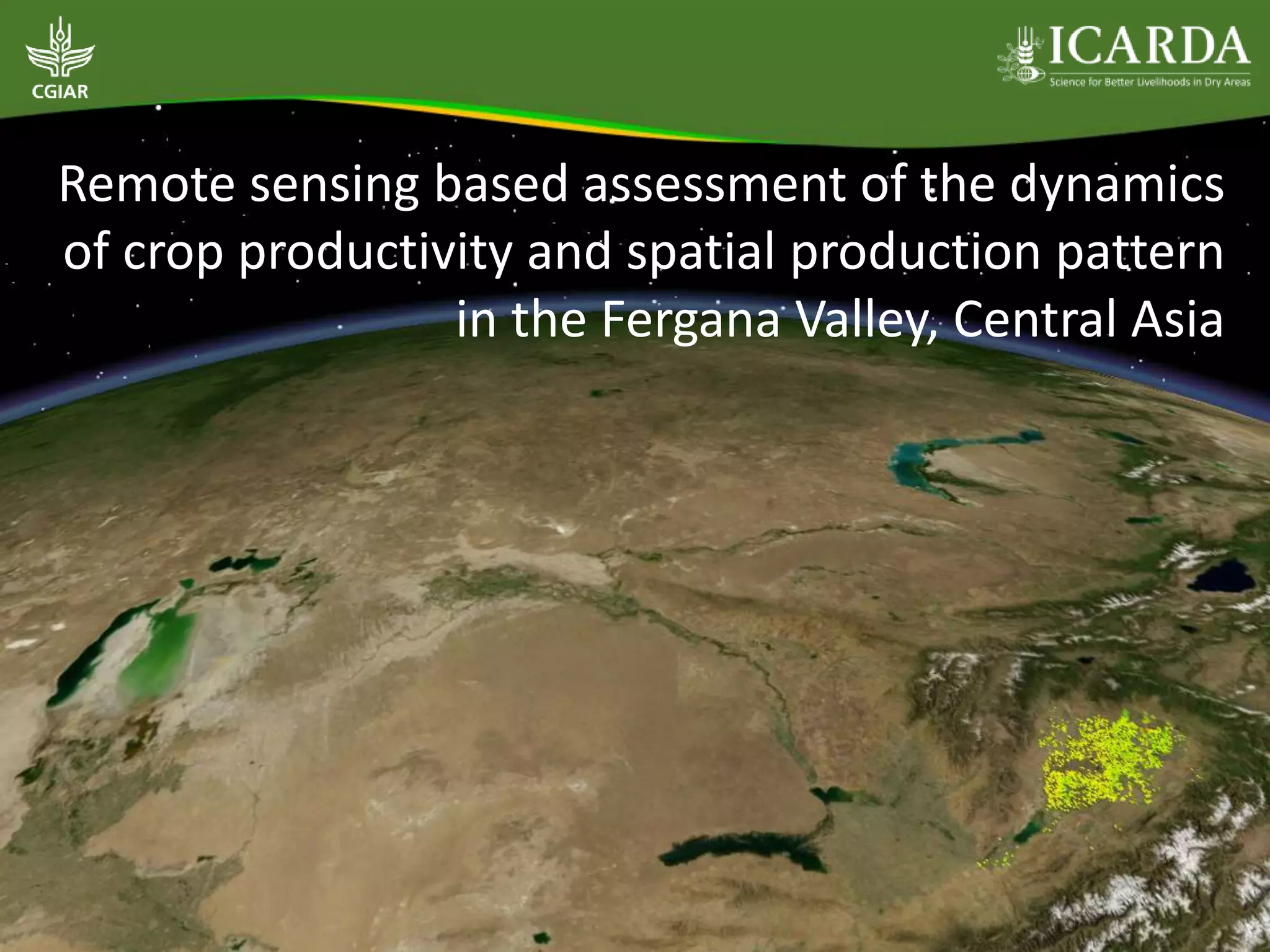
Remote sensing based assessment of the dynamics
of crop productivity and spatial production pattern
in the Fergana Valley, Central Asia
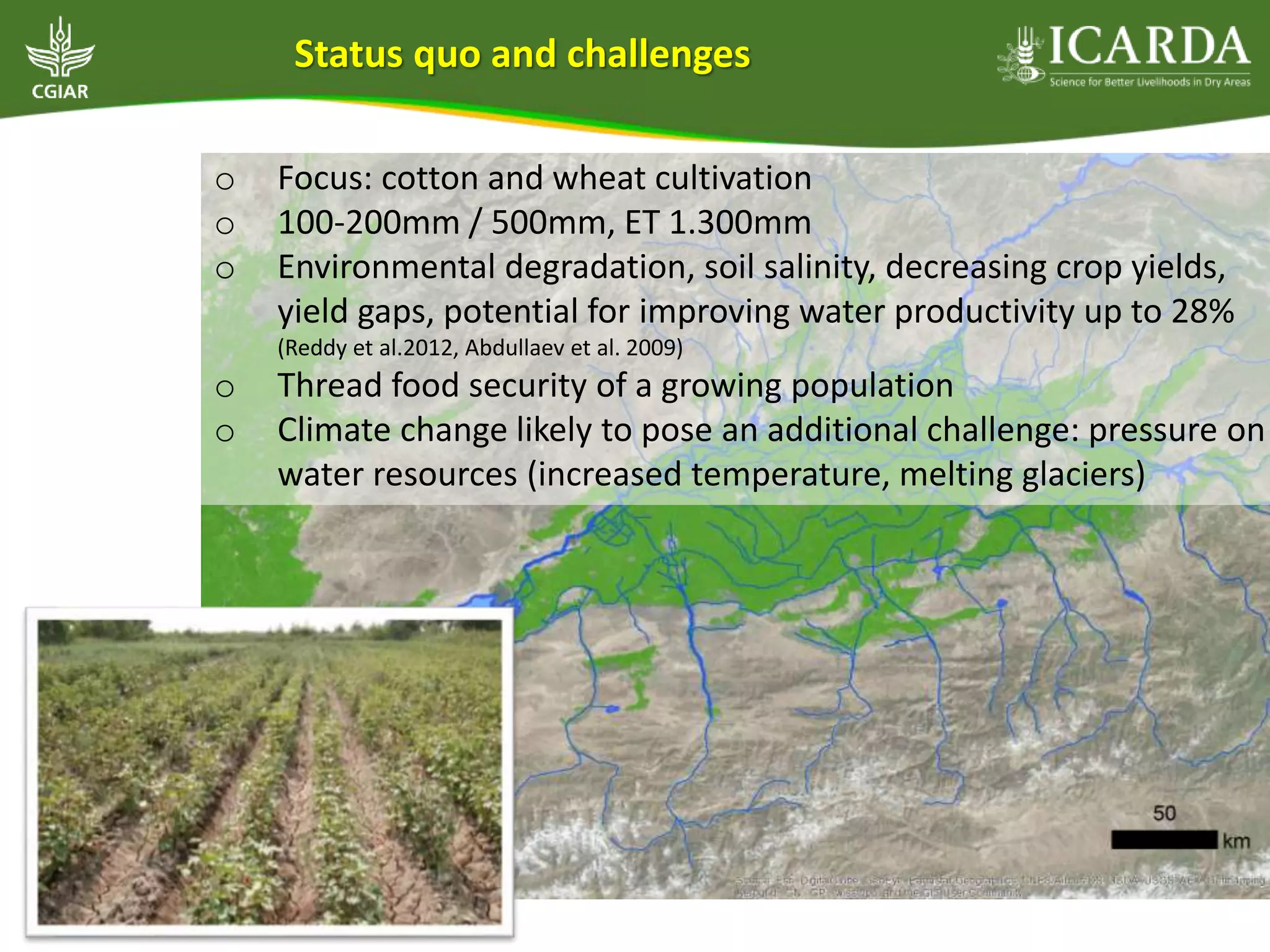
o Focus: cotton and wheat cultivation
o 100-200mm / 500mm, ET 1.300mm
o Environmental degradation, soil salinity, decreasing crop yields,
yield gaps, potential for improving water productivity up to 28%
(Reddy et al.2012, Abdullaev et al. 2009)
o Thread food security of a growing population
o Climate change likely to pose an additional challenge: pressure on
water resources (increased temperature, melting glaciers)
Status quo and challenges
Sustainable land and water resource management
o Guided by information-based /data driven decision making
o Can be supported by a data base containing spatial information
about agricultural production:
 Productivity (yield)
 Water demand and use of crops
 “Water productivity”
o Can hardly achieved by manual ground sampling
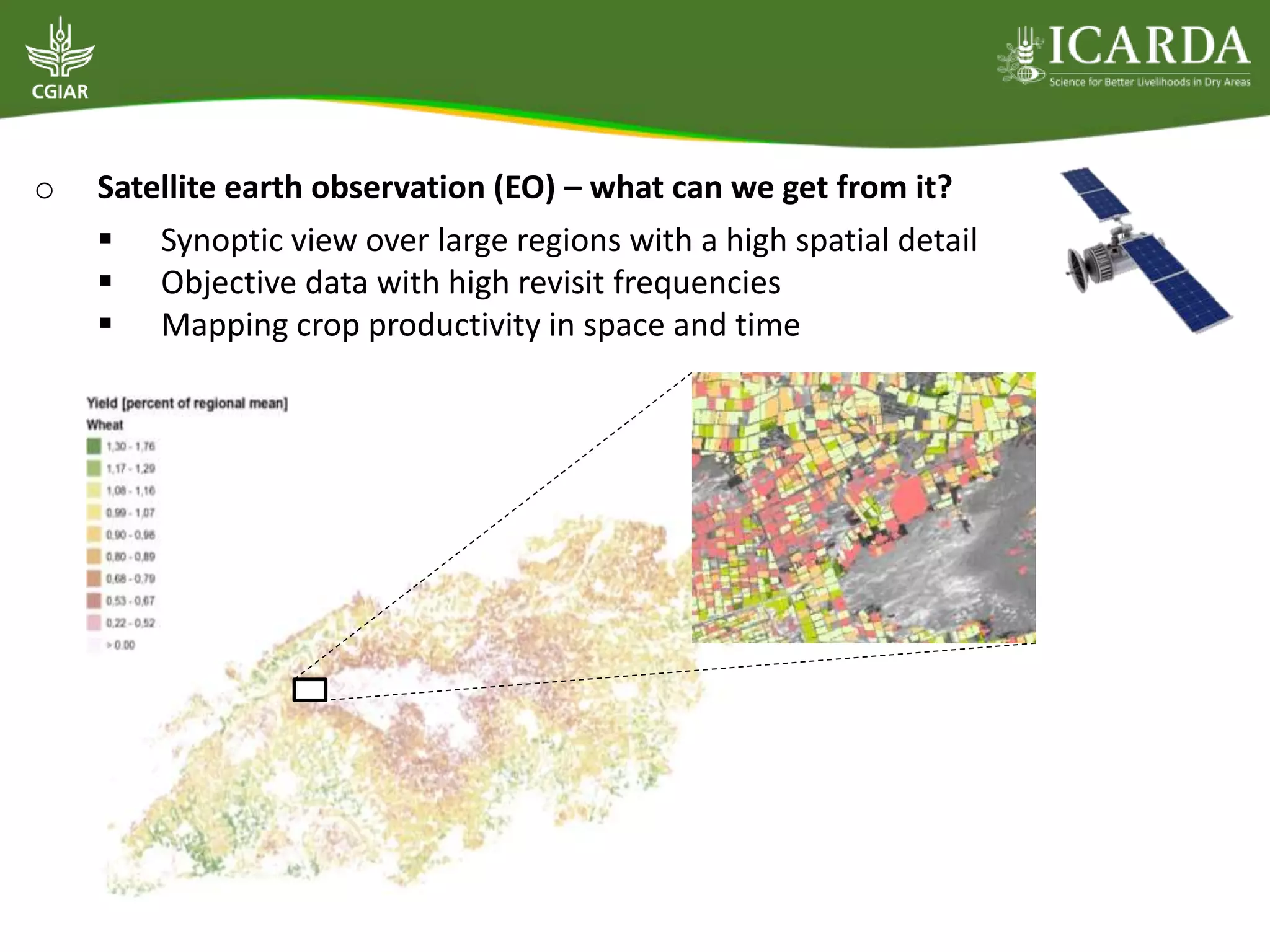
o Satellite earth observation (EO) – what can we get from it?
 Synoptic view over large regions with a high spatial detail
 Objective data with high revisit frequencies
 Mapping crop productivity in space and time
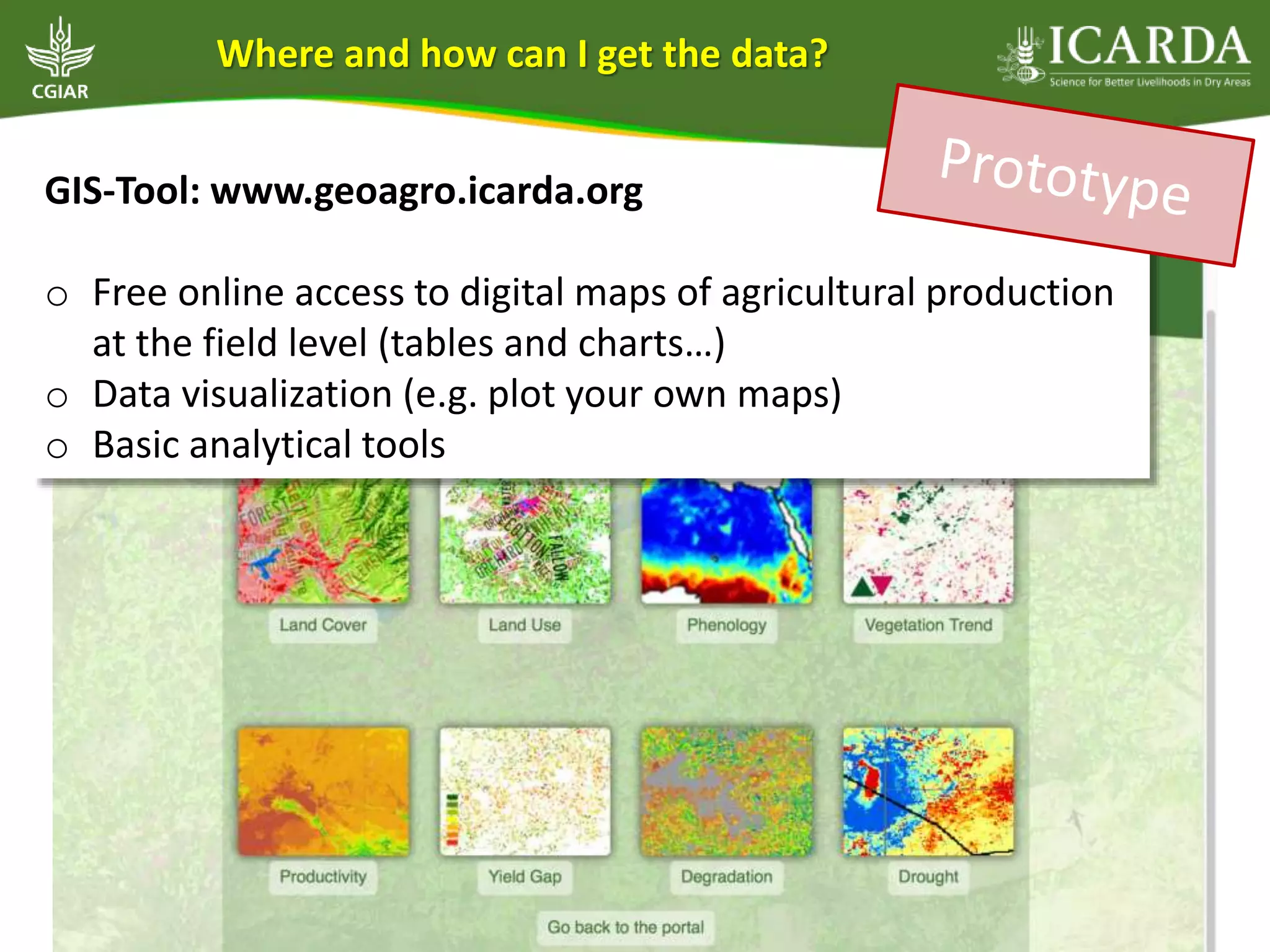
GIS-Tool: www.geoagro.icarda.org
o Free online access to digital maps of agricultural production
at the field level (tables and charts…)
o Data visualization (e.g. plot your own maps)
o Basic analytical tools
Where and how can I get the data?
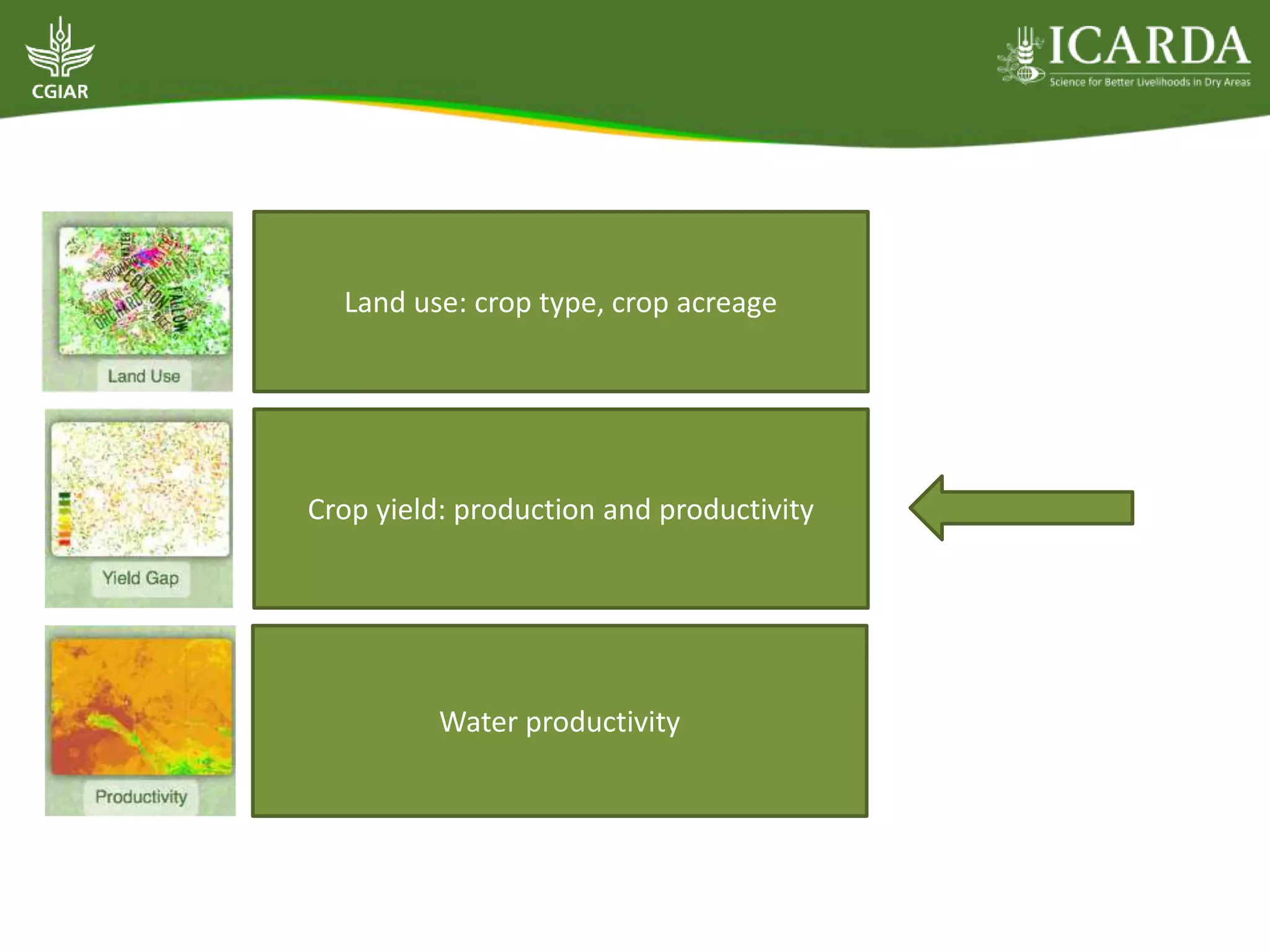
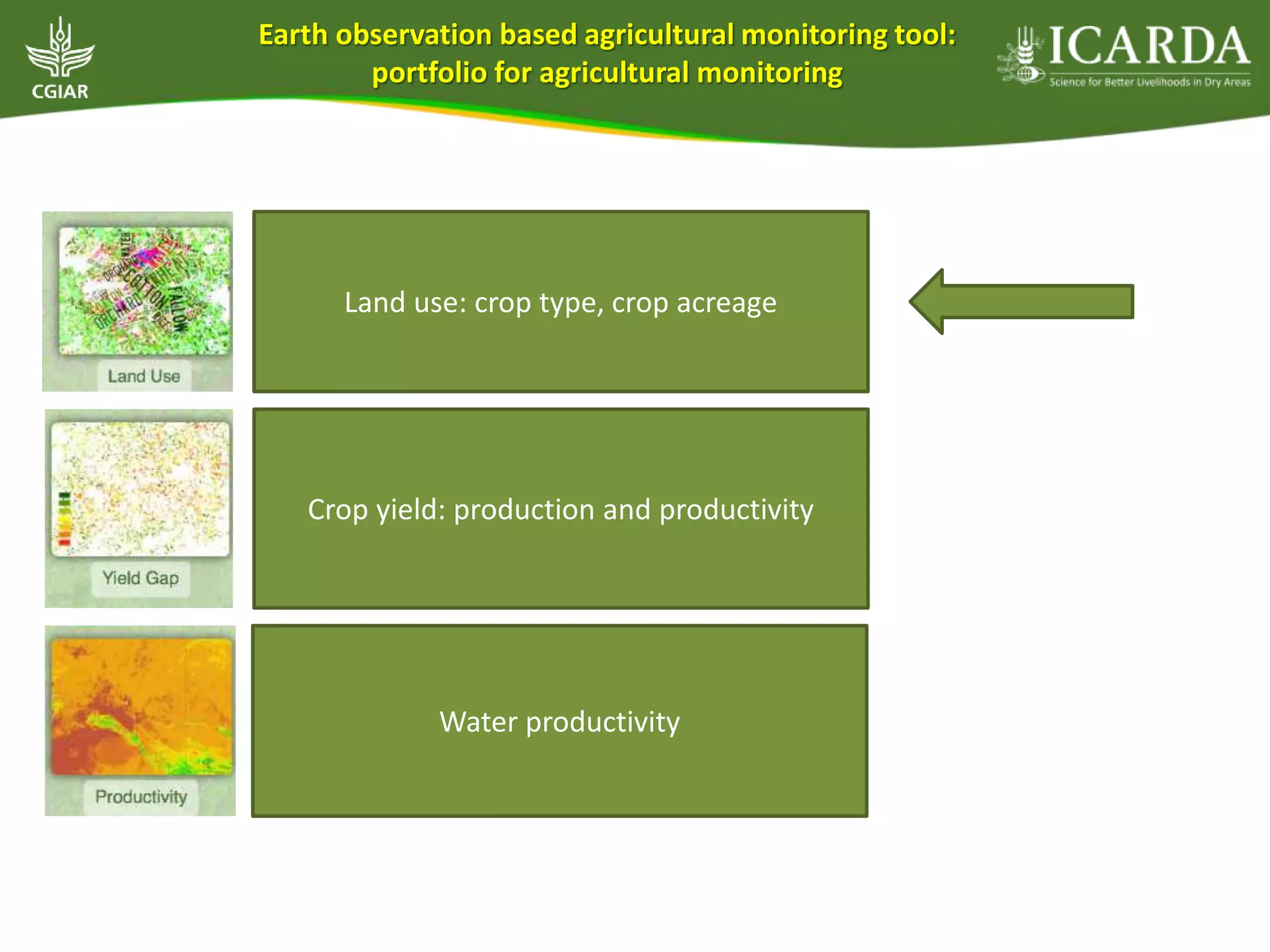
Land use: crop type, crop acreage
Crop yield: production and productivity
Water productivity
Earth observation based agricultural monitoring tool:
portfolio for agricultural monitoring
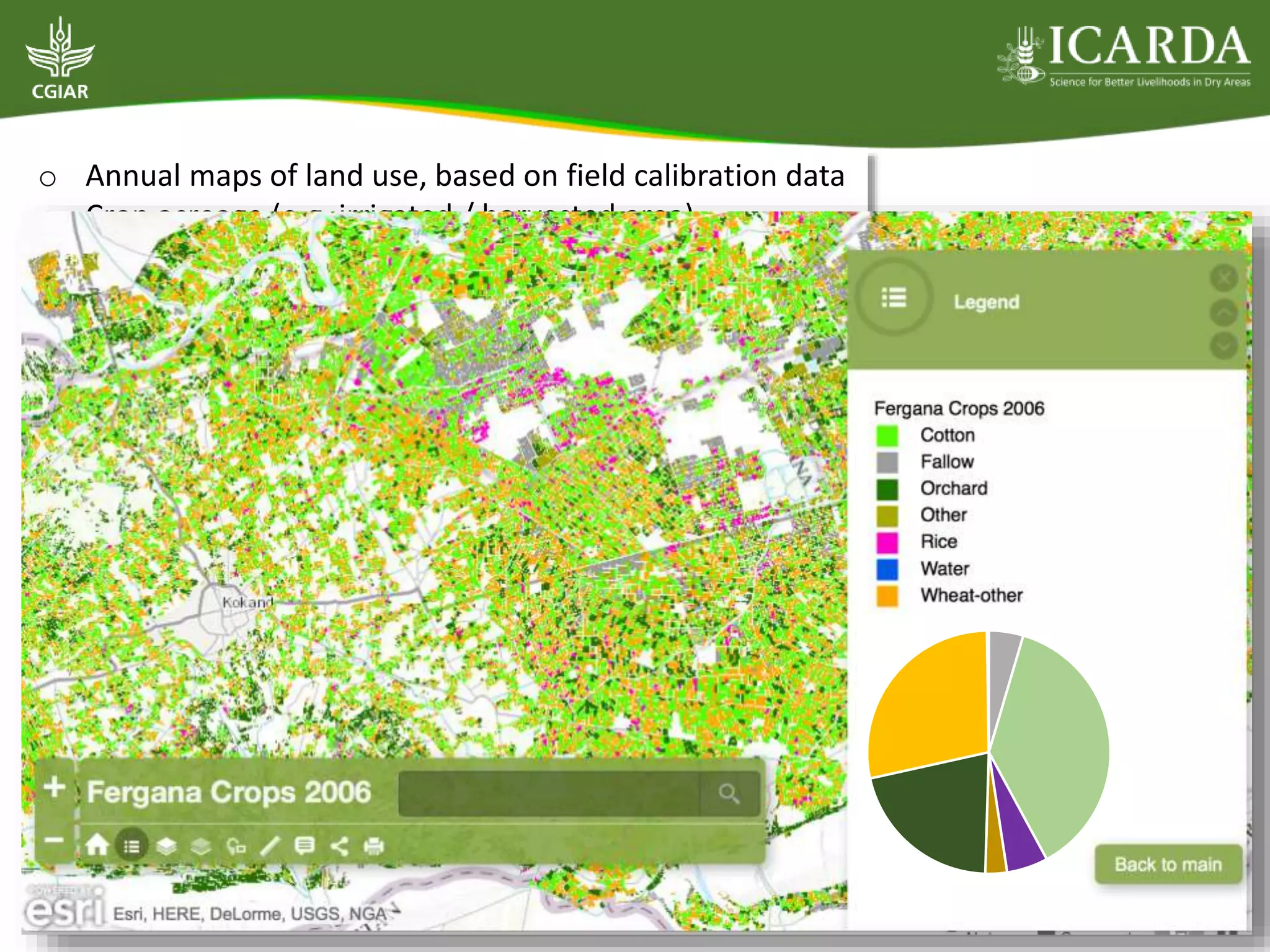
o Annual maps of land use, based on field calibration data
o Crop acreage (e.g. irrigated / harvested area)
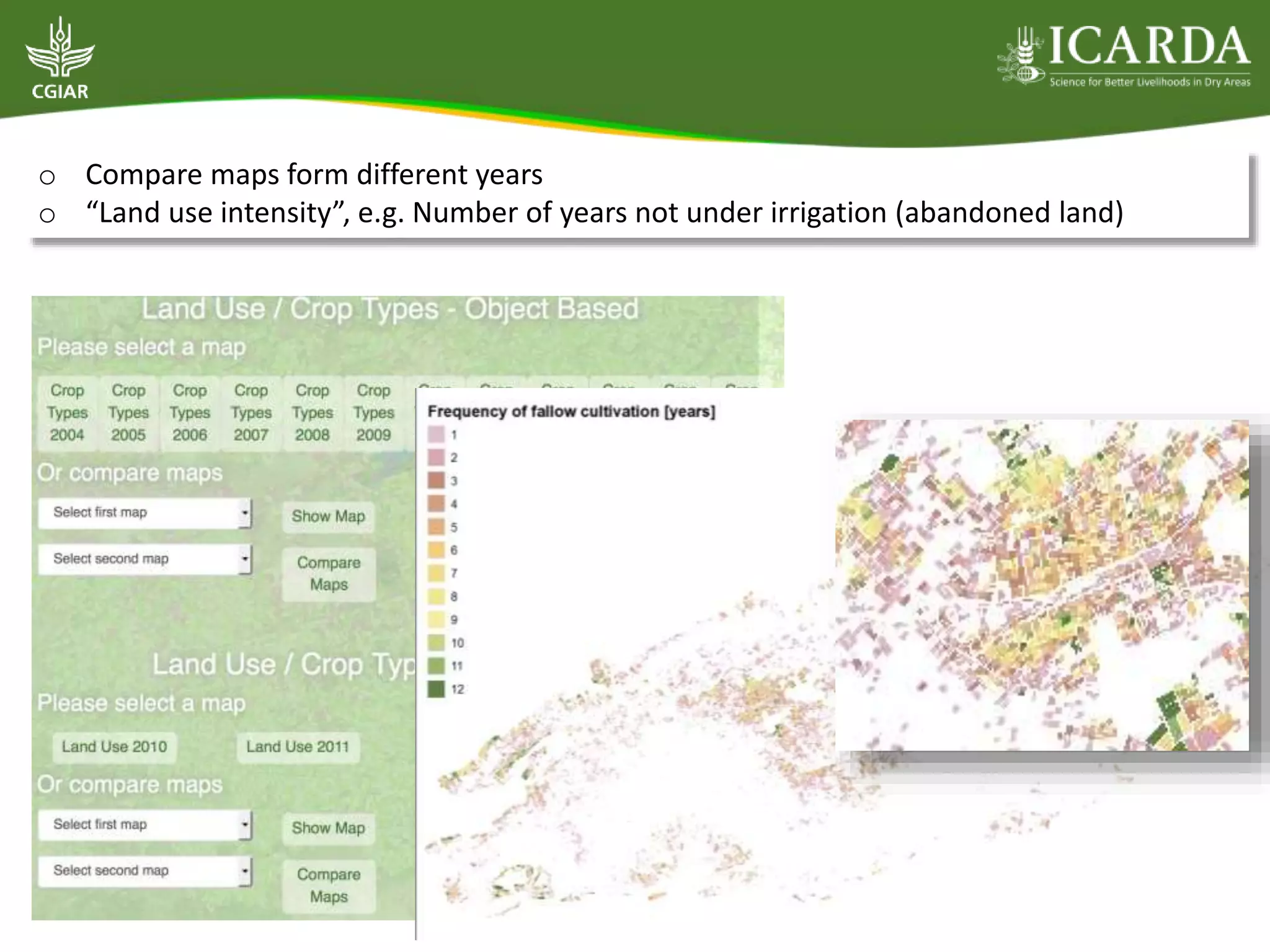
o Compare maps form different years
o “Land use intensity”, e.g. Number of years not under irrigation (abandoned land)
o Aggregate statistics (e.g. administrative units: oblast, rayon)
o Change in acreage across observation years
o Outlook: user defined zones (polygons), water distribution
(“Planning zones”, WUA, smaller channel levels UIS…)
2010
2011
2012
2013
0
0.05
0.1
0.15
0.2
0.25
0.3
0.35
0.4
0.45
2004 2005 2006 2007 2008 2009 2010 2011 2012 2013 2014 2015
Proportioncultivatedarea[%]
Cotton Wheat-other
Land use: crop type, crop acreage
Crop yield: production and productivity
Water productivity
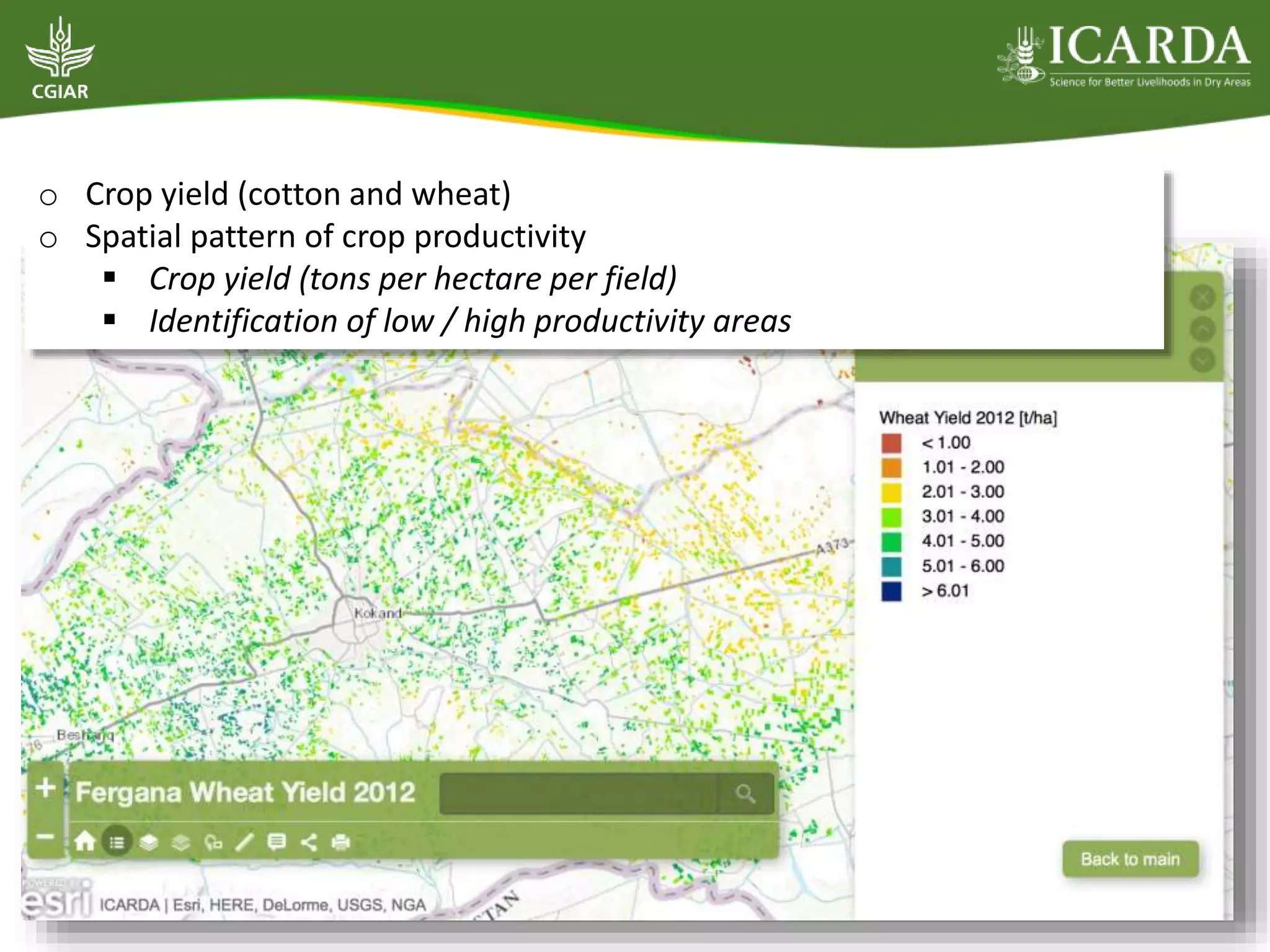
o Crop yield (cotton and wheat)
o Spatial pattern of crop productivity
 Crop yield (tons per hectare per field)
 Identification of low / high productivity areas
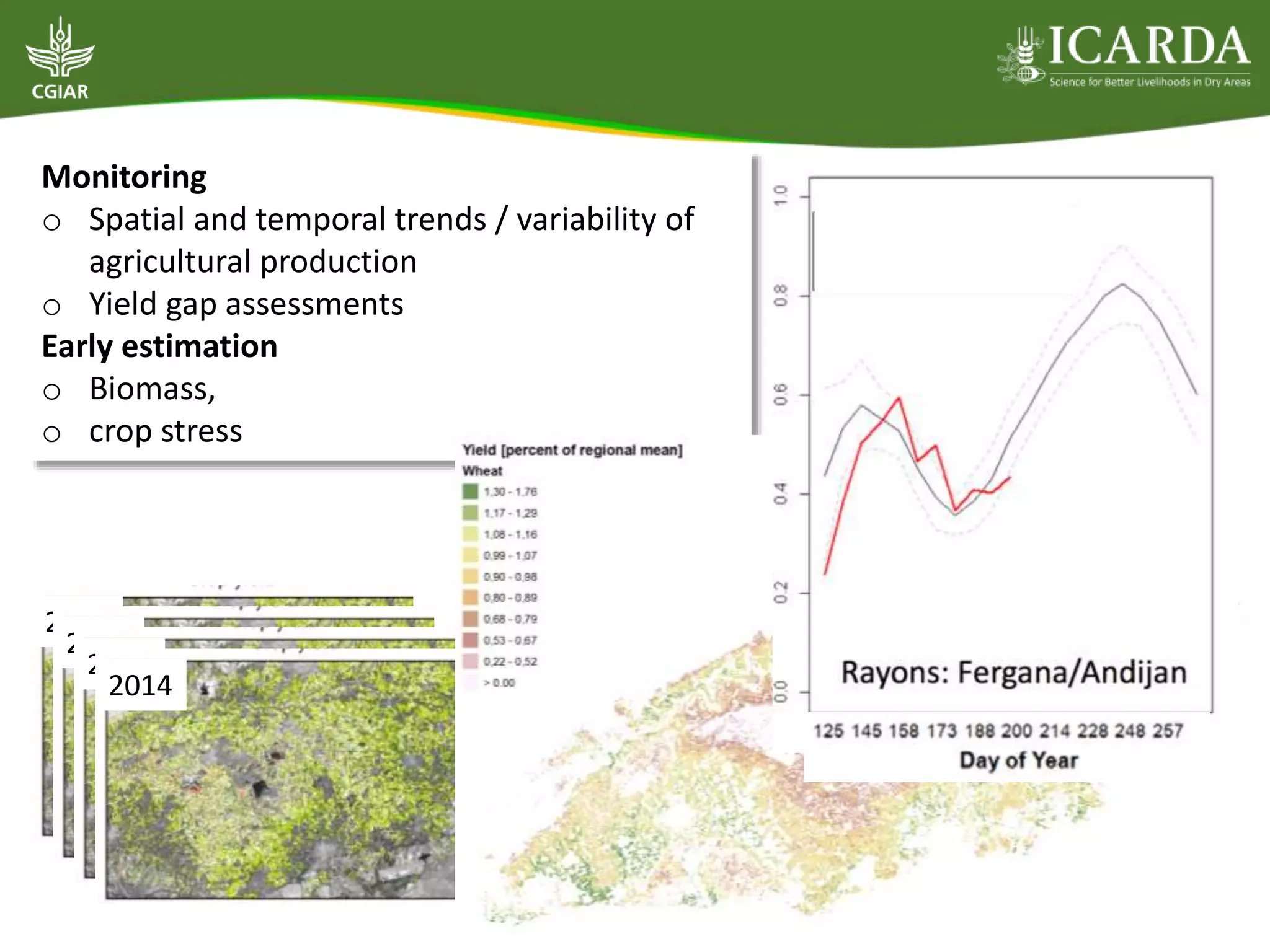
Monitoring
o Spatial and temporal trends / variability of
agricultural production
o Yield gap assessments
Early estimation
o Biomass,
o crop stress
2010
2011
2012
2014
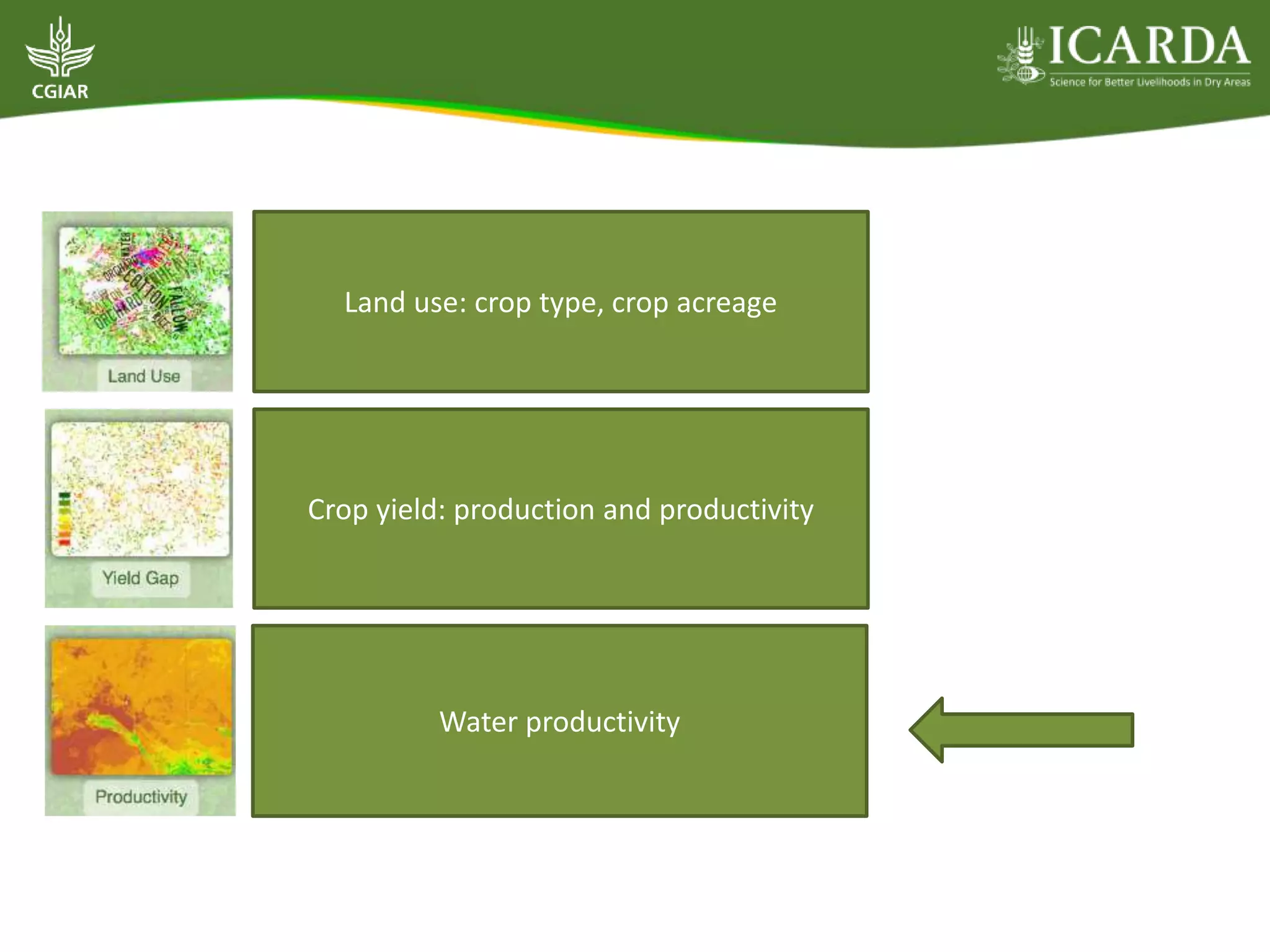
Land use: crop type, crop acreage
Crop yield: production and productivity
Water productivity
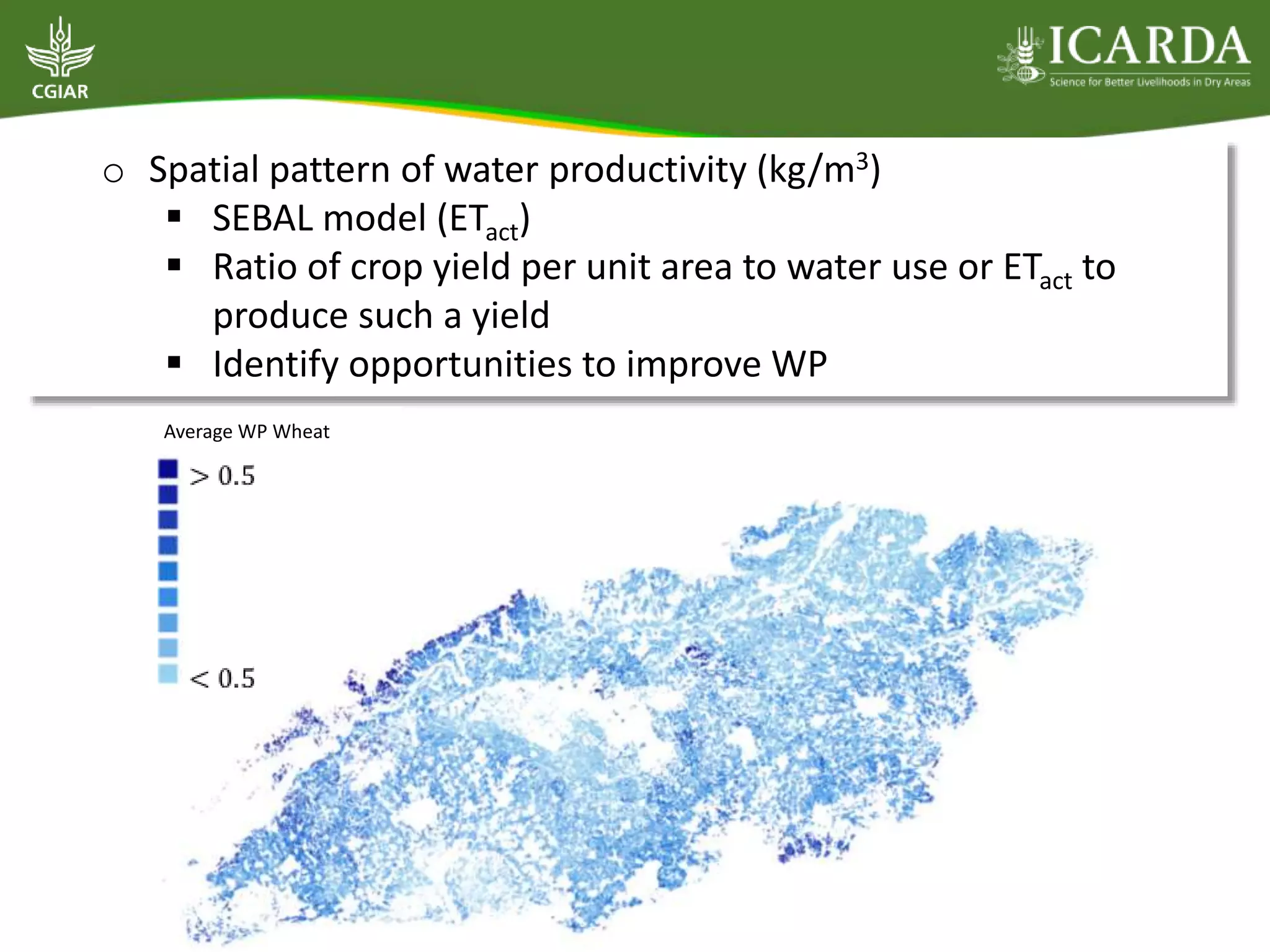
o Spatial pattern of water productivity (kg/m3)
 SEBAL model (ETact)
 Ratio of crop yield per unit area to water use or ETact to
produce such a yield
 Identify opportunities to improve WP
Average WP Wheat
Conclusions
o Satellite EO is a potentially useful tool to support spatial
planning / sustainable water and land use management by
providing geoinformation about agricultural production from
field to regional scale
o Not a hydro-operations tool at the field level / not a precision
agriculture tool (i.e. within field)
o Prioritize focus regions (e.g. affected by low productivity),
spatial targeting of land rehabilitation, restructuring of land use,
focus investments , evaluate impact of management practices
Outlook:
o Development of a fully automated online tool:
 High resolution satellite image download (NASA+ESA) and
“pre-processing”
 Crop stress indication
o Crop condition information at early stages in the crop growing
season: early estimation of crop area, crop stress indication,
every 2-3 weeks, reduce planning uncertainties, increase
resilience
Спасибо за внимание
Contact:
Fabian Löw, PhD
Chandrashekar Biradar, PhD
Web:
ICARDA.CGIAR.ORG
geoagro.icarda.org
E-Mail:
C.Biradar@cgiar.org
fabian.loew@gmx.de
fabian@maptailor.net

Geospatial Science, Technology and Application in Agro-Ecosystem Research

  • 1.
    Fabian Löw andChandrashekhar Biradar ICARDA.CGIAR.ORG geoagro.icarda.org 13 July 2016 | Central Asia Climate Smart Agriculture Workshop | Bishkek, Kyrgyzstan
  • 2.
    Remote sensing basedassessment of the dynamics of crop productivity and spatial production pattern in the Fergana Valley, Central Asia
  • 3.
    o Focus: cottonand wheat cultivation o 100-200mm / 500mm, ET 1.300mm o Environmental degradation, soil salinity, decreasing crop yields, yield gaps, potential for improving water productivity up to 28% (Reddy et al.2012, Abdullaev et al. 2009) o Thread food security of a growing population o Climate change likely to pose an additional challenge: pressure on water resources (increased temperature, melting glaciers) Status quo and challenges
  • 4.
    Sustainable land andwater resource management o Guided by information-based /data driven decision making o Can be supported by a data base containing spatial information about agricultural production:  Productivity (yield)  Water demand and use of crops  “Water productivity” o Can hardly achieved by manual ground sampling
  • 5.
    o Satellite earthobservation (EO) – what can we get from it?  Synoptic view over large regions with a high spatial detail  Objective data with high revisit frequencies  Mapping crop productivity in space and time
  • 6.
    GIS-Tool: www.geoagro.icarda.org o Freeonline access to digital maps of agricultural production at the field level (tables and charts…) o Data visualization (e.g. plot your own maps) o Basic analytical tools Where and how can I get the data?
  • 7.
    Land use: croptype, crop acreage Crop yield: production and productivity Water productivity Earth observation based agricultural monitoring tool: portfolio for agricultural monitoring
  • 8.
    o Annual mapsof land use, based on field calibration data o Crop acreage (e.g. irrigated / harvested area)
  • 9.
    o Compare mapsform different years o “Land use intensity”, e.g. Number of years not under irrigation (abandoned land)
  • 10.
    o Aggregate statistics(e.g. administrative units: oblast, rayon) o Change in acreage across observation years o Outlook: user defined zones (polygons), water distribution (“Planning zones”, WUA, smaller channel levels UIS…) 2010 2011 2012 2013 0 0.05 0.1 0.15 0.2 0.25 0.3 0.35 0.4 0.45 2004 2005 2006 2007 2008 2009 2010 2011 2012 2013 2014 2015 Proportioncultivatedarea[%] Cotton Wheat-other
  • 11.
    Land use: croptype, crop acreage Crop yield: production and productivity Water productivity
  • 12.
    o Crop yield(cotton and wheat) o Spatial pattern of crop productivity  Crop yield (tons per hectare per field)  Identification of low / high productivity areas
  • 13.
    Monitoring o Spatial andtemporal trends / variability of agricultural production o Yield gap assessments Early estimation o Biomass, o crop stress 2010 2011 2012 2014
  • 14.
    Land use: croptype, crop acreage Crop yield: production and productivity Water productivity
  • 15.
    o Spatial patternof water productivity (kg/m3)  SEBAL model (ETact)  Ratio of crop yield per unit area to water use or ETact to produce such a yield  Identify opportunities to improve WP Average WP Wheat
  • 16.
    Conclusions o Satellite EOis a potentially useful tool to support spatial planning / sustainable water and land use management by providing geoinformation about agricultural production from field to regional scale o Not a hydro-operations tool at the field level / not a precision agriculture tool (i.e. within field) o Prioritize focus regions (e.g. affected by low productivity), spatial targeting of land rehabilitation, restructuring of land use, focus investments , evaluate impact of management practices
  • 17.
    Outlook: o Development ofa fully automated online tool:  High resolution satellite image download (NASA+ESA) and “pre-processing”  Crop stress indication o Crop condition information at early stages in the crop growing season: early estimation of crop area, crop stress indication, every 2-3 weeks, reduce planning uncertainties, increase resilience
  • 18.
    Спасибо за внимание Contact: FabianLöw, PhD Chandrashekar Biradar, PhD Web: ICARDA.CGIAR.ORG geoagro.icarda.org E-Mail: C.Biradar@cgiar.org fabian.loew@gmx.de fabian@maptailor.net

Editor's Notes

  • #3 In the following 15 Minutes I will present you our ongoing work that relates to the application of satellite earth observation for monitoring spatial and temporal dynamics of agricultural production in the Fergana Valley
  • #4 Fergana Valley is located in the SE part of Central Asia, stretching between the TienShan and Alai Mountains and belongs to the oldest cultivated regions in the world, where agricultural activities can be traced back for millennia. Today it is one if not the core area of agricultural production in CA. The focus of agriculture in FA is especially cotton and wheat, which is irrigated due to the arid climate. However, soil salinity, land degradation and water logging decrease productivity, which means that agricultural productivity is not equally high and studies showed that in many places yields are lower than the potential yield in this area. Since all countries have increasing populations and the rural population heavily depends on agriculture, this development has the potential to thread food security but also national economy and is likely to be aggravated when glaciers melt, the only source of irrigation water in this region. This figure is just a snapshot, but it preludes how climate change could make this task more difficult An average application efficiency of 78% suggests that there were some fields that were under- irrigated (yield losses due to water stress), and some fields that were over-irrigated (yield losses due to leaching of fertilizers and temporary waterlogging conditions). Addressing the issue of inequity and reliability in water supply, through improved water management, would also increase crop yields and water productivity from project areas.
  • #5 With that said, it is clear that agricultural production should be improved in a sustainable manner and that, for instance, water productivity can probably be increased. We suggest that this task can be guided by information based decision making … which are the key parameters of agric production
  • #6 Due to the need to have such information frequently over large areas, we use satellite remote sensing for creating such a data base. The highlight of remote sensing is that we can observe this signal over time and over large area. Based on certain machine learning algorithms and biophysical models, and in combination with meteorological data from meteo stations or remote sensing we can convert this multi-temporalsignal and use GIS to create georeferenced maps
  • #7 Now, in order to make this data base accessible to potential users we have set up a web-portal that provides free access… It provides basic visualization and analytical functionality and is steadily been developed toward a fully automized field level crop monitoring system The webportal consists of several thematic modules, but I will focus on the agricultural modules.
  • #8 These are: Land use, crop yield, and water use efficiency All modules deliver archives of satellite based maps from 2003 onwards and will be supplemented by an early estimation module next year, which will allow users to get the desired information within the season It is of great significance to obtain the crop condition information at early stages in the crop growing season. Sometimes it is even more important than acquiring the exact production after harvest time.
  • #9 Maize, Sorghum, Garden, Tamorkas
  • #14 In some rayons, average yield of fields was 1,6 t/ha less compared to the top 5% of fields. It is of great significance to obtain the crop condition information at early stages in the crop growing season. Sometimes it is even more important than acquiring the exact production after harvest time.
  • #18 It is of great significance to obtain the crop condition information at early stages in the crop growing season. Sometimes it is even more important than acquiring the exact production after harvest time.