[intro]We know climate change is real.
[intro]We know climate change is happening now.
[intro]We know that solutions exist.
[intro]So why aren’t we doing anything to stop the biggest problem to face humanity?
[intro]It’ll take a movement of concerned people like us to ensure our leaders act in the face of the biggest challenge to ever confront humanity.
350 Climate Presentation OverviewIntroClimate science (or, climate change is real)Climate impacts (or, climate change is happening now)Climate solutions (or, we know that solutions exist)Climate politics (or, so why aren’t we doing anything about it?)Conclusions
[science] we know climate change is real.
[science overview] What is climate change?What is causing it?How sure are we?Are we too late?
1What is climate change?
What is climate change?Climate is the average weather conditions of a place or area (or the whole globe) over a period of years‘Climate change’ is a long term change in the average weather
Our climate has always been variable.Glacial periods and warmer periods have occurred throughout Earth’s history.This variability is natural and is caused by many things
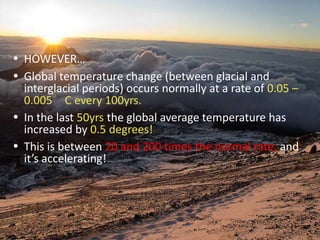
HOWEVER…Global temperature change (between glacial and interglacial periods) occurs normally at a rate of 0.05 – 0.005°C every 100yrs.In the last 50yrs the global average temperature has increased by 0.5 degrees!This is between 20 and 200 times the normal rate, and it’s accelerating!
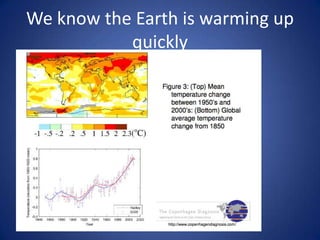
We know the Earth is warming up quickly (figure 3)
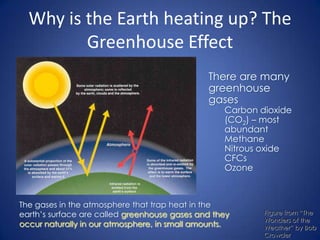
Why is the Earth heating up? The Greenhouse EffectThere are many greenhouse gases Carbon dioxide (CO2) – most abundantMethaneNitrous oxideCFCsOzoneThe gases in the atmosphere that trap heat in the earth’s surface are called greenhouse gases and they occur naturally in our atmosphere, in small amounts.Figure from “The Wonders of the Weather” by Bob Crowder
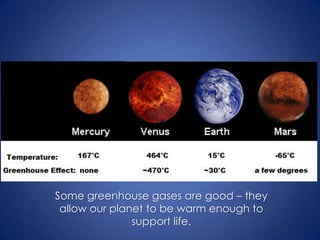
Some greenhouse gases are good – they allow our planet to be warm enough to support life.
Scientists measure how our climate is changing in a few different waysPpm and Ppm-e
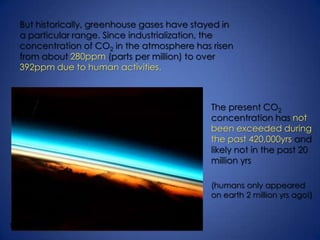
Degrees CelsiusBut historically, greenhouse gases have stayed in a particular range. Since industrialization, the concentration of CO2 in the atmosphere has risen from about 280ppm (parts per million) to over 392ppm due to human activities.The present CO2 concentration has not been exceeded during the past 420,000yrs and likely not in the past 20 million yrs(humans only appeared on earth 2 million yrs ago!)The earth’s fragile atmosphere, as seen from a shuttle
2 What is causing climate change?
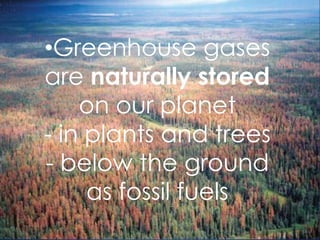
Greenhouse gases are naturally stored on our planet- in plants and trees- below the ground as fossil fuelsBut since the industrial revolution, human activity has caused these gases to be released at abnormal rates
That’s around the time when humans became dependent on coal and oil for transportation and energy.
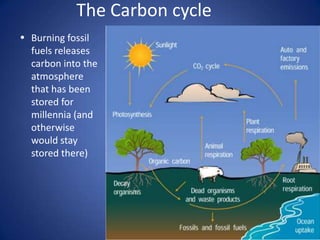
The Carbon cycleBurning fossil fuels releases carbon into the atmosphere that has been stored for millennia (and otherwise would stay stored there)
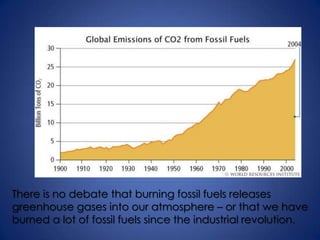
There is no debate that burning fossil fuels releases greenhouse gases into our atmosphere – or that we have burned a lot of fossil fuels since the industrial revolution.
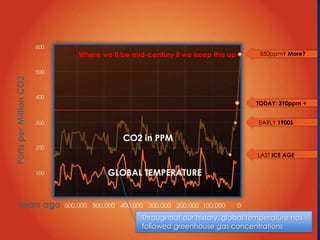
550ppm? More?Where we’ll be mid-century if we keep this upTODAY: 390ppm +Parts per Million CO2EARLY 1900SCO2 in PPMLAST ICE AGEGLOBAL TEMPERATUREYears agoThroughout our history, global temperature has followed greenhouse gas concentrations
To recap:Humans are causing climate change.By burning more and more fossil fuels for our energy needs, it is very clear that:Humans have raised and continue to raise the concentration of greenhouse gases in our atmosphereWhen greenhouse gas concentrations rise, global temperature rises.We are observing that very rise in temperature to match the rise in greenhouse gases.
3           How sure are we of the science?Really, really sure on the general gist, but a little less sure on the specifics
The largest research project in history:     In 1988, the IPCC was created to “provide the decision-makers and others interested in climate change with an objective source of information about climate change”
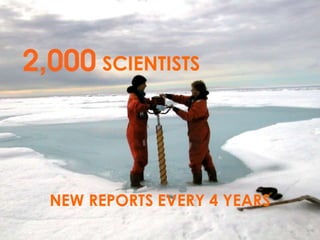
SCIENTISTS
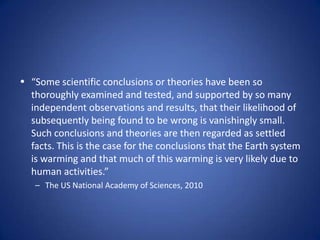
“Some scientific conclusions or theories have been so thoroughly examined and tested, and supported by so many independent observations and results, that their likelihood of subsequently being found to be wrong is vanishingly small. Such conclusions and theories are then regarded as settled facts. This is the case for the conclusions that the Earth system is warming and that much of this warming is very likely due to human activities.”The US National Academy of Sciences, 2010
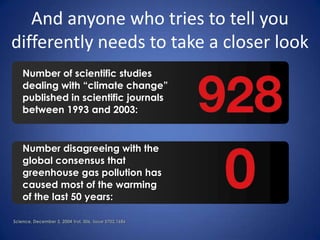
Number of scientific studies dealing with “climate change” published in scientific journals between 1993 and 2003: Number disagreeing with the global consensus that greenhouse gas pollution has caused most of the warming of the last 50 years:And anyone who tries to tell you differently needs to take a closer lookScience, December 3, 2004 Vol. 306, Issue 5702,1686
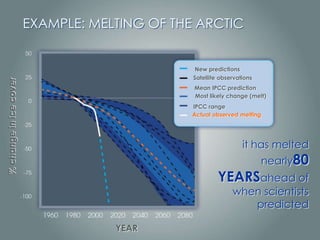
There is uncertainty about just how our climate will change in the futureThat’s because our earth is such a big and complex systemBut in general, scientists’ predictions have tended to be conservative compared to observed impacts so farUNCERTAINTY
EXAMPLE: MELTING OF THE ARCTICNew predictionsSatellite observationsMean IPCC predictionMost likely change (melt)IPCC rangeActual observed melting% change in ice coverit has melted nearly80 YEARSahead of when scientists predictedYEAR
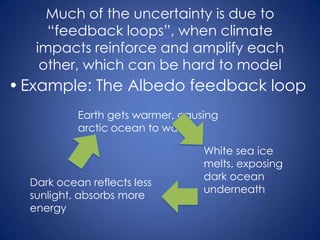
Much of the uncertainty is due to “feedback loops”, when climate impacts reinforce and amplify each other, which can be hard to modelExample: The Albedo feedback loopEarth gets warmer, causing arctic ocean to warmWhite sea ice melts, exposing dark ocean underneathDark ocean reflects less sunlight, absorbs more energy
4So are we too late?
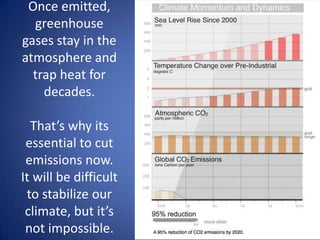
Once emitted, greenhouse gases stay in the atmosphere and trap heat for decades.  That’s why its essential to cut emissions now.  It will be difficult to stabilize our climate, but it’s not impossible.
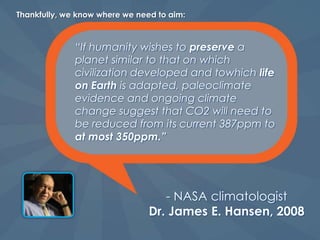
Thankfully, we know where we need to aim:“If humanity wishes to preserve a planet similar to that on which civilization developed and towhich life on Earth is adapted, paleoclimate evidence and ongoing climate change suggest that CO2 will need to be reduced from its current 387ppm to at most 350ppm.”- NASA climatologist       Dr. James E. Hansen, 2008
The 350ppm target means that at our current level – 392ppm, we are already in the danger zone.The Earth and the species that live on it have never gone through a change in climate such as the one we are now facing.But it’s not too late – if we act now!
Up Next: Find out how climate change is already impacting our planet.IntroClimate science (or, climate change is real)Climate impacts (or, climate change is happening now)Climate solutions (or, we know that solutions exist)Climate politics (or, so why aren’t we doing anything about it?)Conclusions
Sources and more informationGrist “Denier Argument FAQ” section350.org “Science of 350” and “FAQ” sections“2 Degrees, One Chance”James Hansen’s “Blue Planet”Scripps CO2 ProgramAudubon society
Science module

Science module

  • 1.
    [intro]We know climatechange is real.
  • 2.
    [intro]We know climatechange is happening now.
  • 3.
    [intro]We know thatsolutions exist.
  • 4.
    [intro]So why aren’twe doing anything to stop the biggest problem to face humanity?
  • 5.
    [intro]It’ll take amovement of concerned people like us to ensure our leaders act in the face of the biggest challenge to ever confront humanity.
  • 6.
    350 Climate PresentationOverviewIntroClimate science (or, climate change is real)Climate impacts (or, climate change is happening now)Climate solutions (or, we know that solutions exist)Climate politics (or, so why aren’t we doing anything about it?)Conclusions
  • 7.
    [science] we knowclimate change is real.
  • 8.
    [science overview] Whatis climate change?What is causing it?How sure are we?Are we too late?
  • 9.
  • 10.
    What is climatechange?Climate is the average weather conditions of a place or area (or the whole globe) over a period of years‘Climate change’ is a long term change in the average weather
  • 11.
    Our climate hasalways been variable.Glacial periods and warmer periods have occurred throughout Earth’s history.This variability is natural and is caused by many things
  • 12.
    HOWEVER…Global temperature change(between glacial and interglacial periods) occurs normally at a rate of 0.05 – 0.005°C every 100yrs.In the last 50yrs the global average temperature has increased by 0.5 degrees!This is between 20 and 200 times the normal rate, and it’s accelerating!
  • 13.
    We know theEarth is warming up quickly (figure 3)
  • 14.
    Why is theEarth heating up? The Greenhouse EffectThere are many greenhouse gases Carbon dioxide (CO2) – most abundantMethaneNitrous oxideCFCsOzoneThe gases in the atmosphere that trap heat in the earth’s surface are called greenhouse gases and they occur naturally in our atmosphere, in small amounts.Figure from “The Wonders of the Weather” by Bob Crowder
  • 15.
    Some greenhouse gasesare good – they allow our planet to be warm enough to support life.
  • 16.
    Scientists measure howour climate is changing in a few different waysPpm and Ppm-e
  • 17.
    Degrees CelsiusBut historically,greenhouse gases have stayed in a particular range. Since industrialization, the concentration of CO2 in the atmosphere has risen from about 280ppm (parts per million) to over 392ppm due to human activities.The present CO2 concentration has not been exceeded during the past 420,000yrs and likely not in the past 20 million yrs(humans only appeared on earth 2 million yrs ago!)The earth’s fragile atmosphere, as seen from a shuttle
  • 18.
    2 What iscausing climate change?
  • 19.
    Greenhouse gases arenaturally stored on our planet- in plants and trees- below the ground as fossil fuelsBut since the industrial revolution, human activity has caused these gases to be released at abnormal rates
  • 20.
    That’s around thetime when humans became dependent on coal and oil for transportation and energy.
  • 21.
    The Carbon cycleBurningfossil fuels releases carbon into the atmosphere that has been stored for millennia (and otherwise would stay stored there)
  • 22.
    There is nodebate that burning fossil fuels releases greenhouse gases into our atmosphere – or that we have burned a lot of fossil fuels since the industrial revolution.
  • 23.
    550ppm? More?Where we’llbe mid-century if we keep this upTODAY: 390ppm +Parts per Million CO2EARLY 1900SCO2 in PPMLAST ICE AGEGLOBAL TEMPERATUREYears agoThroughout our history, global temperature has followed greenhouse gas concentrations
  • 24.
    To recap:Humans arecausing climate change.By burning more and more fossil fuels for our energy needs, it is very clear that:Humans have raised and continue to raise the concentration of greenhouse gases in our atmosphereWhen greenhouse gas concentrations rise, global temperature rises.We are observing that very rise in temperature to match the rise in greenhouse gases.
  • 25.
    3 How sure are we of the science?Really, really sure on the general gist, but a little less sure on the specifics
  • 26.
    The largest researchproject in history: In 1988, the IPCC was created to “provide the decision-makers and others interested in climate change with an objective source of information about climate change”
  • 27.
  • 28.
    “Some scientific conclusionsor theories have been so thoroughly examined and tested, and supported by so many independent observations and results, that their likelihood of subsequently being found to be wrong is vanishingly small. Such conclusions and theories are then regarded as settled facts. This is the case for the conclusions that the Earth system is warming and that much of this warming is very likely due to human activities.”The US National Academy of Sciences, 2010
  • 29.
    Number of scientificstudies dealing with “climate change” published in scientific journals between 1993 and 2003: Number disagreeing with the global consensus that greenhouse gas pollution has caused most of the warming of the last 50 years:And anyone who tries to tell you differently needs to take a closer lookScience, December 3, 2004 Vol. 306, Issue 5702,1686
  • 30.
    There is uncertaintyabout just how our climate will change in the futureThat’s because our earth is such a big and complex systemBut in general, scientists’ predictions have tended to be conservative compared to observed impacts so farUNCERTAINTY
  • 31.
    EXAMPLE: MELTING OFTHE ARCTICNew predictionsSatellite observationsMean IPCC predictionMost likely change (melt)IPCC rangeActual observed melting% change in ice coverit has melted nearly80 YEARSahead of when scientists predictedYEAR
  • 32.
    Much of theuncertainty is due to “feedback loops”, when climate impacts reinforce and amplify each other, which can be hard to modelExample: The Albedo feedback loopEarth gets warmer, causing arctic ocean to warmWhite sea ice melts, exposing dark ocean underneathDark ocean reflects less sunlight, absorbs more energy
  • 33.
    4So are wetoo late?
  • 34.
    Once emitted, greenhousegases stay in the atmosphere and trap heat for decades. That’s why its essential to cut emissions now. It will be difficult to stabilize our climate, but it’s not impossible.
  • 35.
    Thankfully, we knowwhere we need to aim:“If humanity wishes to preserve a planet similar to that on which civilization developed and towhich life on Earth is adapted, paleoclimate evidence and ongoing climate change suggest that CO2 will need to be reduced from its current 387ppm to at most 350ppm.”- NASA climatologist Dr. James E. Hansen, 2008
  • 36.
    The 350ppm targetmeans that at our current level – 392ppm, we are already in the danger zone.The Earth and the species that live on it have never gone through a change in climate such as the one we are now facing.But it’s not too late – if we act now!
  • 37.
    Up Next: Findout how climate change is already impacting our planet.IntroClimate science (or, climate change is real)Climate impacts (or, climate change is happening now)Climate solutions (or, we know that solutions exist)Climate politics (or, so why aren’t we doing anything about it?)Conclusions
  • 38.
    Sources and moreinformationGrist “Denier Argument FAQ” section350.org “Science of 350” and “FAQ” sections“2 Degrees, One Chance”James Hansen’s “Blue Planet”Scripps CO2 ProgramAudubon society

Editor's Notes

  • #10 Photo from 350.org section on flickr
  • #14 Source: Copenhagen Diagnosis, Figure 12– mean temp change; global average temp change.
  • #17 Note: link to 350 FAQ on ppm & ppm-equivalent (http://www.350.org/understanding-350#14); include a note in the script about the difference.Ppm or parts per million of carbon dioxide is the ratio of the number of carbon dioxide molecules to all of the molecules in the atmosphere.Ppm-e or parts per million of CO2 equivalent is the ratio of other greenhouse gas molecules, such as methane, to all of the molecules in the atmosphereDegrees Celsius in relation to climate change is the universal measurement of temperature increase on the centigrade scale, with 0 being the freezing point of water and 100 being the boiling point of water.
  • #20 For millions of years, huge amounts of carbon, methane, and other contributors to the greenhouse effect have been locked up inside ofplants, fossil fuels like oil and coal that are made of dead animals and plants, and in frozen pockets underneath the arctic tundra giving the earth a relatively stable climate, to which all current life on earth has adapted
  • #21 But since the Industrial Revolution, humans have been releasing these greenhouse gases by burning fossil fuels, cutting down forests, and raising huge numbers of greenhouse-gas-producing animals. These gases are entering the atmosphere at rates completely unprecedented in the history of the world, trapping heat and warming the planet at abnormally fast rates.
  • #22 But since the Industrial Revolution, humans have been releasing these greenhouse gases by burning fossil fuels, cutting down forests, and raising huge numbers of greenhouse-gas-producing animals. These gases are entering the atmosphere at rates completely unprecedented in the history of the world, trapping heat and warming the planet at abnormally fast rates.
  • #23 National Earth Science Teacher’s Association: http://www.windows2universe.org/earth/Water/co2_cycle.htmlCarbon is constantly cycling through our planet. It gets “fixed” into plants and our soil and oceans through photosynthesis and other natural processes, and then released as plants and organisms decompose. By burning fossil fuels, we add large amounts of carbon to our atmosphere that would otherwise stay stored beneath the ground, therefore changing the balance of the carbon cycle taking place above ground.
  • #25 350 original slideThroughout time, global temperature has correlated with the amount of CO2 in our atmosphere, so now, as CO2 levels rise to unprecedented levels, so is global temperature.
  • #29 At least 2,000 scientists around the globe study the current changes in climate and its environmental and socioeconomic effects. (IPCC Website). These updates are critical to our understanding of what is occurring on this planet.
  • #30 Source: National Academy of Sciences, http://books.nap.edu/openbook.php?record_id=12782&page=22-The scientific consensus is nearly absolute that human activity is causing climate change. (Read quote).
  • #31 http://www.sciencemag.org/content/306/5702/1686.full. For the script, include this info: ““928 abstracts, published in refereed scientific journals between 1993 and 2003, and listed in the ISI database with the keywords ‘climate change.’ The 928 papers were divided into six categories: explicit endorsement of the consensus position, evaluation of impacts, mitigation proposals, methods, paleoclimate analysis, and rejection of the consensus position. Of all the papers, 75% fell into the first three categories, either explicitly or implicitly accepting the consensus view; 25% dealt with methods or paleoclimate, taking no position on current anthropogenic climate change. Remarkably, none of the papers disagreed with the consensus position. ““Borrowed the slide design from Audobon Society’s “Global_Warming_presentation_long.ppt”
  • #34  “Our Fragile Earth”-There is still an uncertainty as to every aspect of how human activity will result in climate change and its effects. This is primarily due to the idea of feedback loops which can be hard to model if all parts of the loop are not included. One example of a climate change feedback loop is the Albedo feedback loop. “Albedo” is a measure of the amount of light a surface reflects vs. absorbs. -1/3 of the suns rays hitting earth are reflected back into space. Ice, particularly at the poles, is responsible for a lot of that reflectivity. Ice reflects back 90% of the light hitting it. On the other hand, water is a very poor reflector and only reflects back 5-10% of the light hitting it. So if the ice melts, the temperature will increase because their will be less reflectivity. This will also mean that the soil under the ice is exposed, allowing it to release trapped methane. Soil is also a poor reflector of light and absorbs more of the energy. These two soil implications will mean an even greater increase in temperature.
  • #36 From Climate Interactive, www.climateinteractive.org - “Climate momentum simulator”Once we release a greenhouse gas into the atmosphere, it stays there for x years, heating up the planet the whole timeWhich means that even if we stopped emitting all greenhouse gases NOW, the gases already emitted will remain in the atmosphere and continue to heat the planet for many years to come.
  • #38 -To really understand the impacts of a few degrees of climate change on human beings and the planet, see our “Impacts” module-But just remember – while climate has been variable throughout history, the Earth and the species that live on it have never gone through a change in climate as sudden and large as the one we are now facing
  • #40 [will need to tighten this up at the end]