Economic
Geography
Economy
• Economic systems can vary from nation to
nation and/or from region to region.
• An economy consists of the production
and exchange of goods and services
among a group of people.
• Geographers study economic geography
by looking at the economic actives in a
region.
Economic Systems are the way people produce and exchange goods.
There are fourbasic types of economic systems.
• Traditional Economy- Goods
and services are traded.
Money is not
exchanged…
• Command Economy-
Production of goods and
services is decided by a
central government. The
government usually owns
the means of production.
• Market Economy- Production of
goods and services is
decided by the demand
from consumers.
• Mixed Economy- A
combination of command
and market economies. It
is set up to provide goods
and services to benefit all
people.
Subsistence Agriculture
• A type of farming in which
most of the produce is
consumed by the farmer
and his family
• People meet their needs in
a variety of ways. Some
groups raise just enough
food or animals to meet
their own needs.
• This is called subsistence
agriculture.
• In other areas people
produce crops or animals to
meet a demand in a larger
market.
Commercial/ Market Oriented Agriculture
• Is a type of farming in
which the produce is
meant for public sale
Cottage Industry
• Small Scale industry
that can be carried on
at home by family
members using their
own equipment
Commercial/Manufacturing Industries
• The mass production of
goods, typically driven by
supply and demand
– Commercial industries meet the
needs of people in a very large
area.
• No matter how small or large a
business is, it operates at one of
four economic levels.
Service Industry
• Any kind of economic
activity that produces
a service rather than
a product
Primary Activities
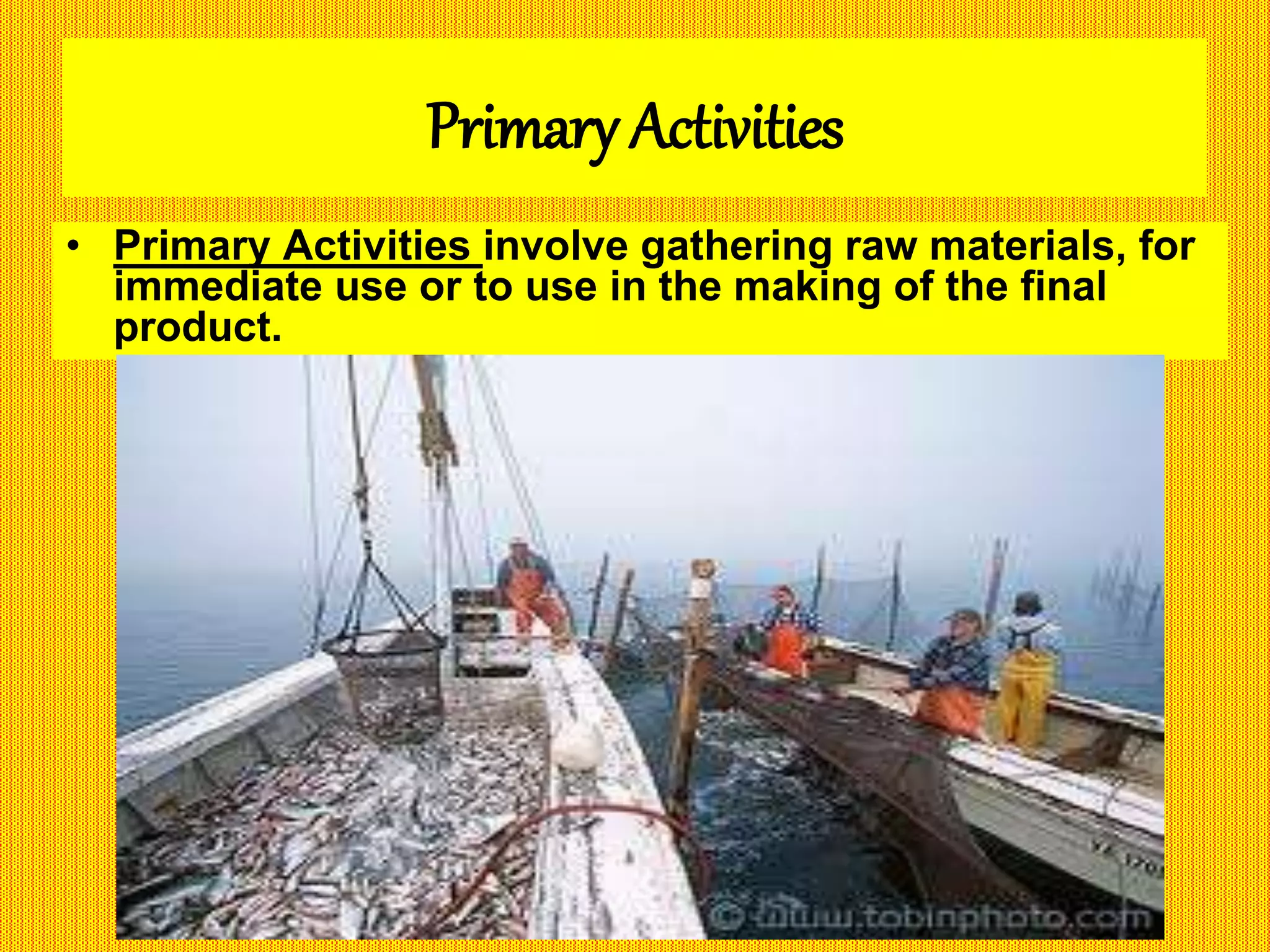
• Primary Activities involve gathering raw materials, for
immediate use or to use in the making of the final
product.
Secondary Activities
• Secondary Activities involve adding
value to materials by changing their
form.
Tertiary Activities
• Tertiary
Activities furnish
personal or
professional
services.
Provides
business or
professional
services, such
as a teacher,
sales person, or
doctor.
Quaternary Activities
• Quaternary Activities provide
information management, and research
services.
Natural Resources
• An important part of
economic geography
is knowing which
resources a nation
has.
• Natural resources are
materials on or in the
earth that have
economic value.
Natural Resources
• Natural resources are not distributed equally around the world.
• When geographers study a country’s economy, they look closely at
the location of the resources.
• They also look at the quality and quantity of the natural resources.
2
RESOURCES
They also divide natural
resources into three basic
types:
• Renewable-these
resources, such as trees,
can be replaced through
natural processes.
Examples are trees.
• Nonrenewable-these
resources cannot be
replaced once they have
been removed from the
ground—metals and
fossil fuels.
Resources
• Inexhaustible energy
sources-these power
producing resources are
the result of solar or Earth
processes. The include
sunlight, geothermal heat,
winds, and tides.
• Recyclable Resources- is
one that can be used over
and over…It must first go
through a process for
reuse. It can be human
driven or naturally
occuring
SCARCITY
• The condition of something being scarce or
deficient; an inadequate amount of something.
Free Enterprise (Free Market/Capitalism)
• Decisions are determined by individuals and are
based on trade.
• Economic choices are determined through
competition and by supply and demand with profit
as a motive
• Private property is protected by law
• In theory, there is no government interference with
these decisions.
• There is no pure free market economy anywhere in
the world
• Countries with largely free market systems include
Canada, Ireland, Australia, New Zealand, the
United States, ect.
Socialist (Mixed Economy)
• Belief that society should democratically distribute
wealth evenly throughout a society. Mixed
Economies generally blend the principles of free
market and command economies
• Individuals are free to make economic choices, but
the government plays a significant role in
determining how wealth is distributed
• Without government involvement in the economy,
private property rights would not be protected, nor
would services requiring vast amounts of capital be
feasible-mass transportation, public education, ect.
• Most of the world’s countries have varying degrees
of a mixed economy
Command (Communist/Centrally Planned Economy)
• The central government alone plans and decides how to
answer all three economic questions to further social goals.
• Private property is restricted-the state controls industry,
capital, and wealth, thus stifling private competition
• Incentives for entrepreneurship are few: there is no
guarantee that the individual will profit from innovative ideas
or the development of new technologies
• Economic freedom is not a valued principle-the state
determines how the factors of production will be allocated
• Examples: North Korea, China, Iran
• Not all centrally planned economies are properly referred to
as ‘communist.’
Infrastructure
• Consist of the basic support systems
needed to keep an economy going
including power, communication,
transportation, water, sanitation, and
education systems.
Infrastructure
Infrastructure
Infrastructure
• Per capita income-the amount of money the
average person makes each year in a
country. Generally, this statistic is generated
by dividing a country’s GDP by its population
• Gross National Product (GNP)-the total value
of all goods and services produced by a
country over a year.
• Gross Domestic Product (GDP)-the total
value of all goods and services produced
with in a given period of time
Economic Indicators
• Aka Developed
• A high income country with a mature
industrial sector and whose residents
enjoy a relatively high standard of living.
• Primary industries tend to be highly
mechanized
More Developed Country
• Aka Developing
• Usually a low or middle income country
whose economy is either mostly agrarian
or only partially industrialized
Newly Industrialized Country
• Aka underdeveloped
• A low income country that is unable to
provide basic necessities, such as job
opportunities, health care, drinkable water,
food, education, and housing
Less Developed
economic_geography.ppt

economic_geography.ppt

  • 1.
  • 2.
    Economy • Economic systemscan vary from nation to nation and/or from region to region. • An economy consists of the production and exchange of goods and services among a group of people. • Geographers study economic geography by looking at the economic actives in a region.
  • 3.
    Economic Systems arethe way people produce and exchange goods. There are fourbasic types of economic systems. • Traditional Economy- Goods and services are traded. Money is not exchanged… • Command Economy- Production of goods and services is decided by a central government. The government usually owns the means of production. • Market Economy- Production of goods and services is decided by the demand from consumers. • Mixed Economy- A combination of command and market economies. It is set up to provide goods and services to benefit all people.
  • 4.
    Subsistence Agriculture • Atype of farming in which most of the produce is consumed by the farmer and his family • People meet their needs in a variety of ways. Some groups raise just enough food or animals to meet their own needs. • This is called subsistence agriculture. • In other areas people produce crops or animals to meet a demand in a larger market.
  • 5.
    Commercial/ Market OrientedAgriculture • Is a type of farming in which the produce is meant for public sale
  • 6.
    Cottage Industry • SmallScale industry that can be carried on at home by family members using their own equipment
  • 7.
    Commercial/Manufacturing Industries • Themass production of goods, typically driven by supply and demand – Commercial industries meet the needs of people in a very large area. • No matter how small or large a business is, it operates at one of four economic levels.
  • 8.
    Service Industry • Anykind of economic activity that produces a service rather than a product
  • 9.
    Primary Activities • PrimaryActivities involve gathering raw materials, for immediate use or to use in the making of the final product.
  • 10.
    Secondary Activities • SecondaryActivities involve adding value to materials by changing their form.
  • 11.
    Tertiary Activities • Tertiary Activitiesfurnish personal or professional services. Provides business or professional services, such as a teacher, sales person, or doctor.
  • 12.
    Quaternary Activities • QuaternaryActivities provide information management, and research services.
  • 13.
    Natural Resources • Animportant part of economic geography is knowing which resources a nation has. • Natural resources are materials on or in the earth that have economic value.
  • 14.
    Natural Resources • Naturalresources are not distributed equally around the world. • When geographers study a country’s economy, they look closely at the location of the resources. • They also look at the quality and quantity of the natural resources.
  • 15.
    2 RESOURCES They also dividenatural resources into three basic types: • Renewable-these resources, such as trees, can be replaced through natural processes. Examples are trees. • Nonrenewable-these resources cannot be replaced once they have been removed from the ground—metals and fossil fuels.
  • 16.
    Resources • Inexhaustible energy sources-thesepower producing resources are the result of solar or Earth processes. The include sunlight, geothermal heat, winds, and tides. • Recyclable Resources- is one that can be used over and over…It must first go through a process for reuse. It can be human driven or naturally occuring
  • 17.
    SCARCITY • The conditionof something being scarce or deficient; an inadequate amount of something.
  • 18.
    Free Enterprise (FreeMarket/Capitalism) • Decisions are determined by individuals and are based on trade. • Economic choices are determined through competition and by supply and demand with profit as a motive • Private property is protected by law • In theory, there is no government interference with these decisions. • There is no pure free market economy anywhere in the world • Countries with largely free market systems include Canada, Ireland, Australia, New Zealand, the United States, ect.
  • 19.
    Socialist (Mixed Economy) •Belief that society should democratically distribute wealth evenly throughout a society. Mixed Economies generally blend the principles of free market and command economies • Individuals are free to make economic choices, but the government plays a significant role in determining how wealth is distributed • Without government involvement in the economy, private property rights would not be protected, nor would services requiring vast amounts of capital be feasible-mass transportation, public education, ect. • Most of the world’s countries have varying degrees of a mixed economy
  • 20.
    Command (Communist/Centrally PlannedEconomy) • The central government alone plans and decides how to answer all three economic questions to further social goals. • Private property is restricted-the state controls industry, capital, and wealth, thus stifling private competition • Incentives for entrepreneurship are few: there is no guarantee that the individual will profit from innovative ideas or the development of new technologies • Economic freedom is not a valued principle-the state determines how the factors of production will be allocated • Examples: North Korea, China, Iran • Not all centrally planned economies are properly referred to as ‘communist.’
  • 21.
    Infrastructure • Consist ofthe basic support systems needed to keep an economy going including power, communication, transportation, water, sanitation, and education systems.
  • 22.
  • 23.
  • 24.
  • 25.
    • Per capitaincome-the amount of money the average person makes each year in a country. Generally, this statistic is generated by dividing a country’s GDP by its population • Gross National Product (GNP)-the total value of all goods and services produced by a country over a year. • Gross Domestic Product (GDP)-the total value of all goods and services produced with in a given period of time Economic Indicators
  • 26.
    • Aka Developed •A high income country with a mature industrial sector and whose residents enjoy a relatively high standard of living. • Primary industries tend to be highly mechanized More Developed Country
  • 27.
    • Aka Developing •Usually a low or middle income country whose economy is either mostly agrarian or only partially industrialized Newly Industrialized Country
  • 28.
    • Aka underdeveloped •A low income country that is unable to provide basic necessities, such as job opportunities, health care, drinkable water, food, education, and housing Less Developed