DENDROECOLOGY
“   Many ecosystem processes, especially those affected
    by climate changes, manifest themselves only over
    longer time periods and broader spatial scales than


                                               ”
    encompassed in typical ecological studies.

                                      Swetnam and Brown, 2010
“   Understanding the dynamics of long-lived organisms
    and ecosystems — and the role of climate in controlling
    these dynamics — requires decadal to centennial and


                                               ”
    landscape- to regional-scale perspectives.

                                       Swetnam and Brown, 2010
Dendroecology is the use of tree-ring dating and analyses
to investigate events and processes involving
the interactions of organisms with their environment.
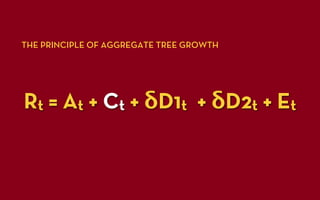
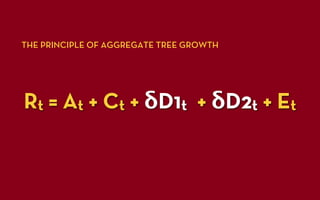
THE PRINCIPLE OF AGGREGATE TREE GROWTH


Rt = At + Ct + δD1t + δD2t + Et
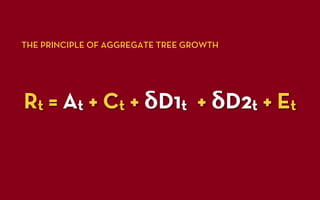
THE PRINCIPLE OF AGGREGATE TREE GROWTH


Rt = At + Ct + δD1t + δD2t + Et
DENDROECOLOGY
A. Forest demography
B. Growth dynamics
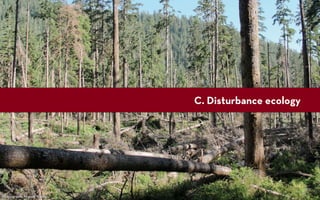
C. Disturbance ecology
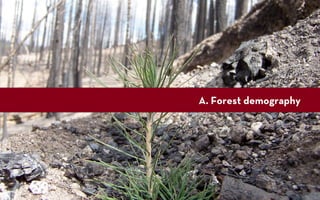
A. Forest demography
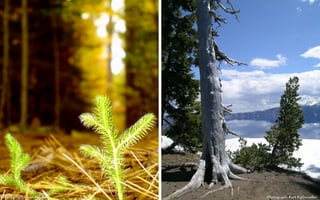
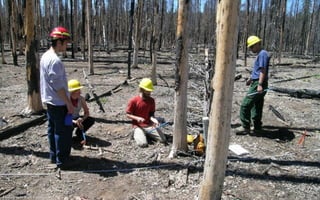
Photograph: Dawn Hopkins   Photograph: Kurt Kipfmueller
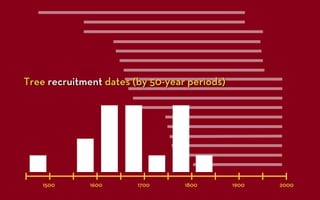
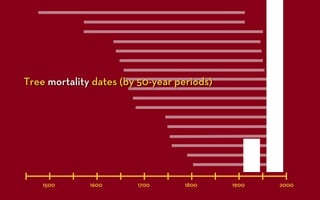
“   Ecologists have long recognized that time series of
    tree births and deaths are of fundamental value for


                                                     ”
    understanding forest and woodland dynamics.


                                       Swetnam and Brown, 2010
Photograph: Kurt Kipfmueller
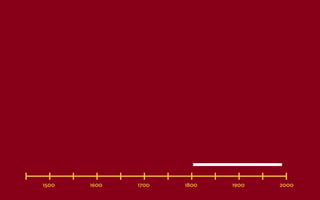
1500   1600   1700   1800   1900   2000
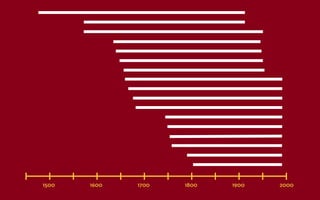
1500   1600   1700   1800   1900   2000
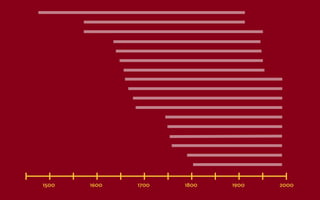
1500   1600   1700   1800   1900   2000
Tree recruitment dates (by 50-year periods)


    1500      1600      1700      1800        1900   2000
Tree mortality dates (by 50-year periods)


    1500      1600      1700       1800     1900   2000
TREE
               DOES
               NOT    DATE OF
              EQUAL   GERMINATION
RECRUITMENT
Pith


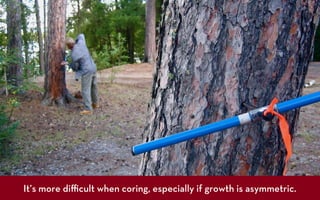
Hi ing the pith is easy when you collect an entire cross-section
It’s more difficult when coring, especially if growth is asymmetric.
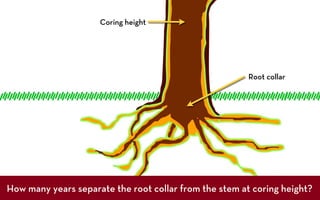
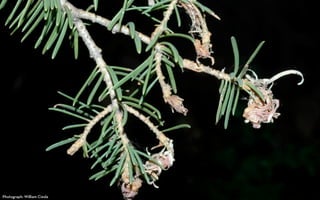
Coring height


                                                        Root collar


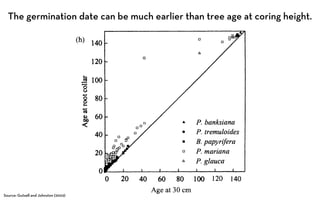
How many years separate the root collar from the stem at coring height?
The germination date can be much earlier than tree age at coring height.


Source: Gutsell and Johnston (2002)
Photograph: Kurt Kipfmueller


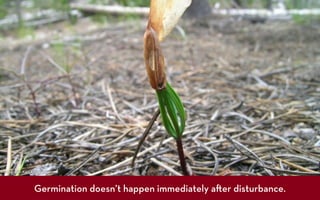
                  Germination doesn’t happen immediately a er disturbance.
The ecesis interval is the amount of time between
an initial disturbance and the successful establishment
of the first trees.
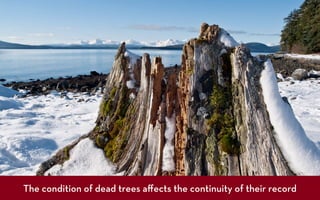
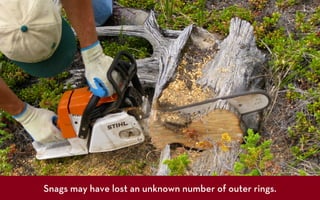
The condition of dead trees affects the continuity of their record
Photograph: John Krumm
Snags may have lost an unknown number of outer rings.
How can we reduce the effects
of these different sources of uncertainty?
“   In old, uneven-aged forests, sometimes hundreds of trees
    must be sampled to obtain adequate characterization


                                 ”
    of age structure distributions.


                                      Swetnam and Brown, 2010
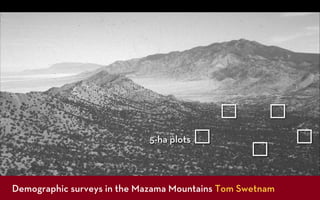
5-ha plots


Demographic surveys in the Mazama Mountains Tom Swetnam
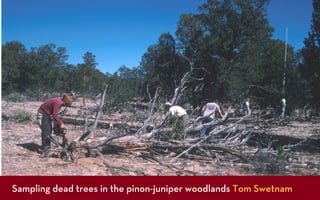
Sampling dead trees in the pinon-juniper woodlands Tom Swetnam
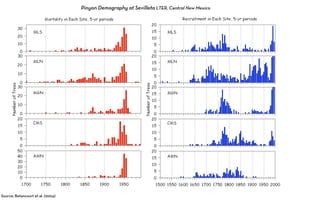
Pinyon Demography at Sevilleta LTER, Central New Mexico


Source: Betancourt et al. (2004)
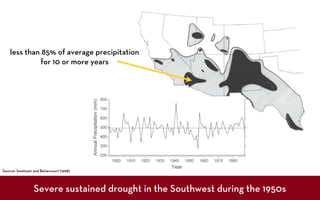
less than 85% of average precipitation
             for 10 or more years


Source: Swetnam and Betancourt (1998)


                 Severe sustained drought in the Southwest during the 1950s
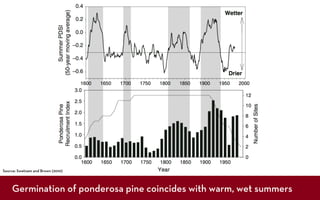
Source: Swetnam and Brown (2010)


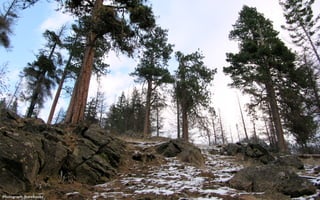
    Germination of ponderosa pine coincides with warm, wet summers
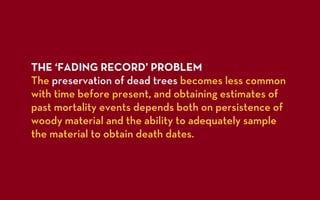
THE ‘FADING RECORD’ PROBLEM
The preservation of dead trees becomes less common
with time before present, and obtaining estimates of
past mortality events depends both on persistence of
woody material and the ability to adequately sample
the material to obtain death dates.
B. Growth dynamics


Photograph: Kyle Pierce
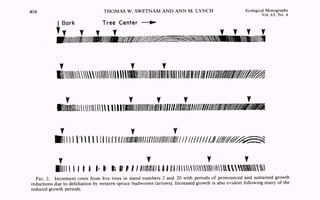
A growth suppression is a rapid reduction of growth
from one year to the next, usually lasting for several years.
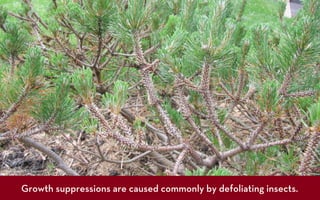
Photograph: Eli Sagor


          Growth suppressions are caused commonly by defoliating insects.
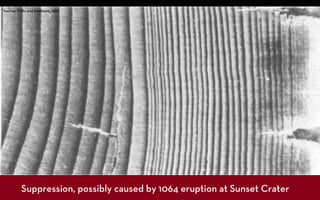
Source: Fri s and Swetnam, 1989


         Suppression, possibly caused by 1064 eruption at Sunset Crater
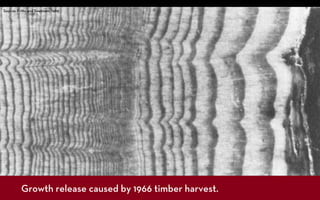
A growth release is the opposite of a suppression,
with growth increasing rapidly for several years.
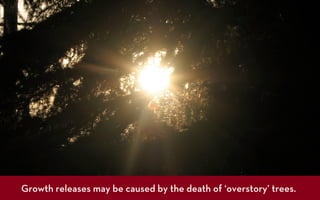
Growth releases may be caused by the death of ‘overstory’ trees.
Source: Fri s and Swetnam, 1989


         Growth release caused by 1966 timber harvest.
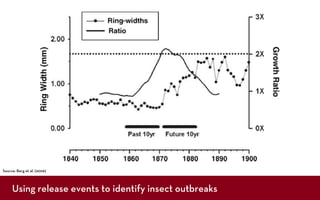
Source: Berg et al. (2006)


     Using release events to identify insect outbreaks
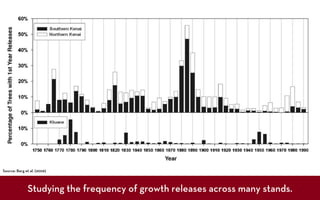
Source: Berg et al. (2006)


              Studying the frequency of growth releases across many stands.
C. Disturbance ecology


Photograph: Miguel Vieira
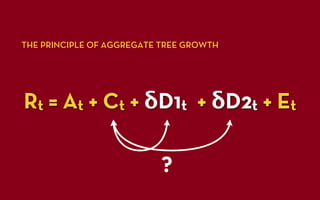
THE PRINCIPLE OF AGGREGATE TREE GROWTH


Rt = At + Ct + δD1t + δD2t + Et
Photograph: William Ciesla
Western spruce budworm Choristoneura occidentalis Freeman
Photograph: brewbooks


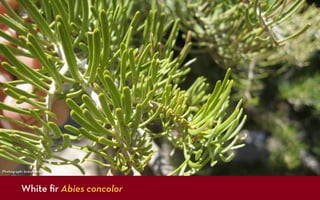
         White fir Abies concolor
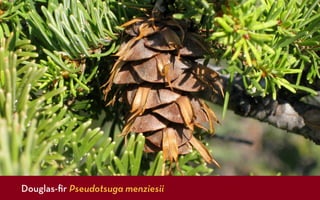
Douglas-fir Pseudotsuga menziesii
Photograph: William Ciesla
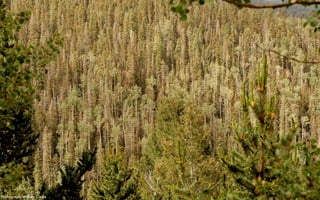
“   No typical pa ern or trend in western spruce budworm epidemics
    has been apparent; most of the early epidemics lasted for
    a few years and then subsided naturally; others persisted longer,


                                                ”
    at times without spreading over large areas.

                                            Fellin and Dewey, 1982
Photograph: Dave Powell
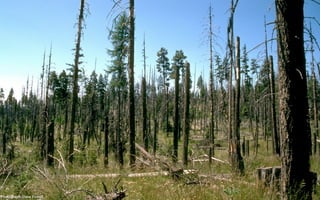
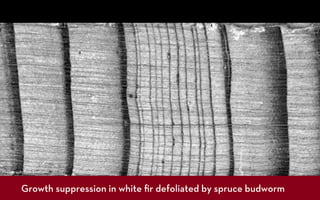
“   The tree-ring basis for developing outbreak chronologies
    is the observation of very sharply reduced ring growth
    in the host species during the defoliation episode,


                                                 ”
    which typically lasts for a decade or longer.

                                       Swetnam and Brown, 2010
Photograph: Tom Swetnam


         Growth suppression in white fir defoliated by spruce budworm
THE PRINCIPLE OF AGGREGATE TREE GROWTH


Rt = At + Ct + δD1t + δD2t + Et

                          ?
HOST   NON-hOST
HOST         NON-hOST
 White fir
              Ponderosa Pine
Douglas-fir
Photograph: Brewbooks
G(HOST) < G(NON-HOST)
            =
   potential outbreak
Source: Ryerson et al. (2003)
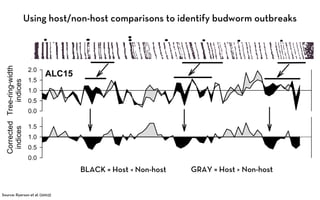
Using host/non-host comparisons to identify budworm outbreaks


                                BLACK = Host < Non-host   GRAY = Host > Non-host


Source: Ryerson et al. (2003)
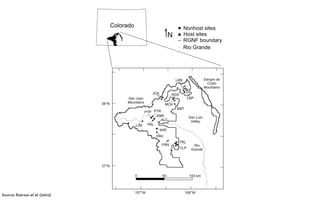
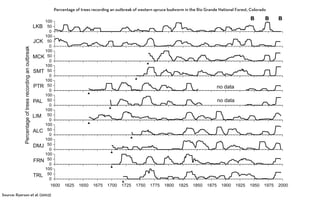
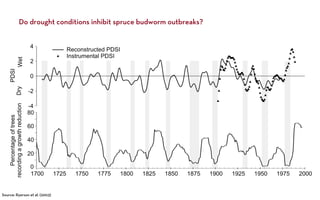
Percentage of trees recording an outbreak of western spruce budworm in the Rio Grande National Forest, Colorado


Source: Ryerson et al. (2003)
397 trees
Do drought conditions inhibit spruce budworm outbreaks?


Source: Ryerson et al. (2003)
Dendroecology is the use of tree-ring dating and analyses
to investigate events and processes involving
the interactions of organisms with their environment.
Strengths of dendroecology

1. Tree-ring records provide a much longer perspective
   than documentary records or modern surveys.
Strengths of dendroecology

1. Tree-ring records provide a much longer perspective
   than documentary records or modern surveys.
2. Tree-ring evidence has a high degree of temporal
   precision compared to other paleoecological tools.
Strengths of dendroecology

1. Tree-ring records provide a much longer perspective
   than documentary records or modern surveys.
2. Tree-ring evidence has a high degree of temporal
   precision compared to other paleoecological tools.
3. Chronological control allows multiple lines of
   evidence to be compared.
Limitations of dendroecology
1. Tree-ring records are fragmentary and can be
   distributed irregularly in time and space.
Limitations of dendroecology
1. Tree-ring records are fragmentary and can be
   distributed irregularly in time and space.
2. Some species, events or processes cannot be
   reconstructed and therefore remain unknown.
Limitations of dendroecology
1. Tree-ring records are fragmentary and can be
   distributed irregularly in time and space.
2. Some species, events or processes cannot be
   reconstructed and therefore remain unknown.
3. Past ecological conditions may have no analog in
   the modern system, making their behavior difficult
   to interpret.
ASSIGNED READING
Tom Swetnam and Peter Brown (2010), Climatic inferences
from dendroecological reconstructions. M.K. Hughes et al.
(eds.), Dendroclimatology, Developments in
Paleoenvironmental Research.
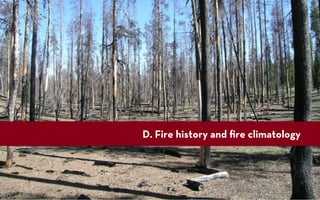
D. Fire history and fire climatology
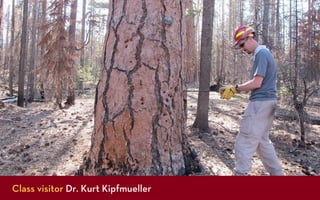
Class visitor Dr. Kurt Kipfmueller
FOR NEXT CLASS
  Read sections 9.2.1 (Fire History and Fire
 Climatology) and 9.3 (The Late Eighteenth-
Century, Early Nineteenth-Century Fire Gap)
GEOG3839.16, Dendroecology

GEOG3839.16, Dendroecology

  • 1.
  • 2.
    Many ecosystem processes, especially those affected by climate changes, manifest themselves only over longer time periods and broader spatial scales than ” encompassed in typical ecological studies. Swetnam and Brown, 2010
  • 3.
    Understanding the dynamics of long-lived organisms and ecosystems — and the role of climate in controlling these dynamics — requires decadal to centennial and ” landscape- to regional-scale perspectives. Swetnam and Brown, 2010
  • 4.
    Dendroecology is theuse of tree-ring dating and analyses to investigate events and processes involving the interactions of organisms with their environment.
  • 5.
    THE PRINCIPLE OFAGGREGATE TREE GROWTH Rt = At + Ct + δD1t + δD2t + Et
  • 6.
    THE PRINCIPLE OFAGGREGATE TREE GROWTH Rt = At + Ct + δD1t + δD2t + Et
  • 7.
    DENDROECOLOGY A. Forest demography B.Growth dynamics C. Disturbance ecology
  • 8.
  • 9.
    Photograph: Dawn Hopkins Photograph: Kurt Kipfmueller
  • 10.
    Ecologists have long recognized that time series of tree births and deaths are of fundamental value for ” understanding forest and woodland dynamics. Swetnam and Brown, 2010
  • 11.
  • 12.
    1500 1600 1700 1800 1900 2000
  • 13.
    1500 1600 1700 1800 1900 2000
  • 14.
    1500 1600 1700 1800 1900 2000
  • 15.
    Tree recruitment dates(by 50-year periods) 1500 1600 1700 1800 1900 2000
  • 16.
    Tree mortality dates(by 50-year periods) 1500 1600 1700 1800 1900 2000
  • 17.
    TREE DOES NOT DATE OF EQUAL GERMINATION RECRUITMENT
  • 18.
    Pith Hi ing thepith is easy when you collect an entire cross-section
  • 19.
    It’s more difficultwhen coring, especially if growth is asymmetric.
  • 20.
    Coring height Root collar How many years separate the root collar from the stem at coring height?
  • 21.
    The germination datecan be much earlier than tree age at coring height. Source: Gutsell and Johnston (2002)
  • 22.
    Photograph: Kurt Kipfmueller Germination doesn’t happen immediately a er disturbance.
  • 23.
    The ecesis intervalis the amount of time between an initial disturbance and the successful establishment of the first trees.
  • 25.
    The condition ofdead trees affects the continuity of their record Photograph: John Krumm
  • 26.
    Snags may havelost an unknown number of outer rings.
  • 27.
    How can wereduce the effects of these different sources of uncertainty?
  • 28.
    In old, uneven-aged forests, sometimes hundreds of trees must be sampled to obtain adequate characterization ” of age structure distributions. Swetnam and Brown, 2010
  • 29.
    5-ha plots Demographic surveysin the Mazama Mountains Tom Swetnam
  • 30.
    Sampling dead treesin the pinon-juniper woodlands Tom Swetnam
  • 31.
    Pinyon Demography atSevilleta LTER, Central New Mexico Source: Betancourt et al. (2004)
  • 32.
    less than 85%of average precipitation for 10 or more years Source: Swetnam and Betancourt (1998) Severe sustained drought in the Southwest during the 1950s
  • 33.
    Source: Swetnam andBrown (2010) Germination of ponderosa pine coincides with warm, wet summers
  • 34.
    THE ‘FADING RECORD’PROBLEM The preservation of dead trees becomes less common with time before present, and obtaining estimates of past mortality events depends both on persistence of woody material and the ability to adequately sample the material to obtain death dates.
  • 35.
  • 36.
    A growth suppressionis a rapid reduction of growth from one year to the next, usually lasting for several years.
  • 37.
    Photograph: Eli Sagor Growth suppressions are caused commonly by defoliating insects.
  • 38.
    Source: Fri sand Swetnam, 1989 Suppression, possibly caused by 1064 eruption at Sunset Crater
  • 39.
    A growth releaseis the opposite of a suppression, with growth increasing rapidly for several years.
  • 40.
    Growth releases maybe caused by the death of ‘overstory’ trees.
  • 41.
    Source: Fri sand Swetnam, 1989 Growth release caused by 1966 timber harvest.
  • 42.
    Source: Berg etal. (2006) Using release events to identify insect outbreaks
  • 43.
    Source: Berg etal. (2006) Studying the frequency of growth releases across many stands.
  • 44.
  • 45.
    THE PRINCIPLE OFAGGREGATE TREE GROWTH Rt = At + Ct + δD1t + δD2t + Et
  • 46.
  • 47.
    Western spruce budwormChoristoneura occidentalis Freeman
  • 48.
    Photograph: brewbooks White fir Abies concolor
  • 49.
  • 50.
  • 51.
    No typical pa ern or trend in western spruce budworm epidemics has been apparent; most of the early epidemics lasted for a few years and then subsided naturally; others persisted longer, ” at times without spreading over large areas. Fellin and Dewey, 1982
  • 52.
  • 53.
    The tree-ring basis for developing outbreak chronologies is the observation of very sharply reduced ring growth in the host species during the defoliation episode, ” which typically lasts for a decade or longer. Swetnam and Brown, 2010
  • 54.
    Photograph: Tom Swetnam Growth suppression in white fir defoliated by spruce budworm
  • 56.
    THE PRINCIPLE OFAGGREGATE TREE GROWTH Rt = At + Ct + δD1t + δD2t + Et ?
  • 57.
    HOST NON-hOST
  • 58.
    HOST NON-hOST White fir Ponderosa Pine Douglas-fir
  • 59.
  • 60.
    G(HOST) < G(NON-HOST) = potential outbreak
  • 61.
  • 62.
    Using host/non-host comparisonsto identify budworm outbreaks BLACK = Host < Non-host GRAY = Host > Non-host Source: Ryerson et al. (2003)
  • 63.
    Percentage of treesrecording an outbreak of western spruce budworm in the Rio Grande National Forest, Colorado Source: Ryerson et al. (2003)
  • 64.
  • 65.
    Do drought conditionsinhibit spruce budworm outbreaks? Source: Ryerson et al. (2003)
  • 66.
    Dendroecology is theuse of tree-ring dating and analyses to investigate events and processes involving the interactions of organisms with their environment.
  • 67.
  • 68.
    Strengths of dendroecology 1.Tree-ring records provide a much longer perspective than documentary records or modern surveys.
  • 69.
    Strengths of dendroecology 1.Tree-ring records provide a much longer perspective than documentary records or modern surveys. 2. Tree-ring evidence has a high degree of temporal precision compared to other paleoecological tools.
  • 70.
    Strengths of dendroecology 1.Tree-ring records provide a much longer perspective than documentary records or modern surveys. 2. Tree-ring evidence has a high degree of temporal precision compared to other paleoecological tools. 3. Chronological control allows multiple lines of evidence to be compared.
  • 71.
  • 72.
    Limitations of dendroecology 1.Tree-ring records are fragmentary and can be distributed irregularly in time and space.
  • 73.
    Limitations of dendroecology 1.Tree-ring records are fragmentary and can be distributed irregularly in time and space. 2. Some species, events or processes cannot be reconstructed and therefore remain unknown.
  • 74.
    Limitations of dendroecology 1.Tree-ring records are fragmentary and can be distributed irregularly in time and space. 2. Some species, events or processes cannot be reconstructed and therefore remain unknown. 3. Past ecological conditions may have no analog in the modern system, making their behavior difficult to interpret.
  • 75.
    ASSIGNED READING Tom Swetnamand Peter Brown (2010), Climatic inferences from dendroecological reconstructions. M.K. Hughes et al. (eds.), Dendroclimatology, Developments in Paleoenvironmental Research.
  • 76.
    D. Fire historyand fire climatology
  • 77.
    Class visitor Dr.Kurt Kipfmueller
  • 78.
    FOR NEXT CLASS Read sections 9.2.1 (Fire History and Fire Climatology) and 9.3 (The Late Eighteenth- Century, Early Nineteenth-Century Fire Gap)