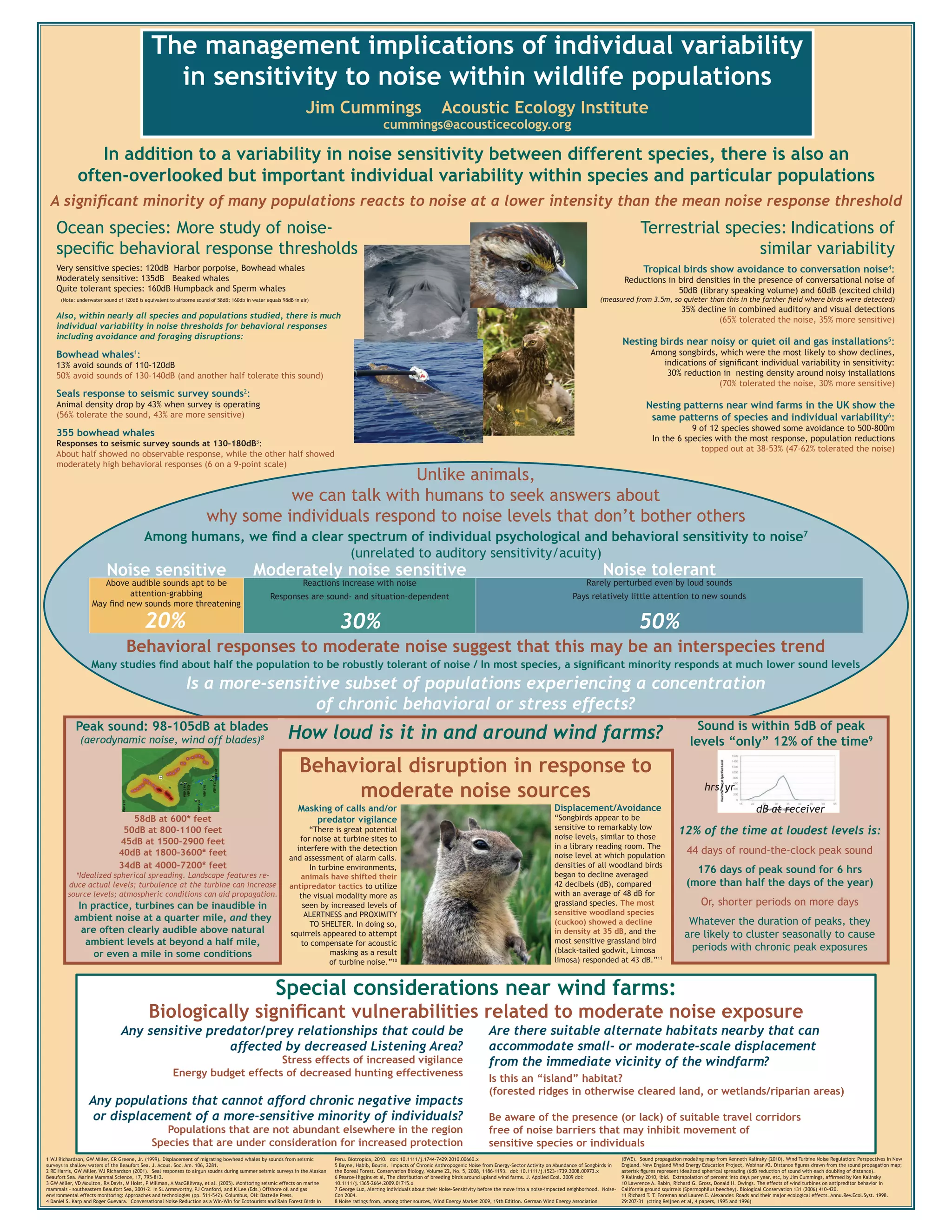
The management implications of individual variability
in sensitivity to noise within wildlife populations
Jim Cummings Acoustic Ecology Institute
cummings@acousticecology.org
In addition to a variability in noise sensitivity between different species, there is also an
often-overlooked but important individual variability within species and particular populations
Ocean species: More study of noise-
Bowhead whales :
Seals response to seismic survey sounds :
355 bowhead whales
Responses to seismic survey sounds at 130-180dB :
Indications of
Tropical birds show avoidance to conversation noise :
Nesting birds near noisy or quiet oil and gas installations :
Nesting patterns near wind farms in the UK show the
same patterns of species and individual variability :
Noise sensitive Moderately noise sensitive
Responses are sound- and situation-dependent
Noise tolerant
20% 30% 50%
7
Behavioral responses to moderate noise suggest that this may be an interspecies trend
Sound is within 5dB of peak
levels “only” 12% of the time9
176 days of peak sound for 6 hrs
(more than half the days of the year)
hrs/yr
Peak sound: 98-105dB at blades
8
58dB at 600* feet
50dB at 800-1100 feet
45dB at 1500-2900 feet
40dB at 1800-3600* feet
34dB at 4000-7200* feet
-
In practice, turbines can be inaudible in
ambient noise at a quarter mile, they
are often clearly audible above natural
ambient levels at beyond a half mile,
or even a mile in some conditions
Behavioral disruption in response to
moderate noise sources
predator vigilance
animals have shifted their
antipredator tactics
The most
sensitive woodland species
(cuckoo) showed a decline
in density at 35 dB
Special considerations near wind farms:
Stress effects of increased vigilance
Energy budget effects of decreased hunting effectiveness
Populations that are not abundant elsewhere in the region
Species that are under consideration for increased protection
Is this an “island” habitat?
Be aware of the presence (or lack) of suitable travel corridors
free of noise barriers that may inhibit movement of
sensitive species or individuals

Wind & Wildlife: Management implications of individual variability in noise sensitivity

  • 1.
    The management implicationsof individual variability in sensitivity to noise within wildlife populations Jim Cummings Acoustic Ecology Institute cummings@acousticecology.org In addition to a variability in noise sensitivity between different species, there is also an often-overlooked but important individual variability within species and particular populations Ocean species: More study of noise- Bowhead whales : Seals response to seismic survey sounds : 355 bowhead whales Responses to seismic survey sounds at 130-180dB : Indications of Tropical birds show avoidance to conversation noise : Nesting birds near noisy or quiet oil and gas installations : Nesting patterns near wind farms in the UK show the same patterns of species and individual variability : Noise sensitive Moderately noise sensitive Responses are sound- and situation-dependent Noise tolerant 20% 30% 50% 7 Behavioral responses to moderate noise suggest that this may be an interspecies trend Sound is within 5dB of peak levels “only” 12% of the time9 176 days of peak sound for 6 hrs (more than half the days of the year) hrs/yr Peak sound: 98-105dB at blades 8 58dB at 600* feet 50dB at 800-1100 feet 45dB at 1500-2900 feet 40dB at 1800-3600* feet 34dB at 4000-7200* feet - In practice, turbines can be inaudible in ambient noise at a quarter mile, they are often clearly audible above natural ambient levels at beyond a half mile, or even a mile in some conditions Behavioral disruption in response to moderate noise sources predator vigilance animals have shifted their antipredator tactics The most sensitive woodland species (cuckoo) showed a decline in density at 35 dB Special considerations near wind farms: Stress effects of increased vigilance Energy budget effects of decreased hunting effectiveness Populations that are not abundant elsewhere in the region Species that are under consideration for increased protection Is this an “island” habitat? Be aware of the presence (or lack) of suitable travel corridors free of noise barriers that may inhibit movement of sensitive species or individuals