Mackenzie
Nelsen
Junior at Watauga
High School
Using
Dendroclimatology to
Predict the Effects of
Climate Change on
High Elevations
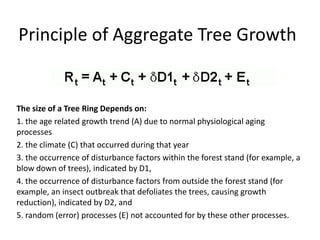
Principle of Aggregate Tree Growth
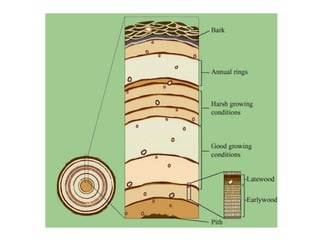
The size of a Tree Ring Depends on:
1. the age related growth trend (A) due to normal physiological aging
processes
2. the climate (C) that occurred during that year
3. the occurrence of disturbance factors within the forest stand (for example, a
blow down of trees), indicated by D1,
4. the occurrence of disturbance factors from outside the forest stand (for
example, an insect outbreak that defoliates the trees, causing growth
reduction), indicated by D2, and
5. random (error) processes (E) not accounted for by these other processes.
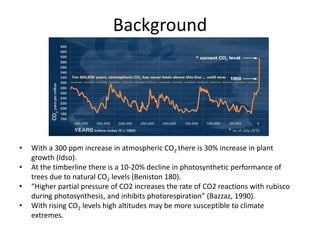
• With a 300 ppm increase in atmospheric CO2 there is 30% increase in plant
growth (Idso).
• At the timberline there is a 10-20% decline in photosynthetic performance of
trees due to natural CO2 levels (Beniston 180).
• “Higher partial pressure of CO2 increases the rate of CO2 reactions with rubisco
during photosynthesis, and inhibits photorespiration” (Bazzaz, 1990).
• With rising CO2 levels high altitudes may be more susceptible to climate
extremes.
Background
Research Question:
How will climate change affect high altitude
carbon sequestration?
Hypothesis:
Since high altitude trees are normally limited by
colder temperatures and a thinner atmosphere
they will be more susceptible to climate change.
Methods
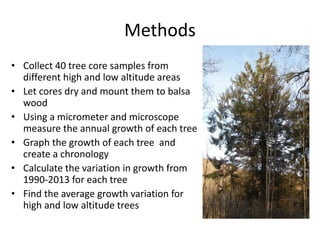
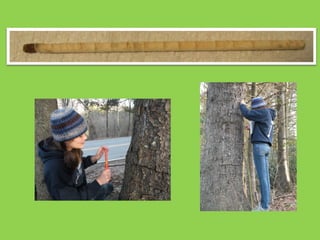
• Collect 40 tree core samples from
different high and low altitude areas
• Let cores dry and mount them to balsa
wood
• Using a micrometer and microscope
measure the annual growth of each tree
• Graph the growth of each tree and
create a chronology
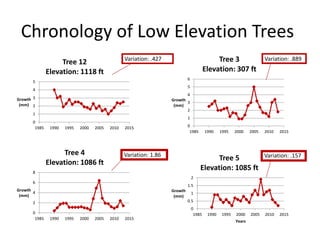
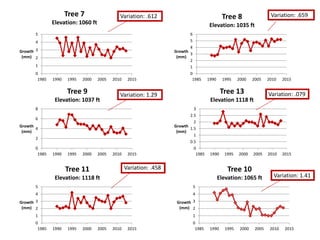
• Calculate the variation in growth from
1990-2013 for each tree
• Find the average growth variation for
high and low altitude trees
To eliminate random variation:
• Large sample size
• “For most sites in the United States, 20 overlapping
tree records are usually sufficient for a reliable
chronology.” (Speer 4)
• Several locations
• Boone, Howards Knob, Wilkesboro, Durham, Hickory
• Different size trees
• Ranging from 223 cm- 77 cm
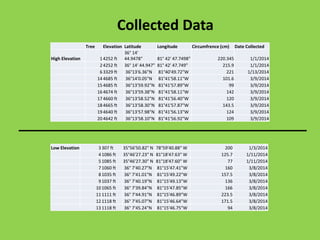
Collected Data
Tree Elevation Latitude Longitude Circumfrence (cm) Date Collected
High Elevation 14252 ft
36° 14'
44.9478" 81° 42' 47.7498" 220.345 1/1/2014
24252 ft 36° 14' 44.947" 81° 42' 47.749" 215.9 1/1/2014
63329 ft 36°13'6.36"N 81°40'49.72"W 221 1/13/2014
144685 ft 36°14'0.05"N 81°41'58.11"W 101.6 3/9/2014
154685 ft 36°13'59.92"N 81°41'57.89"W 99 3/9/2014
164674 ft 36°13'59.38"N 81°41'58.11"W 142 3/9/2014
174660 ft 36°13'58.52"N 81°41'56.40"W 120 3/9/2014
184665 ft 36°13'58.30"N 81°41'57.87"W 143.5 3/9/2014
194640 ft 36°13'57.98"N 81°41'56.13"W 124 3/9/2014
204642 ft 36°13'58.10"N 81°41'56.92"W 109 3/9/2014
Low Elevation 3307 ft 35°56'50.82" N 78°59'40.88" W 200 1/3/2014
41086 ft 35°46'27.23" N 81°18'47.63" W 125.7 1/11/2014
51085 ft 35°46'27.30" N 81°18'47.60" W 77 1/11/2014
71060 ft 36° 7'40.27"N 81°15'47.41"W 160 3/8/2014
81035 ft 36° 7'41.01"N 81°15'49.22"W 157.5 3/8/2014
91037 ft 36° 7'40.19"N 81°15'49.13"W 136 3/8/2014
101065 ft 36° 7'39.84"N 81°15'47.85"W 166 3/8/2014
111111 ft 36° 7'44.91"N 81°15'46.89"W 223.5 3/8/2014
121118 ft 36° 7'45.07"N 81°15'46.64"W 171.5 3/8/2014
131118 ft 36° 7'45.24"N 81°15'46.75"W 94 3/8/2014
Chronology of Low Elevation Trees
0
1
2
3
4
5
1985 1990 1995 2000 2005 2010 2015
Growth
(mm)
Tree 12
Elevation: 1118 ft
0
1
2
3
4
5
6
1985 1990 1995 2000 2005 2010 2015
Growth
(mm)
Tree 3
Elevation: 307 ft
0
2
4
6
8
1985 1990 1995 2000 2005 2010 2015
Growth
(mm)
Tree 4
Elevation: 1086 ft
0
0.5
1
1.5
2
1985 1990 1995 2000 2005 2010 2015
Growth
(mm)
Years
Tree 5
Elevation: 1085 ft
Variation: .427 Variation: .889
Variation: 1.86 Variation: .157
0
1
2
3
4
5
1985 1990 1995 2000 2005 2010 2015
Growth
(mm)
Tree 7
Elevation: 1060 ft
0
1
2
3
4
5
6
1985 1990 1995 2000 2005 2010 2015
Growth
(mm)
Tree 8
Elevation: 1035 ft
0
2
4
6
8
1985 1990 1995 2000 2005 2010 2015
Growth
(mm)
Tree 9
Elevation: 1037 ft
0
0.5
1
1.5
2
2.5
3
1985 1990 1995 2000 2005 2010 2015
Growth
(mm)
Tree 13
Elevation 1118 ft
0
1
2
3
4
5
1985 1990 1995 2000 2005 2010 2015
Growth
(mm)
Tree 11
Elevation: 1118 ft
Variation: .612 Variation: .659
Variation: 1.29 Variation: .079
Variation: .458
0
1
2
3
4
5
1985 1990 1995 2000 2005 2010 2015
Growth
(mm)
Tree 10
Elevation: 1065 ft Variation: 1.41
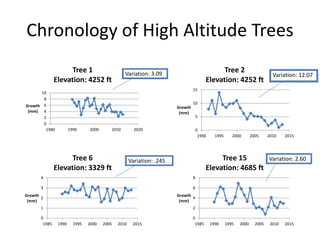
Chronology of High Altitude Trees
0
2
4
6
8
10
1980 1990 2000 2010 2020
Growth
(mm)
Tree 1
Elevation: 4252 ft
0
5
10
15
1990 1995 2000 2005 2010 2015
Growth
(mm)
Tree 2
Elevation: 4252 ft
0
1
2
3
4
1985 1990 1995 2000 2005 2010 2015
Growth
(mm)
Tree 6
Elevation: 3329 ft
0
2
4
6
8
1985 1990 1995 2000 2005 2010 2015
Growth
(mm)
Tree 15
Elevation: 4685 ft
Variation: 3.09
Variation: .245
Variation: 12.07
Variation: 2.60
0
1
2
3
4
5
6
7
1980 1990 2000 2010 2020
Growth
(mm)
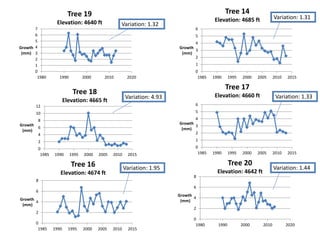
Tree 19
Elevation: 4640 ft
0
1
2
3
4
5
6
1985 1990 1995 2000 2005 2010 2015
Growth
(mm)
Tree 14
Elevation: 4685 ft
0
2
4
6
8
10
12
1985 1990 1995 2000 2005 2010 2015
Growth
(mm)
Tree 18
Elevation: 4665 ft
0
2
4
6
8
1985 1990 1995 2000 2005 2010 2015
Growth
(mm)
Tree 16
Elevation: 4674 ft
Variation: 1.32
Variation: 1.31
Variation: 4.93
Variation: 1.95
0
1
2
3
4
5
6
1985 1990 1995 2000 2005 2010 2015
Growth
(mm)
Tree 17
Elevation: 4660 ft Variation: 1.33
0
2
4
6
8
1980 1990 2000 2010 2020
Growth
(mm)
Tree 20
Elevation: 4642 ft
Variation: 1.44
0
1
2
3
4
5
6
1985 1990 1995 2000 2005 2010 2015
Growth
(mm)
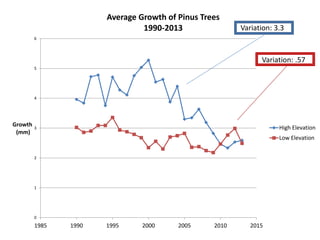
Average Growth of Pinus Trees
1990-2013
High Elevation
Low Elevation
Variation: 3.3
Variation: .57
Average Growth Variation
• High Elevation: 3.3
• Low Elevation: .57
Implications: There is a significant difference in
growth variability between high elevation and
low elevation trees. High elevation trees
experienced more growth variation than low
elevation trees.
Discussion
Based on experimental data high elevation trees are more affected
by climate change. In years of climate extremes trees at 3,000 plus feet
showed significant changes in growth rate. Low elevation trees show a very
steady growth trend that is not affected by climate. This suggests that future
climate change will have a significant effect on mountain ecosystems. As
atmospheric carbon dioxide increases high elevation trees will experience a
carbon dioxide fertilization effect. This effect is capable of shifting species
ranges and altering ecosystem dynamics. Climate will have an effect on high
altitudes and it is important to understand how the ecosystems will respond.
Works Cited
Beniston, Martin. Mountain Environments in Changing Climates. London: Routledge, 1994. Print.
"Carbon Storage in Trees." The Envirothon. N.p., n.d. Web. 3 Jan. 2014.
Climate Change: How Do We Know? Digital image. Global Climate Change. National Aeronautics and Space Administration, n.d.
Web. 13 Jan. 2014.
"CO2 Fertilization." RealClimate RSS. Guardian Environment Network, 28 Nov. 2004. Web. 20 Dec. 2013.
Dyer, James. "Tree Coring Videos - James Dyer." Introduction to Tree Coring & Preparing Tree Cores for Analysis. Ohio University,
25 July 2013. Web. 15 Jan. 2014.
Idso, Sherwood B. "Three Phases of Plant Response to Atmospheric CO2 Enrichment."Plant Physiol. United States Water
Conservation Laboratory,, 21 Jan. 1988. Web. 13 Jan. 2014.
Jacoby, Gordon C., and Rosanne D. D'Arrgio. "Tree Rings, Carbon Dioxide, and Climatic change." Proceeding of the National
Academy of Sciences of the United States of America 94.16 (1997): 8350-353. PNAS. National Academy of Sciences. Web. 21
Dec. 2013.
"Laboratory of Tree-Ring Research." About Tree Rings. The Arizona Board of Regents, 5 Jan. 2012. Web. 12 Dec. 2013.
Mathez, Edmond A. "Studying Tree Rings to Learn About Global Climate." Earth: Inside and out. N.p.: n.p., n.d. N. pag. Studying
Tree Rings to Learn About Global Climate. New Press. Web. 15 Jan. 2014.
Speer, James H. Fundamentals of Tree-ring Research. Tucson: University of Arizona, 2010. Print.
Stoffel, Markus, Michelle Bollschweiler, David R. Butler, and Brian H. Luckman. Tree Rings and Natural Hazards: A State-of-the-
art. Dordrecht: Springer, 2010. Print.
Acknowledgements
Dr. Schmalbeck- NCSSM
Dr. van de Gevel- ASU

Dendroclimatology

  • 1.
    Mackenzie Nelsen Junior at Watauga HighSchool Using Dendroclimatology to Predict the Effects of Climate Change on High Elevations
  • 3.
    Principle of AggregateTree Growth The size of a Tree Ring Depends on: 1. the age related growth trend (A) due to normal physiological aging processes 2. the climate (C) that occurred during that year 3. the occurrence of disturbance factors within the forest stand (for example, a blow down of trees), indicated by D1, 4. the occurrence of disturbance factors from outside the forest stand (for example, an insect outbreak that defoliates the trees, causing growth reduction), indicated by D2, and 5. random (error) processes (E) not accounted for by these other processes.
  • 4.
    • With a300 ppm increase in atmospheric CO2 there is 30% increase in plant growth (Idso). • At the timberline there is a 10-20% decline in photosynthetic performance of trees due to natural CO2 levels (Beniston 180). • “Higher partial pressure of CO2 increases the rate of CO2 reactions with rubisco during photosynthesis, and inhibits photorespiration” (Bazzaz, 1990). • With rising CO2 levels high altitudes may be more susceptible to climate extremes. Background
  • 5.
    Research Question: How willclimate change affect high altitude carbon sequestration? Hypothesis: Since high altitude trees are normally limited by colder temperatures and a thinner atmosphere they will be more susceptible to climate change.
  • 6.
    Methods • Collect 40tree core samples from different high and low altitude areas • Let cores dry and mount them to balsa wood • Using a micrometer and microscope measure the annual growth of each tree • Graph the growth of each tree and create a chronology • Calculate the variation in growth from 1990-2013 for each tree • Find the average growth variation for high and low altitude trees
  • 7.
    To eliminate randomvariation: • Large sample size • “For most sites in the United States, 20 overlapping tree records are usually sufficient for a reliable chronology.” (Speer 4) • Several locations • Boone, Howards Knob, Wilkesboro, Durham, Hickory • Different size trees • Ranging from 223 cm- 77 cm
  • 9.
    Collected Data Tree ElevationLatitude Longitude Circumfrence (cm) Date Collected High Elevation 14252 ft 36° 14' 44.9478" 81° 42' 47.7498" 220.345 1/1/2014 24252 ft 36° 14' 44.947" 81° 42' 47.749" 215.9 1/1/2014 63329 ft 36°13'6.36"N 81°40'49.72"W 221 1/13/2014 144685 ft 36°14'0.05"N 81°41'58.11"W 101.6 3/9/2014 154685 ft 36°13'59.92"N 81°41'57.89"W 99 3/9/2014 164674 ft 36°13'59.38"N 81°41'58.11"W 142 3/9/2014 174660 ft 36°13'58.52"N 81°41'56.40"W 120 3/9/2014 184665 ft 36°13'58.30"N 81°41'57.87"W 143.5 3/9/2014 194640 ft 36°13'57.98"N 81°41'56.13"W 124 3/9/2014 204642 ft 36°13'58.10"N 81°41'56.92"W 109 3/9/2014 Low Elevation 3307 ft 35°56'50.82" N 78°59'40.88" W 200 1/3/2014 41086 ft 35°46'27.23" N 81°18'47.63" W 125.7 1/11/2014 51085 ft 35°46'27.30" N 81°18'47.60" W 77 1/11/2014 71060 ft 36° 7'40.27"N 81°15'47.41"W 160 3/8/2014 81035 ft 36° 7'41.01"N 81°15'49.22"W 157.5 3/8/2014 91037 ft 36° 7'40.19"N 81°15'49.13"W 136 3/8/2014 101065 ft 36° 7'39.84"N 81°15'47.85"W 166 3/8/2014 111111 ft 36° 7'44.91"N 81°15'46.89"W 223.5 3/8/2014 121118 ft 36° 7'45.07"N 81°15'46.64"W 171.5 3/8/2014 131118 ft 36° 7'45.24"N 81°15'46.75"W 94 3/8/2014
  • 10.
    Chronology of LowElevation Trees 0 1 2 3 4 5 1985 1990 1995 2000 2005 2010 2015 Growth (mm) Tree 12 Elevation: 1118 ft 0 1 2 3 4 5 6 1985 1990 1995 2000 2005 2010 2015 Growth (mm) Tree 3 Elevation: 307 ft 0 2 4 6 8 1985 1990 1995 2000 2005 2010 2015 Growth (mm) Tree 4 Elevation: 1086 ft 0 0.5 1 1.5 2 1985 1990 1995 2000 2005 2010 2015 Growth (mm) Years Tree 5 Elevation: 1085 ft Variation: .427 Variation: .889 Variation: 1.86 Variation: .157
  • 11.
    0 1 2 3 4 5 1985 1990 19952000 2005 2010 2015 Growth (mm) Tree 7 Elevation: 1060 ft 0 1 2 3 4 5 6 1985 1990 1995 2000 2005 2010 2015 Growth (mm) Tree 8 Elevation: 1035 ft 0 2 4 6 8 1985 1990 1995 2000 2005 2010 2015 Growth (mm) Tree 9 Elevation: 1037 ft 0 0.5 1 1.5 2 2.5 3 1985 1990 1995 2000 2005 2010 2015 Growth (mm) Tree 13 Elevation 1118 ft 0 1 2 3 4 5 1985 1990 1995 2000 2005 2010 2015 Growth (mm) Tree 11 Elevation: 1118 ft Variation: .612 Variation: .659 Variation: 1.29 Variation: .079 Variation: .458 0 1 2 3 4 5 1985 1990 1995 2000 2005 2010 2015 Growth (mm) Tree 10 Elevation: 1065 ft Variation: 1.41
  • 12.
    Chronology of HighAltitude Trees 0 2 4 6 8 10 1980 1990 2000 2010 2020 Growth (mm) Tree 1 Elevation: 4252 ft 0 5 10 15 1990 1995 2000 2005 2010 2015 Growth (mm) Tree 2 Elevation: 4252 ft 0 1 2 3 4 1985 1990 1995 2000 2005 2010 2015 Growth (mm) Tree 6 Elevation: 3329 ft 0 2 4 6 8 1985 1990 1995 2000 2005 2010 2015 Growth (mm) Tree 15 Elevation: 4685 ft Variation: 3.09 Variation: .245 Variation: 12.07 Variation: 2.60
  • 13.
    0 1 2 3 4 5 6 7 1980 1990 20002010 2020 Growth (mm) Tree 19 Elevation: 4640 ft 0 1 2 3 4 5 6 1985 1990 1995 2000 2005 2010 2015 Growth (mm) Tree 14 Elevation: 4685 ft 0 2 4 6 8 10 12 1985 1990 1995 2000 2005 2010 2015 Growth (mm) Tree 18 Elevation: 4665 ft 0 2 4 6 8 1985 1990 1995 2000 2005 2010 2015 Growth (mm) Tree 16 Elevation: 4674 ft Variation: 1.32 Variation: 1.31 Variation: 4.93 Variation: 1.95 0 1 2 3 4 5 6 1985 1990 1995 2000 2005 2010 2015 Growth (mm) Tree 17 Elevation: 4660 ft Variation: 1.33 0 2 4 6 8 1980 1990 2000 2010 2020 Growth (mm) Tree 20 Elevation: 4642 ft Variation: 1.44
  • 14.
    0 1 2 3 4 5 6 1985 1990 19952000 2005 2010 2015 Growth (mm) Average Growth of Pinus Trees 1990-2013 High Elevation Low Elevation Variation: 3.3 Variation: .57
  • 15.
    Average Growth Variation •High Elevation: 3.3 • Low Elevation: .57 Implications: There is a significant difference in growth variability between high elevation and low elevation trees. High elevation trees experienced more growth variation than low elevation trees.
  • 16.
    Discussion Based on experimentaldata high elevation trees are more affected by climate change. In years of climate extremes trees at 3,000 plus feet showed significant changes in growth rate. Low elevation trees show a very steady growth trend that is not affected by climate. This suggests that future climate change will have a significant effect on mountain ecosystems. As atmospheric carbon dioxide increases high elevation trees will experience a carbon dioxide fertilization effect. This effect is capable of shifting species ranges and altering ecosystem dynamics. Climate will have an effect on high altitudes and it is important to understand how the ecosystems will respond.
  • 17.
    Works Cited Beniston, Martin.Mountain Environments in Changing Climates. London: Routledge, 1994. Print. "Carbon Storage in Trees." The Envirothon. N.p., n.d. Web. 3 Jan. 2014. Climate Change: How Do We Know? Digital image. Global Climate Change. National Aeronautics and Space Administration, n.d. Web. 13 Jan. 2014. "CO2 Fertilization." RealClimate RSS. Guardian Environment Network, 28 Nov. 2004. Web. 20 Dec. 2013. Dyer, James. "Tree Coring Videos - James Dyer." Introduction to Tree Coring & Preparing Tree Cores for Analysis. Ohio University, 25 July 2013. Web. 15 Jan. 2014. Idso, Sherwood B. "Three Phases of Plant Response to Atmospheric CO2 Enrichment."Plant Physiol. United States Water Conservation Laboratory,, 21 Jan. 1988. Web. 13 Jan. 2014. Jacoby, Gordon C., and Rosanne D. D'Arrgio. "Tree Rings, Carbon Dioxide, and Climatic change." Proceeding of the National Academy of Sciences of the United States of America 94.16 (1997): 8350-353. PNAS. National Academy of Sciences. Web. 21 Dec. 2013. "Laboratory of Tree-Ring Research." About Tree Rings. The Arizona Board of Regents, 5 Jan. 2012. Web. 12 Dec. 2013. Mathez, Edmond A. "Studying Tree Rings to Learn About Global Climate." Earth: Inside and out. N.p.: n.p., n.d. N. pag. Studying Tree Rings to Learn About Global Climate. New Press. Web. 15 Jan. 2014. Speer, James H. Fundamentals of Tree-ring Research. Tucson: University of Arizona, 2010. Print. Stoffel, Markus, Michelle Bollschweiler, David R. Butler, and Brian H. Luckman. Tree Rings and Natural Hazards: A State-of-the- art. Dordrecht: Springer, 2010. Print.
  • 18.