Streamside Environmental Factors and Occurrence of Breeding Behaviors of Ebony
Jewelwing, (Calopteryx, maculata) in South Brook
Joshua Bryant
Mentor: Dr. Kevin D. Curry
Department of Biological Sciences, Bridgewater State University, Bridgewater, MA 02325
Materials and Methods
• Annual clearing of winter debris covering stream
• Re-marked movement zones: 375 m stretch of South Brook divided into twenty-five, 15 m sections
• Weekly surveys to mark and recapture. Specimens marked with fine tipped oil based markers.
• New captures and recaptures recorded by wing number, sex, date and time of capture and zone
• Behavioral and movement observations were recorded for each day
• Measured weekly stream flow and depth
• Hobo temperature and light sensor in control and breeding habitats recorded data every 30 minutes
• Behaviors observed weekly for 20 min periods in of each of the four zones on the same day
Results
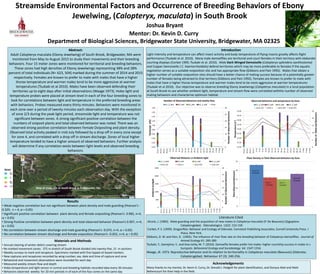
• Weak negative correlation but not significant between plant density and male guarding (Pearson’s -
0.329, n = 4, α = 0.05)
• Significant positive correlation between plant density and female ovipositing (Pearson’s 0.982, n=4,
α = 0.05)
• Strong Positive correlation between plant density and total observed behavior (Pearson’s 0.907, n=4,
α = 0.05)
• No correlation between stream discharge and male guarding (Pearson’s -0.074, n=4, α = 0.05)
• No correlation between stream discharge and female oviposition (Pearson’s -0.052, n=4, α = 0.05)
Map of study site at South Brook in Bridgewater, Ma.
Acknowledgements
Many thanks to my mentor, Dr. Kevin D. Curry, Dr. Donald J. Padgett for plant identification, and Donyce Abel and Matt
Bettencourt for their help in the field.
Literature Cited
Alcock, J. (1983). Mate guarding and the acquisition of new mates in Calopteryx maculata (P. De Beauvois) (Zygoptera:
Calopterygidae). Odonatologica 12(2): 153-159.
Corbet, P. S. (1999). Dragonflies: Behavior and Ecology of Odonata. Comstock Publishing Associates, Cornell University Press. I
thaca, New York.
Gibbons, D. W. and Pain, D. (1992). The influence of river flow rate on the breeding behavior of Calopteryx damselflies. Journal of
Animal Ecology 61: 283-289
Tsubaki, Y., Samejima, Y., and Siva-Jothy, M. T. (2010). Damselfly females prefer hot males: higher courtship success in males in s
Sunspots. Behavioral Ecology and Sociobiology 64: 1547-1554.
Waage, JK. 1973. Reproductive behavior and its relation to territoriality in Calopteryx maculata (Beauvois) (Odonata:
Calopterygidae). Behaviour 47 (3): 240-256.
Abstract:
Adult Calopteryx maculata (Ebony Jewelwing) of South Brook, Bridgewater, MA were
monitored from May to August 2015 to study their movements and their breeding
behaviors. Four 15 meter zones were monitored for territorial and breeding behaviors.
These zones had high densities of Ebony Jewelwings representing 38% and 28%
percent of total individuals (N= 623, 504) marked during the summer of 2014 and 2015
respectively. Females are known to prefer to mate with males that have a higher
thorax temperature and warmer males tend to be more aggressive at warmer
temperatures (Tsubaki et al 2010). Males have been observed defending their
territories up to eight days after initial observations (Waage 1973). Hobo light and
temperature probes were placed at stream level in each of the four breeding zones to
look for correlations between light and temperature in the preferred breeding areas
with behaviors. Probes measured every thirty minutes. Behaviors were monitored in
each zone over a period of twenty minutes each observation day. With the exception
of zone 2/3 during the peak light period, streamside light and temperature was not
significant between zones. A strong significant positive correlation between the
numbers of oviposit plants and total observed behavior was noted. There was an
observed strong positive correlation between Female Ovipositing and plant density.
Observed total activity peaked in mid-July followed by a drop off in every zone except
for zone 4, and correlated with a drop off in stream discharge. Zones of local higher
temperature tended to have a higher amount of observed behaviors. Further analysis
will determine if any correlation exists between light levels and observed breeding
behaviors.
Introduction
Light intensity and temperature can affect insect activity and body temperature of flying insects greatly affects flight
performance (Tsubaki et al. 2010). Many male damselflies are territorial and court females in their territory with elaborate
courting displays (Corbet 1999, Tsubaki et al. 2010). Male Dark Winged Demoiselle (Calopteryx splendens xanthostoma)
and Copper Demoiselle ( C. haemorrhoidalis) defend territories which may be more preferable to females if the aquatic
vegetation serves as a suitable oviposition site and has appropriate flow (Gibbons and Pain 1992). Males that obtain a
higher number of suitable oviposition sites should have a better chance of mating success because of a potentially greater
number of females being attracted to that territory (Gibbons and Pain 1992). Females are known to prefer to mate with
males that have a higher thorax temperature and warmer males tend to be more aggressive at warmer temperatures
(Tsubaki et al 2010). Our objective was to observe breeding Ebony Jewelwings (Calopteryx maculata) in a local population
at South Brook to see whether ambient light, temperature and stream flow were correlated withthe number of observed
mating behaviors and characterize optimum habitat.
Zones
½
¾
4/5
3
0
5
10
15
20
25
30
0.00
0.20
0.40
0.60
0.80
1.00
1.20
1.40
1.60
1.80
24-Jun
26-Jun
28-Jun
30-Jun
2-Jul
4-Jul
6-Jul
8-Jul
10-Jul
12-Jul
14-Jul
16-Jul
18-Jul
20-Jul
22-Jul
24-Jul
26-Jul
28-Jul
30-Jul
1-Aug
3-Aug
5-Aug
Numberofobservedbehaviors
Discharge(cfs)
Number of Observed behaviors and weekly flow
z1_2_Beh Z3_beh z4_beh z4_5_beh Flow
0
5
10
15
20
25
21.00
21.50
22.00
22.50
23.00
23.50
24.00
24.50
25.00
24-Jun
26-Jun
28-Jun
30-Jun
2-Jul
4-Jul
6-Jul
8-Jul
10-Jul
12-Jul
14-Jul
16-Jul
18-Jul
20-Jul
22-Jul
24-Jul
26-Jul
28-Jul
30-Jul
1-Aug
3-Aug
5-Aug
NumberofObservedBehaviors
Temperature(c°)
Observed behaviors and temperature by Zone
z1_2_Beh Z3_beh z4_beh z4_5_beh
zone 1/2 zone 3 zone 3/4 zone 4/5
0
5
10
15
20
25
30
0
500
1000
1500
2000
2500
24-Jun
26-Jun
28-Jun
30-Jun
2-Jul
4-Jul
6-Jul
8-Jul
10-Jul
12-Jul
14-Jul
16-Jul
18-Jul
20-Jul
22-Jul
24-Jul
26-Jul
28-Jul
30-Jul
1-Aug
3-Aug
5-Aug
NumberofObservedBehaviors
AmbientSunlight
Observed Behavior vs Ambient Light
z1_2_Beh Z3_beh z4_beh z4_5_beh
zone 1/2 zone 3 zone 3/4 zone 4/5
0
5
10
15
20
25
1
TotalObservedBehaviors
Plant Density vs Total Observed behaviors by Zone
Zone 1/2
48 plants
Zone 3
35 Plants
Zone 4
43 plants
Zone 4/5
28 plants

JBryant_Poster2016

  • 1.
    Streamside Environmental Factorsand Occurrence of Breeding Behaviors of Ebony Jewelwing, (Calopteryx, maculata) in South Brook Joshua Bryant Mentor: Dr. Kevin D. Curry Department of Biological Sciences, Bridgewater State University, Bridgewater, MA 02325 Materials and Methods • Annual clearing of winter debris covering stream • Re-marked movement zones: 375 m stretch of South Brook divided into twenty-five, 15 m sections • Weekly surveys to mark and recapture. Specimens marked with fine tipped oil based markers. • New captures and recaptures recorded by wing number, sex, date and time of capture and zone • Behavioral and movement observations were recorded for each day • Measured weekly stream flow and depth • Hobo temperature and light sensor in control and breeding habitats recorded data every 30 minutes • Behaviors observed weekly for 20 min periods in of each of the four zones on the same day Results • Weak negative correlation but not significant between plant density and male guarding (Pearson’s - 0.329, n = 4, α = 0.05) • Significant positive correlation between plant density and female ovipositing (Pearson’s 0.982, n=4, α = 0.05) • Strong Positive correlation between plant density and total observed behavior (Pearson’s 0.907, n=4, α = 0.05) • No correlation between stream discharge and male guarding (Pearson’s -0.074, n=4, α = 0.05) • No correlation between stream discharge and female oviposition (Pearson’s -0.052, n=4, α = 0.05) Map of study site at South Brook in Bridgewater, Ma. Acknowledgements Many thanks to my mentor, Dr. Kevin D. Curry, Dr. Donald J. Padgett for plant identification, and Donyce Abel and Matt Bettencourt for their help in the field. Literature Cited Alcock, J. (1983). Mate guarding and the acquisition of new mates in Calopteryx maculata (P. De Beauvois) (Zygoptera: Calopterygidae). Odonatologica 12(2): 153-159. Corbet, P. S. (1999). Dragonflies: Behavior and Ecology of Odonata. Comstock Publishing Associates, Cornell University Press. I thaca, New York. Gibbons, D. W. and Pain, D. (1992). The influence of river flow rate on the breeding behavior of Calopteryx damselflies. Journal of Animal Ecology 61: 283-289 Tsubaki, Y., Samejima, Y., and Siva-Jothy, M. T. (2010). Damselfly females prefer hot males: higher courtship success in males in s Sunspots. Behavioral Ecology and Sociobiology 64: 1547-1554. Waage, JK. 1973. Reproductive behavior and its relation to territoriality in Calopteryx maculata (Beauvois) (Odonata: Calopterygidae). Behaviour 47 (3): 240-256. Abstract: Adult Calopteryx maculata (Ebony Jewelwing) of South Brook, Bridgewater, MA were monitored from May to August 2015 to study their movements and their breeding behaviors. Four 15 meter zones were monitored for territorial and breeding behaviors. These zones had high densities of Ebony Jewelwings representing 38% and 28% percent of total individuals (N= 623, 504) marked during the summer of 2014 and 2015 respectively. Females are known to prefer to mate with males that have a higher thorax temperature and warmer males tend to be more aggressive at warmer temperatures (Tsubaki et al 2010). Males have been observed defending their territories up to eight days after initial observations (Waage 1973). Hobo light and temperature probes were placed at stream level in each of the four breeding zones to look for correlations between light and temperature in the preferred breeding areas with behaviors. Probes measured every thirty minutes. Behaviors were monitored in each zone over a period of twenty minutes each observation day. With the exception of zone 2/3 during the peak light period, streamside light and temperature was not significant between zones. A strong significant positive correlation between the numbers of oviposit plants and total observed behavior was noted. There was an observed strong positive correlation between Female Ovipositing and plant density. Observed total activity peaked in mid-July followed by a drop off in every zone except for zone 4, and correlated with a drop off in stream discharge. Zones of local higher temperature tended to have a higher amount of observed behaviors. Further analysis will determine if any correlation exists between light levels and observed breeding behaviors. Introduction Light intensity and temperature can affect insect activity and body temperature of flying insects greatly affects flight performance (Tsubaki et al. 2010). Many male damselflies are territorial and court females in their territory with elaborate courting displays (Corbet 1999, Tsubaki et al. 2010). Male Dark Winged Demoiselle (Calopteryx splendens xanthostoma) and Copper Demoiselle ( C. haemorrhoidalis) defend territories which may be more preferable to females if the aquatic vegetation serves as a suitable oviposition site and has appropriate flow (Gibbons and Pain 1992). Males that obtain a higher number of suitable oviposition sites should have a better chance of mating success because of a potentially greater number of females being attracted to that territory (Gibbons and Pain 1992). Females are known to prefer to mate with males that have a higher thorax temperature and warmer males tend to be more aggressive at warmer temperatures (Tsubaki et al 2010). Our objective was to observe breeding Ebony Jewelwings (Calopteryx maculata) in a local population at South Brook to see whether ambient light, temperature and stream flow were correlated withthe number of observed mating behaviors and characterize optimum habitat. Zones ½ ¾ 4/5 3 0 5 10 15 20 25 30 0.00 0.20 0.40 0.60 0.80 1.00 1.20 1.40 1.60 1.80 24-Jun 26-Jun 28-Jun 30-Jun 2-Jul 4-Jul 6-Jul 8-Jul 10-Jul 12-Jul 14-Jul 16-Jul 18-Jul 20-Jul 22-Jul 24-Jul 26-Jul 28-Jul 30-Jul 1-Aug 3-Aug 5-Aug Numberofobservedbehaviors Discharge(cfs) Number of Observed behaviors and weekly flow z1_2_Beh Z3_beh z4_beh z4_5_beh Flow 0 5 10 15 20 25 21.00 21.50 22.00 22.50 23.00 23.50 24.00 24.50 25.00 24-Jun 26-Jun 28-Jun 30-Jun 2-Jul 4-Jul 6-Jul 8-Jul 10-Jul 12-Jul 14-Jul 16-Jul 18-Jul 20-Jul 22-Jul 24-Jul 26-Jul 28-Jul 30-Jul 1-Aug 3-Aug 5-Aug NumberofObservedBehaviors Temperature(c°) Observed behaviors and temperature by Zone z1_2_Beh Z3_beh z4_beh z4_5_beh zone 1/2 zone 3 zone 3/4 zone 4/5 0 5 10 15 20 25 30 0 500 1000 1500 2000 2500 24-Jun 26-Jun 28-Jun 30-Jun 2-Jul 4-Jul 6-Jul 8-Jul 10-Jul 12-Jul 14-Jul 16-Jul 18-Jul 20-Jul 22-Jul 24-Jul 26-Jul 28-Jul 30-Jul 1-Aug 3-Aug 5-Aug NumberofObservedBehaviors AmbientSunlight Observed Behavior vs Ambient Light z1_2_Beh Z3_beh z4_beh z4_5_beh zone 1/2 zone 3 zone 3/4 zone 4/5 0 5 10 15 20 25 1 TotalObservedBehaviors Plant Density vs Total Observed behaviors by Zone Zone 1/2 48 plants Zone 3 35 Plants Zone 4 43 plants Zone 4/5 28 plants

Editor's Notes

  • #2  Annual clearing of winter debris Re-mark movement zones