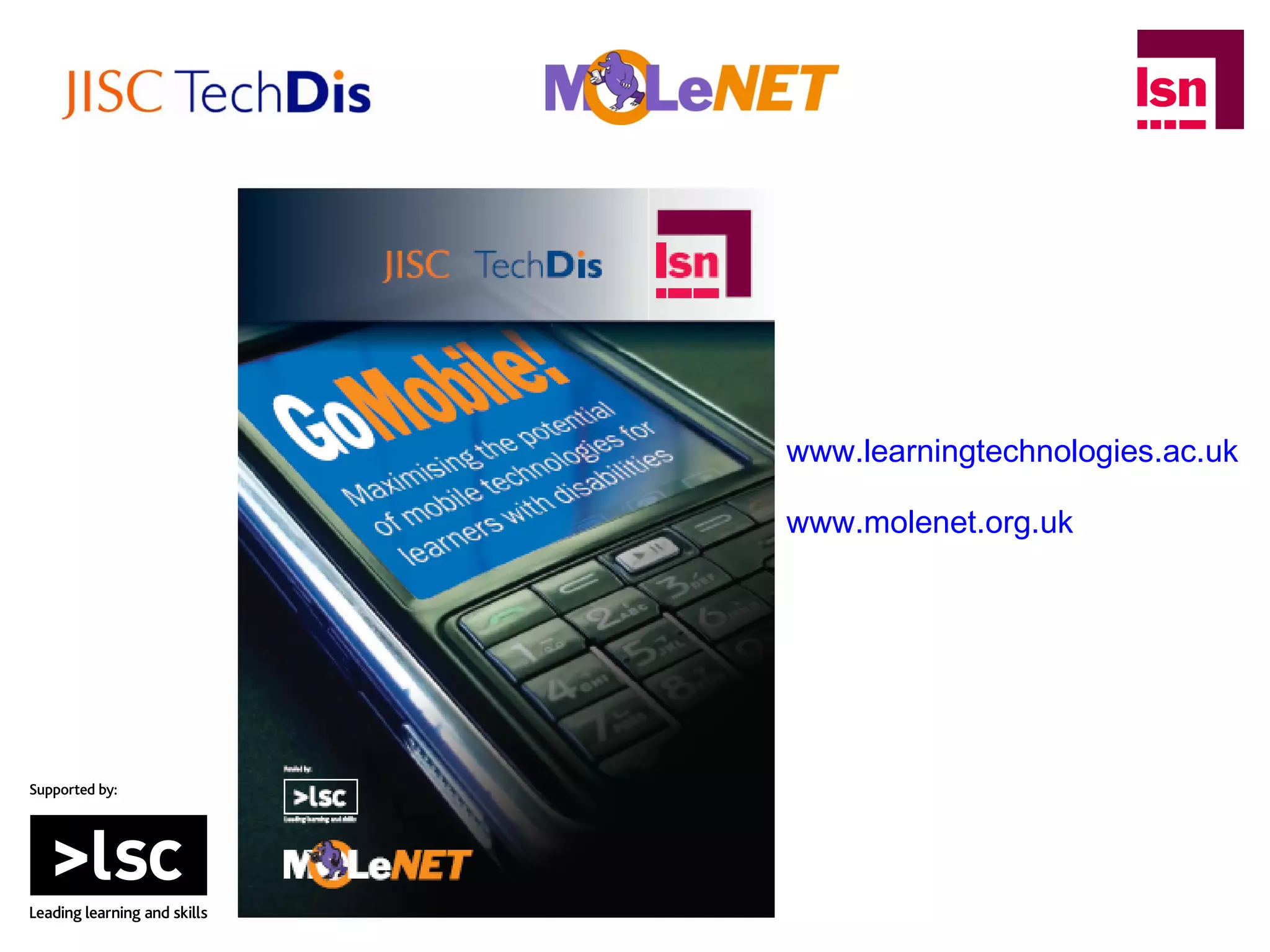
GoMobile!  Maximising the potential of mobile technologies for learners with disabilities Geoff. Foot – LSN [email_address]
www.learningtechnologies.ac.uk www.molenet.org.uk
Across the sectors, practitioners are dealing with increasingly diverse learner needs. However, there are limits to how effectively traditional teaching and learning methods can engage, support and stretch learners who have markedly different starting points and accessibility needs.  Mobile learning offers some innovative and effective ways of tackling this challenge
There have been a number of important initiatives in recent years to promote both inclusivity and m-learning: LSC - L4LW LSC - MoLeNET JISC TechDis – HEAT JISC – RSCs Scotland - BRITE GoMobile! features 12 case studies from further, higher and independent specialist colleges that show how m-learning benefits learners with disabilities and learning difficulties
Enabling: Supporting and assisting    Rob’s use of the Nokia N95 smartphone is having unexpected benefits. Rob is starting to remember regular occurrences ‒ for example, the times for his medication ‒ in much the same way that someone wakes up the same time each day.  National Star College Funded via the MoLeNET programme
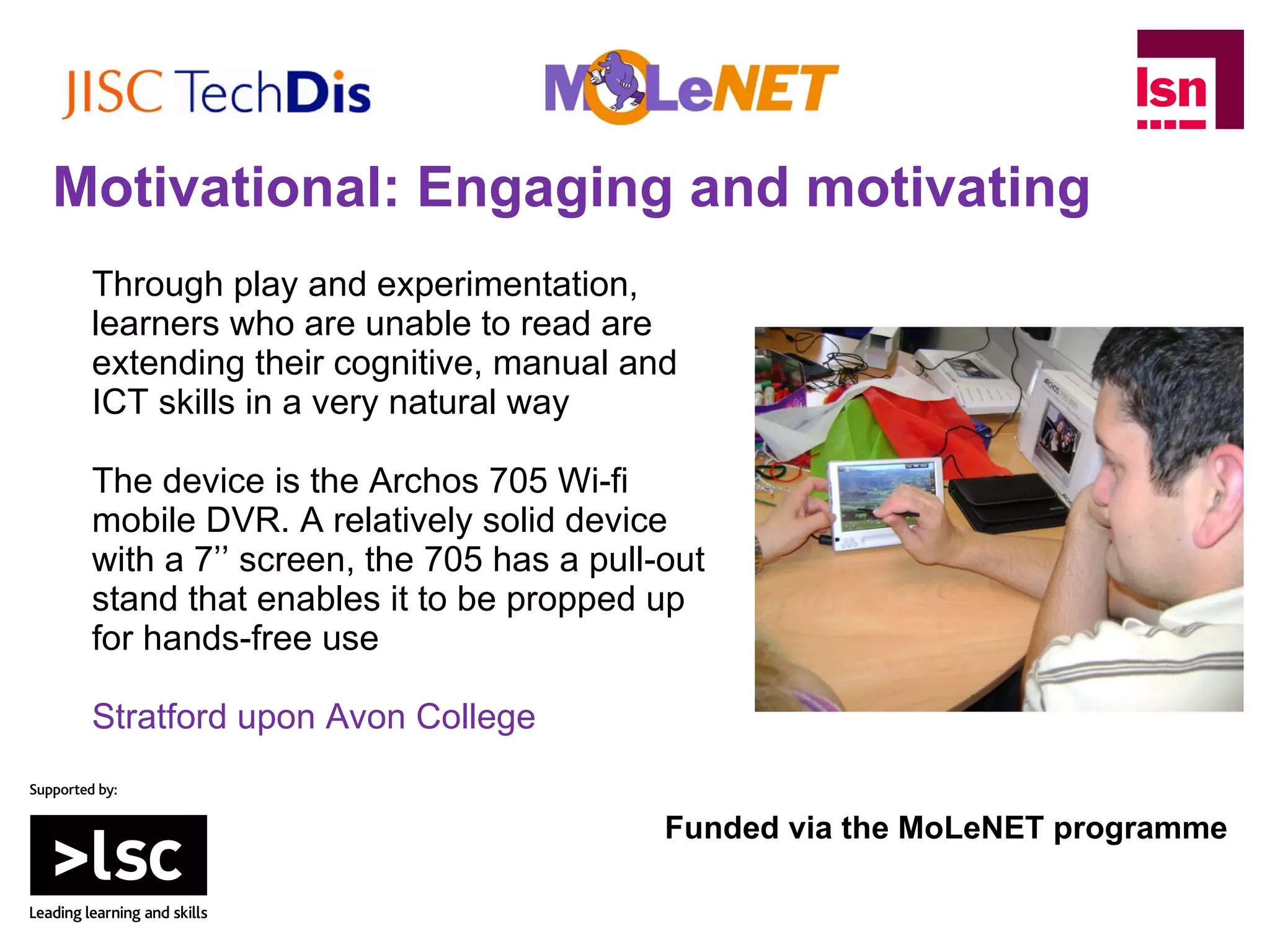
Through play and experimentation, learners who are unable to read are extending their cognitive, manual and ICT skills in a very natural way The device is the Archos 705 Wi-fi mobile DVR. A relatively solid device with a 7’’ screen, the 705 has a pull-out stand that enables it to be propped up for hands-free use Stratford upon Avon College Funded via the MoLeNET programme Motivational: Engaging and motivating
Transformational: Maximising and extending capabilities Stephen, a 19 year-old learner at Henshaw’s College, has visual impairment but has made significant progress in achieving personal and educational goals with the help of an Olympus digital voice recorder Henshaw’s College
Making it happen Toolkit available for those starting out on inclusive mobile learning First steps checklist Glossary of m-learning terms Key tips and lessons learnt eg: Each device offers benefits and challenges which vary from context to context – the trick is to match the learner with the device that is the most suited to their purpose and needs
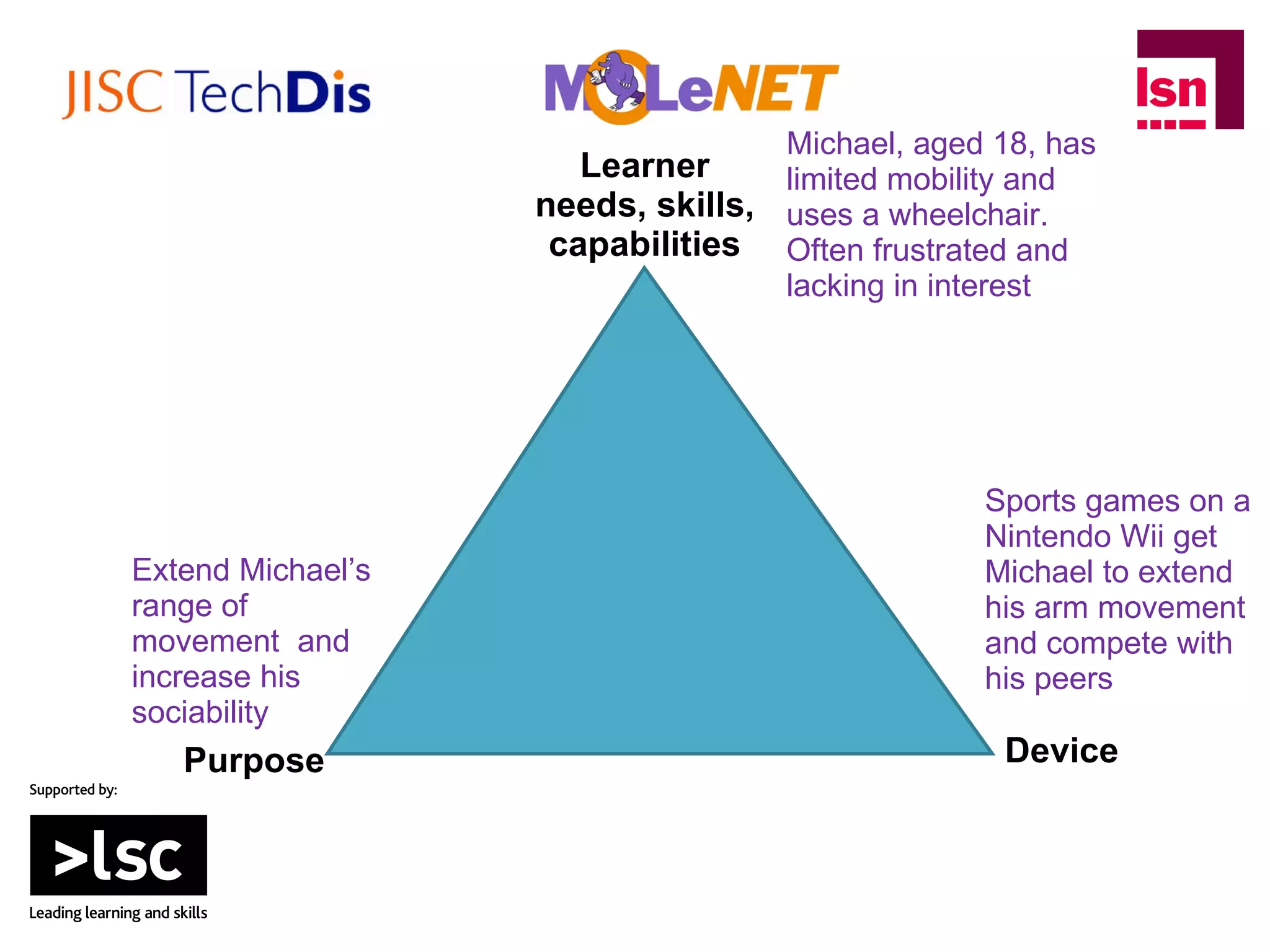
Learner needs, skills, capabilities Purpose Device Michael, aged 18, has limited mobility and uses a wheelchair. Often frustrated and lacking in interest Sports games on a Nintendo Wii get Michael to extend his arm movement  and compete with his peers Extend Michael’s range of movement  and increase his sociability

Geoff Foot

  • 1.
    GoMobile! Maximisingthe potential of mobile technologies for learners with disabilities Geoff. Foot – LSN [email_address]
  • 2.
  • 3.
    Across the sectors,practitioners are dealing with increasingly diverse learner needs. However, there are limits to how effectively traditional teaching and learning methods can engage, support and stretch learners who have markedly different starting points and accessibility needs. Mobile learning offers some innovative and effective ways of tackling this challenge
  • 4.
    There have beena number of important initiatives in recent years to promote both inclusivity and m-learning: LSC - L4LW LSC - MoLeNET JISC TechDis – HEAT JISC – RSCs Scotland - BRITE GoMobile! features 12 case studies from further, higher and independent specialist colleges that show how m-learning benefits learners with disabilities and learning difficulties
  • 5.
    Enabling: Supporting andassisting   Rob’s use of the Nokia N95 smartphone is having unexpected benefits. Rob is starting to remember regular occurrences ‒ for example, the times for his medication ‒ in much the same way that someone wakes up the same time each day. National Star College Funded via the MoLeNET programme
  • 6.
    Through play andexperimentation, learners who are unable to read are extending their cognitive, manual and ICT skills in a very natural way The device is the Archos 705 Wi-fi mobile DVR. A relatively solid device with a 7’’ screen, the 705 has a pull-out stand that enables it to be propped up for hands-free use Stratford upon Avon College Funded via the MoLeNET programme Motivational: Engaging and motivating
  • 7.
    Transformational: Maximising andextending capabilities Stephen, a 19 year-old learner at Henshaw’s College, has visual impairment but has made significant progress in achieving personal and educational goals with the help of an Olympus digital voice recorder Henshaw’s College
  • 8.
    Making it happenToolkit available for those starting out on inclusive mobile learning First steps checklist Glossary of m-learning terms Key tips and lessons learnt eg: Each device offers benefits and challenges which vary from context to context – the trick is to match the learner with the device that is the most suited to their purpose and needs
  • 9.
    Learner needs, skills,capabilities Purpose Device Michael, aged 18, has limited mobility and uses a wheelchair. Often frustrated and lacking in interest Sports games on a Nintendo Wii get Michael to extend his arm movement and compete with his peers Extend Michael’s range of movement and increase his sociability