The Use of Technology in the
Classroom
By: Wonga L. Ntshinga
2015/08/11 1
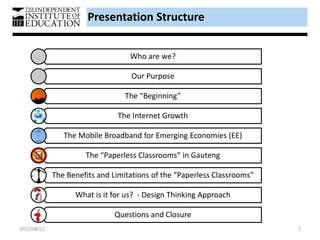
Presentation Structure
Who are we?
Our Purpose
The “Beginning”
The Internet Growth
The Mobile Broadband for Emerging Economies (EE)
The “Paperless Classrooms” in Gauteng
The Benefits and Limitations of the “Paperless Classrooms”
What is it for us? - Design Thinking Approach
Questions and Closure
2015/08/11 2
Who are we?
2015/08/11 3
The Independent Institute of Education (The IIE) is a private higher education
institution operating across 20 sites
Offering more than 70 registered and accredited higher education
programmes from Higher Certificate to Masters level
Brands: Varsity College, Vega, Rosebank College and DSSA campuses.
Visit us at www.iie.ac.za or Twitter @theworldofwork
Our Purpose
2015/08/11 4
Build student careers – we understand that students study as the first step in
their careers and that what they learn and how they learn need to lay the
foundation for further growth, employment and learning.
Relevant curriculum - to the modern world of work and we build strong
industry and academic partnerships that ensure and assure this relevance.
Commit to student success which includes a focus on innovative and
supportive teaching methodologies, a comprehensive and holistic
developmental student support system and the provision of learning
opportunities that meet the diverse needs of the student population.
Produce graduates who can and will contribute to the economy and society
and who recognise their roles and responsibilities as citizens of a global
community.
© SAP AG 2009. All rights reserved. / Page 5
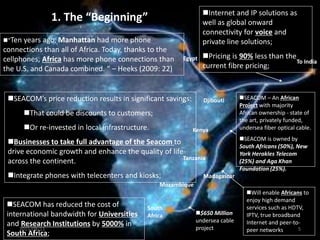
South
Africa
Mozambique
$650 Million
undersea cable
project
Egypt
To India
Kenya
Tanzania
SEACOM – An African
Project with majority
African ownership - state of
the art, privately funded,
undersea fiber optical cable.
SEACOM is owned by
South Africans (50%), New
York Herakles Telecom
(25%) and Aga Khan
Foundation (25%).
Will enable Africans to
enjoy high demand
services such as HDTV,
IPTV, true broadband
Internet and peer-to-
peer networks
Madagascar
Internet and IP solutions as
well as global onward
connectivity for voice and
private line solutions;
Pricing is 90% less than the
current fibre pricing;
DjiboutiSEACOM’s price reduction results in significant savings:
That could be discounts to customers;
Or re-invested in local infrastructure.
Businesses to take full advantage of the Seacom to
drive economic growth and enhance the quality of life
across the continent.
Integrate phones with telecenters and kiosks;
1. The “Beginning”
SEACOM has reduced the cost of
international bandwidth for Universities
and Research Institutions by 5000% in
South Africa;
“Ten years ago, Manhattan had more phone
connections than all of Africa. Today, thanks to the
cellphones, Africa has more phone connections than
the U.S. and Canada combined. “ – Heeks (2009: 22)
2015/08/11 5
Internet Growth
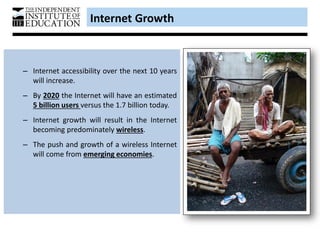
– Internet accessibility over the next 10 years
will increase.
– By 2020 the Internet will have an estimated
5 billion users versus the 1.7 billion today.
– Internet growth will result in the Internet
becoming predominately wireless.
– The push and growth of a wireless Internet
will come from emerging economies.
Mobile Broadband for Emerging Economies
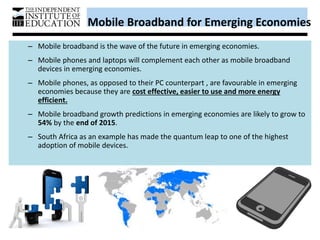
– Mobile broadband is the wave of the future in emerging economies.
– Mobile phones and laptops will complement each other as mobile broadband
devices in emerging economies.
– Mobile phones, as opposed to their PC counterpart , are favourable in emerging
economies because they are cost effective, easier to use and more energy
efficient.
– Mobile broadband growth predictions in emerging economies are likely to grow to
54% by the end of 2015.
– South Africa as an example has made the quantum leap to one of the highest
adoption of mobile devices.
• The Gauteng Department of Education
(@EducationGP) extend its learning technology to
matric classrooms at 375 high schools – best
performing
• Mainly in townships and rural areas to participate in
the programme.
• Programme entails the usage of interactive boards,
mobile devices such as tablets, laptops with complete
internet connectivity.
• To conduct teaching and learning.
• 4 000 Grade 12 classrooms had to be refurbished.
• 17 000 Tables for Grade 12 learners with tracking
devices.
• 1 800 3D LED interactive boards.
• Delays with installation at about 30% of the targeted
375 schools.
• Tablets will be connected to a server through
broadband, Wi-Fi and 4G connections.
‘Paperless Classrooms’ in Gauteng
Source: Adapted from [Online]. Available at: http://www.iol.co.za/news/south-africa/gauteng/paperless-classrooms-set-to-expand-
1.1887977#.VcP0uE3z6M8 [Accessed 7 August 2015].
2015/08/11 8
• End the use of chalk boards by the end of
the 2017/2018 financial year.
• Make Gauteng’s schools internationally
competitive.
• Children take pure Mathematics and not
Mathematics Literacy.
• The Gauteng Education will need R17bn to
roll out “paperless classrooms”.
• Funded by partners in the private sector:
• MTN (also provided centres at each
school for pupils to download
curriculum material for their lessons)
• Huawei (provides the tablets)
• Old Mutual gave R1.2m worth of ICT
tools to 115 Gauteng schools.
• Still in need of funds for technical support
and maintenance of the tables.
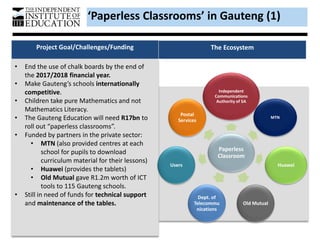
Project Goal/Challenges/Funding The Ecosystem
Paperless
Classroom
Independent
Communications
Authority of SA
MTN
Huawei
Old Mutual
Dept. of
Telecommu
nications
Users
Postal
Services
‘Paperless Classrooms’ in Gauteng (1)
• Of the at least 6 200 paperless classroom
tablets at the first seven schools
• 11 of them – each worth about R3 500 –
have been stolen or lost.
• All had been fitted with tracking devices;
• Five of them had been recovered.
• Six of the tablets had not been switched
on since they were stolen and therefore
could not be found.
‘Paperless Classrooms’ in Gauteng (2)
Source: Adapted from [Online]. Available at: http://mobi.iol.co.za/#!/article/soweto-school-set-to-go-digital-1.1886189 [Accessed 7 August 2015].
2015/08/11 10
6200
11 5 6
0
1000
2000
3000
4000
5000
6000
7000
Tablets Stolen or
lost
Recored Not been
switched pn
No.ofTablets
Column1
Column1
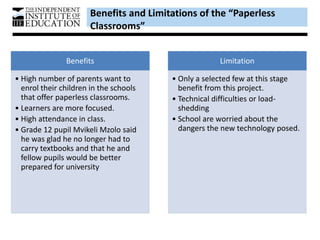
Benefits and Limitations of the “Paperless
Classrooms”
Benefits
• High number of parents want to
enrol their children in the schools
that offer paperless classrooms.
• Learners are more focused.
• High attendance in class.
• Grade 12 pupil Mvikeli Mzolo said
he was glad he no longer had to
carry textbooks and that he and
fellow pupils would be better
prepared for university
Limitation
• Only a selected few at this stage
benefit from this project.
• Technical difficulties or load-
shedding
• School are worried about the
dangers the new technology posed.
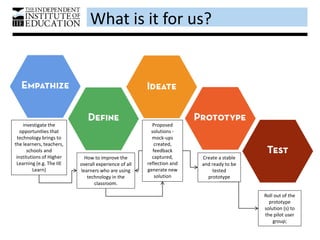
What is it for us?
investigate the
opportunities that
technology brings to
the learners, teachers,
schools and
institutions of Higher
Learning (e.g. The IIE
Learn)
How to improve the
overall experience of all
learners who are using
technology in the
classroom.
Proposed
solutions -
mock-ups
created,
feedback
captured,
reflection and
generate new
solution
Create a stable
and ready to be
tested
prototype
Roll out of the
prototype
solution (s) to
the pilot user
group;
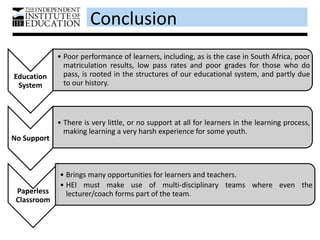
Conclusion
Education
System
• Poor performance of learners, including, as is the case in South Africa, poor
matriculation results, low pass rates and poor grades for those who do
pass, is rooted in the structures of our educational system, and partly due
to our history.
No Support
• There is very little, or no support at all for learners in the learning process,
making learning a very harsh experience for some youth.
Paperless
Classroom
• Brings many opportunities for learners and teachers.
• HEI must make use of multi-disciplinary teams where even the
lecturer/coach forms part of the team.
Closure and Question Time
Thank you!
Wonga L Ntshinga
Senior Head of Programmes: IT
The Independent Institute of Education
wntshinga@iie.ac.za
www.iie.ac.za
@wntshinga
011 676 8021
Opinions expressed and conclusions arrived at are those of the author and not necessarily to be attributed to the companies mentioned in
this acknowledgement.
All images used are the property of their respective copyright owners and used under the terms of Fair Use
2015/08/11 14

UseofTechnologyintheClassroom

  • 1.
    The Use ofTechnology in the Classroom By: Wonga L. Ntshinga 2015/08/11 1
  • 2.
    Presentation Structure Who arewe? Our Purpose The “Beginning” The Internet Growth The Mobile Broadband for Emerging Economies (EE) The “Paperless Classrooms” in Gauteng The Benefits and Limitations of the “Paperless Classrooms” What is it for us? - Design Thinking Approach Questions and Closure 2015/08/11 2
  • 3.
    Who are we? 2015/08/113 The Independent Institute of Education (The IIE) is a private higher education institution operating across 20 sites Offering more than 70 registered and accredited higher education programmes from Higher Certificate to Masters level Brands: Varsity College, Vega, Rosebank College and DSSA campuses. Visit us at www.iie.ac.za or Twitter @theworldofwork
  • 4.
    Our Purpose 2015/08/11 4 Buildstudent careers – we understand that students study as the first step in their careers and that what they learn and how they learn need to lay the foundation for further growth, employment and learning. Relevant curriculum - to the modern world of work and we build strong industry and academic partnerships that ensure and assure this relevance. Commit to student success which includes a focus on innovative and supportive teaching methodologies, a comprehensive and holistic developmental student support system and the provision of learning opportunities that meet the diverse needs of the student population. Produce graduates who can and will contribute to the economy and society and who recognise their roles and responsibilities as citizens of a global community.
  • 5.
    © SAP AG2009. All rights reserved. / Page 5 South Africa Mozambique $650 Million undersea cable project Egypt To India Kenya Tanzania SEACOM – An African Project with majority African ownership - state of the art, privately funded, undersea fiber optical cable. SEACOM is owned by South Africans (50%), New York Herakles Telecom (25%) and Aga Khan Foundation (25%). Will enable Africans to enjoy high demand services such as HDTV, IPTV, true broadband Internet and peer-to- peer networks Madagascar Internet and IP solutions as well as global onward connectivity for voice and private line solutions; Pricing is 90% less than the current fibre pricing; DjiboutiSEACOM’s price reduction results in significant savings: That could be discounts to customers; Or re-invested in local infrastructure. Businesses to take full advantage of the Seacom to drive economic growth and enhance the quality of life across the continent. Integrate phones with telecenters and kiosks; 1. The “Beginning” SEACOM has reduced the cost of international bandwidth for Universities and Research Institutions by 5000% in South Africa; “Ten years ago, Manhattan had more phone connections than all of Africa. Today, thanks to the cellphones, Africa has more phone connections than the U.S. and Canada combined. “ – Heeks (2009: 22) 2015/08/11 5
  • 6.
    Internet Growth – Internetaccessibility over the next 10 years will increase. – By 2020 the Internet will have an estimated 5 billion users versus the 1.7 billion today. – Internet growth will result in the Internet becoming predominately wireless. – The push and growth of a wireless Internet will come from emerging economies.
  • 7.
    Mobile Broadband forEmerging Economies – Mobile broadband is the wave of the future in emerging economies. – Mobile phones and laptops will complement each other as mobile broadband devices in emerging economies. – Mobile phones, as opposed to their PC counterpart , are favourable in emerging economies because they are cost effective, easier to use and more energy efficient. – Mobile broadband growth predictions in emerging economies are likely to grow to 54% by the end of 2015. – South Africa as an example has made the quantum leap to one of the highest adoption of mobile devices.
  • 8.
    • The GautengDepartment of Education (@EducationGP) extend its learning technology to matric classrooms at 375 high schools – best performing • Mainly in townships and rural areas to participate in the programme. • Programme entails the usage of interactive boards, mobile devices such as tablets, laptops with complete internet connectivity. • To conduct teaching and learning. • 4 000 Grade 12 classrooms had to be refurbished. • 17 000 Tables for Grade 12 learners with tracking devices. • 1 800 3D LED interactive boards. • Delays with installation at about 30% of the targeted 375 schools. • Tablets will be connected to a server through broadband, Wi-Fi and 4G connections. ‘Paperless Classrooms’ in Gauteng Source: Adapted from [Online]. Available at: http://www.iol.co.za/news/south-africa/gauteng/paperless-classrooms-set-to-expand- 1.1887977#.VcP0uE3z6M8 [Accessed 7 August 2015]. 2015/08/11 8
  • 9.
    • End theuse of chalk boards by the end of the 2017/2018 financial year. • Make Gauteng’s schools internationally competitive. • Children take pure Mathematics and not Mathematics Literacy. • The Gauteng Education will need R17bn to roll out “paperless classrooms”. • Funded by partners in the private sector: • MTN (also provided centres at each school for pupils to download curriculum material for their lessons) • Huawei (provides the tablets) • Old Mutual gave R1.2m worth of ICT tools to 115 Gauteng schools. • Still in need of funds for technical support and maintenance of the tables. Project Goal/Challenges/Funding The Ecosystem Paperless Classroom Independent Communications Authority of SA MTN Huawei Old Mutual Dept. of Telecommu nications Users Postal Services ‘Paperless Classrooms’ in Gauteng (1)
  • 10.
    • Of theat least 6 200 paperless classroom tablets at the first seven schools • 11 of them – each worth about R3 500 – have been stolen or lost. • All had been fitted with tracking devices; • Five of them had been recovered. • Six of the tablets had not been switched on since they were stolen and therefore could not be found. ‘Paperless Classrooms’ in Gauteng (2) Source: Adapted from [Online]. Available at: http://mobi.iol.co.za/#!/article/soweto-school-set-to-go-digital-1.1886189 [Accessed 7 August 2015]. 2015/08/11 10 6200 11 5 6 0 1000 2000 3000 4000 5000 6000 7000 Tablets Stolen or lost Recored Not been switched pn No.ofTablets Column1 Column1
  • 11.
    Benefits and Limitationsof the “Paperless Classrooms” Benefits • High number of parents want to enrol their children in the schools that offer paperless classrooms. • Learners are more focused. • High attendance in class. • Grade 12 pupil Mvikeli Mzolo said he was glad he no longer had to carry textbooks and that he and fellow pupils would be better prepared for university Limitation • Only a selected few at this stage benefit from this project. • Technical difficulties or load- shedding • School are worried about the dangers the new technology posed.
  • 12.
    What is itfor us? investigate the opportunities that technology brings to the learners, teachers, schools and institutions of Higher Learning (e.g. The IIE Learn) How to improve the overall experience of all learners who are using technology in the classroom. Proposed solutions - mock-ups created, feedback captured, reflection and generate new solution Create a stable and ready to be tested prototype Roll out of the prototype solution (s) to the pilot user group;
  • 13.
    Conclusion Education System • Poor performanceof learners, including, as is the case in South Africa, poor matriculation results, low pass rates and poor grades for those who do pass, is rooted in the structures of our educational system, and partly due to our history. No Support • There is very little, or no support at all for learners in the learning process, making learning a very harsh experience for some youth. Paperless Classroom • Brings many opportunities for learners and teachers. • HEI must make use of multi-disciplinary teams where even the lecturer/coach forms part of the team.
  • 14.
    Closure and QuestionTime Thank you! Wonga L Ntshinga Senior Head of Programmes: IT The Independent Institute of Education wntshinga@iie.ac.za www.iie.ac.za @wntshinga 011 676 8021 Opinions expressed and conclusions arrived at are those of the author and not necessarily to be attributed to the companies mentioned in this acknowledgement. All images used are the property of their respective copyright owners and used under the terms of Fair Use 2015/08/11 14