Geodesic algorithms: an experimental study
Vissarion Fisikopoulos
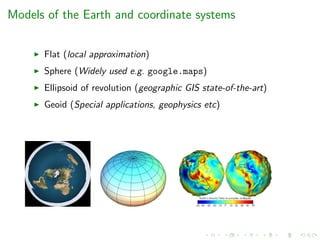
Models of the Earth and coordinate systems
Flat (local approximation)
Sphere (Widely used e.g. google.maps)
Ellipsoid of revolution (geographic GIS state-of-the-art)
Geoid (Special applications, geophysics etc)
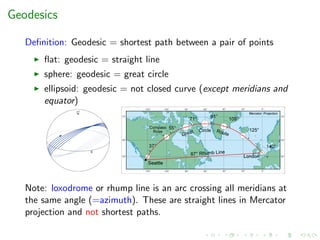
Geodesics
Definition: Geodesic = shortest path between a pair of points
flat: geodesic = straight line
sphere: geodesic = great circle
ellipsoid: geodesic = not closed curve (except meridians and
equator)
Note: loxodrome or rhump line is an arc crossing all meridians at
the same angle (=azimuth). These are straight lines in Mercator
projection and not shortest paths.
Geodesic problems
Direct given point, azimuth, distance compute new point
Inverse given two points compute distance, azimuth
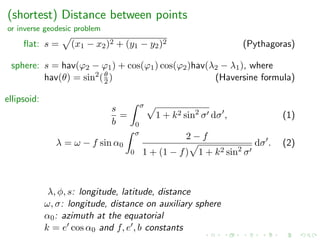
(shortest) Distance between points
or inverse geodesic problem
flat: s = (x1 − x2)2 + (y1 − y2)2 (Pythagoras)
sphere: s = hav(ϕ2 − ϕ1) + cos(ϕ1) cos(ϕ2)hav(λ2 − λ1), where
hav(θ) = sin2
(θ
2) (Haversine formula)
ellipsoid:
s
b
=
σ
0
1 + k2 sin2
σ dσ , (1)
λ = ω − f sin α0
σ
0
2 − f
1 + (1 − f) 1 + k2 sin2
σ
dσ . (2)
λ, φ, s: longitude, latitude, distance
ω, σ: longitude, distance on auxiliary sphere
α0: azimuth at the equatorial
k = e cos α0 and f, e , b constants
Algorithms for geodesic problems
1. Higher series approximation (up-to order 8) + iterative
methods [Bessel’1865, Karney’12]
2. Numerical integration [Sjoberg’12, Panou et al.’13]
3. Iterative methods [Vincenty’75] (widely used)
4. Series approximation of order 2 [Thomas’70]
5. Series approximation of order 1 [Andoyer’65,Thomas’65]
6. Spherical (trigonometric approximation)
7. inverse elliptic arc length formulas [Thomas’65]
8. Projection + cartesian methods (local approximation)
(1) GeographicLib (PR in Boost Geometry)
(2) not considered here
(3-8) supported by Boost Geometry
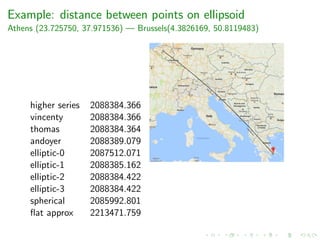
Example: distance between points on ellipsoid
Athens (23.725750, 37.971536) — Brussels(4.3826169, 50.8119483)
higher series 2088384.366
vincenty 2088384.366
thomas 2088384.364
andoyer 2088389.079
elliptic-0 2087512.071
elliptic-1 2088385.162
elliptic-2 2088384.422
elliptic-3 2088384.422
spherical 2085992.801
flat approx 2213471.759
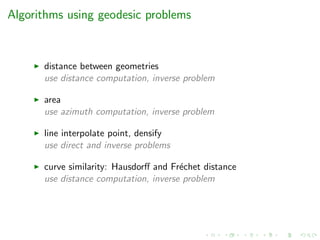
Algorithms using geodesic problems
distance between geometries
use distance computation, inverse problem
area
use azimuth computation, inverse problem
line interpolate point, densify
use direct and inverse problems
curve similarity: Hausdorff and Fr´echet distance
use distance computation, inverse problem
Example: distance between point and segment
L := LINESTRING(-16.42203 -7.52882,4.89998 -6.15568)
P := POINT(3.32696 -6.29345)
Boost.Geometry (version 1.71.0)
spherical: 508.0731159
andoyer: 480.3460262
thomas: 481.7457616
vincenty: 481.7390876
POSTGIS (version 2.5)
spherical: 508.073115931
geographic: 505.320928239
Homework: find the most accurate result!
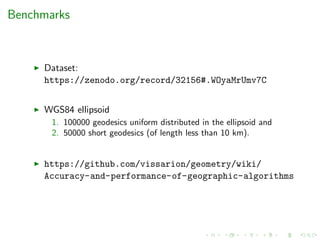
Benchmarks
Dataset:
https://zenodo.org/record/32156#.WOyaMrUmv7C
WGS84 ellipsoid
1. 100000 geodesics uniform distributed in the ellipsoid and
2. 50000 short geodesics (of length less than 10 km).
https://github.com/vissarion/geometry/wiki/
Accuracy-and-performance-of-geographic-algorithms
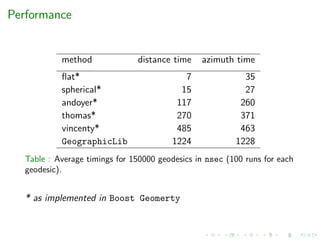
Performance
method distance time azimuth time
flat* 7 35
spherical* 15 27
andoyer* 117 260
thomas* 270 371
vincenty* 485 463
GeographicLib 1224 1228
Table : Average timings for 150000 geodesics in nsec (100 runs for each
geodesic).
* as implemented in Boost Geomerty
Distance accuracy
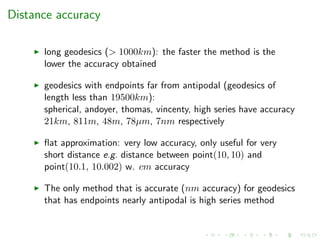
long geodesics (> 1000km): the faster the method is the
lower the accuracy obtained
geodesics with endpoints far from antipodal (geodesics of
length less than 19500km):
spherical, andoyer, thomas, vincenty, high series have accuracy
21km, 811m, 48m, 78µm, 7nm respectively
flat approximation: very low accuracy, only useful for very
short distance e.g. distance between point(10, 10) and
point(10.1, 10.002) w. cm accuracy
The only method that is accurate (nm accuracy) for geodesics
that has endpoints nearly antipodal is high series method
Accuracy
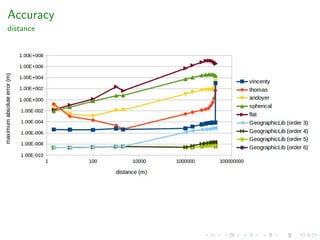
distance
The maximum absolute distance error as a function of distance.
Area and azimuth accuracy
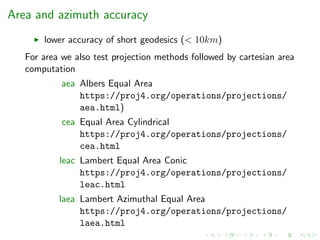
lower accuracy of short geodesics (< 10km)
For area we also test projection methods followed by cartesian area
computation
aea Albers Equal Area
https://proj4.org/operations/projections/
aea.html)
cea Equal Area Cylindrical
https://proj4.org/operations/projections/
cea.html
leac Lambert Equal Area Conic
https://proj4.org/operations/projections/
leac.html
laea Lambert Azimuthal Equal Area
https://proj4.org/operations/projections/
laea.html
Accuracy
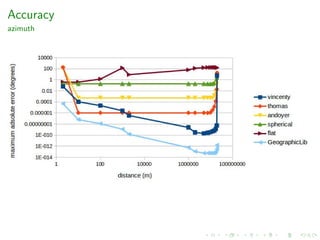
azimuth
The maximum absolute azimuth error as a function of distance.
Accuracy
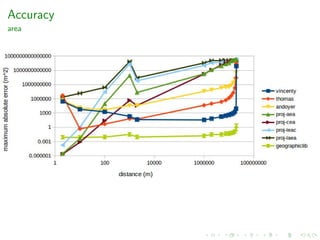
area
The maximum absolute area error as a function of distance
Thank you! Questions?
Solution: distance between point and segment
L := LINESTRING(-16.42203 -7.52882,4.89998 -6.15568)
P1 := POINT(3.32696 -6.29345)
P2 := POINT(3.3262, -6.28451)
Boost.Geometry (version 1.71.0)
P1 spherical: 508.0731159
P1 vincenty: 481.7390876
P2 spherical 489.553212
P2 vincenty 510.4827314
P1
P2
POSTGIS (version 2.5)
P1 spherical: 508.073115931
P1 geographic: 505.320928239
P2 spherical: 489.553211954
P2 geographic: 486.901261892

Geodesic algorithms: an experimental study

  • 1.
    Geodesic algorithms: anexperimental study Vissarion Fisikopoulos
  • 2.
    Models of theEarth and coordinate systems Flat (local approximation) Sphere (Widely used e.g. google.maps) Ellipsoid of revolution (geographic GIS state-of-the-art) Geoid (Special applications, geophysics etc)
  • 3.
    Geodesics Definition: Geodesic =shortest path between a pair of points flat: geodesic = straight line sphere: geodesic = great circle ellipsoid: geodesic = not closed curve (except meridians and equator) Note: loxodrome or rhump line is an arc crossing all meridians at the same angle (=azimuth). These are straight lines in Mercator projection and not shortest paths.
  • 4.
    Geodesic problems Direct givenpoint, azimuth, distance compute new point Inverse given two points compute distance, azimuth
  • 5.
    (shortest) Distance betweenpoints or inverse geodesic problem flat: s = (x1 − x2)2 + (y1 − y2)2 (Pythagoras) sphere: s = hav(ϕ2 − ϕ1) + cos(ϕ1) cos(ϕ2)hav(λ2 − λ1), where hav(θ) = sin2 (θ 2) (Haversine formula) ellipsoid: s b = σ 0 1 + k2 sin2 σ dσ , (1) λ = ω − f sin α0 σ 0 2 − f 1 + (1 − f) 1 + k2 sin2 σ dσ . (2) λ, φ, s: longitude, latitude, distance ω, σ: longitude, distance on auxiliary sphere α0: azimuth at the equatorial k = e cos α0 and f, e , b constants
  • 6.
    Algorithms for geodesicproblems 1. Higher series approximation (up-to order 8) + iterative methods [Bessel’1865, Karney’12] 2. Numerical integration [Sjoberg’12, Panou et al.’13] 3. Iterative methods [Vincenty’75] (widely used) 4. Series approximation of order 2 [Thomas’70] 5. Series approximation of order 1 [Andoyer’65,Thomas’65] 6. Spherical (trigonometric approximation) 7. inverse elliptic arc length formulas [Thomas’65] 8. Projection + cartesian methods (local approximation) (1) GeographicLib (PR in Boost Geometry) (2) not considered here (3-8) supported by Boost Geometry
  • 7.
    Example: distance betweenpoints on ellipsoid Athens (23.725750, 37.971536) — Brussels(4.3826169, 50.8119483) higher series 2088384.366 vincenty 2088384.366 thomas 2088384.364 andoyer 2088389.079 elliptic-0 2087512.071 elliptic-1 2088385.162 elliptic-2 2088384.422 elliptic-3 2088384.422 spherical 2085992.801 flat approx 2213471.759
  • 8.
    Algorithms using geodesicproblems distance between geometries use distance computation, inverse problem area use azimuth computation, inverse problem line interpolate point, densify use direct and inverse problems curve similarity: Hausdorff and Fr´echet distance use distance computation, inverse problem
  • 9.
    Example: distance betweenpoint and segment L := LINESTRING(-16.42203 -7.52882,4.89998 -6.15568) P := POINT(3.32696 -6.29345) Boost.Geometry (version 1.71.0) spherical: 508.0731159 andoyer: 480.3460262 thomas: 481.7457616 vincenty: 481.7390876 POSTGIS (version 2.5) spherical: 508.073115931 geographic: 505.320928239 Homework: find the most accurate result!
  • 10.
    Benchmarks Dataset: https://zenodo.org/record/32156#.WOyaMrUmv7C WGS84 ellipsoid 1. 100000geodesics uniform distributed in the ellipsoid and 2. 50000 short geodesics (of length less than 10 km). https://github.com/vissarion/geometry/wiki/ Accuracy-and-performance-of-geographic-algorithms
  • 11.
    Performance method distance timeazimuth time flat* 7 35 spherical* 15 27 andoyer* 117 260 thomas* 270 371 vincenty* 485 463 GeographicLib 1224 1228 Table : Average timings for 150000 geodesics in nsec (100 runs for each geodesic). * as implemented in Boost Geomerty
  • 12.
    Distance accuracy long geodesics(> 1000km): the faster the method is the lower the accuracy obtained geodesics with endpoints far from antipodal (geodesics of length less than 19500km): spherical, andoyer, thomas, vincenty, high series have accuracy 21km, 811m, 48m, 78µm, 7nm respectively flat approximation: very low accuracy, only useful for very short distance e.g. distance between point(10, 10) and point(10.1, 10.002) w. cm accuracy The only method that is accurate (nm accuracy) for geodesics that has endpoints nearly antipodal is high series method
  • 13.
    Accuracy distance The maximum absolutedistance error as a function of distance.
  • 14.
    Area and azimuthaccuracy lower accuracy of short geodesics (< 10km) For area we also test projection methods followed by cartesian area computation aea Albers Equal Area https://proj4.org/operations/projections/ aea.html) cea Equal Area Cylindrical https://proj4.org/operations/projections/ cea.html leac Lambert Equal Area Conic https://proj4.org/operations/projections/ leac.html laea Lambert Azimuthal Equal Area https://proj4.org/operations/projections/ laea.html
  • 15.
    Accuracy azimuth The maximum absoluteazimuth error as a function of distance.
  • 16.
    Accuracy area The maximum absolutearea error as a function of distance
  • 17.
  • 18.
    Solution: distance betweenpoint and segment L := LINESTRING(-16.42203 -7.52882,4.89998 -6.15568) P1 := POINT(3.32696 -6.29345) P2 := POINT(3.3262, -6.28451) Boost.Geometry (version 1.71.0) P1 spherical: 508.0731159 P1 vincenty: 481.7390876 P2 spherical 489.553212 P2 vincenty 510.4827314 P1 P2 POSTGIS (version 2.5) P1 spherical: 508.073115931 P1 geographic: 505.320928239 P2 spherical: 489.553211954 P2 geographic: 486.901261892