Confidential Customized for Lorem Ipsum LLC Version 1.0
Geo Technical
Engineering-I
Naveen Hanchinahal
Asst. Prof.
SJCEM,palghar
Confidential Customized for Lorem Ipsum LLC Version 1.0
INDEX
Introduction to Geo Tech
Plasticity of Soil
Classification of Soil
Permiability of Soil
Effective stress Principle
Compaction
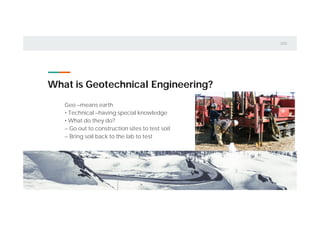
What is Geotechnical Engineering?
Geo –means earth
• Technical –having special knowledge
• What do they do?
– Go out to construction sites to test soil
– Bring soil back to the lab to test
When do we need Geotechnical Engineers?
Whenever there is construction!
1 Roads
2 Buildings
3
Bridges
4 Excavations
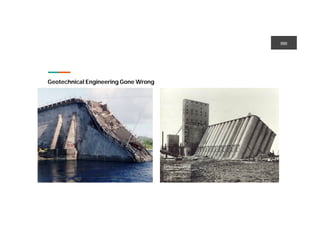
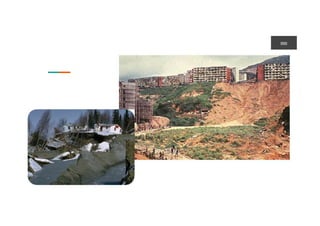
Geotechnical Engineering Gone Wrong
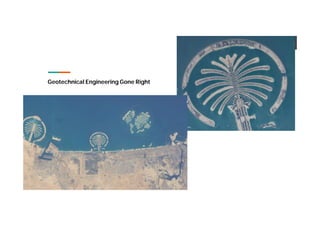
Geotechnical Engineering Gone Right
Role of Geotechnical Engineer
•Preparesand inspects projects involving drilling and exploration
•Responsible for geological mapping, report writing, site characterization,
numerical modeling and analysis of excavations /supports
• Designs and supervises construction projects such as airports, bridges,
channels, dams, railroads and roads
• Responsibilities also include estimating costs and personnel and
material needs, preparing proposals and establishing completion dates
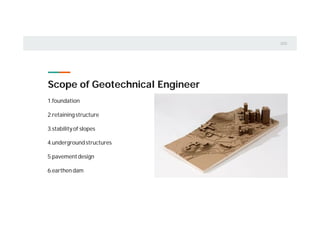
1.foundation
2.retainingstructure
3.stabilityof slopes
4.undergroundstructures
5.pavementdesign
6.earthendam
Scope of Geotechnical Engineer
To study the general suitability of the site for an engineering project.
To enable a safe, practical and economic design to be prepared.
To determine the possible difficulties that may be encountered by a specific
construction method for any particular civil project.
To study the suitability of construction material (soil or rock).
To prevent the delay of any construction project due to problematic ground
conditions.
Importance of Site investigation
Importance of Site Characterization
Determines the nature of the site and its influence on the project.
It reduces the economy.
It enables an adequate and economical design to be made.
It provides information regarding the geology, hydrology,
hydrogeology, climatic conditions, radioactivity, etc., of the site.
It determines the ground water conditions.
Site characterization is
done with the following
objectives:
Determination of the soil
properties.
Development of map for
the region.
Site selection:
Foundationand earthworks design:
Temporaryworks design:
The effects of the proposed project
on its environment:
Site characterization should provide the following
information:
Investigationof existing
construction:
The design of remedial works:
Safety checks:
Syllabus
Introduction to Geotechnical Engineering, Basic Definitions & Relationships
● Definitions: Rocks, Soil, origin & mode of formation and type of soil obtained, soil
mechanics, rock mechanics, soil engineering, geotechnical engineering
● Scope of soil engineering: Importance of field exploration and characterization
Cohesionless & cohesive soils
● Soil as three-phase & two-phase system in terms of weight, volume, void ratio, porosity
● Weight-volume relationship: water content, void ratio, porosity, degree of saturation, air
voids, air content, different unit weights, specific gravity of solids, and mass, absolute
specific gravity.
● Relationship between: different unit weights with void ratio, degree of saturation,
specific gravity; different unit weights with porosity, void ratio, water content; different
unit weights with water content, unit weights air voids.
● Mention different methods to find water content, specific gravity, unit weight of soil
(Detailed description to be covered during practical)
01
Definitions:
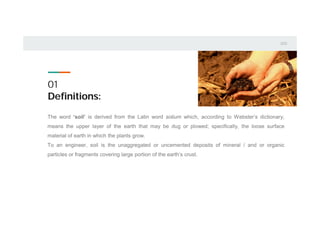
The word ‘soil’ is derived from the Latin word solium which, according to Webster’s dictionary,
means the upper layer of the earth that may be dug or plowed; specifically, the loose surface
material of earth in which the plants grow.
To an engineer, soil is the unaggregated or uncemented deposits of mineral / and or organic
particles or fragments covering large portion of the earth’s crust.
Soil Mechanics
According to Terzaghi (1948) : “Soil Mechanics is the application of laws of mechanics and
hydraulics to engineering problems dealing with sediments and other unconsolidated accumulations
of solid particles produced by mechanical and chemical disintegration of of rocks regardless of
whether or not they contain an admixture of organic constituent”.
Rock Mechanics
Rock mechanics is a theoretical and applied science of the mechanical behavior of rock and rock
masses; compared to geology, it is that branch of mechanics concerned with the response of rock
and rock masses to the force fields of their physical environment.
Geotechnical Engineering
Geotechnics is an engineering discipline that deals with soil and rock behaviour in an engineering
perspective.
Soil Engineering is a stream of geotechnical engineering which exclusively deals with
understanding the characteristics and mechanics of soil.
Soil Engineering
Soil Mechanics
According to Terzaghi (1948) : “Soil Mechanics is the application of laws of mechanics and
hydraulics to engineering problems dealing with sediments and other unconsolidated accumulations
of solid particles produced by mechanical and chemical disintegration of of rocks regardless of
whether or not they contain an admixture of organic constituent”.
02 Origin & Mode of formation
All soils originate, directly or indirectly, from different rock types.
Soil Formation
Soils are formed from the physical and chemical weathering of rocks. Soil is
generally formed by disintegration and decomposition (weathering) of rocks
through the action of physical (or mechanical) and chemical agents which break
them into smaller and smaller particles.
Soil Formation ution
Physical weathering Involves reduction of size without any change in the
original composition of the parent rock. The main agents responsible for
this process are exfoliation, erosion, freezing, and thawing.
Physical or mechanical processes taking place on the earth's surface
include the actions of water, frost, temperature changes, wind and ice.
They cause disintegration and the products are mainly coarse soils.
incididunt .
Soil Formation ution
Chemical weathering causes both reduction in size and chemical
alteration of the original parent rock. The main agents responsible for
chemical weathering are hydration, carbonation, and oxidation.
Rain water that comes in contact with the rock surface reacts to form
hydrated oxides, carbonates and sulphates. The results of chemical
weathering are generally fine soils with altered mineral grains
Types of Soil
0
1
0
2
● Bentonite: Decomposed volcanic ash containing a high percentage of clay
mineral montmorillonite. It exhibits high degree of shrinkage and swelling.
● Boulder clay: Glacial clay containing all sizes of rock fragments from boulders
down to finely pulverized clay minerals. It is also known as ‘Glacial till’.
● Black cotton soil: Black cotton soil containing a high percentage of
montmorillonite and colloidal material; exhibits high degree of shrinkage and
swelling. The name is derived from the fact that cotton grows well in the black
soil.
● Hard pan: Densely cemented soil which remains hard when wet. Boulder clays
or glacial tills may also be called hard pan very difficult to penetrate or excavate.
0
1
0
2
● Caliche: Soil conglomerate of gravel, sand and clay cemented by
calcium carbonate.
● Laterite: deep brown soil of cellular structure, easy to excavate but gets
hardened on exposure to air owing to the formation of hydrated iron
oxides.
● Loam: Mixture of sand, silt and clay size particles approximately in equal
proportions; sometimes contains organic matter.
● Loess: Uniform wind-blown yellowish brown silt clay; exhibits cohesion
in the dry condition, which is lost on wetting. Near vertical cuts can be
made in the dry condition.
0
1
0
2
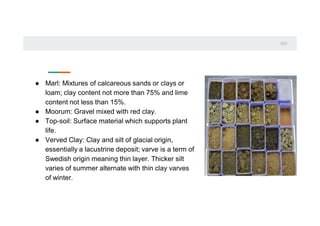
● Marl: Mixtures of calcareous sands or clays or
loam; clay content not more than 75% and lime
content not less than 15%.
● Moorum: Gravel mixed with red clay.
● Top-soil: Surface material which supports plant
life.
● Verved Clay: Clay and silt of glacial origin,
essentially a lacustrine deposit; varve is a term of
Swedish origin meaning thin layer. Thicker silt
varies of summer alternate with thin clay varves
of winter.
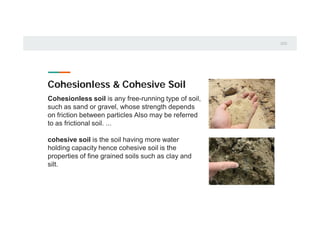
Cohesionless & Cohesive Soil
Cohesionless soil is any free-running type of soil,
such as sand or gravel, whose strength depends
on friction between particles Also may be referred
to as frictional soil. ...
cohesive soil is the soil having more water
holding capacity hence cohesive soil is the
properties of fine grained soils such as clay and
silt.
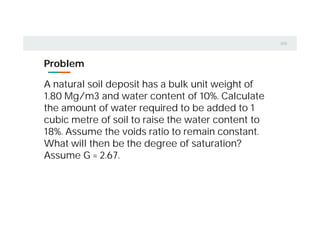
Problem
A natural soil deposit has a bulk unit weight of
1.80 Mg/m3 and water content of 10%. Calculate
the amount of water required to be added to 1
cubic metre of soil to raise the water content to
18%. Assume the voids ratio to remain constant.
What will then be the degree of saturation?
Assume G = 2.67.
Solution
Given data
γb = 18.44kN/m3
w = 5%
V = 1m3
γdry = ?
γdry = Yb/(1+w) = 17.56 kN
When w = 5%
w = Ww/Wd …..(1)
Yd = Wdry / V : Wd = Yd x V ; Wd = 17.56 x 1= 17.56 kN
From eq no 1 Ww = Wd x w = 17.56 x 0.05 Ww = 0.878 kN
For 1 m3 of soil V=1m3
We know that
Yw = 9.81 kN/m3 and Ww = 0.878kN
Vw(5%) =Ww/ Yw = 0.0895 m3
When w = 15% Ww = w x Wd =0.15 x 17.56 = 2.634 kN
Vw(15%) = Ww / Yw = 2.634 / 9.81 =0.2685 m3
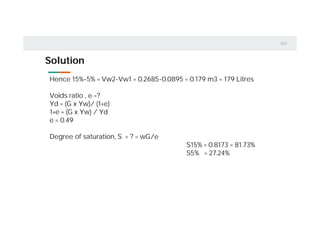
Solution
Hence 15%-5% = Vw2-Vw1 = 0.2685-0.0895 = 0.179 m3 = 179 Litres
Voids ratio , e =?
Yd = (G x Yw)/ (1+e)
1+e = (G x Yw) / Yd
e = 0.49
Degree of saturation, S = ? = wG/e
S15% = 0.8173 = 81.73%
S5% = 27.24%
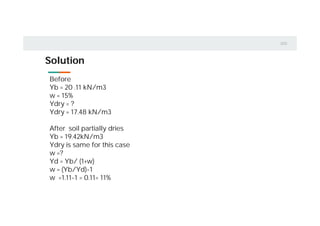
Solution
Before
Yb = 20 .11 kN/m3
w = 15%
Ydry = ?
Ydry = 17.48 kN/m3
After soil partially dries
Yb = 19.42kN/m3
Ydry is same for this case
w =?
Yd = Yb/ (1+w)
w = (Yb/Yd)-1
w =1.11-1 = 0.11= 11%
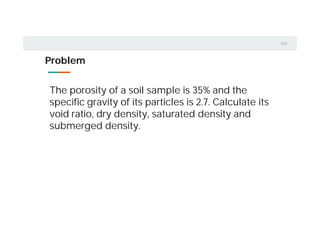
Problem
The porosity of a soil sample is 35% and the
specific gravity of its particles is 2.7. Calculate its
void ratio, dry density, saturated density and
submerged density.
Thank you.

Introduction to geo tech

  • 1.
    Confidential Customized forLorem Ipsum LLC Version 1.0 Geo Technical Engineering-I Naveen Hanchinahal Asst. Prof. SJCEM,palghar
  • 2.
    Confidential Customized forLorem Ipsum LLC Version 1.0 INDEX Introduction to Geo Tech Plasticity of Soil Classification of Soil Permiability of Soil Effective stress Principle Compaction
  • 3.
    What is GeotechnicalEngineering? Geo –means earth • Technical –having special knowledge • What do they do? – Go out to construction sites to test soil – Bring soil back to the lab to test
  • 4.
    When do weneed Geotechnical Engineers? Whenever there is construction! 1 Roads 2 Buildings 3 Bridges 4 Excavations
  • 5.
  • 7.
  • 8.
    Role of GeotechnicalEngineer •Preparesand inspects projects involving drilling and exploration •Responsible for geological mapping, report writing, site characterization, numerical modeling and analysis of excavations /supports • Designs and supervises construction projects such as airports, bridges, channels, dams, railroads and roads • Responsibilities also include estimating costs and personnel and material needs, preparing proposals and establishing completion dates
  • 9.
  • 10.
    To study thegeneral suitability of the site for an engineering project. To enable a safe, practical and economic design to be prepared. To determine the possible difficulties that may be encountered by a specific construction method for any particular civil project. To study the suitability of construction material (soil or rock). To prevent the delay of any construction project due to problematic ground conditions. Importance of Site investigation
  • 11.
    Importance of SiteCharacterization Determines the nature of the site and its influence on the project. It reduces the economy. It enables an adequate and economical design to be made. It provides information regarding the geology, hydrology, hydrogeology, climatic conditions, radioactivity, etc., of the site. It determines the ground water conditions. Site characterization is done with the following objectives: Determination of the soil properties. Development of map for the region.
  • 12.
    Site selection: Foundationand earthworksdesign: Temporaryworks design: The effects of the proposed project on its environment: Site characterization should provide the following information: Investigationof existing construction: The design of remedial works: Safety checks:
  • 13.
    Syllabus Introduction to GeotechnicalEngineering, Basic Definitions & Relationships ● Definitions: Rocks, Soil, origin & mode of formation and type of soil obtained, soil mechanics, rock mechanics, soil engineering, geotechnical engineering ● Scope of soil engineering: Importance of field exploration and characterization Cohesionless & cohesive soils ● Soil as three-phase & two-phase system in terms of weight, volume, void ratio, porosity ● Weight-volume relationship: water content, void ratio, porosity, degree of saturation, air voids, air content, different unit weights, specific gravity of solids, and mass, absolute specific gravity. ● Relationship between: different unit weights with void ratio, degree of saturation, specific gravity; different unit weights with porosity, void ratio, water content; different unit weights with water content, unit weights air voids. ● Mention different methods to find water content, specific gravity, unit weight of soil (Detailed description to be covered during practical)
  • 14.
    01 Definitions: The word ‘soil’is derived from the Latin word solium which, according to Webster’s dictionary, means the upper layer of the earth that may be dug or plowed; specifically, the loose surface material of earth in which the plants grow. To an engineer, soil is the unaggregated or uncemented deposits of mineral / and or organic particles or fragments covering large portion of the earth’s crust.
  • 15.
    Soil Mechanics According toTerzaghi (1948) : “Soil Mechanics is the application of laws of mechanics and hydraulics to engineering problems dealing with sediments and other unconsolidated accumulations of solid particles produced by mechanical and chemical disintegration of of rocks regardless of whether or not they contain an admixture of organic constituent”.
  • 16.
    Rock Mechanics Rock mechanicsis a theoretical and applied science of the mechanical behavior of rock and rock masses; compared to geology, it is that branch of mechanics concerned with the response of rock and rock masses to the force fields of their physical environment. Geotechnical Engineering Geotechnics is an engineering discipline that deals with soil and rock behaviour in an engineering perspective. Soil Engineering is a stream of geotechnical engineering which exclusively deals with understanding the characteristics and mechanics of soil. Soil Engineering
  • 17.
    Soil Mechanics According toTerzaghi (1948) : “Soil Mechanics is the application of laws of mechanics and hydraulics to engineering problems dealing with sediments and other unconsolidated accumulations of solid particles produced by mechanical and chemical disintegration of of rocks regardless of whether or not they contain an admixture of organic constituent”.
  • 18.
    02 Origin &Mode of formation All soils originate, directly or indirectly, from different rock types. Soil Formation Soils are formed from the physical and chemical weathering of rocks. Soil is generally formed by disintegration and decomposition (weathering) of rocks through the action of physical (or mechanical) and chemical agents which break them into smaller and smaller particles.
  • 19.
    Soil Formation ution Physicalweathering Involves reduction of size without any change in the original composition of the parent rock. The main agents responsible for this process are exfoliation, erosion, freezing, and thawing. Physical or mechanical processes taking place on the earth's surface include the actions of water, frost, temperature changes, wind and ice. They cause disintegration and the products are mainly coarse soils. incididunt .
  • 20.
    Soil Formation ution Chemicalweathering causes both reduction in size and chemical alteration of the original parent rock. The main agents responsible for chemical weathering are hydration, carbonation, and oxidation. Rain water that comes in contact with the rock surface reacts to form hydrated oxides, carbonates and sulphates. The results of chemical weathering are generally fine soils with altered mineral grains
  • 21.
    Types of Soil 0 1 0 2 ●Bentonite: Decomposed volcanic ash containing a high percentage of clay mineral montmorillonite. It exhibits high degree of shrinkage and swelling. ● Boulder clay: Glacial clay containing all sizes of rock fragments from boulders down to finely pulverized clay minerals. It is also known as ‘Glacial till’. ● Black cotton soil: Black cotton soil containing a high percentage of montmorillonite and colloidal material; exhibits high degree of shrinkage and swelling. The name is derived from the fact that cotton grows well in the black soil. ● Hard pan: Densely cemented soil which remains hard when wet. Boulder clays or glacial tills may also be called hard pan very difficult to penetrate or excavate.
  • 22.
    0 1 0 2 ● Caliche: Soilconglomerate of gravel, sand and clay cemented by calcium carbonate. ● Laterite: deep brown soil of cellular structure, easy to excavate but gets hardened on exposure to air owing to the formation of hydrated iron oxides. ● Loam: Mixture of sand, silt and clay size particles approximately in equal proportions; sometimes contains organic matter. ● Loess: Uniform wind-blown yellowish brown silt clay; exhibits cohesion in the dry condition, which is lost on wetting. Near vertical cuts can be made in the dry condition.
  • 23.
    0 1 0 2 ● Marl: Mixturesof calcareous sands or clays or loam; clay content not more than 75% and lime content not less than 15%. ● Moorum: Gravel mixed with red clay. ● Top-soil: Surface material which supports plant life. ● Verved Clay: Clay and silt of glacial origin, essentially a lacustrine deposit; varve is a term of Swedish origin meaning thin layer. Thicker silt varies of summer alternate with thin clay varves of winter.
  • 24.
    Cohesionless & CohesiveSoil Cohesionless soil is any free-running type of soil, such as sand or gravel, whose strength depends on friction between particles Also may be referred to as frictional soil. ... cohesive soil is the soil having more water holding capacity hence cohesive soil is the properties of fine grained soils such as clay and silt.
  • 25.
    Problem A natural soildeposit has a bulk unit weight of 1.80 Mg/m3 and water content of 10%. Calculate the amount of water required to be added to 1 cubic metre of soil to raise the water content to 18%. Assume the voids ratio to remain constant. What will then be the degree of saturation? Assume G = 2.67.
  • 26.
    Solution Given data γb =18.44kN/m3 w = 5% V = 1m3 γdry = ? γdry = Yb/(1+w) = 17.56 kN When w = 5% w = Ww/Wd …..(1) Yd = Wdry / V : Wd = Yd x V ; Wd = 17.56 x 1= 17.56 kN From eq no 1 Ww = Wd x w = 17.56 x 0.05 Ww = 0.878 kN For 1 m3 of soil V=1m3 We know that Yw = 9.81 kN/m3 and Ww = 0.878kN Vw(5%) =Ww/ Yw = 0.0895 m3 When w = 15% Ww = w x Wd =0.15 x 17.56 = 2.634 kN Vw(15%) = Ww / Yw = 2.634 / 9.81 =0.2685 m3
  • 27.
    Solution Hence 15%-5% =Vw2-Vw1 = 0.2685-0.0895 = 0.179 m3 = 179 Litres Voids ratio , e =? Yd = (G x Yw)/ (1+e) 1+e = (G x Yw) / Yd e = 0.49 Degree of saturation, S = ? = wG/e S15% = 0.8173 = 81.73% S5% = 27.24%
  • 28.
    Solution Before Yb = 20.11 kN/m3 w = 15% Ydry = ? Ydry = 17.48 kN/m3 After soil partially dries Yb = 19.42kN/m3 Ydry is same for this case w =? Yd = Yb/ (1+w) w = (Yb/Yd)-1 w =1.11-1 = 0.11= 11%
  • 29.
    Problem The porosity ofa soil sample is 35% and the specific gravity of its particles is 2.7. Calculate its void ratio, dry density, saturated density and submerged density.
  • 30.