The Theory of
Documentaries
 The purpose of a documentary is to document or report something with evidence (a
particular topic of event that has taken place) and must be based on facts.
 Within a documentary, there are various forms of evidence that can be used such as:
footage, reconstruct events, interviews, observations of subjects.
 A voice-over will usually be used to add further meaning to the documentary via
commentating over footage or images linking to the topic of conversation.
 Documentaries are based on observations from events that have happened to specific
people. They can also bear some resemblance to films, but they have to be based on
truth.
 They rely on people affected by the topic of the documentary to help give
understanding to the audience.
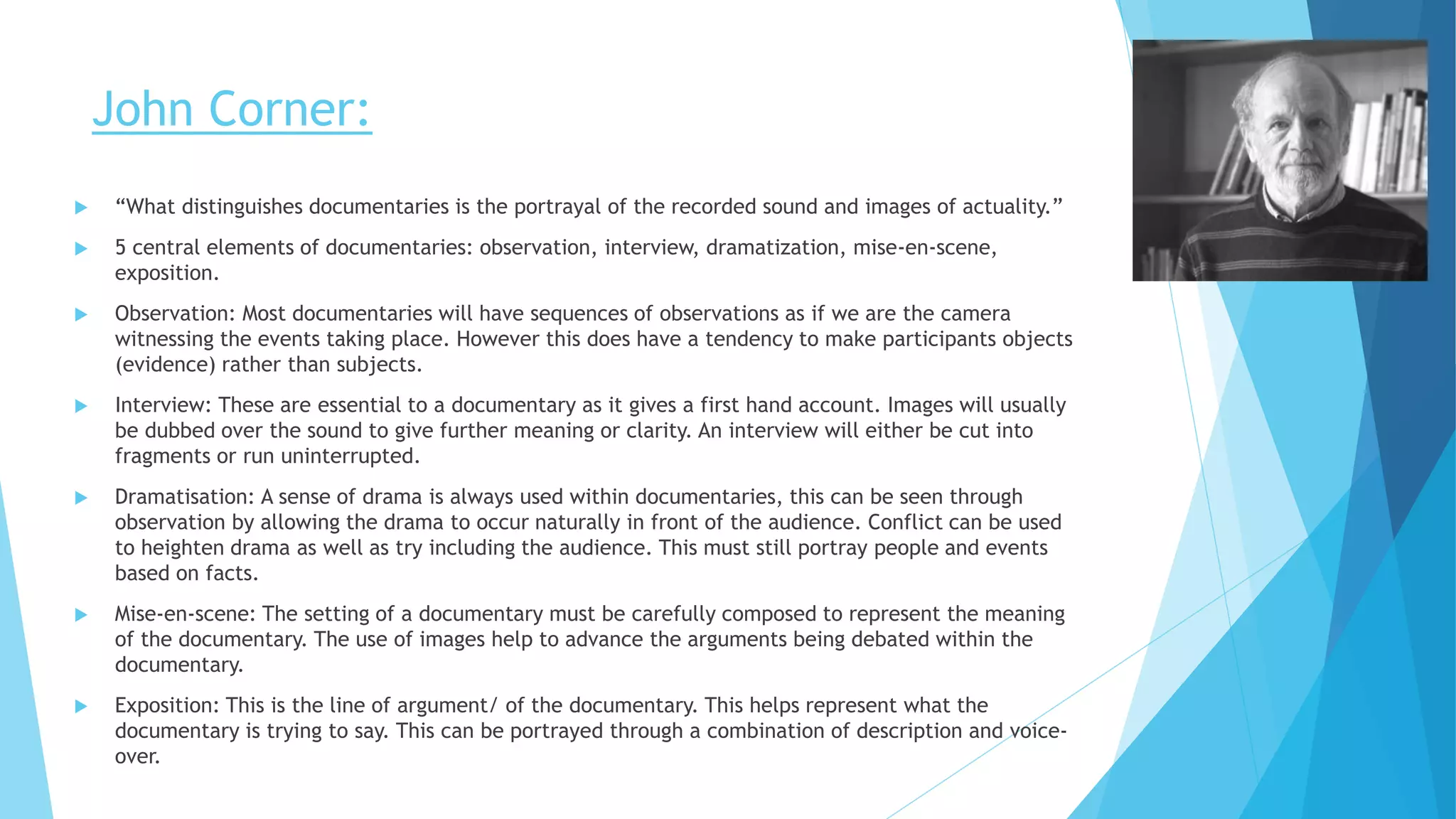
John Corner:
 “What distinguishes documentaries is the portrayal of the recorded sound and images of actuality.”
 5 central elements of documentaries: observation, interview, dramatization, mise-en-scene,
exposition.
 Observation: Most documentaries will have sequences of observations as if we are the camera
witnessing the events taking place. However this does have a tendency to make participants objects
(evidence) rather than subjects.
 Interview: These are essential to a documentary as it gives a first hand account. Images will usually
be dubbed over the sound to give further meaning or clarity. An interview will either be cut into
fragments or run uninterrupted.
 Dramatisation: A sense of drama is always used within documentaries, this can be seen through
observation by allowing the drama to occur naturally in front of the audience. Conflict can be used
to heighten drama as well as try including the audience. This must still portray people and events
based on facts.
 Mise-en-scene: The setting of a documentary must be carefully composed to represent the meaning
of the documentary. The use of images help to advance the arguments being debated within the
documentary.
 Exposition: This is the line of argument/ of the documentary. This helps represent what the
documentary is trying to say. This can be portrayed through a combination of description and voice-
over.
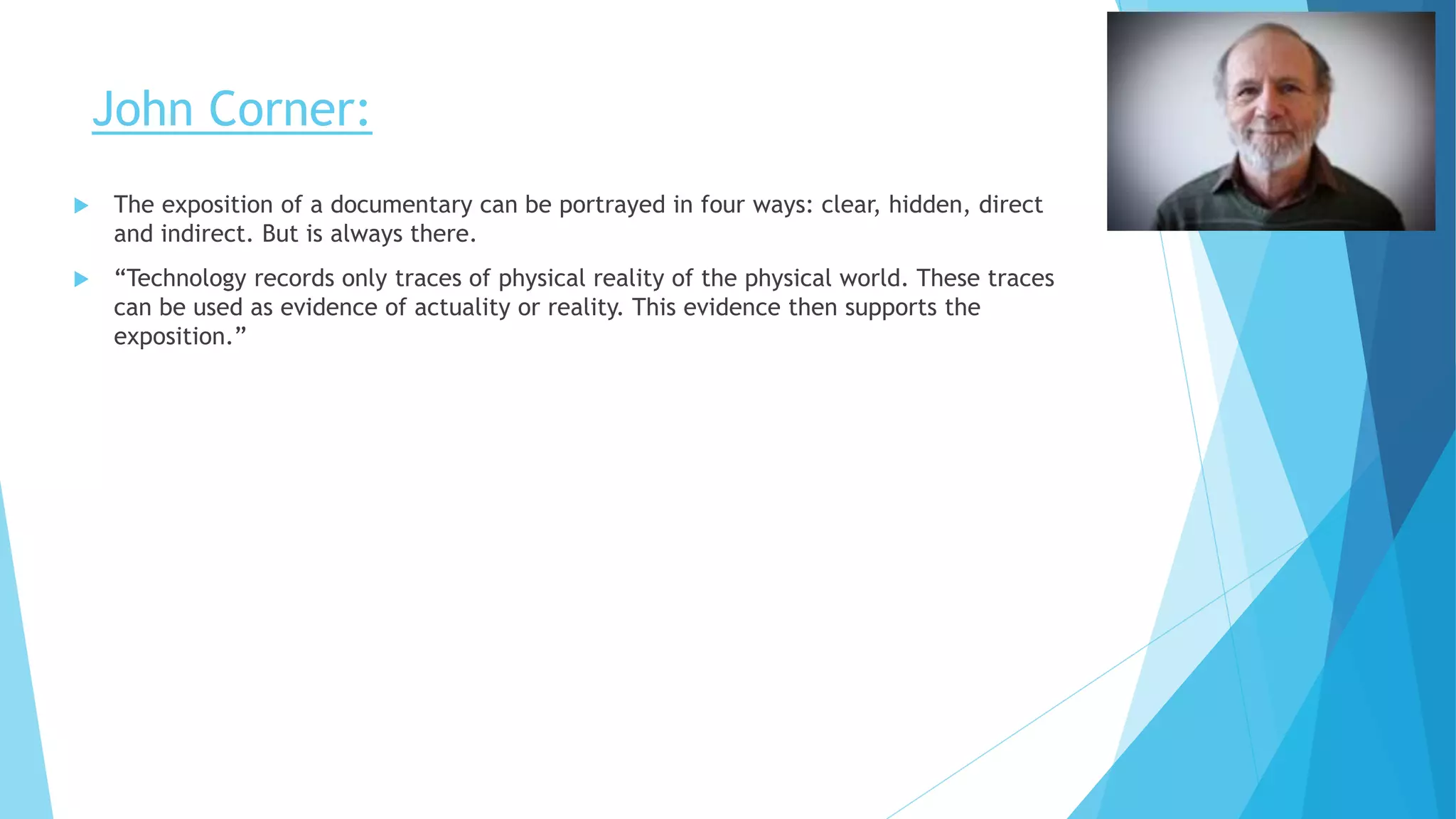
John Corner:
 The exposition of a documentary can be portrayed in four ways: clear, hidden, direct
and indirect. But is always there.
 “Technology records only traces of physical reality of the physical world. These traces
can be used as evidence of actuality or reality. This evidence then supports the
exposition.”
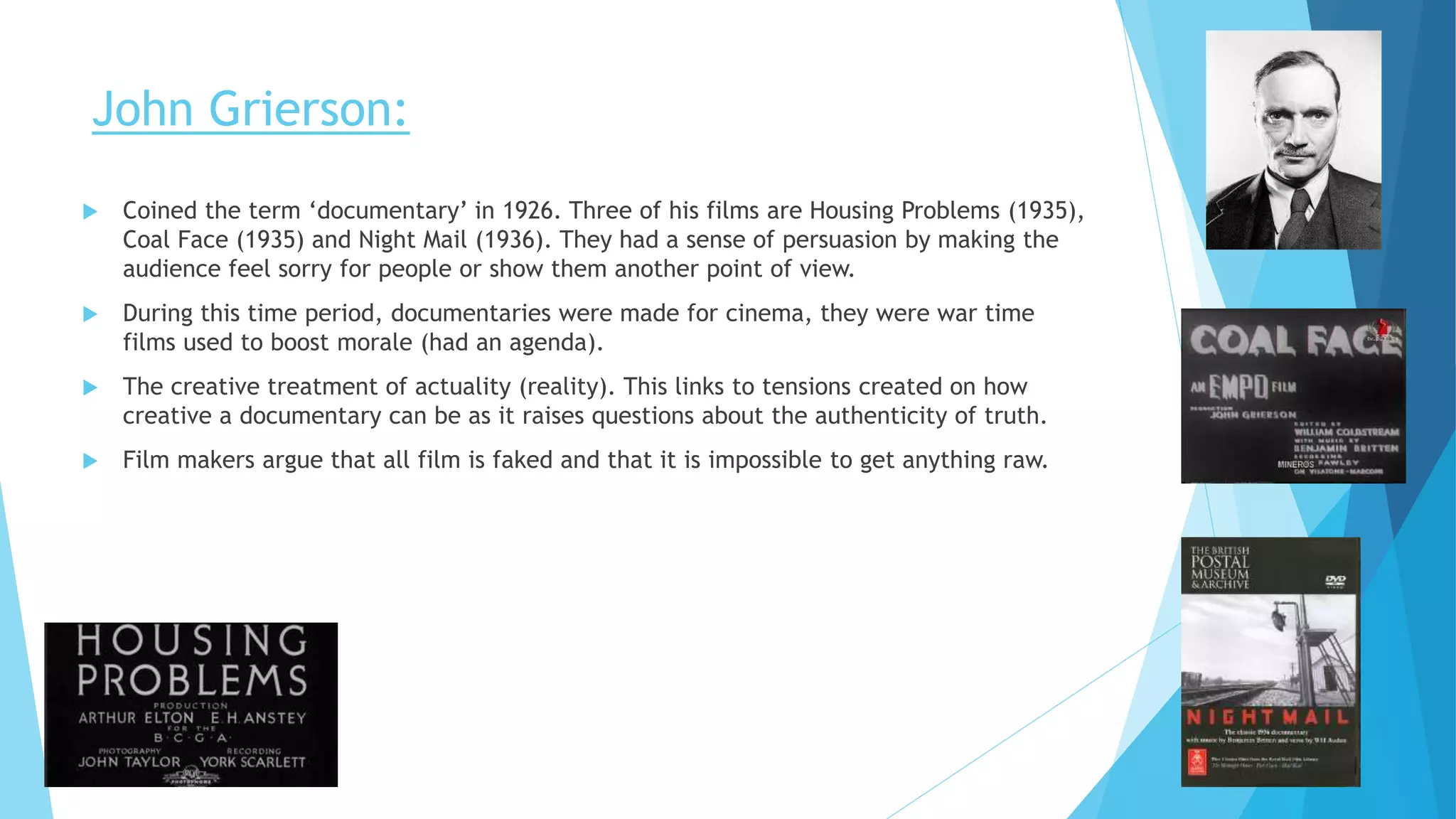
John Grierson:
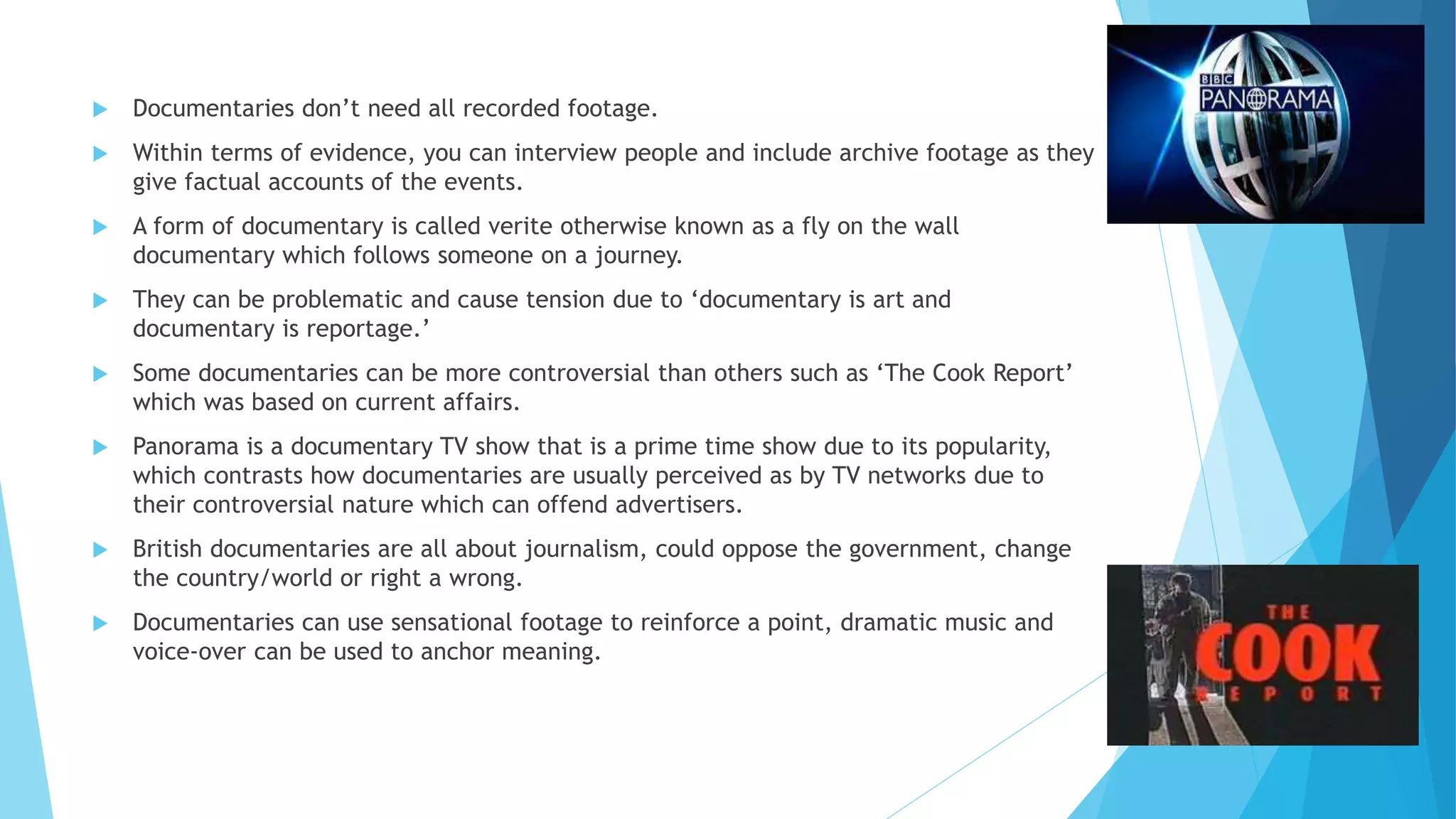
 Coined the term ‘documentary’ in 1926. Three of his films are Housing Problems (1935),
Coal Face (1935) and Night Mail (1936). They had a sense of persuasion by making the
audience feel sorry for people or show them another point of view.
 During this time period, documentaries were made for cinema, they were war time
films used to boost morale (had an agenda).
 The creative treatment of actuality (reality). This links to tensions created on how
creative a documentary can be as it raises questions about the authenticity of truth.
 Film makers argue that all film is faked and that it is impossible to get anything raw.
 Documentaries don’t need all recorded footage.
 Within terms of evidence, you can interview people and include archive footage as they
give factual accounts of the events.
 A form of documentary is called verite otherwise known as a fly on the wall
documentary which follows someone on a journey.
 They can be problematic and cause tension due to ‘documentary is art and
documentary is reportage.’
 Some documentaries can be more controversial than others such as ‘The Cook Report’
which was based on current affairs.
 Panorama is a documentary TV show that is a prime time show due to its popularity,
which contrasts how documentaries are usually perceived as by TV networks due to
their controversial nature which can offend advertisers.
 British documentaries are all about journalism, could oppose the government, change
the country/world or right a wrong.
 Documentaries can use sensational footage to reinforce a point, dramatic music and
voice-over can be used to anchor meaning.
 Documentaries need a narrative to allow it to make sense to the audience.
 “I think the truth is what you actually come away with at the end of seeing a film. I
mean its your truth that you’re seeing. Everybody who makes a film is putting their
own truth on screen.” Dianne Tames- Film maker.
 Creative development has affected documentaries, they have widened and broadened.
This in turn has made it difficult to agree on what a documentary really is.
 It can be debated that due to this that they should be called non fiction programming
rather than documentaries.
 It is agreed that footage of images and videos included is from actuality or lived
experiences.
 The end point of a documentary will usually leave the answer open to the audience to
judge.
 Current affairs is the midpoint between documentaries and news. Documentaries
investigate rather than news which reports. They are usually between 30 minutes to 1
hour.
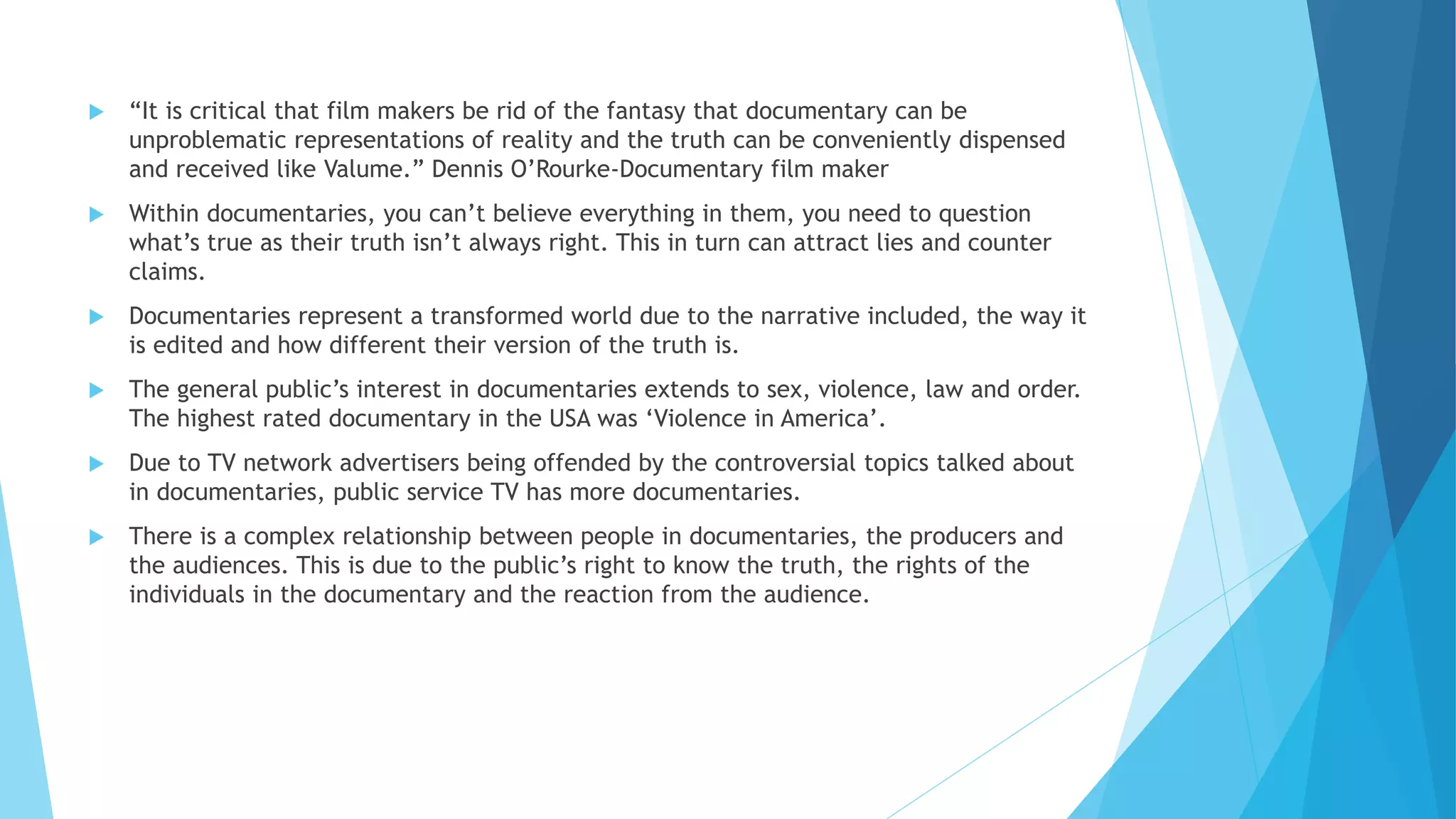
 They will usually cover weighty issues or significant social developments, such as
Tonight with Trevor McDonald which uses sensationalised content as a way to improve
ratings.
 “It is critical that film makers be rid of the fantasy that documentary can be
unproblematic representations of reality and the truth can be conveniently dispensed
and received like Valume.” Dennis O’Rourke-Documentary film maker
 Within documentaries, you can’t believe everything in them, you need to question
what’s true as their truth isn’t always right. This in turn can attract lies and counter
claims.
 Documentaries represent a transformed world due to the narrative included, the way it
is edited and how different their version of the truth is.
 The general public’s interest in documentaries extends to sex, violence, law and order.
The highest rated documentary in the USA was ‘Violence in America’.
 Due to TV network advertisers being offended by the controversial topics talked about
in documentaries, public service TV has more documentaries.
 There is a complex relationship between people in documentaries, the producers and
the audiences. This is due to the public’s right to know the truth, the rights of the
individuals in the documentary and the reaction from the audience.
 Current affairs and documentaries usually focus on society’s victims. They use humans
as evidence which does expose and exploit people’s lives.
 The producers of documentaries assume that they know what the audience wants due
to their right to know the truth, and will usually try to make the public want to do
something about it.
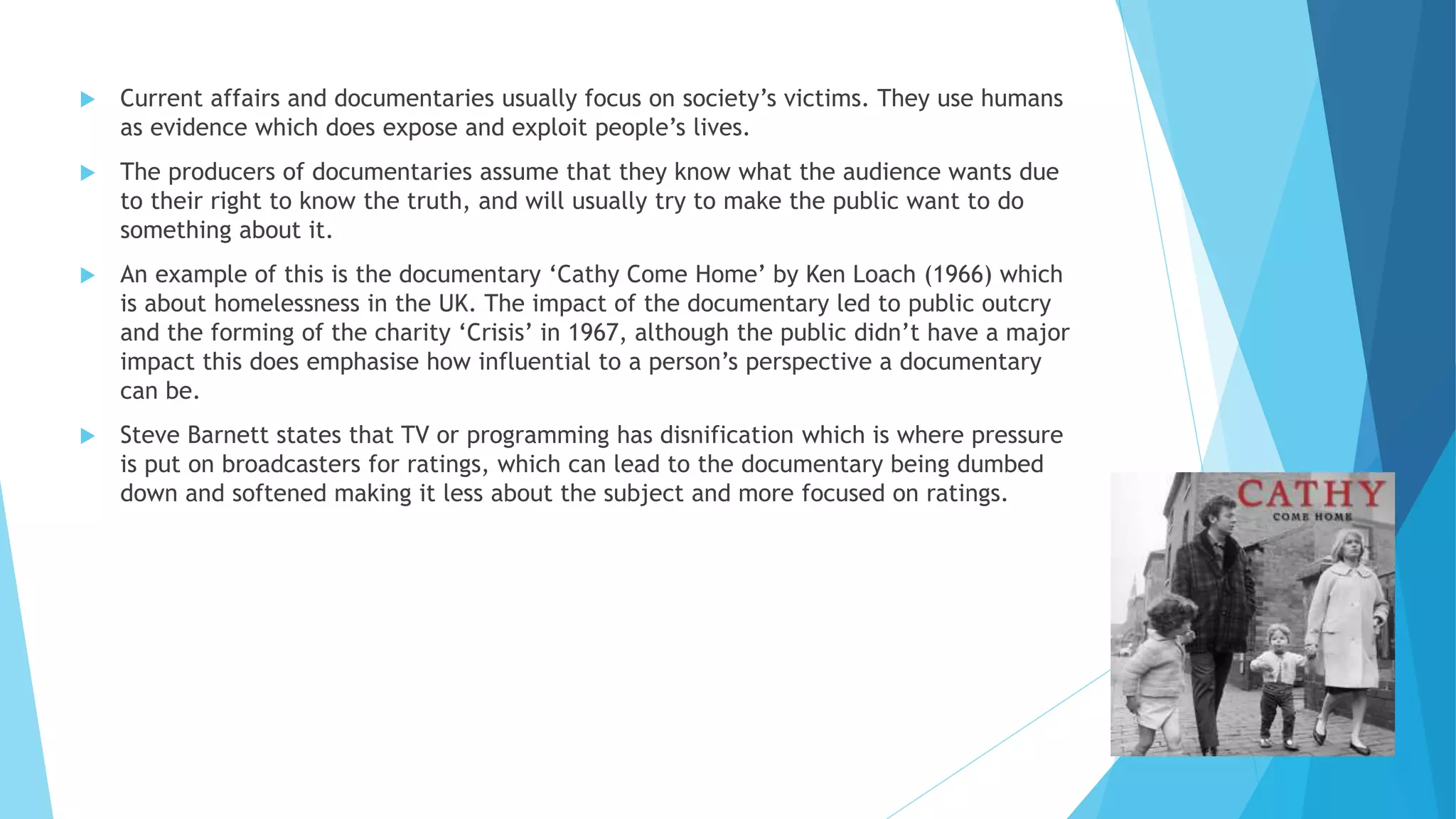
 An example of this is the documentary ‘Cathy Come Home’ by Ken Loach (1966) which
is about homelessness in the UK. The impact of the documentary led to public outcry
and the forming of the charity ‘Crisis’ in 1967, although the public didn’t have a major
impact this does emphasise how influential to a person’s perspective a documentary
can be.
 Steve Barnett states that TV or programming has disnification which is where pressure
is put on broadcasters for ratings, which can lead to the documentary being dumbed
down and softened making it less about the subject and more focused on ratings.
Narrative Conventions:
 Need a story for the documentary.
 Need an exposition.
 The beginning-The main question for the documentary, which helps to create intrigue
for the audience. The images/footage help to create drama, also a quick paced
interview or conflict can be used.
 Middle-This is the complication stage, an issue is created in human terms. The focus is
on the people and their opinions. There is usually a blockage to the exposition via some
form of conflict.
 End-The exposition should be fully apparent to the audience, this is the resolution
stage. The audience should now fully understand the point of the documentary.
 Sense of conflict-the focus is on people’s beliefs, goals or circumstances. Usually there
will be some form of confrontation on camera.
Narrative Conventions:
 Sense of movement-this helps to strengthen the narrative, there can be a personal
journey for a specific individual.
 Sound-the music and sound effects used help anchor the emotional response wanted
from the producers by the audience.
 Interviews should appear natural, via the lighting making it appear real and authentic.
As well as the setting/environment being natural and linking to the topic at hand.
 The interview creates a new reality, this can be shown as your version of reality due to
the way the interview is constructed once you have edited it as you are changing the
original reality.
 Cutaways are essential to an interview as they help to anchor meaning and illustrate a
specific point, which helps to avoid the inclusion of jump cuts.

The theory of documentaries

  • 1.
  • 2.
     The purposeof a documentary is to document or report something with evidence (a particular topic of event that has taken place) and must be based on facts.  Within a documentary, there are various forms of evidence that can be used such as: footage, reconstruct events, interviews, observations of subjects.  A voice-over will usually be used to add further meaning to the documentary via commentating over footage or images linking to the topic of conversation.  Documentaries are based on observations from events that have happened to specific people. They can also bear some resemblance to films, but they have to be based on truth.  They rely on people affected by the topic of the documentary to help give understanding to the audience.
  • 3.
    John Corner:  “Whatdistinguishes documentaries is the portrayal of the recorded sound and images of actuality.”  5 central elements of documentaries: observation, interview, dramatization, mise-en-scene, exposition.  Observation: Most documentaries will have sequences of observations as if we are the camera witnessing the events taking place. However this does have a tendency to make participants objects (evidence) rather than subjects.  Interview: These are essential to a documentary as it gives a first hand account. Images will usually be dubbed over the sound to give further meaning or clarity. An interview will either be cut into fragments or run uninterrupted.  Dramatisation: A sense of drama is always used within documentaries, this can be seen through observation by allowing the drama to occur naturally in front of the audience. Conflict can be used to heighten drama as well as try including the audience. This must still portray people and events based on facts.  Mise-en-scene: The setting of a documentary must be carefully composed to represent the meaning of the documentary. The use of images help to advance the arguments being debated within the documentary.  Exposition: This is the line of argument/ of the documentary. This helps represent what the documentary is trying to say. This can be portrayed through a combination of description and voice- over.
  • 4.
    John Corner:  Theexposition of a documentary can be portrayed in four ways: clear, hidden, direct and indirect. But is always there.  “Technology records only traces of physical reality of the physical world. These traces can be used as evidence of actuality or reality. This evidence then supports the exposition.”
  • 5.
    John Grierson:  Coinedthe term ‘documentary’ in 1926. Three of his films are Housing Problems (1935), Coal Face (1935) and Night Mail (1936). They had a sense of persuasion by making the audience feel sorry for people or show them another point of view.  During this time period, documentaries were made for cinema, they were war time films used to boost morale (had an agenda).  The creative treatment of actuality (reality). This links to tensions created on how creative a documentary can be as it raises questions about the authenticity of truth.  Film makers argue that all film is faked and that it is impossible to get anything raw.
  • 6.
     Documentaries don’tneed all recorded footage.  Within terms of evidence, you can interview people and include archive footage as they give factual accounts of the events.  A form of documentary is called verite otherwise known as a fly on the wall documentary which follows someone on a journey.  They can be problematic and cause tension due to ‘documentary is art and documentary is reportage.’  Some documentaries can be more controversial than others such as ‘The Cook Report’ which was based on current affairs.  Panorama is a documentary TV show that is a prime time show due to its popularity, which contrasts how documentaries are usually perceived as by TV networks due to their controversial nature which can offend advertisers.  British documentaries are all about journalism, could oppose the government, change the country/world or right a wrong.  Documentaries can use sensational footage to reinforce a point, dramatic music and voice-over can be used to anchor meaning.
  • 7.
     Documentaries needa narrative to allow it to make sense to the audience.  “I think the truth is what you actually come away with at the end of seeing a film. I mean its your truth that you’re seeing. Everybody who makes a film is putting their own truth on screen.” Dianne Tames- Film maker.  Creative development has affected documentaries, they have widened and broadened. This in turn has made it difficult to agree on what a documentary really is.  It can be debated that due to this that they should be called non fiction programming rather than documentaries.  It is agreed that footage of images and videos included is from actuality or lived experiences.  The end point of a documentary will usually leave the answer open to the audience to judge.  Current affairs is the midpoint between documentaries and news. Documentaries investigate rather than news which reports. They are usually between 30 minutes to 1 hour.  They will usually cover weighty issues or significant social developments, such as Tonight with Trevor McDonald which uses sensationalised content as a way to improve ratings.
  • 8.
     “It iscritical that film makers be rid of the fantasy that documentary can be unproblematic representations of reality and the truth can be conveniently dispensed and received like Valume.” Dennis O’Rourke-Documentary film maker  Within documentaries, you can’t believe everything in them, you need to question what’s true as their truth isn’t always right. This in turn can attract lies and counter claims.  Documentaries represent a transformed world due to the narrative included, the way it is edited and how different their version of the truth is.  The general public’s interest in documentaries extends to sex, violence, law and order. The highest rated documentary in the USA was ‘Violence in America’.  Due to TV network advertisers being offended by the controversial topics talked about in documentaries, public service TV has more documentaries.  There is a complex relationship between people in documentaries, the producers and the audiences. This is due to the public’s right to know the truth, the rights of the individuals in the documentary and the reaction from the audience.
  • 9.
     Current affairsand documentaries usually focus on society’s victims. They use humans as evidence which does expose and exploit people’s lives.  The producers of documentaries assume that they know what the audience wants due to their right to know the truth, and will usually try to make the public want to do something about it.  An example of this is the documentary ‘Cathy Come Home’ by Ken Loach (1966) which is about homelessness in the UK. The impact of the documentary led to public outcry and the forming of the charity ‘Crisis’ in 1967, although the public didn’t have a major impact this does emphasise how influential to a person’s perspective a documentary can be.  Steve Barnett states that TV or programming has disnification which is where pressure is put on broadcasters for ratings, which can lead to the documentary being dumbed down and softened making it less about the subject and more focused on ratings.
  • 10.
    Narrative Conventions:  Needa story for the documentary.  Need an exposition.  The beginning-The main question for the documentary, which helps to create intrigue for the audience. The images/footage help to create drama, also a quick paced interview or conflict can be used.  Middle-This is the complication stage, an issue is created in human terms. The focus is on the people and their opinions. There is usually a blockage to the exposition via some form of conflict.  End-The exposition should be fully apparent to the audience, this is the resolution stage. The audience should now fully understand the point of the documentary.  Sense of conflict-the focus is on people’s beliefs, goals or circumstances. Usually there will be some form of confrontation on camera.
  • 11.
    Narrative Conventions:  Senseof movement-this helps to strengthen the narrative, there can be a personal journey for a specific individual.  Sound-the music and sound effects used help anchor the emotional response wanted from the producers by the audience.  Interviews should appear natural, via the lighting making it appear real and authentic. As well as the setting/environment being natural and linking to the topic at hand.  The interview creates a new reality, this can be shown as your version of reality due to the way the interview is constructed once you have edited it as you are changing the original reality.  Cutaways are essential to an interview as they help to anchor meaning and illustrate a specific point, which helps to avoid the inclusion of jump cuts.