Documentaries
By Kate Constable
Introduction
A documentary is used to DOCUMENT some aspects of
reality. Documentary has been described as a ‘film making
practice, a cinematic tradition and mode of audience
reception”
The purposes of a documentary are to: Document, inform,
educate, entertain, sometimes controversial, factual, topic
based/argument/point to make.
The word documentary was founded by a guy called John
Grieson. He worked for the GPO, general post office. John
defined the term ‘Documentary’ to be the creative
treatment of actuality.
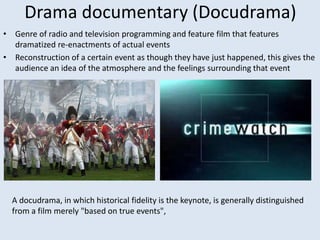
Drama documentary (Docudrama)
• Genre of radio and television programming and feature film that features
dramatized re-enactments of actual events
• Reconstruction of a certain event as though they have just happened, this gives the
audience an idea of the atmosphere and the feelings surrounding that event
A docudrama, in which historical fidelity is the keynote, is generally distinguished
from a film merely "based on true events",
Fly on the wall
• Used in filmmaking and TV production, this name came from
the fact that events are seen candidly (observing)
The Fly on the Wall type of documentary is rooted in the wave of
Cinema Verite (France) and Direct cinema (USA) movements, which
aimed to take documentary making back to its roots, with limited
interference.
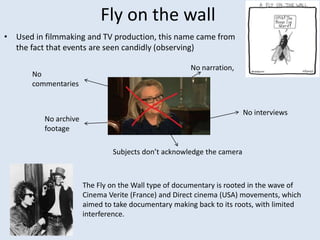
No
commentaries
No narration,
No interviews
No archive
footage
Subjects don’t acknowledge the camera
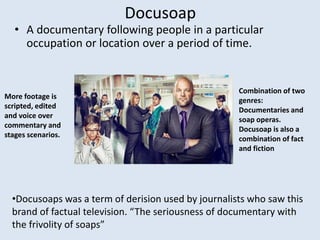
Docusoap
• A documentary following people in a particular
occupation or location over a period of time.
•Docusoaps was a term of derision used by journalists who saw this
brand of factual television. “The seriousness of documentary with
the frivolity of soaps”
More footage is
scripted, edited
and voice over
commentary and
stages scenarios.
Combination of two
genres:
Documentaries and
soap operas.
Docusoap is also a
combination of fact
and fiction
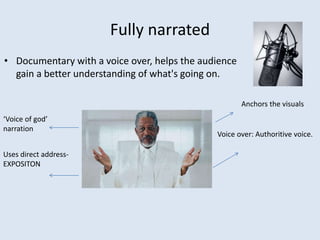
Fully narrated
• Documentary with a voice over, helps the audience
gain a better understanding of what's going on.
Voice over: Authoritive voice.
‘Voice of god’
narration
Uses direct address-
EXPOSITON
Anchors the visuals
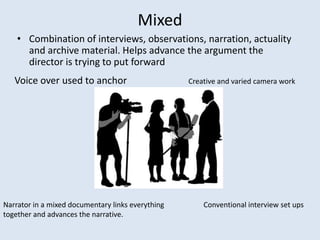
Mixed
• Combination of interviews, observations, narration, actuality
and archive material. Helps advance the argument the
director is trying to put forward
Voice over used to anchor Creative and varied camera work
Conventional interview set upsNarrator in a mixed documentary links everything
together and advances the narrative.
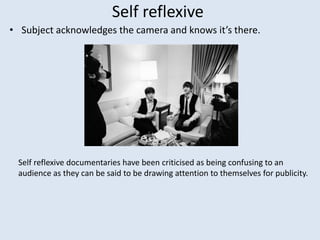
Self reflexive
• Subject acknowledges the camera and knows it’s there.
Self reflexive documentaries have been criticised as being confusing to an
audience as they can be said to be drawing attention to themselves for publicity.
Interview
• Interview set up in a particular way
• Usually experts in the topic
• Relevant people
• Interviewee responds to just the question but not to the
interviewer
• Usually the question isn’t heard on screen.
• Cut away to observative/archive footage.
•Programme makes the camera pretend the camera is
unseen/ignored by the people events.
•Footage used to illustrate/provide evidence.
•Seem to occur naturally in front of the camera
•Audience witnessing dramatic events
•Actually constructed/set up footage based on facts
•Actors
Dramatisation
•All shots carefully composed to contain what they want the audience
to see
•Setting for interview
•Lighting used in shots
•Shots are framed effective
Mise en scene
Expostion
•Lines up the argument
•Direct or indirect mode of address- what the documentary is saying.

Documentaries types

  • 1.
  • 2.
    Introduction A documentary isused to DOCUMENT some aspects of reality. Documentary has been described as a ‘film making practice, a cinematic tradition and mode of audience reception” The purposes of a documentary are to: Document, inform, educate, entertain, sometimes controversial, factual, topic based/argument/point to make. The word documentary was founded by a guy called John Grieson. He worked for the GPO, general post office. John defined the term ‘Documentary’ to be the creative treatment of actuality.
  • 3.
    Drama documentary (Docudrama) •Genre of radio and television programming and feature film that features dramatized re-enactments of actual events • Reconstruction of a certain event as though they have just happened, this gives the audience an idea of the atmosphere and the feelings surrounding that event A docudrama, in which historical fidelity is the keynote, is generally distinguished from a film merely "based on true events",
  • 4.
    Fly on thewall • Used in filmmaking and TV production, this name came from the fact that events are seen candidly (observing) The Fly on the Wall type of documentary is rooted in the wave of Cinema Verite (France) and Direct cinema (USA) movements, which aimed to take documentary making back to its roots, with limited interference. No commentaries No narration, No interviews No archive footage Subjects don’t acknowledge the camera
  • 5.
    Docusoap • A documentaryfollowing people in a particular occupation or location over a period of time. •Docusoaps was a term of derision used by journalists who saw this brand of factual television. “The seriousness of documentary with the frivolity of soaps” More footage is scripted, edited and voice over commentary and stages scenarios. Combination of two genres: Documentaries and soap operas. Docusoap is also a combination of fact and fiction
  • 6.
    Fully narrated • Documentarywith a voice over, helps the audience gain a better understanding of what's going on. Voice over: Authoritive voice. ‘Voice of god’ narration Uses direct address- EXPOSITON Anchors the visuals
  • 7.
    Mixed • Combination ofinterviews, observations, narration, actuality and archive material. Helps advance the argument the director is trying to put forward Voice over used to anchor Creative and varied camera work Conventional interview set upsNarrator in a mixed documentary links everything together and advances the narrative.
  • 8.
    Self reflexive • Subjectacknowledges the camera and knows it’s there. Self reflexive documentaries have been criticised as being confusing to an audience as they can be said to be drawing attention to themselves for publicity.
  • 9.
    Interview • Interview setup in a particular way • Usually experts in the topic • Relevant people • Interviewee responds to just the question but not to the interviewer • Usually the question isn’t heard on screen. • Cut away to observative/archive footage. •Programme makes the camera pretend the camera is unseen/ignored by the people events. •Footage used to illustrate/provide evidence.
  • 10.
    •Seem to occurnaturally in front of the camera •Audience witnessing dramatic events •Actually constructed/set up footage based on facts •Actors Dramatisation •All shots carefully composed to contain what they want the audience to see •Setting for interview •Lighting used in shots •Shots are framed effective Mise en scene Expostion •Lines up the argument •Direct or indirect mode of address- what the documentary is saying.