Documentary Genre
• The purpose of a documentary is to document something
that has happened.
• It can be shown by using actuality footage or
reconstructions.
• It can use a narrator’s voice over to anchor the meaning or
rely on the participants themselves with the odd
interjection by the unseen narrator.
Types of Documentary
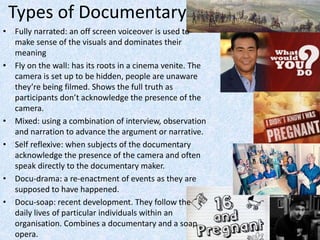
• Fully narrated: an off screen voiceover is used to
make sense of the visuals and dominates their
meaning
• Fly on the wall: has its roots in a cinema venite. The
camera is set up to be hidden, people are unaware
they’re being filmed. Shows the full truth as
participants don’t acknowledge the presence of the
camera.
• Mixed: using a combination of interview, observation
and narration to advance the argument or narrative.
• Self reflexive: when subjects of the documentary
acknowledge the presence of the camera and often
speak directly to the documentary maker.
• Docu-drama: a re-enactment of events as they are
supposed to have happened.
• Docu-soap: recent development. They follow the
daily lives of particular individuals within an
organisation. Combines a documentary and a soap
opera.
Features of Documentaries
• Observation:
– Contain sequences of observation
– The programme pretends that the camera is unseen
– Places the audience in the position of an observer or an eye witness to events
• Interview
– Documentaries rely on interviews
– Interviewer is either seen or unseen
• Mise-en-scene
– All shots are carefully composed so they only contain certain images they want
the audience to see
• Dramatisation
– Use a sense of drama in the observational element
– Sometimes dramatic reconstructions are used
• Exposition
– The line of argument in the documentary
– Exposition is made up of description combined with commentary

Documentary genre

  • 1.
    Documentary Genre • Thepurpose of a documentary is to document something that has happened. • It can be shown by using actuality footage or reconstructions. • It can use a narrator’s voice over to anchor the meaning or rely on the participants themselves with the odd interjection by the unseen narrator.
  • 2.
    Types of Documentary •Fully narrated: an off screen voiceover is used to make sense of the visuals and dominates their meaning • Fly on the wall: has its roots in a cinema venite. The camera is set up to be hidden, people are unaware they’re being filmed. Shows the full truth as participants don’t acknowledge the presence of the camera. • Mixed: using a combination of interview, observation and narration to advance the argument or narrative. • Self reflexive: when subjects of the documentary acknowledge the presence of the camera and often speak directly to the documentary maker. • Docu-drama: a re-enactment of events as they are supposed to have happened. • Docu-soap: recent development. They follow the daily lives of particular individuals within an organisation. Combines a documentary and a soap opera.
  • 3.
    Features of Documentaries •Observation: – Contain sequences of observation – The programme pretends that the camera is unseen – Places the audience in the position of an observer or an eye witness to events • Interview – Documentaries rely on interviews – Interviewer is either seen or unseen • Mise-en-scene – All shots are carefully composed so they only contain certain images they want the audience to see • Dramatisation – Use a sense of drama in the observational element – Sometimes dramatic reconstructions are used • Exposition – The line of argument in the documentary – Exposition is made up of description combined with commentary