Types of Documentaries
• Fully Narrated:
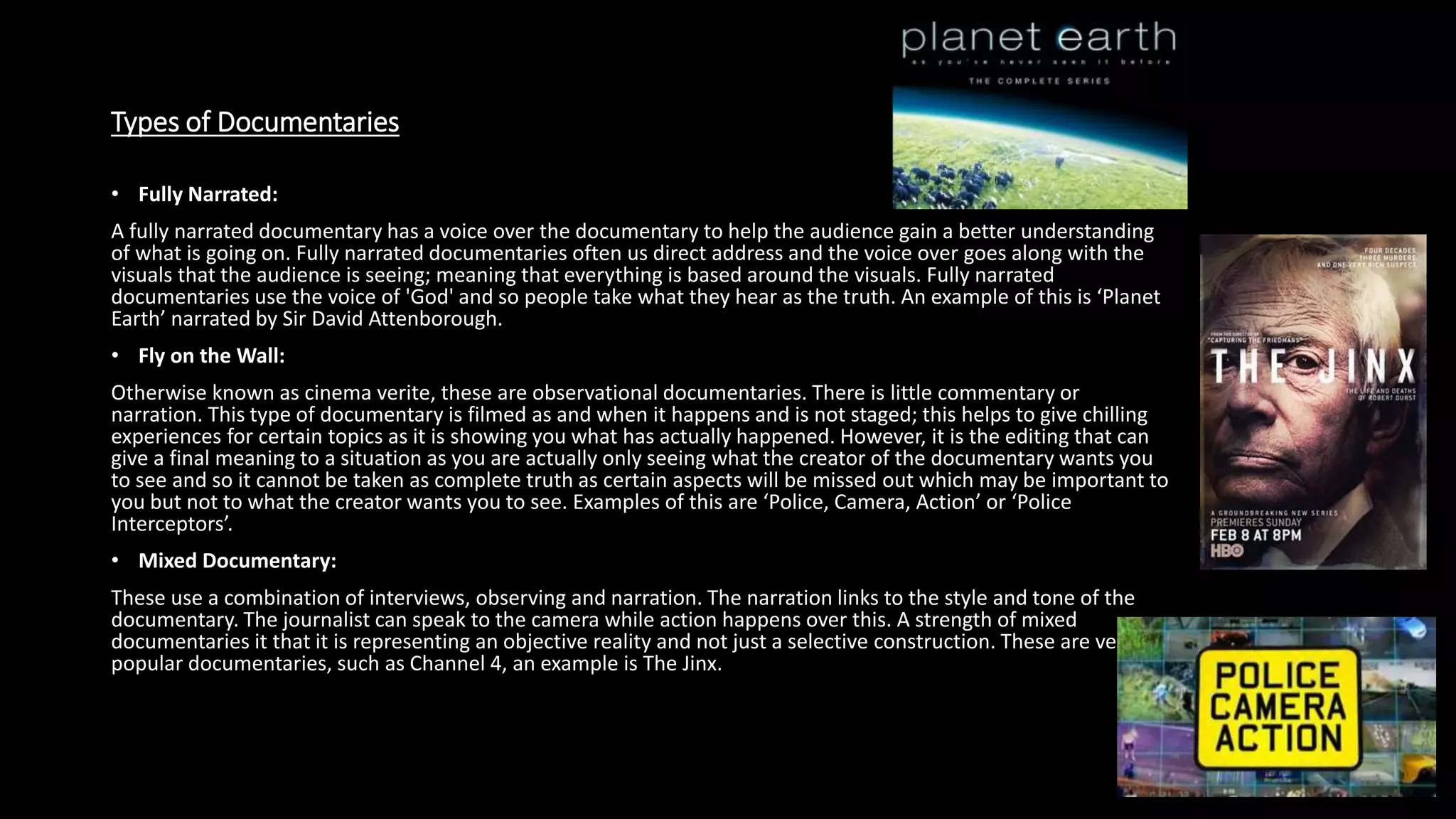
A fully narrated documentary has a voice over the documentary to help the audience gain a better understanding
of what is going on. Fully narrated documentaries often us direct address and the voice over goes along with the
visuals that the audience is seeing; meaning that everything is based around the visuals. Fully narrated
documentaries use the voice of 'God' and so people take what they hear as the truth. An example of this is ‘Planet
Earth’ narrated by Sir David Attenborough.
• Fly on the Wall:
Otherwise known as cinema verite, these are observational documentaries. There is little commentary or
narration. This type of documentary is filmed as and when it happens and is not staged; this helps to give chilling
experiences for certain topics as it is showing you what has actually happened. However, it is the editing that can
give a final meaning to a situation as you are actually only seeing what the creator of the documentary wants you
to see and so it cannot be taken as complete truth as certain aspects will be missed out which may be important to
you but not to what the creator wants you to see. Examples of this are ‘Police, Camera, Action’ or ‘Police
Interceptors’.
• Mixed Documentary:
These use a combination of interviews, observing and narration. The narration links to the style and tone of the
documentary. The journalist can speak to the camera while action happens over this. A strength of mixed
documentaries it that it is representing an objective reality and not just a selective construction. These are very
popular documentaries, such as Channel 4, an example is The Jinx.
 Self-Reflexive:
A fully narrated documentary has a voice over the documentary to help the audience gain a better understanding of what is
going on. Fully narrated documentaries often us direct address and the voice over goes along with the visuals that the
audience is seeing; meaning that everything is based around the visuals. Fully narrated documentaries use the voice of 'God'
and so people take what they hear as the truth. An example of this is ‘Planet Earth’ narrated by Sir David Attenborough.
 Docu-Drama:
Otherwise known as cinema verite, these are observational documentaries. There is little commentary or narration. This
type of documentary is filmed as and when it happens and is not staged; this helps to give chilling experiences for certain
topics as it is showing you what has actually happened. However, it is the editing that can give a final meaning to a situation
as you are actually only seeing what the creator of the documentary wants you to see and so it cannot be taken as complete
truth as certain aspects will be missed out which may be important to you but not to what the creator wants you to see.
Examples of this are ‘Police, Camera, Action’ or ‘Police Interceptors’.
 Docu-Soap:
These use a combination of interviews, observing and narration. The narration links to the style and tone of the
documentary. The journalist can speak to the camera while action happens over this. A strength of mixed documentaries it
that it is representing an objective reality and not just a selective construction. These are very popular documentaries, such
as Channel 4, an example is The Jinx.

Types of Documentaries

  • 1.
    Types of Documentaries •Fully Narrated: A fully narrated documentary has a voice over the documentary to help the audience gain a better understanding of what is going on. Fully narrated documentaries often us direct address and the voice over goes along with the visuals that the audience is seeing; meaning that everything is based around the visuals. Fully narrated documentaries use the voice of 'God' and so people take what they hear as the truth. An example of this is ‘Planet Earth’ narrated by Sir David Attenborough. • Fly on the Wall: Otherwise known as cinema verite, these are observational documentaries. There is little commentary or narration. This type of documentary is filmed as and when it happens and is not staged; this helps to give chilling experiences for certain topics as it is showing you what has actually happened. However, it is the editing that can give a final meaning to a situation as you are actually only seeing what the creator of the documentary wants you to see and so it cannot be taken as complete truth as certain aspects will be missed out which may be important to you but not to what the creator wants you to see. Examples of this are ‘Police, Camera, Action’ or ‘Police Interceptors’. • Mixed Documentary: These use a combination of interviews, observing and narration. The narration links to the style and tone of the documentary. The journalist can speak to the camera while action happens over this. A strength of mixed documentaries it that it is representing an objective reality and not just a selective construction. These are very popular documentaries, such as Channel 4, an example is The Jinx.
  • 2.
     Self-Reflexive: A fullynarrated documentary has a voice over the documentary to help the audience gain a better understanding of what is going on. Fully narrated documentaries often us direct address and the voice over goes along with the visuals that the audience is seeing; meaning that everything is based around the visuals. Fully narrated documentaries use the voice of 'God' and so people take what they hear as the truth. An example of this is ‘Planet Earth’ narrated by Sir David Attenborough.  Docu-Drama: Otherwise known as cinema verite, these are observational documentaries. There is little commentary or narration. This type of documentary is filmed as and when it happens and is not staged; this helps to give chilling experiences for certain topics as it is showing you what has actually happened. However, it is the editing that can give a final meaning to a situation as you are actually only seeing what the creator of the documentary wants you to see and so it cannot be taken as complete truth as certain aspects will be missed out which may be important to you but not to what the creator wants you to see. Examples of this are ‘Police, Camera, Action’ or ‘Police Interceptors’.  Docu-Soap: These use a combination of interviews, observing and narration. The narration links to the style and tone of the documentary. The journalist can speak to the camera while action happens over this. A strength of mixed documentaries it that it is representing an objective reality and not just a selective construction. These are very popular documentaries, such as Channel 4, an example is The Jinx.