PURPOSE OF A DOCUMENTARY
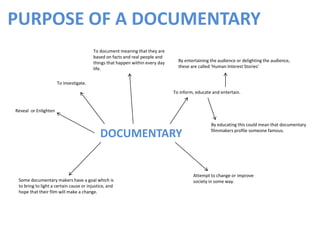
To document meaning that they are
based on facts and real people and
things that happen within every day
life.
To inform, educate and entertain.
To Investigate.
Attempt to change or improve
society in some way.Some documentary makers have a goal which is
to bring to light a certain cause or injustice, and
hope that their film will make a change.
By entertaining the audience or delighting the audience,
these are called ‘Human Interest Stories’
By educating this could mean that documentary
filmmakers profile someone famous.
Reveal or Enlighten
DOCUMENTARY
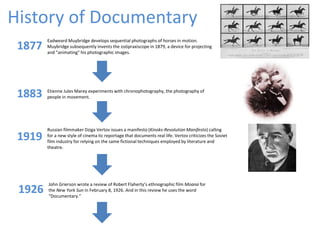
History of Documentary
Eadweard Muybridge develops sequential photographs of horses in motion.
Muybridge subsequently invents the zoöpraxiscope in 1879, a device for projecting
and "animating" his photographic images.
1877
Etienne Jules Marey experiments with chronophotography, the photography of
people in movement.1883
Russian filmmaker Dziga Vertov issues a manifesto (Kinoks-Revolution Manifesto) calling
for a new style of cinema tic reportage that documents real life. Vertov criticizes the Soviet
film industry for relying on the same fictional techniques employed by literature and
theatre.
1919
John Grierson wrote a review of Robert Flaherty’s ethnographic film Moana for
the New York Sun in February 8, 1926. And in this review he uses the word
“Documentary.”
1926
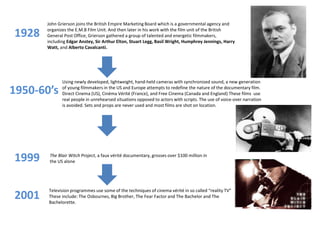
John Grierson joins the British Empire Marketing Board which is a governmental agency and
organizes the E.M.B Film Unit. And then later in his work with the film unit of the British
General Post Office, Grierson gathered a group of talented and energetic filmmakers,
including Edgar Anstey, Sir Arthur Elton, Stuart Legg, Basil Wright, Humphrey Jennings, Harry
Watt, and Alberto Cavalcanti.
1928
Using newly developed, lightweight, hand-held cameras with synchronized sound, a new generation
of young filmmakers in the US and Europe attempts to redefine the nature of the documentary film.
Direct Cinema (US), Cinéma Vérité (France), and Free Cinema (Canada and England) These films use
real people in unrehearsed situations opposed to actors with scripts. The use of voice-over narration
is avoided. Sets and props are never used and most films are shot on location.
1950-60’s
The Blair Witch Project, a faux vérité documentary, grosses over $100 million in
the US alone1999
Television programmes use some of the techniques of cinema vérité in so called “reality TV”
These include: The Osbournes, Big Brother, The Fear Factor and The Bachelor and The
Bachelorette.
2001
FEATURES OF A DOCUMENTARY
OBSERVATION
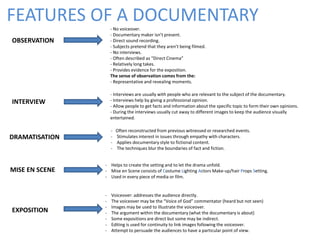
- No voiceover.
- Documentary maker isn’t present.
- Direct sound recording.
- Subjects pretend that they aren’t being filmed.
- No interviews.
- Often described as “Direct Cinema”
- Relatively long takes.
- Provides evidence for the exposition.
The sense of observation comes from the:
- Representative and revealing moments.
EXPOSITION
- Voiceover: addresses the audience directly.
- The voiceover may be the “Voice of God” commentator (heard but not seen)
- Images may be used to illustrate the voiceover.
- The argument within the documentary (what the documentary is about)
- Some expositions are direct but some may be indirect.
- Editing is used for continuity to link images following the voiceover.
- Attempt to persuade the audiences to have a particular point of view.
INTERVIEW
- Interviews are usually with people who are relevant to the subject of the documentary.
- Interviews help by giving a professional opinion.
- Allow people to get facts and information about the specific topic to form their own opinions.
- During the interviews usually cut away to different images to keep the audience visually
entertained.
DRAMATISATION
MISE EN SCENE
- Often reconstructed from previous witnessed or researched events.
- Stimulates interest in issues through empathy with characters.
- Applies documentary style to fictional content.
- The techniques blur the boundaries of fact and fiction.
- Helps to create the setting and to let the drama unfold.
- Mise en Scene consists of Costume Lighting Actors Make-up/hair Props Setting.
- Used in every piece of media or film.
TYPES OF DOCUMENTARY
FULLY NARRATED
- Uses direct mode of address and uses off-screen voiceover. Used to help viewers understand the images on screen.
- The full narration is often known as “Voice of God” as you can hear it, but cannot see it. This anchors the meaning of
the visuals.
- The “Voice of God is also used so that what people hear, they take as the truth.
- Full Narration is often used the most in Nature Documentaries.
FLY ON THE WALL
- Most pure form of documentary.
- Rely on observations.
- Have very little narration.
- Capture huge amounts of footage and relies on the editing process.
- There is no interviews.
MIXED
- Combination of interview, observation, narration, actuality footage and archive material.
- Advance a particular argument.
- Most of the time new documentaries are mixed.
SELF-REFLEXIVE
- Can see the narrator or presenter within the frame.
This then provides a narrative as the film maker acknowledges their presence in front of the camera.
- The camera follows a person/group of people around and the person/people acknowledge the camera and speak to it.
DOCU DRAMA
DOCU SOAP
- Re-acting things that have happened i.e. A reconstruction.
- Often far from reality and the truth.
- Docu Drama producers choose to film their reconstructed events in places i.e. where
historical events have taken place.
- Focusses on facts of the event as they are known.
- More focussed on what happens within peoples lives.
- Mainly set around the workplace and peoples jobs.
- “Documenting reality” / Observational.
- Defined as “programmes about ordinary people and events, made by professionals to entertain as
well as instruct.
- Editing heightens the suspense.

Genre analysis

  • 1.
    PURPOSE OF ADOCUMENTARY To document meaning that they are based on facts and real people and things that happen within every day life. To inform, educate and entertain. To Investigate. Attempt to change or improve society in some way.Some documentary makers have a goal which is to bring to light a certain cause or injustice, and hope that their film will make a change. By entertaining the audience or delighting the audience, these are called ‘Human Interest Stories’ By educating this could mean that documentary filmmakers profile someone famous. Reveal or Enlighten DOCUMENTARY
  • 2.
    History of Documentary EadweardMuybridge develops sequential photographs of horses in motion. Muybridge subsequently invents the zoöpraxiscope in 1879, a device for projecting and "animating" his photographic images. 1877 Etienne Jules Marey experiments with chronophotography, the photography of people in movement.1883 Russian filmmaker Dziga Vertov issues a manifesto (Kinoks-Revolution Manifesto) calling for a new style of cinema tic reportage that documents real life. Vertov criticizes the Soviet film industry for relying on the same fictional techniques employed by literature and theatre. 1919 John Grierson wrote a review of Robert Flaherty’s ethnographic film Moana for the New York Sun in February 8, 1926. And in this review he uses the word “Documentary.” 1926
  • 3.
    John Grierson joinsthe British Empire Marketing Board which is a governmental agency and organizes the E.M.B Film Unit. And then later in his work with the film unit of the British General Post Office, Grierson gathered a group of talented and energetic filmmakers, including Edgar Anstey, Sir Arthur Elton, Stuart Legg, Basil Wright, Humphrey Jennings, Harry Watt, and Alberto Cavalcanti. 1928 Using newly developed, lightweight, hand-held cameras with synchronized sound, a new generation of young filmmakers in the US and Europe attempts to redefine the nature of the documentary film. Direct Cinema (US), Cinéma Vérité (France), and Free Cinema (Canada and England) These films use real people in unrehearsed situations opposed to actors with scripts. The use of voice-over narration is avoided. Sets and props are never used and most films are shot on location. 1950-60’s The Blair Witch Project, a faux vérité documentary, grosses over $100 million in the US alone1999 Television programmes use some of the techniques of cinema vérité in so called “reality TV” These include: The Osbournes, Big Brother, The Fear Factor and The Bachelor and The Bachelorette. 2001
  • 4.
    FEATURES OF ADOCUMENTARY OBSERVATION - No voiceover. - Documentary maker isn’t present. - Direct sound recording. - Subjects pretend that they aren’t being filmed. - No interviews. - Often described as “Direct Cinema” - Relatively long takes. - Provides evidence for the exposition. The sense of observation comes from the: - Representative and revealing moments. EXPOSITION - Voiceover: addresses the audience directly. - The voiceover may be the “Voice of God” commentator (heard but not seen) - Images may be used to illustrate the voiceover. - The argument within the documentary (what the documentary is about) - Some expositions are direct but some may be indirect. - Editing is used for continuity to link images following the voiceover. - Attempt to persuade the audiences to have a particular point of view. INTERVIEW - Interviews are usually with people who are relevant to the subject of the documentary. - Interviews help by giving a professional opinion. - Allow people to get facts and information about the specific topic to form their own opinions. - During the interviews usually cut away to different images to keep the audience visually entertained. DRAMATISATION MISE EN SCENE - Often reconstructed from previous witnessed or researched events. - Stimulates interest in issues through empathy with characters. - Applies documentary style to fictional content. - The techniques blur the boundaries of fact and fiction. - Helps to create the setting and to let the drama unfold. - Mise en Scene consists of Costume Lighting Actors Make-up/hair Props Setting. - Used in every piece of media or film.
  • 5.
    TYPES OF DOCUMENTARY FULLYNARRATED - Uses direct mode of address and uses off-screen voiceover. Used to help viewers understand the images on screen. - The full narration is often known as “Voice of God” as you can hear it, but cannot see it. This anchors the meaning of the visuals. - The “Voice of God is also used so that what people hear, they take as the truth. - Full Narration is often used the most in Nature Documentaries. FLY ON THE WALL - Most pure form of documentary. - Rely on observations. - Have very little narration. - Capture huge amounts of footage and relies on the editing process. - There is no interviews. MIXED - Combination of interview, observation, narration, actuality footage and archive material. - Advance a particular argument. - Most of the time new documentaries are mixed.
  • 6.
    SELF-REFLEXIVE - Can seethe narrator or presenter within the frame. This then provides a narrative as the film maker acknowledges their presence in front of the camera. - The camera follows a person/group of people around and the person/people acknowledge the camera and speak to it. DOCU DRAMA DOCU SOAP - Re-acting things that have happened i.e. A reconstruction. - Often far from reality and the truth. - Docu Drama producers choose to film their reconstructed events in places i.e. where historical events have taken place. - Focusses on facts of the event as they are known. - More focussed on what happens within peoples lives. - Mainly set around the workplace and peoples jobs. - “Documenting reality” / Observational. - Defined as “programmes about ordinary people and events, made by professionals to entertain as well as instruct. - Editing heightens the suspense.