Types of documentaries
poetic
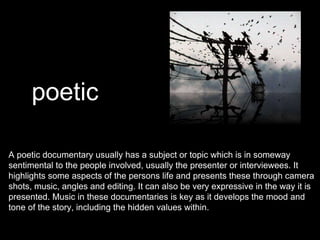
A poetic documentary usually has a subject or topic which is in someway
sentimental to the people involved, usually the presenter or interviewees. It
highlights some aspects of the persons life and presents these through camera
shots, music, angles and editing. It can also be very expressive in the way it is
presented. Music in these documentaries is key as it develops the mood and
tone of the story, including the hidden values within.
observational
This is the mode associated with ‘fly-on-the-wall’ type documentaries.
They appear to have been filmed in ‘real time’, as if the camera has
happened upon events while those involved are seemingly unaware of
the filming going on. The filmmakers correspondingly attempt not to
interfere in what is underway. We do not hear their questions and we do
not see them. There is no voiceover telling us what to think or what
conclusions we should draw, leaving the audience to make their own
conclusions
Expository documentaries talk directly to the viewer, often in the form of an author
expository
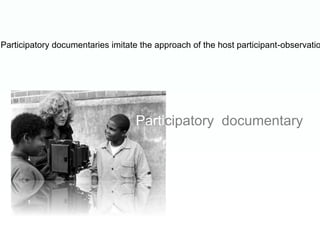
Participatory documentaries imitate the approach of the host participant-observatio
Participatory documentary
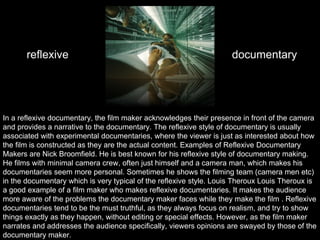
In a reflexive documentary, the film maker acknowledges their presence in front of the camera
and provides a narrative to the documentary. The reflexive style of documentary is usually
associated with experimental documentaries, where the viewer is just as interested about how
the film is constructed as they are the actual content. Examples of Reflexive Documentary
Makers are Nick Broomfield. He is best known for his reflexive style of documentary making.
He films with minimal camera crew, often just himself and a camera man, which makes his
documentaries seem more personal. Sometimes he shows the filming team (camera men etc)
in the documentary which is very typical of the reflexive style. Louis Theroux Louis Theroux is
a good example of a film maker who makes reflexive documentaries. It makes the audience
more aware of the problems the documentary maker faces while they make the film . Reflexive
documentaries tend to be the must truthful, as they always focus on realism, and try to show
things exactly as they happen, without editing or special effects. However, as the film maker
narrates and addresses the audience specifically, viewers opinions are swayed by those of the
documentary maker.
reflexive documentary
A performative documentary acknowledges the emotional and subjective aspects
Performative documentaries emphasise the filmmaker’s own involvement with the
performative documentary

Documentary styles

  • 1.
  • 2.
    poetic A poetic documentaryusually has a subject or topic which is in someway sentimental to the people involved, usually the presenter or interviewees. It highlights some aspects of the persons life and presents these through camera shots, music, angles and editing. It can also be very expressive in the way it is presented. Music in these documentaries is key as it develops the mood and tone of the story, including the hidden values within.
  • 3.
    observational This is themode associated with ‘fly-on-the-wall’ type documentaries. They appear to have been filmed in ‘real time’, as if the camera has happened upon events while those involved are seemingly unaware of the filming going on. The filmmakers correspondingly attempt not to interfere in what is underway. We do not hear their questions and we do not see them. There is no voiceover telling us what to think or what conclusions we should draw, leaving the audience to make their own conclusions
  • 4.
    Expository documentaries talkdirectly to the viewer, often in the form of an author expository
  • 5.
    Participatory documentaries imitatethe approach of the host participant-observatio Participatory documentary
  • 6.
    In a reflexivedocumentary, the film maker acknowledges their presence in front of the camera and provides a narrative to the documentary. The reflexive style of documentary is usually associated with experimental documentaries, where the viewer is just as interested about how the film is constructed as they are the actual content. Examples of Reflexive Documentary Makers are Nick Broomfield. He is best known for his reflexive style of documentary making. He films with minimal camera crew, often just himself and a camera man, which makes his documentaries seem more personal. Sometimes he shows the filming team (camera men etc) in the documentary which is very typical of the reflexive style. Louis Theroux Louis Theroux is a good example of a film maker who makes reflexive documentaries. It makes the audience more aware of the problems the documentary maker faces while they make the film . Reflexive documentaries tend to be the must truthful, as they always focus on realism, and try to show things exactly as they happen, without editing or special effects. However, as the film maker narrates and addresses the audience specifically, viewers opinions are swayed by those of the documentary maker. reflexive documentary
  • 7.
    A performative documentaryacknowledges the emotional and subjective aspects Performative documentaries emphasise the filmmaker’s own involvement with the performative documentary