GENETICS
medpgnotes
GENETICS
www.medpgnotes.com
1GENERAL FEATURES OF GENES AND CHROMOSOMES
CONTENTS
GENERAL FEATURES OF GENES AND CHROMOSOMES................................................................................................. 4
GENERAL FEATURES OF GENETICS............................................................................................................................ 4
GENERAL FEATURES OF CHROMOSOMES................................................................................................................. 4
BARR BODY ............................................................................................................................................................... 5
GENES........................................................................................................................................................................ 5
ANEUPLOIDY ............................................................................................................................................................. 6
CHROMOSOMES ....................................................................................................................................................... 6
CYTOGENETICS AND DNA RECOMBINANT TECHNOLOGY............................................................................................. 6
GENERAL FEATURES OF CYTOGENETIC STUDIES....................................................................................................... 6
POLYMERASE CHAIN REACTION................................................................................................................................ 7
RESTRICTION FRAGMENT LENGTH POLYMORPHISM ............................................................................................... 7
DNA FINGERPRINTING .............................................................................................................................................. 8
FLUORESCENCE AND LUMINENCE ............................................................................................................................ 8
KARYOTYPING ........................................................................................................................................................... 9
BLOTTING.................................................................................................................................................................. 9
HYBRIDOMA TECHNOLOGY....................................................................................................................................... 9
GENETIC STUDIES.................................................................................................................................................... 10
CHROMOSOMAL STUDIES....................................................................................................................................... 10
TRANSGENIC ANIMALS ........................................................................................................................................... 10
GENE INCORPORATION........................................................................................................................................... 10
RECOMBINANT TECHNOLOGY ................................................................................................................................ 11
GENE THERAPY........................................................................................................................................................ 11
MODE OF INHERITANCE OF DISEASES ........................................................................................................................ 11
INHERITANCE OF DISEASES..................................................................................................................................... 11
FEATURES OF INHERITANCE.................................................................................................................................... 12
MITOCHONDRIAL INHERITANCE ............................................................................................................................. 13
GENETIC DISORDERS................................................................................................................................................... 13
GENERAL FEATURES OF GENETIC DISORDERS ........................................................................................................ 13
REARRANGEMENT OF TRANSCRIPTION FACTORS .................................................................................................. 14
DOWN’S SYNDROME............................................................................................................................................... 14
TRISOMY 13 ............................................................................................................................................................ 15
TRISOMY 18 ............................................................................................................................................................ 16
GENETICS
www.medpgnotes.com
2GENERAL FEATURES OF GENES AND CHROMOSOMES
TRISOMY 22 ............................................................................................................................................................ 16
TURNER SYNDROME ............................................................................................................................................... 16
KLINEFELTER SYNDROME........................................................................................................................................ 16
NOONAN SYNDROME ............................................................................................................................................. 17
DISORDERS OF DNA REPAIR MECHANISM.............................................................................................................. 17
GENETICS
www.medpgnotes.com
3GENERAL FEATURES OF GENES AND CHROMOSOMES
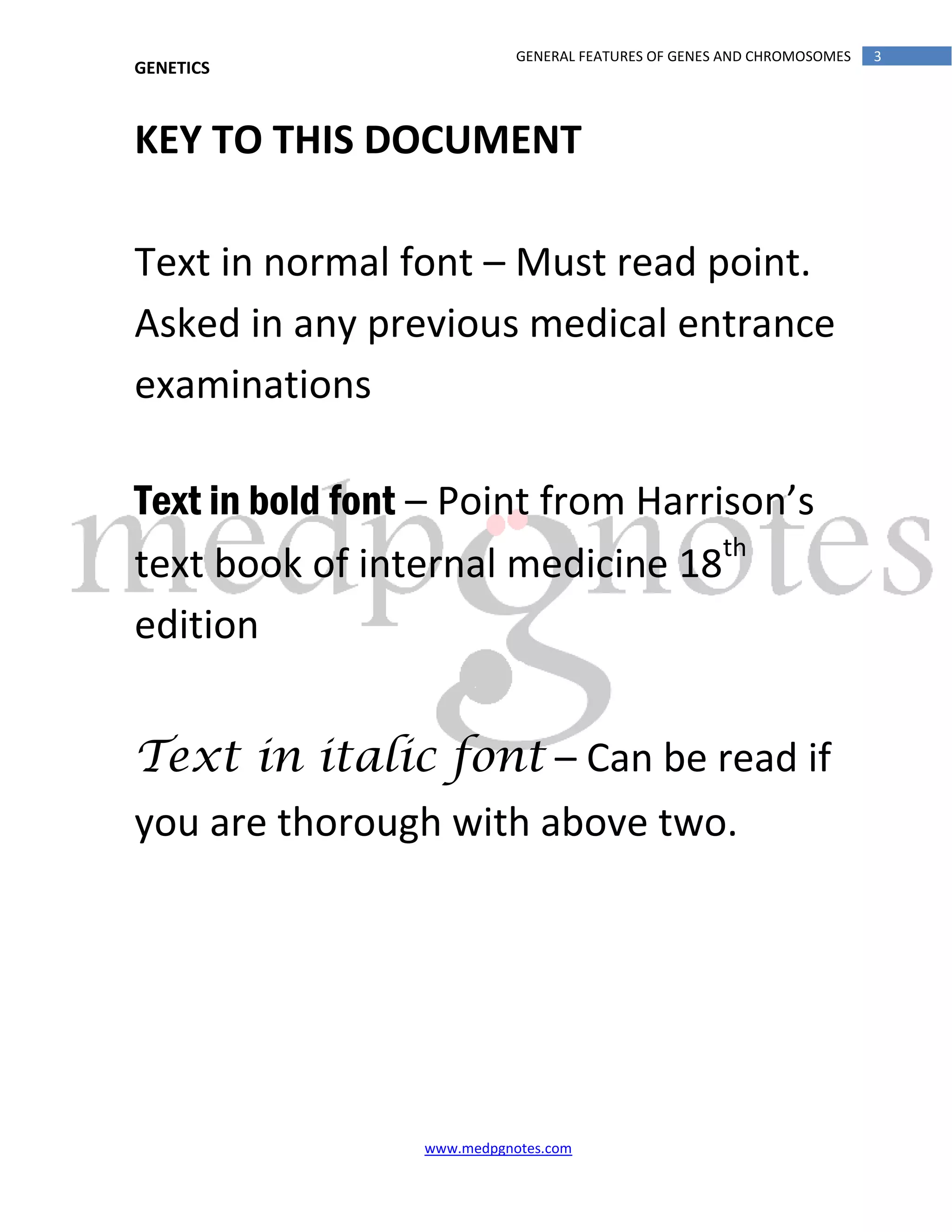
KEY TO THIS DOCUMENT
Text in normal font – Must read point.
Asked in any previous medical entrance
examinations
Text in bold font – Point from Harrison’s
text book of internal medicine 18th
edition
Text in italic font – Can be read if
you are thorough with above two.
GENETICS
www.medpgnotes.com
4GENERAL FEATURES OF GENES AND CHROMOSOMES
GENERAL FEATURES OF GENES AND CHROMOSOMES
GENERAL FEATURES OF GENETICS
Human DNA 3 million base pairs
Polymorphic microsatellite marker also known as Short tandem repeats
Human genome project is completed in May 2006
Hap map project for Single nucleotide polymorphism
Almost all single nucleotide polymorphism
have
2 alleles (biallelic)
Gene rearrangement classically occurs in Immunoglobulin gene
GENERAL FEATURES OF CHROMOSOMES
Components of chromosome DNA, histone
Long and short arms of chromosomes Q and p respectively
During mitosis, anaphase is associated
with
Separation of sister chromatids to form
chromosomes
Y chromosome Acrocentric
SRY gene located on Short arm of Y chromosome
Gene coding androgen receptors are located in Long arm on X chromosome
Acriflavin Schiff X chromosome (Feulgen reaction)
Quinacrine staining Y chromosome
Increased in Prader Willi syndrome Ghrelin
Maternal disomy of chromosome 15 is seen in Prader willi syndrome
MC mechanism of Prader Willi syndrome Trisomy rescue
Trisomy rescue is seen in Chromosome 15
Prader Willi syndrome is associated with Hypotonia, obesity
Features of Prader Willi syndrome Short stature, narrow bifrontal diameter
MC mechanism of Angelmann syndrome Monosomy rescue
If a chromosome divides in an axis perpendicular to its
usual axis of division it is going to form
Isochromosome
Transfer of genetic material in 1 meiotic division
between 2 non homologous chromosome
Translocation
Crossing over Between non sister chromatid of
homologous chromosome
Cross over Pachytene stage of prophase I of meiosis
Highly condensed chromosome in Metaphase
Pericentric inversion Involves 2 arms
Paracentric inversion Involves 1 arm only
Persons with inversion, insertion and
translocation
Phenotypically normal, increased risk of
miscarriage
Deletion is associated with Mental retardation
Telomere mutation is associated with Dyskeratosis congenital, aplastic anemia,
pulmonary and hepatic fibrosis
GENETICS
www.medpgnotes.com
5GENERAL FEATURES OF GENES AND CHROMOSOMES
Chromosomal instability syndromes Nijmegen syndrome, ICF syndrome
(Immunodeficiency, centromere
instability, facial anomalies), Robert’s
syndrome
Additional X chromosome is associated
with
Low IQ
Additional Y chromosome is associated
with
Aggressive behavior
BARR BODY
Barr body is first detected in Brain
Barr body Facultative heterochromatism
Barr body Buccar smear, saliva, hair follicle
Barr bodies are demonstrated in Neutrophils
Barr body is found in Interphase
Barr bodies are Squamous epithelial cell
Barr bodies are NOT seen in Turner syndrome
Sex can be established by examining hair root cells for Barr body
GENES
Gene is Cistron
Genes Smallest functional unit of genome, Promoter and
enhancer genes are typical example, Cistron is single
functional unit
Gene Repressor binds operator gene, Regulator genes
produce repressor subunit, IP TG is inducer but not
substrate, Regulator gene is NOT inducible
Gene whose phenotype is expressed Epistatic
NOT true about eukaryotic gene Polycistronic mRNA, Non coding Exon
Differential expression of same gene depending on
parent of origin
Genomic imprinting
Functional gene is inherited from one parent Genomic imprinting
Gene regulating normal morphogenesis during
development
Homeobox gene
Approximate number of genes in human genome 20,000 – 25,000
ALU family 5-6% of genome
Coding region Less than 1.1% of genome
Highly repetitive means More than 10^6 times
Process underlying differences in expression of a gene
according to which parent has transmitted
Anticipation
Small head, minor anomalies of face, growth delay and
developmental delay, NOT have
Polygenic syndrome
Punnet square is used to Predict genotype of offspring
Methods of fusing two cells in genetic combination Ethylene glycol, electric current, viral transformation
A person showing two cell lines derived from two Chimerism
GENETICS
www.medpgnotes.com
6CYTOGENETICS AND DNA RECOMBINANT TECHNOLOGY
different zygotes
Atavism Child resembling grandparents
DNA methylation Alters gene expression, Genetic code remains intact,
Role in carcinogenesis, Protective mechanism against
cleavage by restriction endonuclease
Single gene defect causing multiple unrelated problems Pleotropism
Inactivation of X chromosome Lyonization
ANEUPLOIDY
Primary defect in a structure Malformation
Aneuploidy due to Non disjunction at meiosis
NOT true about aneuploidy Occurrence of aneuploidy has no relation with
progression of mother age
NOT true about aneuploidy 50-60% of trisomy 18 fetus dies between 12 and 40
weeks
NOT used for detection of specific aneuploidy Microarray
Most sensitive sonological indicator for aneuploidy Nuchal transluscency
CHROMOSOMES
Chromosome 1 Steroid resistant nephrotic syndrome (NHS2 – podocin)
Chromosome 3 Clear cell renal carcinoma, VHL gene
Chromosome 4 Huntington’s chorea
Chromosome 5 APC gene
Chromosome 6 Major histocompatibility complex, HLA 6p
Chromosome 7 Cystic fibrosis
Chromosome 9 Tuberous sclerosis
Chromosome 11 Ataxia telangiectasia gene
Chromosome 12 Darrier disease
Chromosome 13 Hereditary retinoblastoma - deletion of chromosome
13q14, Wilson’s disease, BRCA 2, Friedrich’s ataxia
Chromosome 17 BRCA 1, P53
Chromosome 18 Edward’s Syndrome
Chromosome 19 Myotonic dystrophy, JAK, NPHS1 finnish type (nephrin),
Peutz Jegher syndrome
Chromosome 20 Prion disease
Chromosome 21 Down syndrome, Gene for folate carrier protein
CYTOGENETICS AND DNA RECOMBINANT TECHNOLOGY
GENERAL FEATURES OF CYTOGENETIC STUDIES
Test using oligomer with single base pair substitution RFLP
Linkage analysis Detection of characteristic DNA polymorphism in a

Genetics sample

  • 1.
  • 2.
    GENETICS www.medpgnotes.com 1GENERAL FEATURES OFGENES AND CHROMOSOMES CONTENTS GENERAL FEATURES OF GENES AND CHROMOSOMES................................................................................................. 4 GENERAL FEATURES OF GENETICS............................................................................................................................ 4 GENERAL FEATURES OF CHROMOSOMES................................................................................................................. 4 BARR BODY ............................................................................................................................................................... 5 GENES........................................................................................................................................................................ 5 ANEUPLOIDY ............................................................................................................................................................. 6 CHROMOSOMES ....................................................................................................................................................... 6 CYTOGENETICS AND DNA RECOMBINANT TECHNOLOGY............................................................................................. 6 GENERAL FEATURES OF CYTOGENETIC STUDIES....................................................................................................... 6 POLYMERASE CHAIN REACTION................................................................................................................................ 7 RESTRICTION FRAGMENT LENGTH POLYMORPHISM ............................................................................................... 7 DNA FINGERPRINTING .............................................................................................................................................. 8 FLUORESCENCE AND LUMINENCE ............................................................................................................................ 8 KARYOTYPING ........................................................................................................................................................... 9 BLOTTING.................................................................................................................................................................. 9 HYBRIDOMA TECHNOLOGY....................................................................................................................................... 9 GENETIC STUDIES.................................................................................................................................................... 10 CHROMOSOMAL STUDIES....................................................................................................................................... 10 TRANSGENIC ANIMALS ........................................................................................................................................... 10 GENE INCORPORATION........................................................................................................................................... 10 RECOMBINANT TECHNOLOGY ................................................................................................................................ 11 GENE THERAPY........................................................................................................................................................ 11 MODE OF INHERITANCE OF DISEASES ........................................................................................................................ 11 INHERITANCE OF DISEASES..................................................................................................................................... 11 FEATURES OF INHERITANCE.................................................................................................................................... 12 MITOCHONDRIAL INHERITANCE ............................................................................................................................. 13 GENETIC DISORDERS................................................................................................................................................... 13 GENERAL FEATURES OF GENETIC DISORDERS ........................................................................................................ 13 REARRANGEMENT OF TRANSCRIPTION FACTORS .................................................................................................. 14 DOWN’S SYNDROME............................................................................................................................................... 14 TRISOMY 13 ............................................................................................................................................................ 15 TRISOMY 18 ............................................................................................................................................................ 16
  • 3.
    GENETICS www.medpgnotes.com 2GENERAL FEATURES OFGENES AND CHROMOSOMES TRISOMY 22 ............................................................................................................................................................ 16 TURNER SYNDROME ............................................................................................................................................... 16 KLINEFELTER SYNDROME........................................................................................................................................ 16 NOONAN SYNDROME ............................................................................................................................................. 17 DISORDERS OF DNA REPAIR MECHANISM.............................................................................................................. 17
  • 4.
    GENETICS www.medpgnotes.com 3GENERAL FEATURES OFGENES AND CHROMOSOMES KEY TO THIS DOCUMENT Text in normal font – Must read point. Asked in any previous medical entrance examinations Text in bold font – Point from Harrison’s text book of internal medicine 18th edition Text in italic font – Can be read if you are thorough with above two.
  • 5.
    GENETICS www.medpgnotes.com 4GENERAL FEATURES OFGENES AND CHROMOSOMES GENERAL FEATURES OF GENES AND CHROMOSOMES GENERAL FEATURES OF GENETICS Human DNA 3 million base pairs Polymorphic microsatellite marker also known as Short tandem repeats Human genome project is completed in May 2006 Hap map project for Single nucleotide polymorphism Almost all single nucleotide polymorphism have 2 alleles (biallelic) Gene rearrangement classically occurs in Immunoglobulin gene GENERAL FEATURES OF CHROMOSOMES Components of chromosome DNA, histone Long and short arms of chromosomes Q and p respectively During mitosis, anaphase is associated with Separation of sister chromatids to form chromosomes Y chromosome Acrocentric SRY gene located on Short arm of Y chromosome Gene coding androgen receptors are located in Long arm on X chromosome Acriflavin Schiff X chromosome (Feulgen reaction) Quinacrine staining Y chromosome Increased in Prader Willi syndrome Ghrelin Maternal disomy of chromosome 15 is seen in Prader willi syndrome MC mechanism of Prader Willi syndrome Trisomy rescue Trisomy rescue is seen in Chromosome 15 Prader Willi syndrome is associated with Hypotonia, obesity Features of Prader Willi syndrome Short stature, narrow bifrontal diameter MC mechanism of Angelmann syndrome Monosomy rescue If a chromosome divides in an axis perpendicular to its usual axis of division it is going to form Isochromosome Transfer of genetic material in 1 meiotic division between 2 non homologous chromosome Translocation Crossing over Between non sister chromatid of homologous chromosome Cross over Pachytene stage of prophase I of meiosis Highly condensed chromosome in Metaphase Pericentric inversion Involves 2 arms Paracentric inversion Involves 1 arm only Persons with inversion, insertion and translocation Phenotypically normal, increased risk of miscarriage Deletion is associated with Mental retardation Telomere mutation is associated with Dyskeratosis congenital, aplastic anemia, pulmonary and hepatic fibrosis
  • 6.
    GENETICS www.medpgnotes.com 5GENERAL FEATURES OFGENES AND CHROMOSOMES Chromosomal instability syndromes Nijmegen syndrome, ICF syndrome (Immunodeficiency, centromere instability, facial anomalies), Robert’s syndrome Additional X chromosome is associated with Low IQ Additional Y chromosome is associated with Aggressive behavior BARR BODY Barr body is first detected in Brain Barr body Facultative heterochromatism Barr body Buccar smear, saliva, hair follicle Barr bodies are demonstrated in Neutrophils Barr body is found in Interphase Barr bodies are Squamous epithelial cell Barr bodies are NOT seen in Turner syndrome Sex can be established by examining hair root cells for Barr body GENES Gene is Cistron Genes Smallest functional unit of genome, Promoter and enhancer genes are typical example, Cistron is single functional unit Gene Repressor binds operator gene, Regulator genes produce repressor subunit, IP TG is inducer but not substrate, Regulator gene is NOT inducible Gene whose phenotype is expressed Epistatic NOT true about eukaryotic gene Polycistronic mRNA, Non coding Exon Differential expression of same gene depending on parent of origin Genomic imprinting Functional gene is inherited from one parent Genomic imprinting Gene regulating normal morphogenesis during development Homeobox gene Approximate number of genes in human genome 20,000 – 25,000 ALU family 5-6% of genome Coding region Less than 1.1% of genome Highly repetitive means More than 10^6 times Process underlying differences in expression of a gene according to which parent has transmitted Anticipation Small head, minor anomalies of face, growth delay and developmental delay, NOT have Polygenic syndrome Punnet square is used to Predict genotype of offspring Methods of fusing two cells in genetic combination Ethylene glycol, electric current, viral transformation A person showing two cell lines derived from two Chimerism
  • 7.
    GENETICS www.medpgnotes.com 6CYTOGENETICS AND DNARECOMBINANT TECHNOLOGY different zygotes Atavism Child resembling grandparents DNA methylation Alters gene expression, Genetic code remains intact, Role in carcinogenesis, Protective mechanism against cleavage by restriction endonuclease Single gene defect causing multiple unrelated problems Pleotropism Inactivation of X chromosome Lyonization ANEUPLOIDY Primary defect in a structure Malformation Aneuploidy due to Non disjunction at meiosis NOT true about aneuploidy Occurrence of aneuploidy has no relation with progression of mother age NOT true about aneuploidy 50-60% of trisomy 18 fetus dies between 12 and 40 weeks NOT used for detection of specific aneuploidy Microarray Most sensitive sonological indicator for aneuploidy Nuchal transluscency CHROMOSOMES Chromosome 1 Steroid resistant nephrotic syndrome (NHS2 – podocin) Chromosome 3 Clear cell renal carcinoma, VHL gene Chromosome 4 Huntington’s chorea Chromosome 5 APC gene Chromosome 6 Major histocompatibility complex, HLA 6p Chromosome 7 Cystic fibrosis Chromosome 9 Tuberous sclerosis Chromosome 11 Ataxia telangiectasia gene Chromosome 12 Darrier disease Chromosome 13 Hereditary retinoblastoma - deletion of chromosome 13q14, Wilson’s disease, BRCA 2, Friedrich’s ataxia Chromosome 17 BRCA 1, P53 Chromosome 18 Edward’s Syndrome Chromosome 19 Myotonic dystrophy, JAK, NPHS1 finnish type (nephrin), Peutz Jegher syndrome Chromosome 20 Prion disease Chromosome 21 Down syndrome, Gene for folate carrier protein CYTOGENETICS AND DNA RECOMBINANT TECHNOLOGY GENERAL FEATURES OF CYTOGENETIC STUDIES Test using oligomer with single base pair substitution RFLP Linkage analysis Detection of characteristic DNA polymorphism in a