Genetic Engineering
Vectors
PRESENTED BY: MANSI PATEL
RK University, Rajkot, Gujarat
The second step in molecular cloning is to join the
passenger DNA to the DNA of a suitable cloning
vehicle.
• These vehicles (or vectors) have the property that
they replicate themselves and any attached
passenger DNA so that the passenger is amplified and
can be eventually
isolated.
Plasmids
IDEAL CHARACTERISTICS OF PLASMIDS:
 Relatively Small
 Double-stranded, closed-circular DNA molecules that exist apart
from the chromosomes of their hosts
 Naturally occurring plasmids carry one or more genes
 For example, some plasmids carry genes which confer resistance
to certain antibiotics. Some plasmids may bear genes that code for
the restriction and modification enzymes that were
discussed previously
 Some may carry genes that direct the synthesis of enzymes that aid
in the production of bacterial poisons or antibiotics.
 The most important property of plasmids is that they bear a special
region of DNA called an origin of replication, or more simply an
origin.
Desirable properties of
plasmids
• It should be small (small plasmids replicate faster and
require less energy for replication than large ones.
Finally, small plasmids are easier to purify
than large ones because they are less fragile.)
• Its DNA sequence should be known
• It should grow to high copy number in the host cell.
• It should contain a selectable marker that allows cells
containing the plasmid to be isolated
• There should be a large number of unique restriction sites.
Some popular plasmids
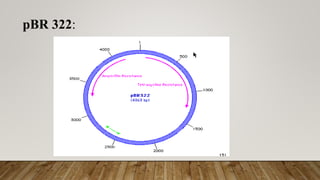
• pBR 322:
The first really useful plasmid for genetic engineering.
• The "B" stands for Bolivar and the "R" for Rodriguez,
another scientist in Boyer’s laboratory).
• It contains an ampicillin resistance gene and a tetracycline
resistance gene
• In addition it has a relaxed origin of replication
pBR 322:
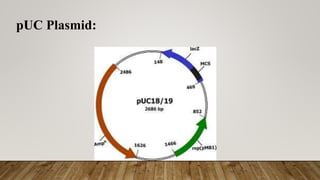
pUC Plasmid:
• About 2.7 kilobase pairs.
• These pUC (pronounced PUCK) plasmids
• Carry an ampicillin resistance gene and an origin of replication,
both from pBR322
• They also bear a multiple cloning site – a sequence of DNA that
carries many restriction sites (13, in the case of pUC18)
• Multiple cloning site of the pUC plasmids is special because it also
codes for a small peptide. This peptide will correct a specific
mutation in the chromosomal gene that codes for the enzyme beta-
galactosidase.
• Cells that harbor an active beta-galactosidase enzyme can be made
to turn blue in the presence of certain substrates.
pUC Plasmid:
Thank you

Genetic vectors

  • 1.
    Genetic Engineering Vectors PRESENTED BY:MANSI PATEL RK University, Rajkot, Gujarat
  • 2.
    The second stepin molecular cloning is to join the passenger DNA to the DNA of a suitable cloning vehicle. • These vehicles (or vectors) have the property that they replicate themselves and any attached passenger DNA so that the passenger is amplified and can be eventually isolated.
  • 3.
  • 4.
    IDEAL CHARACTERISTICS OFPLASMIDS:  Relatively Small  Double-stranded, closed-circular DNA molecules that exist apart from the chromosomes of their hosts  Naturally occurring plasmids carry one or more genes  For example, some plasmids carry genes which confer resistance to certain antibiotics. Some plasmids may bear genes that code for the restriction and modification enzymes that were discussed previously  Some may carry genes that direct the synthesis of enzymes that aid in the production of bacterial poisons or antibiotics.  The most important property of plasmids is that they bear a special region of DNA called an origin of replication, or more simply an origin.
  • 5.
    Desirable properties of plasmids •It should be small (small plasmids replicate faster and require less energy for replication than large ones. Finally, small plasmids are easier to purify than large ones because they are less fragile.) • Its DNA sequence should be known • It should grow to high copy number in the host cell. • It should contain a selectable marker that allows cells containing the plasmid to be isolated • There should be a large number of unique restriction sites.
  • 6.
    Some popular plasmids •pBR 322: The first really useful plasmid for genetic engineering. • The "B" stands for Bolivar and the "R" for Rodriguez, another scientist in Boyer’s laboratory). • It contains an ampicillin resistance gene and a tetracycline resistance gene • In addition it has a relaxed origin of replication
  • 7.
  • 8.
    pUC Plasmid: • About2.7 kilobase pairs. • These pUC (pronounced PUCK) plasmids • Carry an ampicillin resistance gene and an origin of replication, both from pBR322 • They also bear a multiple cloning site – a sequence of DNA that carries many restriction sites (13, in the case of pUC18) • Multiple cloning site of the pUC plasmids is special because it also codes for a small peptide. This peptide will correct a specific mutation in the chromosomal gene that codes for the enzyme beta- galactosidase. • Cells that harbor an active beta-galactosidase enzyme can be made to turn blue in the presence of certain substrates.
  • 9.
  • 10.