GENERAL MANAGEMENT LEADERSHIP
DICKSON MDHLALOSE
LEARNING OUTCOMES
Learning Outcomes Assessment Criteria
Discuss Managing Today • Discuss Management and its importance.
• Describe the factors that are reshaping and
redefining management today.
• Important Managerial Issues
Analyse the role of a manager as a decision maker • Discuss the types of decisions, the decision-
making process, existing conditions, and
approaches used.
• Discuss group decision-making.
• Explain the contemporary issues in decision-
making.
MANAGEMENT AND ITS IMPORTANCE
Management: is the coordination and administration of tasks to achieve a goal.
Importance:
 Establishes Equilibrium.
 Reduces Costs.
 It helps in Achieving Group Goals
 To maintain responsibility and order.
 Helps to achieve strategic goals and objectives.
 Delivering high-quality customer service
 Encouraging innovative efforts
 Using social media efficiently and effectively
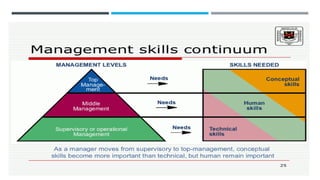
MANAGEMENT ROLES
A role is a position
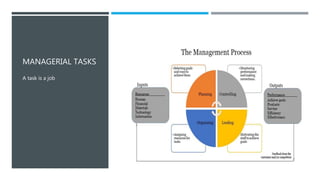
MANAGERIAL TASKS
A task is a job
SKILLS FOR GETTING AND KEEPING A JOB
BUSINESS ENVIRONMENTS
The term business environment means “the
aggregate of all the forces, factors and institutions
which are external to and beyond the control of an
individual business enterprise but which exercise a
significant influence on the functioning and growth
of individual enterprises.”
Describe the factors that are reshaping and redefining
today.
FACTORS
CONSTITUTING THE
INTERNATIONAL
BUSINESS
ENVIRONMENT
FIVE PORTER
FORCES
INTERNAL
ENVIRONMENT
 Organizational structure
 Vision, Mission and Objectives Statements
 Value System
 Organizational Culture
 Functions of a Business
 Management Tasks
 Plans and Policies
 Corporate Image
 Board of Directors
 Stake Holders
FACTORS OF
PRODUCTION
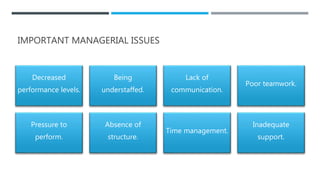
IMPORTANT MANAGERIAL ISSUES
Decreased
performance levels.
Being
understaffed.
Lack of
communication.
Poor teamwork.
Pressure to
perform.
Absence of
structure.
Time management.
Inadequate
support.
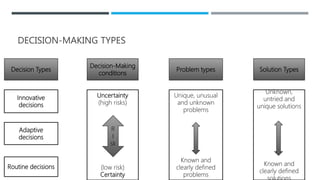
DECISION-MAKING TYPES
Decision Types
Decision-Making
conditions
Problem types Solution Types
Innovative
decisions
Adaptive
decisions
Routine decisions
Uncertainty
(high risks)
(low risk)
Certainty
Unique, unusual
and unknown
problems
Known and
clearly defined
problems
Unknown,
untried and
unique solutions
Known and
clearly defined
R
I
sk
RATIONAL DECISION-MAKING PROBLEM
Step 1
Identification of
the problem
Step 2
Identification of
Decision
Criteria
Step 3
Allocation of
Weights to
Criteria
Step 7
Implementation
of the
Alternative
Step 4
Development of
Alternatives
Step 5
Analysis of
Alternatives
Step 6
Selection of an
Alternative
Step 8
Evaluation of
Decision
Effectiveness
GROUP DECISION
Advantages of Group Decisions Disadvantages
More complete information Time-Consuming
Diversity of experiences and perspectives Minority domination
Increased acceptance of solution Ambiguous responsibility
Increased legitimacy Pressure to conform
 Group decision making, also referred to as collective or collective decision-making, is a participatory process
in which individuals participate jointly in the decision-making process.
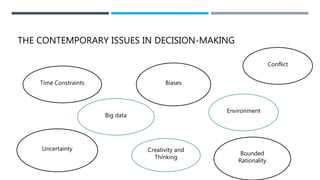
THE CONTEMPORARY ISSUES IN DECISION-MAKING
Time Constraints Biases
Conflict
Uncertainty
Bounded
Rationality
Big data
Creativity and
Thinking
Environment
General Management Chapter 1-3.pptx

General Management Chapter 1-3.pptx

  • 1.
  • 3.
    LEARNING OUTCOMES Learning OutcomesAssessment Criteria Discuss Managing Today • Discuss Management and its importance. • Describe the factors that are reshaping and redefining management today. • Important Managerial Issues Analyse the role of a manager as a decision maker • Discuss the types of decisions, the decision- making process, existing conditions, and approaches used. • Discuss group decision-making. • Explain the contemporary issues in decision- making.
  • 4.
    MANAGEMENT AND ITSIMPORTANCE Management: is the coordination and administration of tasks to achieve a goal. Importance:  Establishes Equilibrium.  Reduces Costs.  It helps in Achieving Group Goals  To maintain responsibility and order.  Helps to achieve strategic goals and objectives.  Delivering high-quality customer service  Encouraging innovative efforts  Using social media efficiently and effectively
  • 6.
  • 7.
  • 8.
    SKILLS FOR GETTINGAND KEEPING A JOB
  • 9.
    BUSINESS ENVIRONMENTS The termbusiness environment means “the aggregate of all the forces, factors and institutions which are external to and beyond the control of an individual business enterprise but which exercise a significant influence on the functioning and growth of individual enterprises.”
  • 10.
    Describe the factorsthat are reshaping and redefining today.
  • 11.
  • 12.
  • 13.
    INTERNAL ENVIRONMENT  Organizational structure Vision, Mission and Objectives Statements  Value System  Organizational Culture  Functions of a Business  Management Tasks  Plans and Policies  Corporate Image  Board of Directors  Stake Holders
  • 14.
  • 15.
    IMPORTANT MANAGERIAL ISSUES Decreased performancelevels. Being understaffed. Lack of communication. Poor teamwork. Pressure to perform. Absence of structure. Time management. Inadequate support.
  • 16.
    DECISION-MAKING TYPES Decision Types Decision-Making conditions Problemtypes Solution Types Innovative decisions Adaptive decisions Routine decisions Uncertainty (high risks) (low risk) Certainty Unique, unusual and unknown problems Known and clearly defined problems Unknown, untried and unique solutions Known and clearly defined R I sk
  • 17.
    RATIONAL DECISION-MAKING PROBLEM Step1 Identification of the problem Step 2 Identification of Decision Criteria Step 3 Allocation of Weights to Criteria Step 7 Implementation of the Alternative Step 4 Development of Alternatives Step 5 Analysis of Alternatives Step 6 Selection of an Alternative Step 8 Evaluation of Decision Effectiveness
  • 18.
    GROUP DECISION Advantages ofGroup Decisions Disadvantages More complete information Time-Consuming Diversity of experiences and perspectives Minority domination Increased acceptance of solution Ambiguous responsibility Increased legitimacy Pressure to conform  Group decision making, also referred to as collective or collective decision-making, is a participatory process in which individuals participate jointly in the decision-making process.
  • 20.
    THE CONTEMPORARY ISSUESIN DECISION-MAKING Time Constraints Biases Conflict Uncertainty Bounded Rationality Big data Creativity and Thinking Environment