

SUCCESSION PLANNING
'WHAT WOULD WE DO IF WE LOST OUR
CEO TOMORROW?'
Presented by:- Popun Patro
Deeptimayee Sahoo Guided by :- Prof. Lopamudra Dash
SUCCESSION PLANNING
A purposeful and systematic efforts made by an
organization to ensure leadership continuity, retain
and develop knowledge and intellectual capital for
the future, and encourage individual employee
growth and development.
DRIVERS FOR SUCCESSION PLANNING:-
• The interest in succession planning has grown to include an
understanding of “leadership” behaviors and core competencies that
aspiring individuals must possess.
• The key elements of the process allow organizations to address their
top talent management challenges which in turn provide a platform
for their risk management strategy.
DROPDEAD SUCCESSION PLANNING:-
A drop dead succession plan is one where an interim
successor is ready to step in case of sudden demise or
departure of a leader.
SUCCESS FACTORS FOR SUCCESSION PLANNING
• Organizations have senior leaders that believe development is a major leadership
activity and senior leaders model this activity.
• More organizational resources are dedicated to training and development.
• Organizations possess a culture that has a higher tolerance for risk allowing
emerging leaders to develop without severe penalties.
• Organizational cultures stress individual ownership for development.
• Organizations tie succession planning to other strategies that are designed to
increase organizational commitment such as diversity, employer of choice, and
corporate citizenship.
Cont…
• Core values and common leadership criteria shared and understood by employees.
• Strong commitment to promoting from within.
• Aggressive management of poor performance and behaviors that conflict with
company values.
• Compensation and other rewards are based on results and leadership behavior
including self-development.
• Best Practice organizations perceive Human Resources as a strategic business
partner.
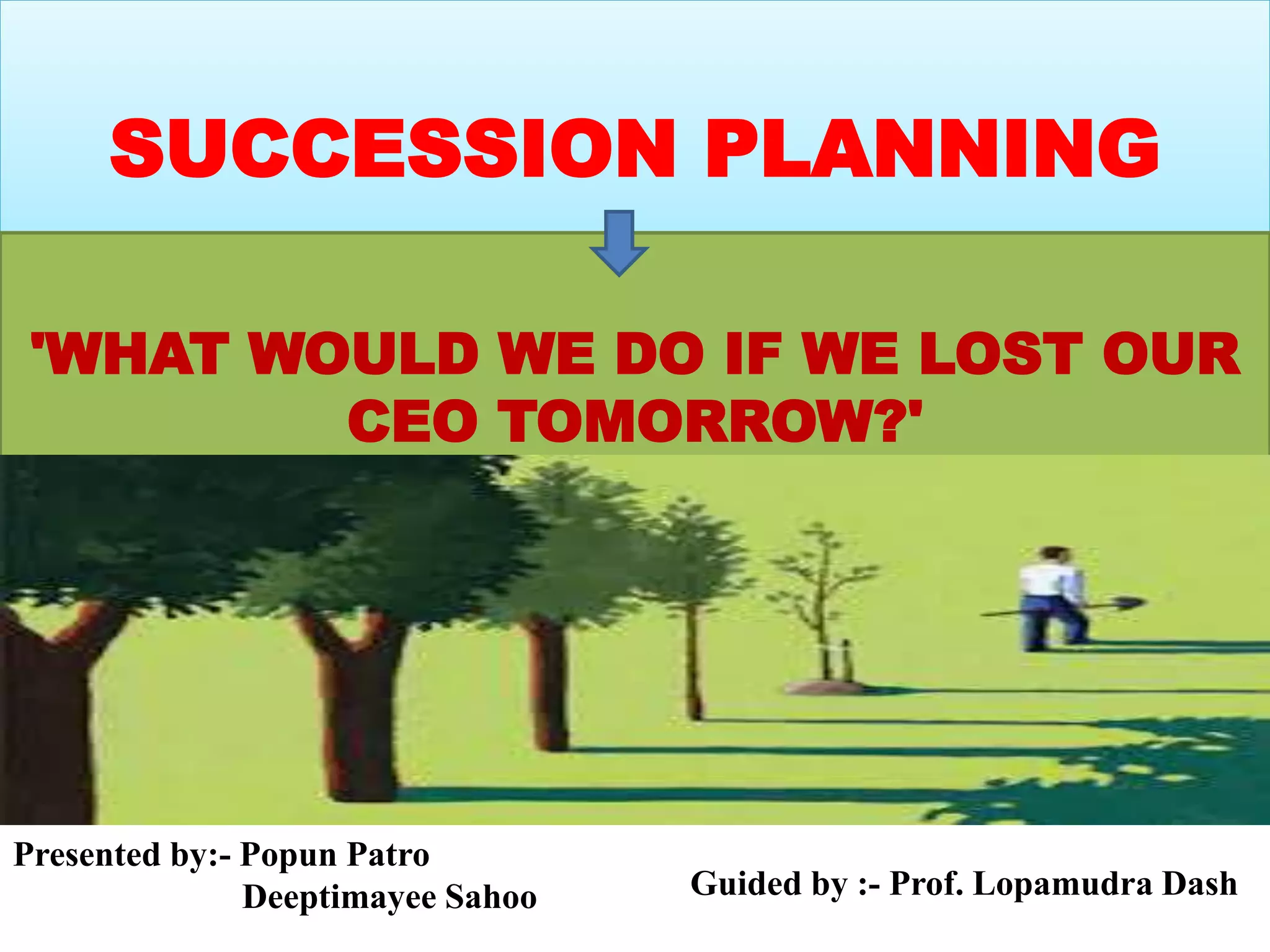
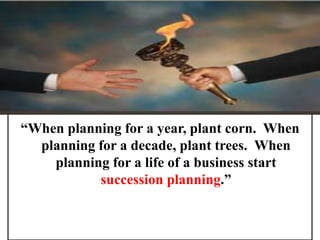
“When planning for a year, plant corn. When
planning for a decade, plant trees. When
planning for a life of a business start
succession planning.”
'What would we do if we lost our CEO
tomorrow?'
• Beyond the obvious human tragedy, Karl Slym's sudden death is a wake-up call for
India Inc on the need for a well-oiled CEO succession mechanism.
• The company's senior executive team should ask themselves, "What would we do if
we lost our CEO tomorrow?"
“A good plan today is better than a perfect plan
tomorrow.”
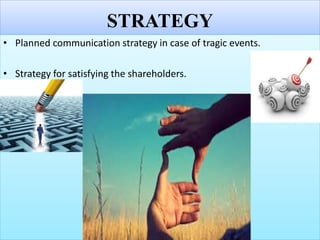
STRATEGY
• Planned communication strategy in case of tragic events.
• Strategy for satisfying the shareholders.
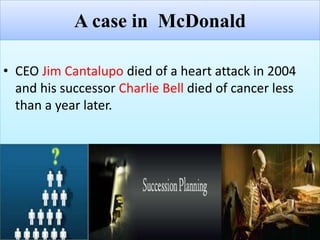
A case in McDonald
• CEO Jim Cantalupo died of a heart attack in 2004
and his successor Charlie Bell died of cancer less
than a year later.
• In the first case, less than six hours after Cantalupo's
death, McDonald's board named 43-year-old Bell, who
was the chief operating officer, for the top job.
• It was a tough decision since under Cantalupo the company
reported a surge in its profits.
• That was a big deal since Cantalupo had joined at a time
when McDonald's had reported its first quarterly loss in 38
years.
• But the transition was a smooth affair since the McDonald's
board executed a plan that was already in place.
• That strategy was followed again when Bell died of cancer, and the
chain named Jim Skinner as CEO almost immediately.
• Key planks of this strategy was communication that showed the
company was open and transparent about the situation.
• Bell, who was diagnosed with cancer just two weeks after taking
charge, communicated to employees through emails and voicemails
some details of his treatment.
• He also attended the company's annual meeting to reassure
shareholders that his battle with cancer had not hurt the company's
operations.
two months after..
• The company issued a release about management changes
and promotions, including an expansion of duties for
Skinner.
• The release, thus served as a kind of de facto announcement
of the succession plan.
Conclusion
SUCCESSION
• S :- Strategy helps to face crisis.
• U :- Utilization of talent generates profit.
• C :- Constant focus on human resource.
• C :- Communication is a grate role in business.
• E :- Emphasize upon future CEO.
• S :- Satisfaction of shareholder creates more profit.
• S :- Stable growth of business require succession planning.
• I :- Integration and fairness is the key to success in business.
• O :- Openness to all members within organization.
• N :- New trends, New strategy, New function.
Succession planning

Succession planning

  • 1.
    SUCCESSION PLANNING 'WHAT WOULDWE DO IF WE LOST OUR CEO TOMORROW?' Presented by:- Popun Patro Deeptimayee Sahoo Guided by :- Prof. Lopamudra Dash
  • 2.
    SUCCESSION PLANNING A purposefuland systematic efforts made by an organization to ensure leadership continuity, retain and develop knowledge and intellectual capital for the future, and encourage individual employee growth and development.
  • 3.
    DRIVERS FOR SUCCESSIONPLANNING:- • The interest in succession planning has grown to include an understanding of “leadership” behaviors and core competencies that aspiring individuals must possess. • The key elements of the process allow organizations to address their top talent management challenges which in turn provide a platform for their risk management strategy.
  • 4.
    DROPDEAD SUCCESSION PLANNING:- Adrop dead succession plan is one where an interim successor is ready to step in case of sudden demise or departure of a leader.
  • 5.
    SUCCESS FACTORS FORSUCCESSION PLANNING • Organizations have senior leaders that believe development is a major leadership activity and senior leaders model this activity. • More organizational resources are dedicated to training and development. • Organizations possess a culture that has a higher tolerance for risk allowing emerging leaders to develop without severe penalties. • Organizational cultures stress individual ownership for development. • Organizations tie succession planning to other strategies that are designed to increase organizational commitment such as diversity, employer of choice, and corporate citizenship.
  • 6.
    Cont… • Core valuesand common leadership criteria shared and understood by employees. • Strong commitment to promoting from within. • Aggressive management of poor performance and behaviors that conflict with company values. • Compensation and other rewards are based on results and leadership behavior including self-development. • Best Practice organizations perceive Human Resources as a strategic business partner.
  • 7.
    “When planning fora year, plant corn. When planning for a decade, plant trees. When planning for a life of a business start succession planning.”
  • 8.
    'What would wedo if we lost our CEO tomorrow?' • Beyond the obvious human tragedy, Karl Slym's sudden death is a wake-up call for India Inc on the need for a well-oiled CEO succession mechanism. • The company's senior executive team should ask themselves, "What would we do if we lost our CEO tomorrow?"
  • 9.
    “A good plantoday is better than a perfect plan tomorrow.”
  • 10.
    STRATEGY • Planned communicationstrategy in case of tragic events. • Strategy for satisfying the shareholders.
  • 11.
    A case inMcDonald • CEO Jim Cantalupo died of a heart attack in 2004 and his successor Charlie Bell died of cancer less than a year later.
  • 12.
    • In thefirst case, less than six hours after Cantalupo's death, McDonald's board named 43-year-old Bell, who was the chief operating officer, for the top job.
  • 13.
    • It wasa tough decision since under Cantalupo the company reported a surge in its profits. • That was a big deal since Cantalupo had joined at a time when McDonald's had reported its first quarterly loss in 38 years. • But the transition was a smooth affair since the McDonald's board executed a plan that was already in place.
  • 14.
    • That strategywas followed again when Bell died of cancer, and the chain named Jim Skinner as CEO almost immediately. • Key planks of this strategy was communication that showed the company was open and transparent about the situation. • Bell, who was diagnosed with cancer just two weeks after taking charge, communicated to employees through emails and voicemails some details of his treatment. • He also attended the company's annual meeting to reassure shareholders that his battle with cancer had not hurt the company's operations.
  • 15.
    two months after.. •The company issued a release about management changes and promotions, including an expansion of duties for Skinner. • The release, thus served as a kind of de facto announcement of the succession plan.
  • 16.
    Conclusion SUCCESSION • S :-Strategy helps to face crisis. • U :- Utilization of talent generates profit. • C :- Constant focus on human resource. • C :- Communication is a grate role in business. • E :- Emphasize upon future CEO. • S :- Satisfaction of shareholder creates more profit. • S :- Stable growth of business require succession planning. • I :- Integration and fairness is the key to success in business. • O :- Openness to all members within organization. • N :- New trends, New strategy, New function.