General Electric
  Corporation
2009: Jeffrey Immelt’s Challenge
2009 GE Strategy
Agenda
 1) Immelt’s Core Strategies for GE (2001-2009)
 2) Analysis
    • Ashridge Frontier
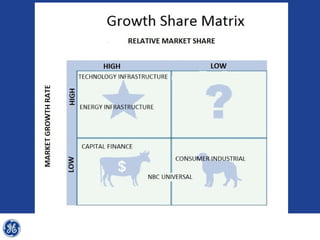
    • BCG Matrix
 3) Financial Performance
 4) Recommendations and Score
 5) Questions
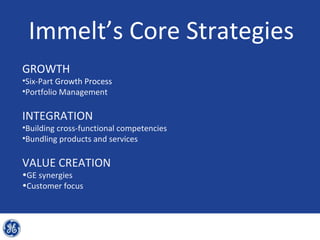
Immelt’s Core Strategies
GROWTH
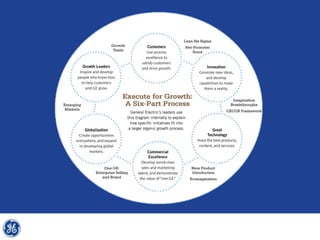
•Six-Part Growth Process
•Portfolio Management

INTEGRATION
•Building cross-functional competencies
•Bundling products and services

VALUE CREATION
•GE synergies
•Customer focus
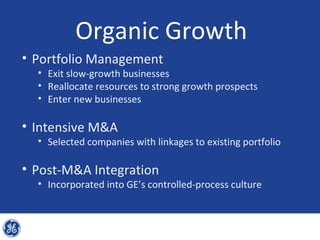
Organic Growth
• Portfolio Management
  • Exit slow-growth businesses
  • Reallocate resources to strong growth prospects
  • Enter new businesses

• Intensive M&A
  • Selected companies with linkages to existing portfolio

• Post-M&A Integration
  • Incorporated into GE’s controlled-process culture
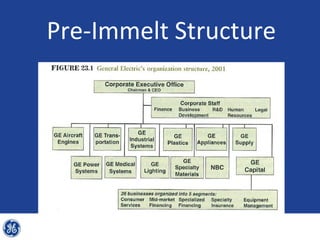
Pre-Immelt Structure
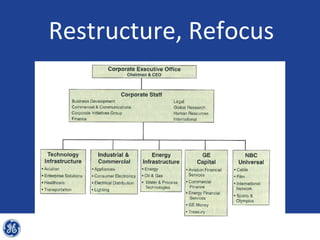
Restructure, Refocus
Integration
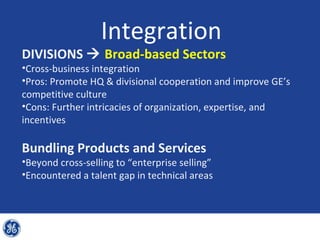
DIVISIONS  Broad-based Sectors
•Cross-business integration
•Pros: Promote HQ & divisional cooperation and improve GE’s
competitive culture
•Cons: Further intricacies of organization, expertise, and
incentives

Bundling Products and Services
•Beyond cross-selling to “enterprise selling”
•Encountered a talent gap in technical areas
Value Creation
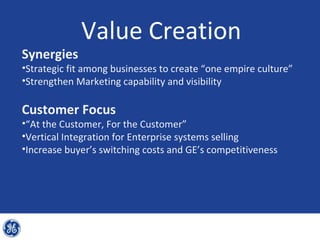
Synergies
•Strategic fit among businesses to create “one empire culture”
•Strengthen Marketing capability and visibility

Customer Focus
•“At the Customer, For the Customer”
•Vertical Integration for Enterprise systems selling
•Increase buyer’s switching costs and GE’s competitiveness
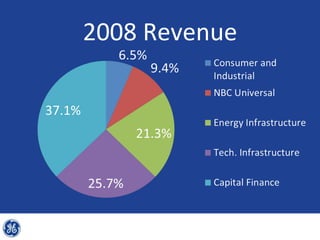
2008 Revenue
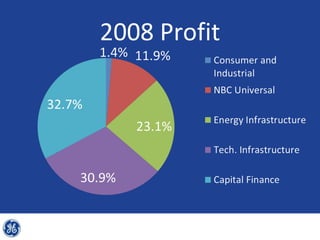
2008 Profit
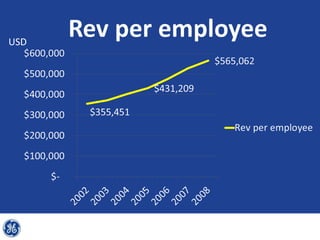
USD
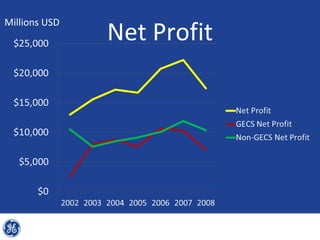
Net Profit
Millions USD
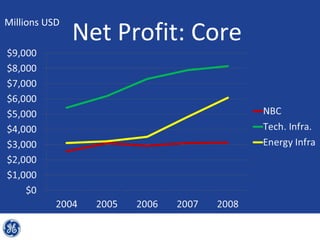
Net Profit: Core
Millions USD
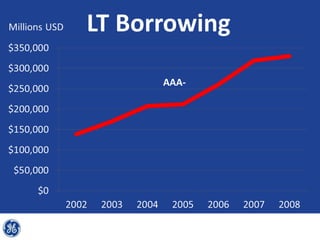
AAA-
Millions USD

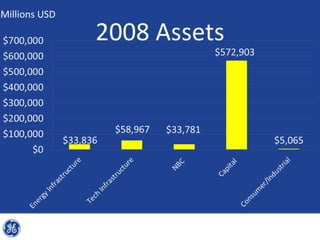
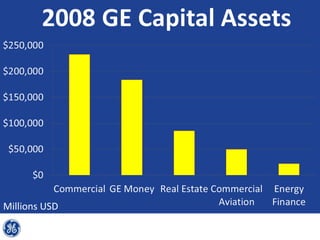
               2008 Assets
Millions USD
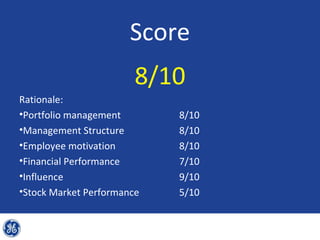
Score
                        8/10
Rationale:
•Portfolio management       8/10
•Management Structure       8/10
•Employee motivation        8/10
•Financial Performance      7/10
•Influence                  9/10
•Stock Market Performance   5/10
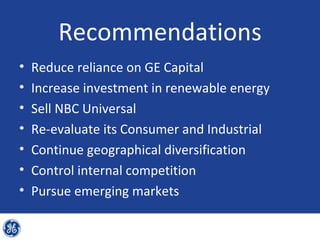
Recommendations
•   Reduce reliance on GE Capital
•   Increase investment in renewable energy
•   Sell NBC Universal
•   Re-evaluate its Consumer and Industrial
•   Continue geographical diversification
•   Control internal competition
•   Pursue emerging markets
Thank You
Appendix Section
5-Forces
Core Sectors
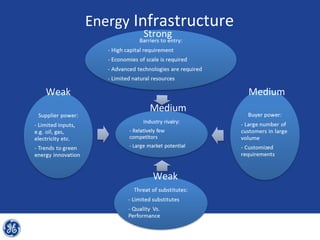
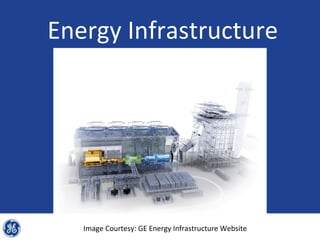
Energy Infrastructure
               Strong


Weak                           Medium
                Medium


                Weak
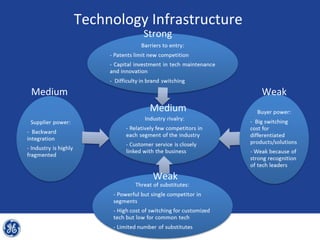
Technology Infrastructure
                   Strong


Medium                               Weak
                    Medium


                    Weak
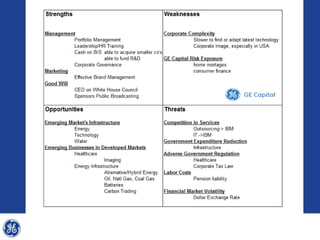
SWOT
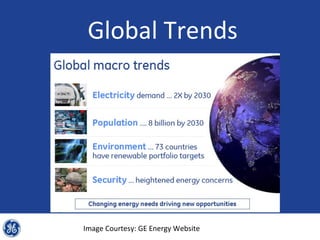
Macro Trends
Global Trends


Image Courtesy: GE Energy Website
Energy Infrastructure


   Image Courtesy: GE Energy Infrastructure Website
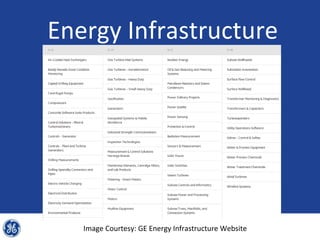
Energy Infrastructure


   Image Courtesy: GE Energy Infrastructure Website
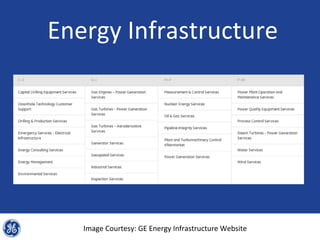
Energy Infrastructure


   Image Courtesy: GE Energy Infrastructure Website
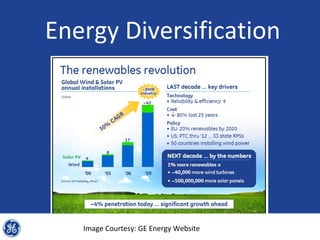
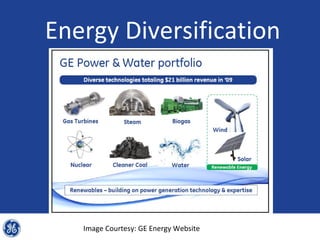
Energy Diversification


   Image Courtesy: GE Energy Website
Energy Diversification


   Image Courtesy: GE Energy Website
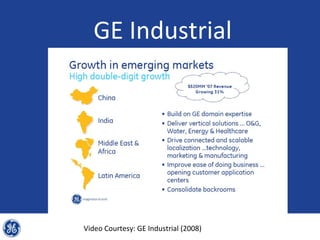
GE Industrial


Video Courtesy: GE Industrial (2008)
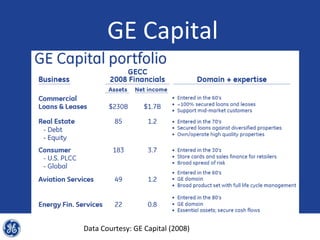
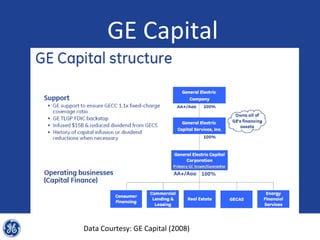
GE Capital


Data Courtesy: GE Capital (2008)
GE Capital


Data Courtesy: GE Capital (2008)
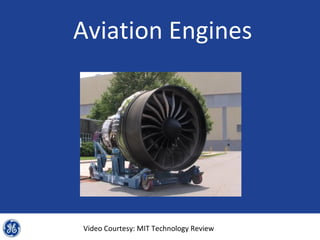
Aviation Engines


Video Courtesy: MIT Technology Review
Appendix Section
   Financials
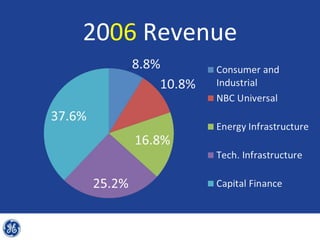
2006 Revenue
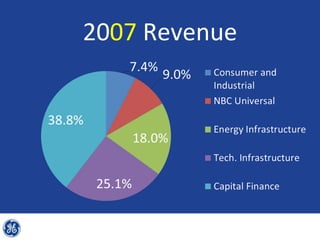
2007 Revenue
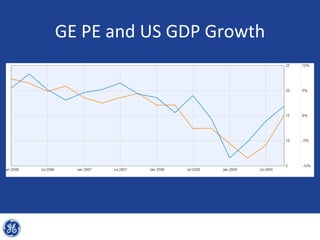
GE PE and US GDP Growth
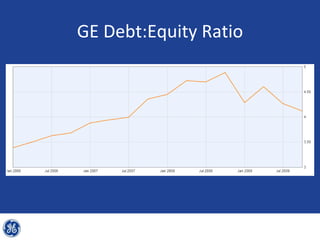
GE Debt:Equity Ratio
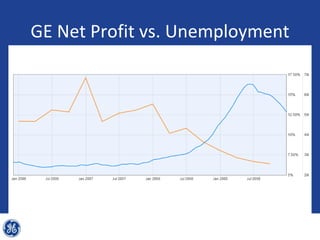
GE Net Profit vs. Unemployment
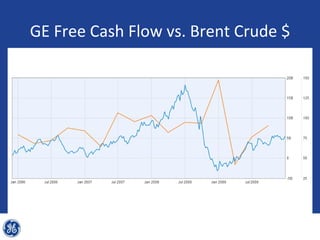
GE Free Cash Flow vs. Brent Crude $
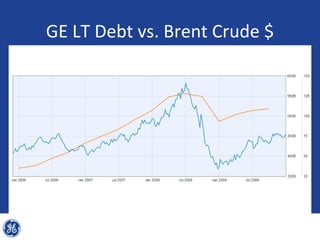
GE LT Debt vs. Brent Crude $
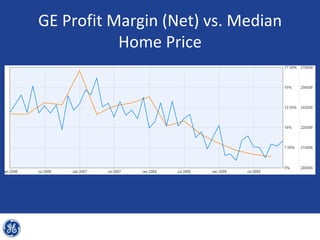
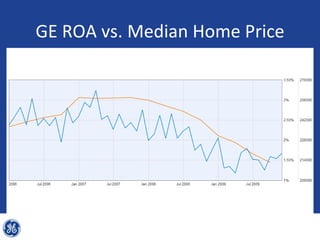
GE Profit Margin (Net) vs. Median
           Home Price
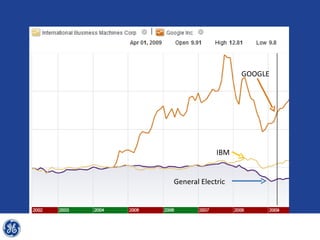
GOOGLE


             IBM


General Electric
GE ROA vs. Median Home Price
References
• http://www.wired.com/cars/futuretransport/news/2008/06/
  ecoaviation23
• http://www.ge.com/pdf/investors/events/06042008/ge_web
  cast_presentation_06042008.pdf
• http://www.ge.com/files/usa/stories/en/Growth_The_HBR_I
  nterview.pdf
• http://ycharts.com/

CS: GE Presentation

Editor's Notes

  • #2 Chi: Good Afternoon and welcome to our presentation on GE’s performance as of the 2009 Case Study. 12 Mins Font: Calbri Title Size: 60 Heading size: 36 Bullet point size: 24
  • #3 Chi: “First we’d like to describe our programme today. We will begin by describing Jeffrey Immelt’s core strategies from 2001-2009. We will provide analysis of these strategies using the Ashridge and BCG frameworks. We’ll describe GE’s financial performance including key ratios and profitability and conclude with our recommendations for GE strategy as of the case date: April 2009. Any questions from the audience can be taken upon the conclusion of our presentation.”
  • #4 Immelt differed from Welch in his focus on the customer and technology implentation to solve the customer’s problems. He was particularly interested in selling the customer a package deal of GE systems that addressed their problems, and focused the organization’s priorities externally to better understand the needs of the customer. Immelt’s strategy was to focus GE’s efforts away from its own internal structure and go out to the customer to truly gain an understanding of the market needs. When at the customer site, Immelt’s focus was to integrate the sales capabilities of different divisions to provide customers with a intelligently packaged deal: “ What we need to do is set things up so that the medical rep can bring in the lighting rep, the turbine rep and so on ” Where profitable opportunites were found, Immelt engaged in tailored M&A to gain expertise in related fields with the goal of vertically integrating products and services into an Enterprise system solution for customers. GE Industrial and GE Energy employed such an approach with GE energy for example bunding computer controlled monitoring and control systems with its renewable energy offerings such as wind turbines.
  • #5 Chi: “Note the position of the customer at the top of GE’s officially published strategy chart during Immelt’s tenure.” Source: Robert M. Grant
  • #6 “ The definition of organic growth as Immelt used it was to acquire carefully chosen companies into GE and allow them to grow within GE’s well managed and controlled-process culture. This was therefore organic in the sense that acquired businesses became integrated into GE’s processes and became capable of contributing in a cross-functional manner.”
  • #7 Chi: “During Welch’s tenure, GE had focused on lucrative businesses and simplified GE organizational structure. Immelt continued this trend, simplifying the organization into 5 divisions of energy infrastructure, technology infrastructure, Industrial and Commercial solutions, GE Capital and NBC Universal. This structure changed over Immelt’s tenure between the years of 2009.”
  • #8 Chi: “During Welch’s tenure, GE had focused on lucrative businesses and simplified GE organizational structure. Immelt continued this trend, simplifying the organization into 5 divisions of energy infrastructure, technology infrastructure, Industrial and Commercial solutions, GE Capital and NBC Universal. This structure changed over Immelt’s tenure between the years of 2009. One key characteristic of this new organizational structure is the higher level complexity required due to cross-business and cross functional coordination. ”
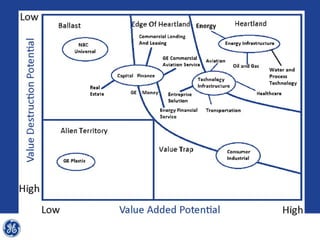
  • #11 Ashridge Frontier Map Explain how the chart works Heartland: businesses with high potential for adding value Edge of Heartland: lower potential for adding value Ballast: typical core business Alien territory:exit. No potential for value creation Value Trap: problems with management fit Explain why we chose to position each businesses as we did GE Capital Finance is the largest profit source, but is Size of the circle proportional to business size Branch missing in energy infrastructure (water and process tech)
  • #12 Ashridge Frontier Map Explain how the chart works Heartland: businesses with high potential for adding value Edge of Heartland: lower potential for adding value Ballast: typical core business Alien territory:exit. No potential for value creation Value Trap: problems with management fit Explain why we chose to position each businesses as we did GE Capital Finance is the largest profit source, but is Size of the circle proportional to business size Branch missing in energy infrastructure (water and process tech)
  • #13 Professor Carr’s favorite slide.
  • #14 Professor Carr’s favorite slide.
  • #15 Eric: The largest threat to GE is a continued recession within the banking sector. A continued recession could destabilize GE Capital, lining them up with other failing banks. We suggest that GE reduce reliance on GE capital for growth by investing in and boosting the group core competencies of energy and infrastructure while reducing the outliers of GE Capital. GE may invest and reinforce its investment in renewable energy in order to expand and develop experience in an important, related field for long-term, future profit. Regarding NBC we suggest GE to sell it as it is far from the Group’s heartland. The resources coming from this could be used to enhance still the investment in the group core business or in R&D. Finally we suggest GE re-evaluate its consumer and industrial business. This business has value creation logic the unit needs help and the parent’s strength and weakness do not fit well with the critical success factor. The business should be sold unless the parents are able to reduce the misfit.
  • #16 Eric: The largest threat to GE is a continued recession within the banking sector. A continued recession could destabilize GE Capital, lining them up with other failing banks. We suggest that GE reduce reliance on GE capital for growth by investing in and boosting the group core competencies of energy and infrastructure while reducing the outliers of GE Capital. GE may invest and reinforce its investment in renewable energy in order to expand and develop experience in an important, related field for long-term, future profit. Regarding NBC we suggest GE to sell it as it is far from the Group’s heartland. The resources coming from this could be used to enhance still the investment in the group core business or in R&D. Finally we suggest GE re-evaluate its consumer and industrial business. This business has value creation logic the unit needs help and the parent’s strength and weakness do not fit well with the critical success factor. The business should be sold unless the parents are able to reduce the misfit.
  • #17 Eric: The largest threat to GE is a continued recession within the banking sector. A continued recession could destabilize GE Capital, lining them up with other failing banks. We suggest that GE reduce reliance on GE capital for growth by investing in and boosting the group core competencies of energy and infrastructure while reducing the outliers of GE Capital. GE may invest and reinforce its investment in renewable energy in order to expand and develop experience in an important, related field for long-term, future profit. Regarding NBC we suggest GE to sell it as it is far from the Group’s heartland. The resources coming from this could be used to enhance still the investment in the group core business or in R&D. Finally we suggest GE re-evaluate its consumer and industrial business. This business has value creation logic the unit needs help and the parent’s strength and weakness do not fit well with the critical success factor. The business should be sold unless the parents are able to reduce the misfit.
  • #18 Despite the financial panic that ensued around 2008, GE’s internal ratios suggest stability and very few ratios have changed more than 20% year on year between 2007 and 2009 Nika- check D:E ratio please Constant Ratios (within rounding error) Current Ratio, Debt to Equity Ratio, Debt to Capital Interest Cover -> Decreasing year on year Inventory Turnover
  • #19 Conglomerate Figure
  • #20 Conglomerate Figure
  • #21 Conglomerate Figure
  • #22 Eric: “I’d like to remind the audience that these numbers were calculated as of the case date: April 2009.” Portfolio: adept at acquiring the right business at the right time. Good acquisition economics Management: leadership, talent allocation, team-building, M&A management Influence: Industry and Socio-Political Influence (including US Govt. Lobbying activities)
  • #23 Sell GE Capital: “We suggest that GE sell GE Capital because it is far from GE’s core business focus on energy and technology infrastructure. The resources from selling NBC Universal could be used to further enhance the investment in the group’s core businesses or R&D. “
  • #24 Eric: “I’d like to remind the audience that these numbers were calculated as of the case date: April 2009.” Portfolio: adept at acquiring the right business at the right time. Good acquisition economics Management: leadership, talent allocation, team-building, M&A management Influence: Industry and Socio-Political Influence (including US Govt. Lobbying activities)
  • #27 Nika: “We considered each of Porter’s 5 forces as either weak, medium or strong for two of GE’s core businesses: Energy and Technology infrastructure.” Porter’s 5 forces is an Industry analysis on attractiveness Put High, Medium, Low on each category Supplier power=> Limited options for power generation Substitutes for energy => Limited (Medium? Low?) Buyer Power=> (low to medium?)
  • #28 Barriers to entry: high Bargaining Power of Suppliers: medium example: Heathcare equipment contains the technology
  • #30 Eric: “This SWOT matrix was calculated based on GE’s position in 2009. Despite the financial crisis, GE was faced with longer term global “macro-trends” such as population growth (8 Billion people in 2030) Here is our assessment of GE’s Strengths, Weaknesses, Opportunities and Threats
  • #32 http://www.ge-energy.com/products_and_services/
  • #33 http://www.ge-energy.com/products_and_services/
  • #34 Products http://www.ge-energy.com/products_and_services/
  • #35 Services
  • #36 GE’s diversification strategy applies also to its energy offerings. Note that only 2 of 8 (25%) are renewable. There are trends of Windpower moving offshore due to zoning restrictions around busy city centres.
  • #37 GE’s diversification strategy applies also to its energy offerings. Note that only 2 of 8 (25%) are renewable.
  • #38 Services
  • #39 Services
  • #40 Services
  • #41 Services
  • #43 Professor Carr’s favorite slide.
  • #44 Professor Carr’s favorite slide.
  • #45 Highly correlated with US GDP growth and contraction cycles!!
  • #46 The financial crisis hit GE hard, particularly the credit crunch and ensuing evaporation of the Commercial Paper Market.
  • #48 6 month time delay between when oil peaked and when GE’s Free Cash Flow Peaked. How effected is GE by the oil price? VERY.
  • #50 GE is highly correlated to the American Economy and to the American Consumer
  • #51 Do investors believe that GE is innovative? Perhaps it depends on “compared to what?”