










Sikolohiyang
PILIPINO
is a wholly
WESTERN
PERSPECTIVE
WESTERN
   PSYCHOLOGY
   HAS ITS LIMITATIONS!
not always applicable/appropriate
 different processes & connections
     possibly artificial & distant
APPROACHresearch
guide or outline to carry out

                 METHOD
      different ways of gathering data
GUIDING
PRINCIPLES FOR
INDIGENOUS
METHODS
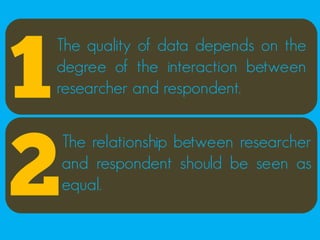
1
The quality of data depends on the
degree of the interaction between
researcher and respondent.


2
    The relationship between researcher
    and respondent should be seen as
    equal.
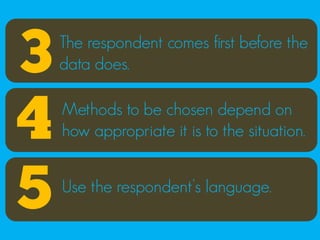
3   The respondent comes first before the
    data does.


4   Methods to be chosen depend on
    how appropriate it is to the situation.


5   Use the respondent’s language.
pakapa-kapa
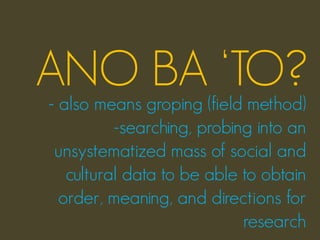
ANO BA ‘TO?
- also means groping (field method)
          -searching, probing into an
 unsystematized mass of social and
   cultural data to be able to obtain
  order, meaning, and directions for
                            research
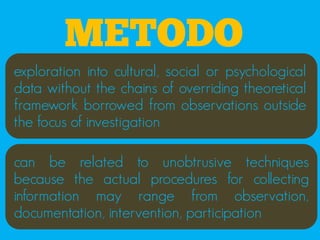
METODO
exploration into cultural, social or psychological
data without the chains of overriding theoretical
framework borrowed from observations outside
the focus of investigation

can be related to unobtrusive techniques
because the actual procedures for collecting
information may range from observation,
documentation, intervention, participation
pakikipag.
kuwentuhan
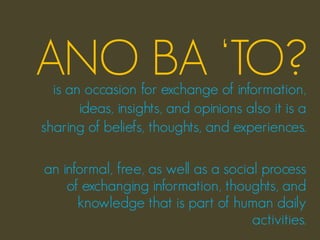
ANO BA ‘TO?
  is an occasion for exchange of information,
       ideas, insights, and opinions also it is a
sharing of beliefs, thoughts, and experiences.

an informal, free, as well as a social process
    of exchanging information, thoughts, and
      knowledge that is part of human daily
                                     activities.
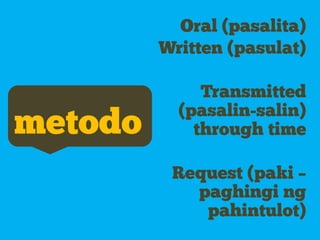
Oral (pasalita)
         Written (pasulat)

              Transmitted
           (pasalin-salin)
metodo       through time

          Request (paki –
            paghingi ng
             pahintulot)
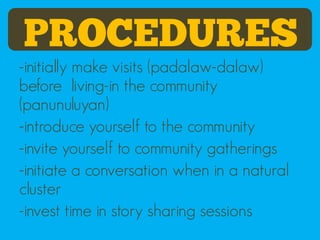
PROCEDURES
-initially make visits (padalaw-dalaw)
before living-in the community
(panunuluyan)
-introduce yourself to the community
-invite yourself to community gatherings
-initiate a conversation when in a natural
cluster
-invest time in story sharing sessions
PRINCIPLES
-may pakikipagkapwa sa kwentuhan
-may ‘paki’ ang kalahok sa kwento
-may pakinabang sa kwentuhan
--libangan
--linangan ng kaalaman
--lunas sa karamdaman
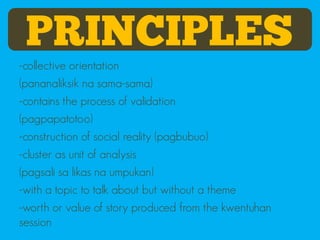
PRINCIPLES
-collective orientation
(pananaliksik na sama-sama)
-contains the process of validation
(pagpapatotoo)
-construction of social reality (pagbubuo)
-cluster as unit of analysis
(pagsali sa likas na umpukan)
-with a topic to talk about but without a theme
-worth or value of story produced from the kwentuhan
session
PRINCIPLES
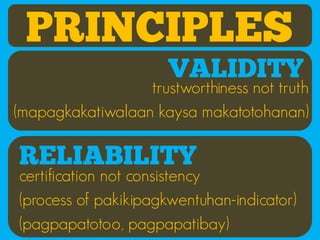
                      VALIDITY
                  trustworthiness not truth
(mapagkakatiwalaan kaysa makatotohanan)

RELIABILITY
certification not consistency
(process of pakikipagkwentuhan-indicator)
(pagpapatotoo, pagpapatibay)
PAGPAPALAYANG
   LOOB AT
PAGDADALAW
ANO BA ‘TO?
uri ng relasyon ng
 mananaliksik sa
      respondente
PAGPAPALAYANG-LOOB
• Nagpapahiwatig na ang isang tao
ay panatag sa kalooban ng kanyang
kapwa
•Wala ng pagkahiya
•Buo na ang pagtitiwala sa isa’t isa
PAGDADALAW
• Pagpunta at pakikipag-usap ng
  isang tao sa kanyang kapwa
• Hindi lahat nasasabi sa isang pag-
  uusap
PAKIKISAMA
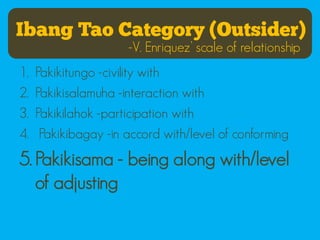
Ibang Tao Category (Outsider)
                      -V. Enriquez’ scale of relationship
1.   Pakikitungo -civility with
2.   Pakikisalamuha -interaction with
3.   Pakikilahok -participation with
4.    Pakikibagay -in accord with/level of conforming
5. Pakikisama - being along with/level
   of adjusting
PAKIKISAMA?
•originated as a Filipino value
•being united with the group
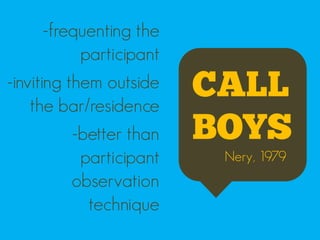
-frequenting the
            participant
-inviting them outside
    the bar/residence
                          CALL
           -better than   BOYS
            participant    Nery, 1979
           observation
             technique
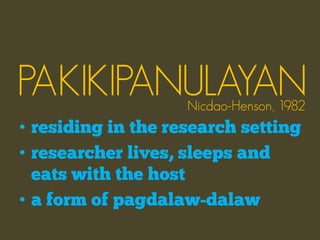
PAKIKIPANULAYAN
PAKIKIPANULAYAN     Nicdao-Henson, 1982
• residing in the research setting
• researcher lives, sleeps and
  eats with the host
• a form of pagdalaw-dalaw
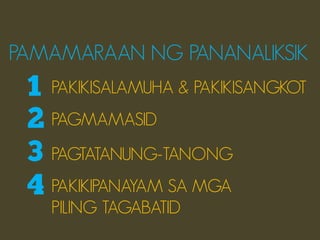
PAMAMARAAN NG PANANALIKSIK
 1 PAKIKISALAMUHA & PAKIKISANGKOT
 2 PAGMAMASID
 3 PAGTATANUNG-TANONG
 4 PAKIKIPANAYAM SA MGA
   PILING TAGABATID
OUR REFERENCES
Amaryllis T. Torres in Sikolohiyang Pilipino: Teorya, metodo, at gamit.
  Rogelia R. Pe-Pua (Ed.) (1989) UP Press.

Carmen E. Santiago (1975) in Sikolohiyang Pilipino: Teorya, metodo,
  at gamit. Rogelia R. Pe-Pua (Ed.) (1989) UP Press.

Grace O. Oteza (1997). Pakikipagkwentuhan: Isang pamamaraan
  ng sama-samang pananaliksik, pagpapatotoo, at pagtulong sa
  Sikolohiyang Pilipino. PPRTH Occasional Papers Series 1997, No.
  1.
thank you.

Sp197 report

  • 1.
  • 2.
  • 3.
    WESTERN PSYCHOLOGY HAS ITS LIMITATIONS! not always applicable/appropriate different processes & connections possibly artificial & distant
  • 4.
    APPROACHresearch guide or outlineto carry out METHOD different ways of gathering data
  • 5.
  • 6.
    1 The quality ofdata depends on the degree of the interaction between researcher and respondent. 2 The relationship between researcher and respondent should be seen as equal.
  • 7.
    3 The respondent comes first before the data does. 4 Methods to be chosen depend on how appropriate it is to the situation. 5 Use the respondent’s language.
  • 8.
  • 9.
    ANO BA ‘TO? -also means groping (field method) -searching, probing into an unsystematized mass of social and cultural data to be able to obtain order, meaning, and directions for research
  • 10.
    METODO exploration into cultural,social or psychological data without the chains of overriding theoretical framework borrowed from observations outside the focus of investigation can be related to unobtrusive techniques because the actual procedures for collecting information may range from observation, documentation, intervention, participation
  • 11.
  • 12.
    ANO BA ‘TO? is an occasion for exchange of information, ideas, insights, and opinions also it is a sharing of beliefs, thoughts, and experiences. an informal, free, as well as a social process of exchanging information, thoughts, and knowledge that is part of human daily activities.
  • 13.
    Oral (pasalita) Written (pasulat) Transmitted (pasalin-salin) metodo through time Request (paki – paghingi ng pahintulot)
  • 14.
    PROCEDURES -initially make visits(padalaw-dalaw) before living-in the community (panunuluyan) -introduce yourself to the community -invite yourself to community gatherings -initiate a conversation when in a natural cluster -invest time in story sharing sessions
  • 15.
    PRINCIPLES -may pakikipagkapwa sakwentuhan -may ‘paki’ ang kalahok sa kwento -may pakinabang sa kwentuhan --libangan --linangan ng kaalaman --lunas sa karamdaman
  • 16.
    PRINCIPLES -collective orientation (pananaliksik nasama-sama) -contains the process of validation (pagpapatotoo) -construction of social reality (pagbubuo) -cluster as unit of analysis (pagsali sa likas na umpukan) -with a topic to talk about but without a theme -worth or value of story produced from the kwentuhan session
  • 17.
    PRINCIPLES VALIDITY trustworthiness not truth (mapagkakatiwalaan kaysa makatotohanan) RELIABILITY certification not consistency (process of pakikipagkwentuhan-indicator) (pagpapatotoo, pagpapatibay)
  • 18.
    PAGPAPALAYANG LOOB AT PAGDADALAW
  • 19.
    ANO BA ‘TO? uring relasyon ng mananaliksik sa respondente
  • 20.
    PAGPAPALAYANG-LOOB • Nagpapahiwatig naang isang tao ay panatag sa kalooban ng kanyang kapwa •Wala ng pagkahiya •Buo na ang pagtitiwala sa isa’t isa
  • 21.
    PAGDADALAW • Pagpunta atpakikipag-usap ng isang tao sa kanyang kapwa • Hindi lahat nasasabi sa isang pag- uusap
  • 22.
  • 23.
    Ibang Tao Category(Outsider) -V. Enriquez’ scale of relationship 1. Pakikitungo -civility with 2. Pakikisalamuha -interaction with 3. Pakikilahok -participation with 4. Pakikibagay -in accord with/level of conforming 5. Pakikisama - being along with/level of adjusting
  • 24.
    PAKIKISAMA? •originated as aFilipino value •being united with the group
  • 25.
    -frequenting the participant -inviting them outside the bar/residence CALL -better than BOYS participant Nery, 1979 observation technique
  • 26.
  • 27.
    PAKIKIPANULAYAN Nicdao-Henson, 1982 • residing in the research setting • researcher lives, sleeps and eats with the host • a form of pagdalaw-dalaw
  • 28.
    PAMAMARAAN NG PANANALIKSIK 1 PAKIKISALAMUHA & PAKIKISANGKOT 2 PAGMAMASID 3 PAGTATANUNG-TANONG 4 PAKIKIPANAYAM SA MGA PILING TAGABATID
  • 29.
    OUR REFERENCES Amaryllis T.Torres in Sikolohiyang Pilipino: Teorya, metodo, at gamit. Rogelia R. Pe-Pua (Ed.) (1989) UP Press. Carmen E. Santiago (1975) in Sikolohiyang Pilipino: Teorya, metodo, at gamit. Rogelia R. Pe-Pua (Ed.) (1989) UP Press. Grace O. Oteza (1997). Pakikipagkwentuhan: Isang pamamaraan ng sama-samang pananaliksik, pagpapatotoo, at pagtulong sa Sikolohiyang Pilipino. PPRTH Occasional Papers Series 1997, No. 1.
  • 30.