Downloaded 404 times



![Indicators of gender parity in education include:
• The numbers of boys and girls enrolled in education and at intake in grade
one
• The numbers of boys and girls who survive up to grade 5 [and thus the
numbers that drop out]
• Regularity of attendance of boys and girls
• The numbers of girls and boys who repeat years of schooling
• The average years of schooling attained for boys and girls
• the transitions of boys and girls between levels of education [pri-school -
primary; primary-secondary; secondary-high school/vocational]
• The number of female and male teachers
• Literacy levels of boys and girls, men and women](https://image.slidesharecdn.com/genderandeducationinternationaltrendscecilieorestis-160404094611/75/Gender-and-education-5-2048.jpg)


![Other indicators to measure rights within
education:
• Family and social factors relating to the learning environment,
including teacher behaviour and influence of home variables [such as
hours of work after school].
• Social discrimination, for example, inequalities of race, caste, class,
ethnicity are all likely to deepen gendered difference between
students, and give rise to varied experiences of the learning process
for boys and girls of different social groups.
• Multiple discrimination – mostly affect girls](https://image.slidesharecdn.com/genderandeducationinternationaltrendscecilieorestis-160404094611/75/Gender-and-education-10-2048.jpg)
![Measurable Indicators:
Equal Access to Equality within*
Equality through
- enrolment
- survival
- regularity of attendance
- repetition
- the average years of
schooling attained
- the transitions of boys and
girls between levels of
education
- the number of female and
male teachers.
subject choice
Learning Outcomes
[performance in
examinations]
Teacher-learner ratio
Gender balance within the
classroom
Qualifications of teachers
Level of training of teachers
Factors shaping performance
including:
Health of students
Nutritional status
Child's involvement in family
work
Social discrimination within the
classroom/society [context-specific
indicators would be necessary]
Male/female employment
across different levels of
education by gender
Gender differentials in wages
across different levels of
employment/education
Political participation](https://image.slidesharecdn.com/genderandeducationinternationaltrendscecilieorestis-160404094611/75/Gender-and-education-11-2048.jpg)
![Measurable indicators
- enrolment
- survival
- regularity of attendance
- repetition
- the average years of
schooling attained
- the transitions of boys and
girls between levels of
education
- the number of female and
male teachers.
subject choice
Learning Outcomes
[performance in
examinations]
Teacher-learner ratio
Gender balance within the
classroom
Qualifications of teachers
Level of training of teachers
Factors shaping performance
including:
Health of students
Nutritional status
Child's involvement in family
work
Social discrimination within the
classroom/society [context-specific
indicators would be necessary]
Male/female employment
across different levels of
education by gender
Gender differentials in wages
across different levels of
employment/education
Political participation](https://image.slidesharecdn.com/genderandeducationinternationaltrendscecilieorestis-160404094611/75/Gender-and-education-12-2048.jpg)


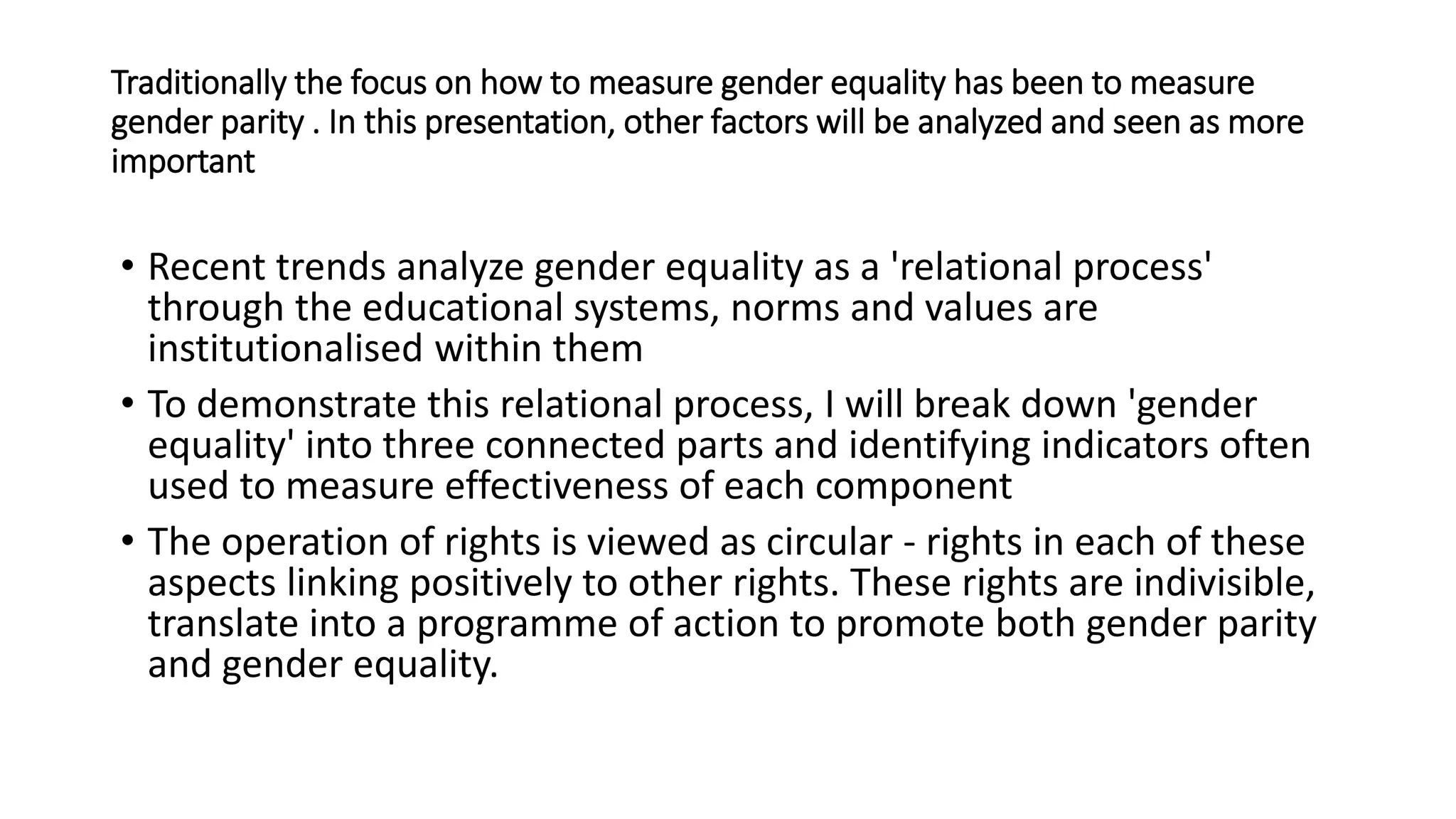
The document discusses gender equality in education from a rights-based perspective. It analyzes gender equality as a relational process with three interconnected components: rights to education, rights within education, and rights through education. Each component is associated with specific indicators that can measure effectiveness. For example, rights to education focuses on gender parity and is measured by enrollment rates. Rights within education focuses on non-discrimination and quality, measured by factors like subject choice and learning outcomes. Rights through education concerns how education promotes gender equality outside of school, measured by employment and political participation rates. Case studies from countries like Norway, Germany, Canada, and Macedonia are presented to demonstrate how these components and indicators can be applied.
![Socialization[1].ppt](https://cdn.slidesharecdn.com/ss_thumbnails/socialization1-ppt-120131084221-phpapp01-thumbnail.jpg?width=640&height=640&fit=bounds)


