BOOMIKA.S
I MSc microbiology
Reg. No: BP231517
GEL DOCUMENTATION
SYSTEM
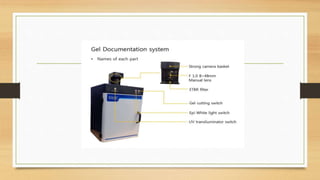
Gel Documentation System
INTRODUCTION:
 Also known as a gel documentation system, gel image system or gel imager,
 equipment widely used in molecular biology laboratories for the imaging and
documentation of nucleic acid and protein suspended within polyacrylamide or
agarose gels.
PRINCIPLE:
Gel documentation systems or gel imaging systems are widely used in molecular
biology laboratories.
Gel documentation works in the principle of fluorescence. Nuclei acids stained
with a fluorescent(Ethidium Bromide) excited by ultraviolet irradiation & emit
fluorescent light.
 used to separate DNA fragments according to their size.
 DNA samples are loaded into wells (indentations) at one end of a gel, and an
electric current is applied to pull them through the gel.
DNA fragments are negatively charged, so they move towards the positive
electrode.
PURPOSE AND ANALYSIS:
Gel doc systems, also known as 'gel docs' or 'gel imagers.
Used to record and analyse the results of gel electrophoresis and membrane
blotting experiments.
These instruments are necessary for visualizing stained or labelled nucleic acids
and proteins in media such as agarose, acrylamide, or cellulose.
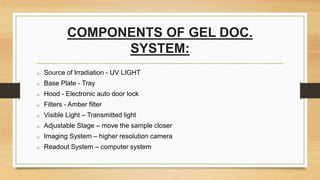
COMPONENTS OF GEL DOC.
SYSTEM:
 Source of Irradiation - UV LIGHT
 Base Plate - Tray
 Hood - Electronic auto door lock
 Filters - Amber filter
 Visible Light – Transmitted light
 Adjustable Stage – move the sample closer
 Imaging System – higher resolution camera
 Readout System – computer system
ADVANTAGES and DISADVANTAGES:
ADVANTAGES:
 Provides far depth information on the sample data.
 Wider linear dynamic range.
 Saves time and reduced cost.
 Fewer harmful chemicals.
Quantitative rather than qualitative data
DISADVANTAGES:
Save time, facilitate workflow convenience, and do not involve the use of harmful
chemicals. However, a disadvantage of gel-doc systems is that they are quite
expensive
APPLICATIONS:
 used to record and analyse the results of gel electrophoresis
 membrane blotting experiments.
 These instruments are necessary for visualizing stained or labelled nucleic acids
 proteins in media such as agarose, acrylamide, or cellulose.
GEL DOCUMENTATION SYSTEM.pptx microbial instrumentation

GEL DOCUMENTATION SYSTEM.pptx microbial instrumentation

  • 1.
    BOOMIKA.S I MSc microbiology Reg.No: BP231517 GEL DOCUMENTATION SYSTEM
  • 2.
    Gel Documentation System INTRODUCTION: Also known as a gel documentation system, gel image system or gel imager,  equipment widely used in molecular biology laboratories for the imaging and documentation of nucleic acid and protein suspended within polyacrylamide or agarose gels.
  • 3.
    PRINCIPLE: Gel documentation systemsor gel imaging systems are widely used in molecular biology laboratories. Gel documentation works in the principle of fluorescence. Nuclei acids stained with a fluorescent(Ethidium Bromide) excited by ultraviolet irradiation & emit fluorescent light.  used to separate DNA fragments according to their size.  DNA samples are loaded into wells (indentations) at one end of a gel, and an electric current is applied to pull them through the gel. DNA fragments are negatively charged, so they move towards the positive electrode.
  • 4.
    PURPOSE AND ANALYSIS: Geldoc systems, also known as 'gel docs' or 'gel imagers. Used to record and analyse the results of gel electrophoresis and membrane blotting experiments. These instruments are necessary for visualizing stained or labelled nucleic acids and proteins in media such as agarose, acrylamide, or cellulose.
  • 6.
    COMPONENTS OF GELDOC. SYSTEM:  Source of Irradiation - UV LIGHT  Base Plate - Tray  Hood - Electronic auto door lock  Filters - Amber filter  Visible Light – Transmitted light  Adjustable Stage – move the sample closer  Imaging System – higher resolution camera  Readout System – computer system
  • 7.
    ADVANTAGES and DISADVANTAGES: ADVANTAGES: Provides far depth information on the sample data.  Wider linear dynamic range.  Saves time and reduced cost.  Fewer harmful chemicals. Quantitative rather than qualitative data DISADVANTAGES: Save time, facilitate workflow convenience, and do not involve the use of harmful chemicals. However, a disadvantage of gel-doc systems is that they are quite expensive
  • 8.
    APPLICATIONS:  used torecord and analyse the results of gel electrophoresis  membrane blotting experiments.  These instruments are necessary for visualizing stained or labelled nucleic acids  proteins in media such as agarose, acrylamide, or cellulose.