Subject :rDNA Technology
Subject Code:YBT201
Topic: Microinjection
Submitted To,
Ms.P Mala
Assistant Professor
Department of
Biotechnology
Periyar maniammai
university
Submitted by,
Name: J.shifa
Reg no:123011356017
Class:1st Msc, Biotechnology
Microinjection
Contents
 Introduction to Gene Transfer
 Methods of gene transfer
 Microinjection
 Principle of Microinjection
 Procedure
 Applications
 Disadvantages
Introduction to Gene Transfer
 It is defined simply as a technique to efficiency and stably
introduce foreign genes into the genome of targeted cells.
 The insertion of unrelated ,therapeutic genetic
Information in the form of DNA into targeted cells.
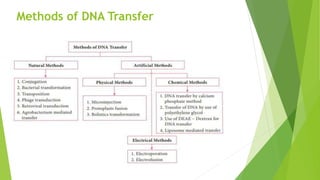
Methods of gene transfer
There are two methods of gene transfer
 Natural method of gene transfer
 Artificial method of gene transfer
Methods of DNA Transfer
Microinjection
 Microinjection is one of the physical methods of gene
transfer used to introduce DNA or other genetic materials
directly into a cell using a small glass needle
or micropipette.
 Dr. Marshall A. Barber introduced the concept
of DNA microinjection during the early 19th century. Since
then, it has continually evolved to keep up with the
advancements in biomedical fields
 This method allows efficient transfer and integration of
desired genes into the host cell’s genome
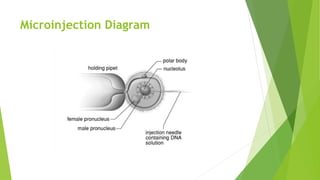
Microinjection Diagram
Principle of Microinjection
 The principle of microinjection is based on the direct delivery
of genetic material into individual cells using a fine glass needle
called a micropipette, a positioning device known as a
micromanipulator, and a microinjector.
 Nikon’s ECLIPSE Ti2 and ECLIPSE Ts2R series of inverted
microscopes, and SMZ18/25 stereo microscopes, are stable and
vibration-resistant systems that can be used for microinjection
work.
 The genetic material is delivered into the cell by applying
hydrostatic pressure to release a fluid containing the DNA
through the micropipette.
Microinjection procedure
 The delivery of foreign DNA is done under a powerful
microscope Using a glass micropipette tip of 0.5mm
diameter.
 Cells to be microinjected are placed in a container . A
holding pipette is placed in the field of view of a
microscope that sucks and holds a targeted cell at the tip.
 The tip of micropipette is injected through the membrane
of the cell to deliver the Content of the needle into the
cytoplasm and then the empty needle is taken out.
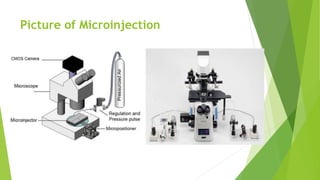
Picture of Microinjection
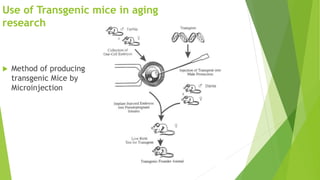
Use of Transgenic mice in aging
research
 Method of producing
transgenic Mice by
Microinjection
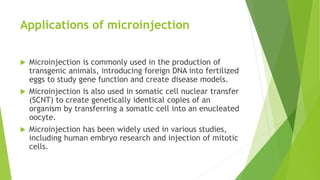
Applications of microinjection
 Microinjection is commonly used in the production of
transgenic animals, introducing foreign DNA into fertilized
eggs to study gene function and create disease models.
 Microinjection is also used in somatic cell nuclear transfer
(SCNT) to create genetically identical copies of an
organism by transferring a somatic cell into an enucleated
oocyte.
 Microinjection has been widely used in various studies,
including human embryo research and injection of mitotic
cells.
Disadvantages
 Time consuming procedure.
 Low success rate.
 Only one cell is targeted per injection
 Costly method and requires high skills.
MCQ Questions
1.Who introduced the
concept of DNA
Microinjection?
a.Dr. Marshall A. Barber
b.Robert Hook
c.Herbert Boyer
2.Microinjection is
commonly used in the
production of ________.
a.Transgenic plants
b.Transgenic Animals
c.Both
3.The genetic material is
delivered into the cell by
applying _______
2.________ is one of the
physical method of gene
transfer.
5.Microinjection is also used
in ________ to create
genetically identical copies of
an organism .
Answers
1.a
2.b
3.Hydrostatic pressure
4.Microinjection
5.Somatic cell nuclear transfer
References
 Arlan Richardson, Ahmad R. Heydari, William W. Morgan, James F.
Nelson, Z. David Sharp, Christi A. Walter, Use of Transgenic Mice in
Aging Research, ILAR Journal, Volume 38, Issue 3, 1997, Pages 124–
136,
 Blanco, J. Transgenic animals. Worcester Polytechnic Institue. 2012.
 Ghaemi, R.; Tong, J.; Gupta, B.P.; Selvaganapathy, P.R. Microfluidic
Device for Microinjection of Caenorhabditis
elegans. Micromachines 2020, 11, 295.
https://doi.org/10.3390/mi11030295
 Lee, S.; Jeong, W.; Beebe, D.J. Microfluidic valve with cored glass
microneedle for microinjection. Lab A Chip 2003, 3, 164–167.
Thank you

Recombination DNA Technology (Microinjection)

  • 1.
    Subject :rDNA Technology SubjectCode:YBT201 Topic: Microinjection Submitted To, Ms.P Mala Assistant Professor Department of Biotechnology Periyar maniammai university Submitted by, Name: J.shifa Reg no:123011356017 Class:1st Msc, Biotechnology
  • 2.
  • 3.
    Contents  Introduction toGene Transfer  Methods of gene transfer  Microinjection  Principle of Microinjection  Procedure  Applications  Disadvantages
  • 4.
    Introduction to GeneTransfer  It is defined simply as a technique to efficiency and stably introduce foreign genes into the genome of targeted cells.  The insertion of unrelated ,therapeutic genetic Information in the form of DNA into targeted cells.
  • 5.
    Methods of genetransfer There are two methods of gene transfer  Natural method of gene transfer  Artificial method of gene transfer
  • 6.
  • 7.
    Microinjection  Microinjection isone of the physical methods of gene transfer used to introduce DNA or other genetic materials directly into a cell using a small glass needle or micropipette.  Dr. Marshall A. Barber introduced the concept of DNA microinjection during the early 19th century. Since then, it has continually evolved to keep up with the advancements in biomedical fields  This method allows efficient transfer and integration of desired genes into the host cell’s genome
  • 8.
  • 9.
    Principle of Microinjection The principle of microinjection is based on the direct delivery of genetic material into individual cells using a fine glass needle called a micropipette, a positioning device known as a micromanipulator, and a microinjector.  Nikon’s ECLIPSE Ti2 and ECLIPSE Ts2R series of inverted microscopes, and SMZ18/25 stereo microscopes, are stable and vibration-resistant systems that can be used for microinjection work.  The genetic material is delivered into the cell by applying hydrostatic pressure to release a fluid containing the DNA through the micropipette.
  • 10.
    Microinjection procedure  Thedelivery of foreign DNA is done under a powerful microscope Using a glass micropipette tip of 0.5mm diameter.  Cells to be microinjected are placed in a container . A holding pipette is placed in the field of view of a microscope that sucks and holds a targeted cell at the tip.  The tip of micropipette is injected through the membrane of the cell to deliver the Content of the needle into the cytoplasm and then the empty needle is taken out.
  • 11.
  • 12.
    Use of Transgenicmice in aging research  Method of producing transgenic Mice by Microinjection
  • 13.
    Applications of microinjection Microinjection is commonly used in the production of transgenic animals, introducing foreign DNA into fertilized eggs to study gene function and create disease models.  Microinjection is also used in somatic cell nuclear transfer (SCNT) to create genetically identical copies of an organism by transferring a somatic cell into an enucleated oocyte.  Microinjection has been widely used in various studies, including human embryo research and injection of mitotic cells.
  • 14.
    Disadvantages  Time consumingprocedure.  Low success rate.  Only one cell is targeted per injection  Costly method and requires high skills.
  • 15.
    MCQ Questions 1.Who introducedthe concept of DNA Microinjection? a.Dr. Marshall A. Barber b.Robert Hook c.Herbert Boyer 2.Microinjection is commonly used in the production of ________. a.Transgenic plants b.Transgenic Animals c.Both 3.The genetic material is delivered into the cell by applying _______ 2.________ is one of the physical method of gene transfer. 5.Microinjection is also used in ________ to create genetically identical copies of an organism .
  • 16.
  • 17.
    References  Arlan Richardson,Ahmad R. Heydari, William W. Morgan, James F. Nelson, Z. David Sharp, Christi A. Walter, Use of Transgenic Mice in Aging Research, ILAR Journal, Volume 38, Issue 3, 1997, Pages 124– 136,  Blanco, J. Transgenic animals. Worcester Polytechnic Institue. 2012.  Ghaemi, R.; Tong, J.; Gupta, B.P.; Selvaganapathy, P.R. Microfluidic Device for Microinjection of Caenorhabditis elegans. Micromachines 2020, 11, 295. https://doi.org/10.3390/mi11030295  Lee, S.; Jeong, W.; Beebe, D.J. Microfluidic valve with cored glass microneedle for microinjection. Lab A Chip 2003, 3, 164–167.
  • 18.