An End-to-End Approach to
Physically Based Rendering
_
__
Wes McDermott
Community Manager – Tech Artist, Allegorithmic
_
Sam Bugden
Senior Technical Artist, Geomerics
Session: Context
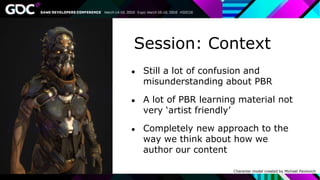
● Still a lot of confusion and
misunderstanding about PBR
● A lot of PBR learning material not
very ‘artist friendly’
● Completely new approach to the
way we think about how we
author our content
Character model created by Michael Pavlovich
High-level look into:
1. Understanding PBR
2. Authoring Workflow & Guidelines
3. Troubleshooting Physically-Based
Scenes
4. Q&A
Session: Purpose
Character model created by Michael Pavlovich
1. Understanding PBR
_
__
What is PBR?
As the name suggests, physically-based rendering (PBR) is a
method of shading & rendering, used in order to provide a
more accurate representation of the real (physics-based)
world around us.
Why bother to learn the science?
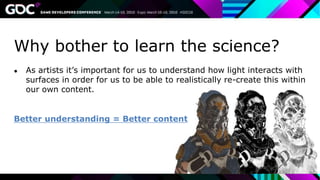
● As artists it’s important for us to understand how light interacts with
surfaces in order for us to be able to realistically re-create this within
our own content.
Better understanding = Better content
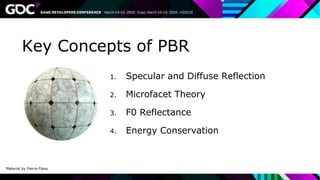
Key Concepts of PBR
1. Specular and Diffuse Reflection
2. Microfacet Theory
3. F0 Reflectance
4. Energy Conservation
Material by Pierre Fleau
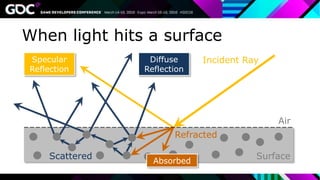
When light hits a surface
Incident RaySpecular
Reflection
Refracted
Scattered
Diffuse
Reflection
Air
Surface
Absorbed
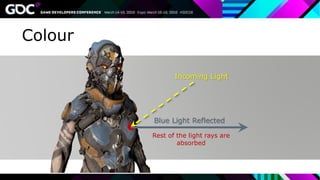
Colour
Incoming Light
Blue Light Reflected
Rest of the light rays are
absorbed
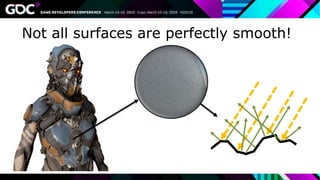
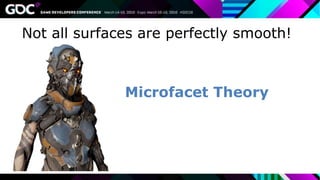
Not all surfaces are perfectly smooth!
Microfacet Theory
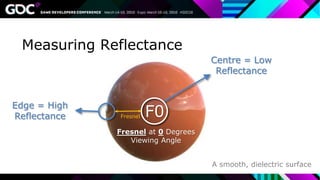
Measuring Reflectance
Edge = High
Reflectance
Centre = Low
Reflectance
F0
A smooth, dielectric surface
Fresnel
Fresnel at 0 Degrees
Viewing Angle
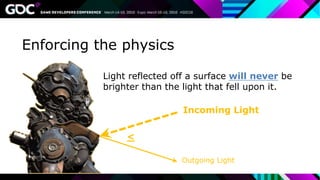
Enforcing the physics
Light reflected off a surface will never be
brighter than the light that fell upon it.
Incoming Light
Outgoing Light
<
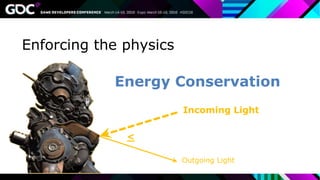
Enforcing the physics
Energy Conservation
Incoming Light
Outgoing Light
<
2. Authoring Workflow & Guidelines
_
__
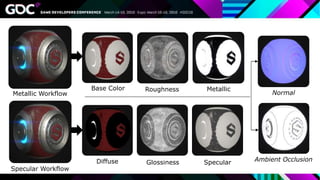
Base Color Roughness Metallic
Diffuse Glossiness Specular
Normal
Ambient Occlusion
Metallic Workflow
Specular Workflow
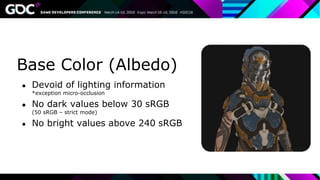
Base Color (Albedo)
● Devoid of lighting information
*exception micro-occlusion
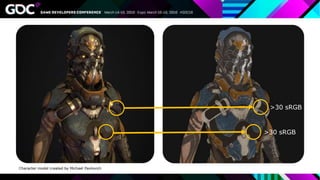
● No dark values below 30 sRGB
(50 sRGB – strict mode)
● No bright values above 240 sRGB
>30 sRGB
>30 sRGB
Character model created by Michael Pavlovich
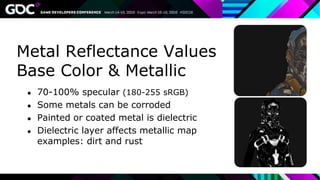
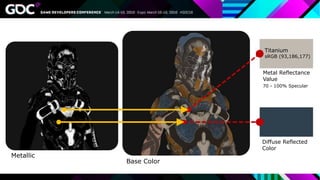
Metal Reflectance Values
Base Color & Metallic
● 70-100% specular (180-255 sRGB)
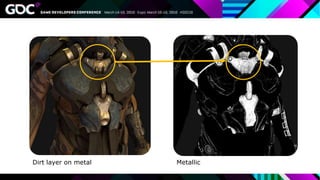
● Some metals can be corroded
● Painted or coated metal is dielectric
● Dielectric layer affects metallic map
examples: dirt and rust
Titanium
sRGB (93,186,177)
Base Color
Metallic
70 - 100% Specular
Diffuse Reflected
Color
Metal Reflectance
Value
MetallicDirt layer on metal
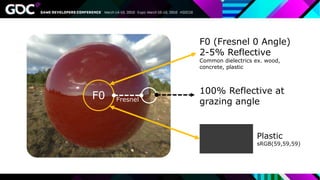
F0 (Fresnel 0 Angle)
2-5% Reflective
Common dielectrics ex. wood,
concrete, plastic
100% Reflective at
grazing angleFresnelF0
Plastic
sRGB(59,59,59)
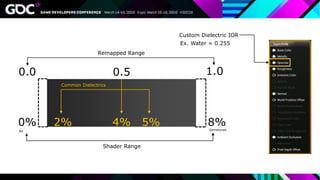
0% 8%2% 4% 5%
0.0 1.00.5
Common Dielectrics
Remapped Range
Shader Range
GemstonesAir
Custom Dielectric IOR
Ex. Water = 0.255
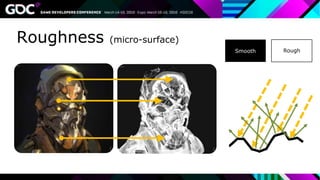
Roughness (micro-surface)
RoughSmooth
3. Troubleshooting Physically-Based Scenes
_
__
Summary
1. Understanding PBR:
● Many great benefits to using PBR, but we must
fully embrace it and its rules in order to truly get
the best out of it.
● In order for us to do this, its crucial that we
spend some time looking at the basic scientific
theories and principles which underpin PBR, as
the better our understanding is – the better our
content will become.
Character model created by Michael Pavlovich
Summary
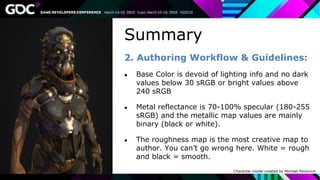
2. Authoring Workflow & Guidelines:
● Base Color is devoid of lighting info and no dark
values below 30 sRGB or bright values above
240 sRGB
● Metal reflectance is 70-100% specular (180-255
sRGB) and the metallic map values are mainly
binary (black or white).
● The roughness map is the most creative map to
author. You can’t go wrong here. White = rough
and black = smooth.
Character model created by Michael Pavlovich
Summary
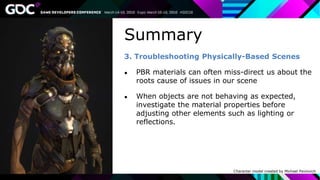
3. Troubleshooting Physically-Based Scenes
● PBR materials can often miss-direct us about the
roots cause of issues in our scene
● When objects are not behaving as expected,
investigate the material properties before
adjusting other elements such as lighting or
reflections.
Character model created by Michael Pavlovich
4. Q&A – Thanks for your time! 
_
__

GDC 2016 End-to-End Approach to Physically Based Rendering

  • 1.
    An End-to-End Approachto Physically Based Rendering _ __ Wes McDermott Community Manager – Tech Artist, Allegorithmic _ Sam Bugden Senior Technical Artist, Geomerics
  • 2.
    Session: Context ● Stilla lot of confusion and misunderstanding about PBR ● A lot of PBR learning material not very ‘artist friendly’ ● Completely new approach to the way we think about how we author our content Character model created by Michael Pavlovich
  • 3.
    High-level look into: 1.Understanding PBR 2. Authoring Workflow & Guidelines 3. Troubleshooting Physically-Based Scenes 4. Q&A Session: Purpose Character model created by Michael Pavlovich
  • 4.
  • 5.
    What is PBR? Asthe name suggests, physically-based rendering (PBR) is a method of shading & rendering, used in order to provide a more accurate representation of the real (physics-based) world around us.
  • 6.
    Why bother tolearn the science? ● As artists it’s important for us to understand how light interacts with surfaces in order for us to be able to realistically re-create this within our own content. Better understanding = Better content
  • 7.
    Key Concepts ofPBR 1. Specular and Diffuse Reflection 2. Microfacet Theory 3. F0 Reflectance 4. Energy Conservation Material by Pierre Fleau
  • 8.
    When light hitsa surface Incident RaySpecular Reflection Refracted Scattered Diffuse Reflection Air Surface Absorbed
  • 9.
    Colour Incoming Light Blue LightReflected Rest of the light rays are absorbed
  • 10.
    Not all surfacesare perfectly smooth!
  • 11.
    Not all surfacesare perfectly smooth! Microfacet Theory
  • 12.
    Measuring Reflectance Edge =High Reflectance Centre = Low Reflectance F0 A smooth, dielectric surface Fresnel Fresnel at 0 Degrees Viewing Angle
  • 13.
    Enforcing the physics Lightreflected off a surface will never be brighter than the light that fell upon it. Incoming Light Outgoing Light <
  • 14.
    Enforcing the physics EnergyConservation Incoming Light Outgoing Light <
  • 15.
    2. Authoring Workflow& Guidelines _ __
  • 16.
    Base Color RoughnessMetallic Diffuse Glossiness Specular Normal Ambient Occlusion Metallic Workflow Specular Workflow
  • 17.
    Base Color (Albedo) ●Devoid of lighting information *exception micro-occlusion ● No dark values below 30 sRGB (50 sRGB – strict mode) ● No bright values above 240 sRGB
  • 18.
    >30 sRGB >30 sRGB Charactermodel created by Michael Pavlovich
  • 19.
    Metal Reflectance Values BaseColor & Metallic ● 70-100% specular (180-255 sRGB) ● Some metals can be corroded ● Painted or coated metal is dielectric ● Dielectric layer affects metallic map examples: dirt and rust
  • 20.
    Titanium sRGB (93,186,177) Base Color Metallic 70- 100% Specular Diffuse Reflected Color Metal Reflectance Value
  • 21.
  • 22.
    F0 (Fresnel 0Angle) 2-5% Reflective Common dielectrics ex. wood, concrete, plastic 100% Reflective at grazing angleFresnelF0 Plastic sRGB(59,59,59)
  • 23.
    0% 8%2% 4%5% 0.0 1.00.5 Common Dielectrics Remapped Range Shader Range GemstonesAir Custom Dielectric IOR Ex. Water = 0.255
  • 24.
  • 25.
  • 26.
    Summary 1. Understanding PBR: ●Many great benefits to using PBR, but we must fully embrace it and its rules in order to truly get the best out of it. ● In order for us to do this, its crucial that we spend some time looking at the basic scientific theories and principles which underpin PBR, as the better our understanding is – the better our content will become. Character model created by Michael Pavlovich
  • 27.
    Summary 2. Authoring Workflow& Guidelines: ● Base Color is devoid of lighting info and no dark values below 30 sRGB or bright values above 240 sRGB ● Metal reflectance is 70-100% specular (180-255 sRGB) and the metallic map values are mainly binary (black or white). ● The roughness map is the most creative map to author. You can’t go wrong here. White = rough and black = smooth. Character model created by Michael Pavlovich
  • 28.
    Summary 3. Troubleshooting Physically-BasedScenes ● PBR materials can often miss-direct us about the roots cause of issues in our scene ● When objects are not behaving as expected, investigate the material properties before adjusting other elements such as lighting or reflections. Character model created by Michael Pavlovich
  • 29.
    4. Q&A –Thanks for your time!  _ __

Editor's Notes

  • #3 Question; how many in audience are artists and how many using or considering using PBR? Set context of talk – why are we here and why are we delivering this talk?
  • #4 Set purpose of the talk – What will we discuss? What will the audience gain? What is PBR? Basic principles and theories which underpin PBR Guidelines for creating PBR content. Practical demo with Substance Painter (Wes). What happens when we implement all this into our games? Practical demo with UE4 Finally, time for questions at the end
  • #6 A revisit to the definition of PBR with the intention of breaking down it’s actually meaning and the simplicity of it’s concept.
  • #7 Why should the audience bother or care to learn about PBR? As an artist, why is it important to grasp some of the more technical concepts and theories behind how it works?
  • #8 Unfortunately there is not enough time in this session to go into all topics of PBR or get into them at any great depth, but we’ll touch on some of the core concepts to: a) They’re not overly complex ideas b) To help try and provide a bit more background to some of the authoring stuff that Wes is going to demonstrate.
  • #9 Light which reflects off a surface is called Specular Reflection. Light which refracts into a surface and never makes it back out is Absorbed. Light which refracts into a surface, scattered around and refracted back out again is called Diffuse Reflection.
  • #10 Different wavelengths of light will get reflected, scattered and absorbed differently and this is in fact what determines an object's colour. For example, as the incoming light hits our character, only the blue wavelengths are scattered back outside of the breast plate and the others are absorbed. This is why we perceive it as blue!
  • #11 Diffuse and specular reflection is not the complete story. In reality, surfaces have lots of tiny imperfections and irregularities which dramatically affect the diffusion and reflection of light. To simulate this in PBR we use define the roughness of surfaces using a roughness map.
  • #12 This whole concept is referred to as Microfacet Theory.
  • #13 Fresnel is nothing new to us as artists and it tells us that the amount light you see reflected from a surface depends on the viewing angle at which you perceive it. With PBR this effect is handled in the shader automatically for us! :) All the shader requires is a reference point for how much light is reflected back when it hits a surface at a measurable angle (at 0 degrees) The fancy term they give this reference point is The Fresnel at 0 degree viewing angle (F0).
  • #14 One of the best benefits of PBR is material consistency regardless of lighting conditions This is achieved because we are now enforcing the laws of physics within our shading model Physics tells us that light reflected off a surface will never be brighter than the light that fell upon it
  • #15 By enforcing this law; known as Energy Conservation it: - Makes artists' lives easier - Ensures materials are more physically accurate & consistency
  • #16 Thank you for enduring my science lesson - I will now hand over to Wes to show you some way more exciting stuff about PBR authoring workflow and guidelines..
  • #19 Devoid of lighting information with the exception of micro-occlusion  Dark values should not go below 30 sRGB (tolerant range) - 50 sRGB (strict range) *exception of raw metal (black) in difffuse Bright values should not go above 240 sRGB 
  • #21 Range is high - 70-100% specular (180-255 sRGB) and some metals can be corroded Some metals absorb light at different wavelengths. Gold absorbs blue light at high-frequency end of the visible spectrum so it appears yellow as a result. Since the refracted light is absorbed, the color tint of metals come from the reflected light and thus in our maps we don’t give metals a diffuse color.
  • #22 Dirt or oxidation affects reflectance values For metal map values lower then 235 sRGB, the reflectance needs to be lowered in the base color 
  • #23 F0 range for common dielectrics 0.02 – 0.05 F0 reflectance value is what we are concerned witth. F0 for non-metals doesn’t change drastically.
  • #24 Dielectrics reflect smaller amount of light than metals Shader is mapped to a range of (0.0-0.08 linear), as zero is needed to represent air.  Metallic workflow, handled by shader, default 4% (0.04 linear) Common dielectrics around 2-5% reflective (40 – 75 sRGB) (0.02 – 0.05 linear) Can’t find an IOR, use 4% (0.04 linear) Plastic rang
  • #25 Most creative map – can’t go wrong Relates to the normal map (high freq detail) roughness (micro-surface detail)
  • #26 What I'd like to do now, is dive into UE4 and do a bit of a practical demonstration of not only what happens when we take what we’ve done and actually apply it within our game environment, but more importantly look at what happens when things inevitably go wrong – and how we might go about fixing that.
  • #27 Provide summary of first section of the session. Key takeaways for the audience.
  • #28 Provide summary of second section of the session. Key takeaways for the audience.
  • #29 Provide summary of third section of the session. Key takeaways for the audience.
  • #30 Acknowledge the audience and open for Q&A session.