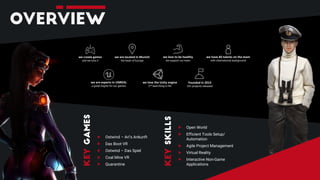
we are experts in UNREAL
a great engine for our games
we love the Unity engine
2nd best thing in life
we have 40 talents on the team
with international background
we love to be healthy
we support our team
we are located in Munich
the heart of Europe
we create games
and we love it
Founded in 2013
25+ projects released
Ostwind – Ari’s Ankunft
Das Boot VR
Ostwind – Das Spiel
Coal Mine VR
Quarantine
Open World
Efficient Tools Setup/
Automation
Agile Project Management
Virtual Reality
Interactive Non-Game
Applications
We are a rapidly growing independent developer with 42 employees and a proven track-record of delivering both internal and external IP’s from Conception through Release, and
beyond. We have specialized in development using the Unreal Engine since 2014, and have already shipped more than 12 released products of various sizes for both corporate
and entertainment applications. This has allowed us to build an efficient and state-of-the-art technology stack (including automated testing and open-world benchmarking) that
allows us to improve our overall efficiency while reducing both cost and personnel overhead.
We strongly value the importance of on-time and on-budget production and pride ourselves on our strong Project Management and External Collaboration skills. With our deep
understanding of both open-world environments and performance, as well as our automated tool-chain built around fast and efficient iterative development, we feel we are a
perfect fit for your project needs and are excited at the prospect of partnering to deliver an AAA Experience your players will love.
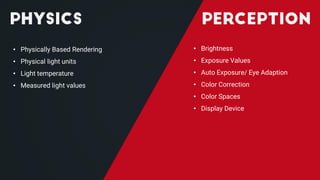
• Physically Based Rendering
• Physical light units
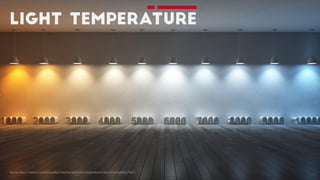
• Light temperature
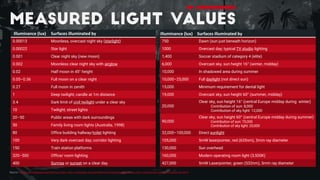
• Measured light values
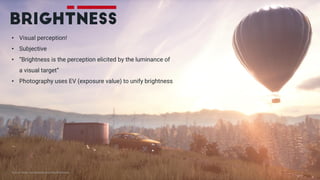
• Brightness
• Exposure Values
• Auto Exposure/ Eye Adaption
• Color Correction
• Color Spaces
• Display Device
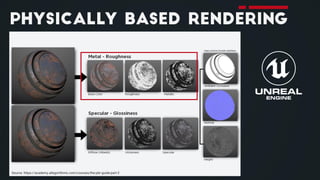
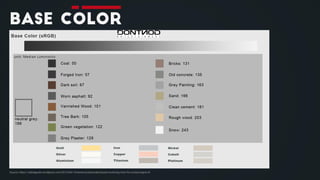
Source: https://academy.allegorithmic.com/courses/the-pbr-guide-part-2
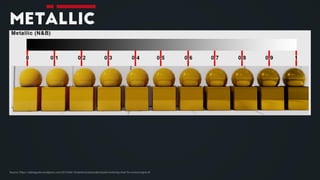
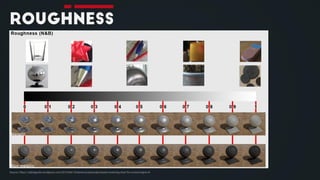
Source: https://academy.allegorithmic.com/courses/the-pbr-guide-part-2Source: https://seblagarde.wordpress.com/2014/04/14/dontnod-physically-based-rendering-chart-for-unreal-engine-4/
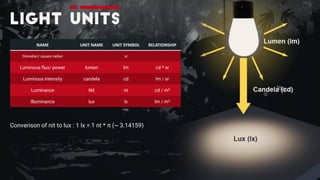
NAME UNIT NAME UNIT SYMBOL RELATIONSHIP
Steradian/ square radian sr
Luminous flux/ power lumen lm cd * sr
Luminous intensity candela cd lm / sr
Luminance Nit nt cd / m²
Illuminance lux lx lm / m²
Converison of nit to lux : 1 lx = 1 nt * π (~ 3.14159)
Source: https://medium.com/@Dropality/matching-lights-color-temperature-to-your-home-8ee80cc79474
Illuminance (lux) Surfaces illuminated by
0.00013 Moonless, overcast night sky (starlight)
0.00022 Star light
0.001 Clear night sky (new moon)
0.002 Moonless clear night sky with airglow
0.02 Half moon in 45° height
0.05–0.36 Full moon on a clear night
0.27 Full moon in zenith
1 Deep twilight; candle at 1m distance
3.4 Dark limit of civil twilight under a clear sky
10 Twilight; street lights
20–50 Public areas with dark surroundings
50 Family living room lights (Australia, 1998)
80 Office building hallway/toilet lighting
100 Very dark overcast day; corridor lighting
150 Train station platforms
320–500 Office/ room lighting
400 Sunrise or sunset on a clear day.
Source: https://en.wikipedia.org/wiki/Lux, https://de.m.wikipedia.org/wiki/Beleuchtungsstärke#Beispiele, http://stjarnhimlen.se/comp/radfaq.html#10
Illuminance (lux) Surfaces illuminated by
750 Dawn (sun just beneath horizon)
1000 Overcast day; typical TV studio lighting
1,400 Soccer stadium of category 4 (elite)
6,000 Overcast sky, sun height 16° (winter, midday)
10,000 In shadowed area during summer
10,000–25,000 Full daylight (not direct sun)
15,000 Minimum requirement for dental light
19,000 Overcast sky, sun height 60° (summer, midday)
20,000
Clear sky, sun height 16° (central Europe midday during winter)
Contribution of sun: 8,000
Contribution of sky light: 12,000
90,000
Clear sky, sun height 60° (central Europe midday during summer)
Contribution of sun: 70,000
Contribution of sky light: 20,000
32,000–100,000 Direct sunlight
105,000 5mW laserpointer, red (635nm), 3mm ray diameter
130,000 Sun overhead
160,000 Modern operating room light (3,500K)
427,000 5mW Laserpointer, green (532nm), 3mm ray diameter
Source: https://en.wikipedia.org/wiki/Brightness
• Visual perception!
• Subjective
• “Brightness is the perception elicited by the luminance of
a visual target”
• Photography uses EV (exposure value) to unify brightness
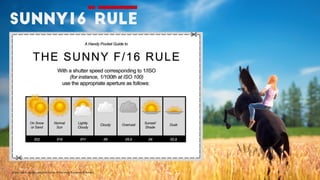
https://www.dpmag.com/how-to/tip-of-the-week/the-sunny-f16-rule/
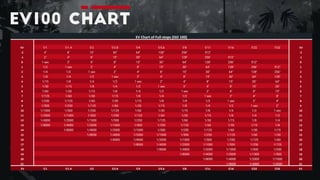
EV Chart of Full stops (ISO 100)
EV f/1 f/1.4 f/2 f/2.8 f/4 f/5.6 f/8 f/11 f/16 f/22 f/32 EV
-2 4" 8" 15" 30" 64" 128" 256" 512" -2
-1 2" 4" 8" 15" 30" 64" 128" 256" 512" -1
0 1 sec 2" 4" 8" 15" 30" 64" 128" 256" 512" 0
1 1/2 1 sec 2" 4" 8" 15" 30" 64" 128" 256" 512" 1
2 1/4 1/2 1 sec 2" 4" 8" 15" 30" 64" 128" 256" 2
3 1/8 1/4 1/2 1 sec 2" 4" 8" 15" 30" 64" 128" 3
4 1/15 1/8 1/4 1/2 1 sec 2" 4" 8" 15" 30" 64" 4
5 1/30 1/15 1/8 1/4 1/2 1 sec 2" 4" 8" 15" 30" 5
6 1/60 1/30 1/15 1/8 1/4 1/2 1 sec 2" 4" 8" 15" 6
7 1/125 1/60 1/30 1/15 1/8 1/4 1/2 1 sec 2" 4" 8" 7
8 1/250 1/125 1/60 1/30 1/15 1/8 1/4 1/2 1 sec 2" 4" 8
9 1/500 1/250 1/125 1/60 1/30 1/15 1/8 1/4 1/2 1 sec 2" 9
10 1/1000 1/500 1/250 1/125 1/60 1/30 1/15 1/8 1/4 1/2 1 sec 10
11 1/2000 1/1000 1/500 1/250 1/125 1/60 1/30 1/15 1/8 1/4 1/2 11
12 1/4000 1/2000 1/1000 1/500 1/250 1/125 1/60 1/30 1/15 1/8 1/4 12
13 1/8000 1/4000 1/2000 1/1000 1/500 1/250 1/125 1/60 1/30 1/15 1/8 13
14 1/8000 1/4000 1/2000 1/1000 1/500 1/250 1/125 1/60 1/30 1/15 14
15 1/8000 1/4000 1/2000 1/1000 1/500 1/250 1/125 1/60 1/30 15
16 1/8000 1/4000 1/2000 1/1000 1/500 1/250 1/125 1/60 16
17 1/8000 1/4000 1/2000 1/1000 1/500 1/250 1/125 17
18 1/8000 1/4000 1/2000 1/1000 1/500 1/250 18
19 1/8000 1/4000 1/2000 1/1000 1/500 19
20 1/8000 1/4000 1/2000 1/1000 20
21 1/8000 1/4000 1/2000 21
EV f/1 f/1.4 f/2 f/2.8 f/4 f/5.6 f/8 f/11 f/16 f/22 f/32 EV
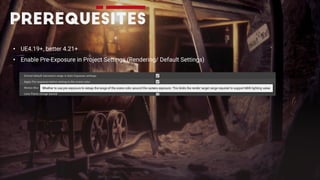
• UE4.19+, better 4.21+
• Enable Pre-Exposure in Project Settings (Rendering/ Default Settings)
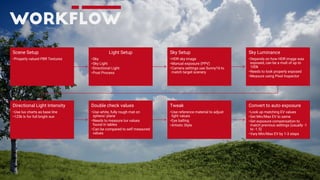
Scene Setup
•Properly valued PBR Textures
Light Setup
•Sky
•Sky Light
•Directional Light
•Post Process
Sky Setup
•HDR sky image
•Manual exposure (PPV)
•Camera settings use Sunny16 to
match target scenery
Sky Luminance
•Depends on how HDR image was
exposed, can be a mult of up to
100k
•Needs to look properly exposed
•Measure using Pixel Inspector
Directional Light Intensity
•Use lux charts as base line
•125k lx for full bright sun
Double check values
•Use white, fully rough mat on
sphere/ plane
•Needs to measure lux values
found in tables
•Can be compared to self measured
values
Tweak
•Use reference material to adjust
light values
•Eye balling
•Artistic Style
Convert to auto exposure
•Look up matching EV values
•Set Min/Max EV to same
•Set exposure compensation to
match previous settings (usually -1
to -1.5)
•Vary Min/Max EV by 1-3 steps
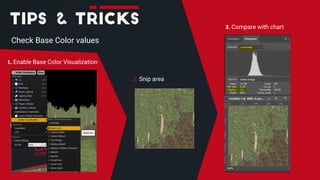
Check Base Color values
2. Snip area
1. Enable Base Color Visualization
3. Compare with chart
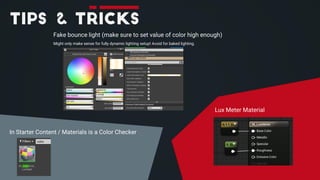
Fake bounce light (make sure to set value of color high enough)
Might only make sense for fully dynamic lighting setup! Avoid for baked lighting.
Lux Meter Material
In Starter Content / Materials is a Color Checker
Measure LUX values on your own
using a LUX meter!
Use Eye Adaption node in materials to compensate for auto exposure
(contains value auto exposure is outputting roughly between 0 [dark] – 64+ [very bright])
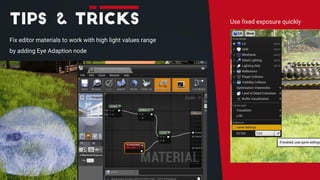
Fix editor materials to work with high light values range
by adding Eye Adaption node
Use fixed exposure quickly
Source: https://academy.allegorithmic.com/courses/the-pbr-guide-part-2
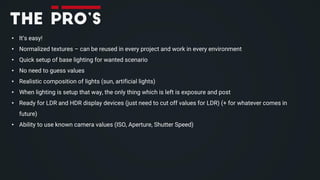
• It‘s easy!
• Normalized textures – can be reused in every project and work in every environment
• Quick setup of base lighting for wanted scenario
• No need to guess values
• Realistic composition of lights (sun, artificial lights)
• When lighting is setup that way, the only thing which is left is exposure and post
• Ready for LDR and HDR display devices (just need to cut off values for LDR) (+ for whatever comes in
future)
• Ability to use known camera values (ISO, Aperture, Shutter Speed)
Source: https://academy.allegorithmic.com/courses/the-pbr-guide-part-2
• Need for newest engine version
• Some engine materials won‘t render correctly (e.g. Landscape brush) if not fixed manually or in a later
release
• Planar reflections blow out when pre-exposure is enabled
• It‘s a team effort – everyone should understand how it works to not break it
l.lang@aesir-interactive.com
Talk to me or apply via
aesir-interactive.com/jobs
PARTNER OF THE REMOTE CONTROL FAMILY
Source: https://academy.allegorithmic.com/courses/the-pbr-guide-part-2
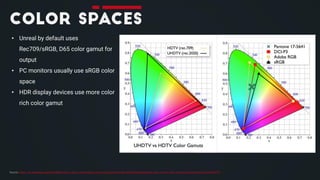
• Unreal by default uses
Rec709/sRGB, D65 color gamut for
output
• PC monitors usually use sRGB color
space
• HDR display devices use more color
rich color gamut
Source: https://en.wikipedia.org/wiki/SRGB, https://docs.unrealengine.com/en-us/Engine/Rendering/HDRDisplayOutput, https://www.flickr.com/photos/jeanrouck/13262569773
Source: https://en.m.wikipedia.org/wiki/Exposure_value#EV_as_a_measure_of_luminance_and_illuminance
Lighting condition EV100
Daylight
Light sand or snow in full or slightly hazy
sunlight (distinct shadows)
16
Typical scene in full or slightly hazy sunlight
(distinct shadows)
15
Typical scene in hazy sunlight (soft
shadows)
14
Typical scene, cloudy bright (no shadows) 13
Typical scene, heavy overcast 12
Areas in open shade, clear sunlight 12
Outdoor, natural light
Rainbows
Clear sky background 15
Cloudy sky background 14
Sunsets and skylines
Just before sunset 12–14
At sunset 12
Just after sunset 9–11
The Moon altitude > 40°
Full 15
Gibbous 14
Quarter 13
Crescent 12
Blood 0 to 3[6]
Moonlight, Moon altitude > 40°
Full −3 to −2
Gibbous −4
Quarter −6
Aurora borealis and australis
Bright −4 to −3
Medium −6 to −5
Milky Way galactic center −11 to −9
Lighting condition EV100
Outdoor, artificial light
Neon and other bright signs 9–10
Night sports 9
Fires and burning buildings 9
Bright street scenes 8
Night street scenes and window displays 7–8
Night vehicle traffic 5
Fairs and amusement parks 7
Christmas tree lights 4–5
Floodlit buildings, monuments, and fountains 3–5
Distant views of lighted buildings 2
Indoor, artificial light
Galleries 8–11
Sports events, stage shows, and the like 8–9
Circuses, floodlit 8
Ice shows, floodlit 9
Offices and work areas 7–8
Home interiors 5–7
Christmas tree lights 4–5
Can be directly used for auto exposure or mapped using EV100 chart
Source: https://en.m.wikipedia.org/wiki/Exposure_value#EV_as_a_measure_of_luminance_and_illuminance
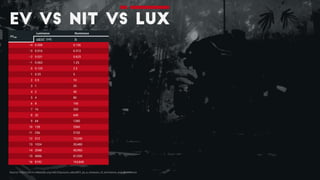
EV100
Luminance Illuminance
cd/m2 (nit) lx
−4 0.008 0.156
−3 0.016 0.313
−2 0.031 0.625
−1 0.063 1.25
0 0.125 2.5
1 0.25 5
2 0.5 10
3 1 20
4 2 40
5 4 80
6 8 160
7 16 320
8 32 640
9 64 1280
10 128 2560
11 256 5120
12 512 10,240
13 1024 20,480
14 2048 40,960
15 4096 81,920
16 8192 163,840
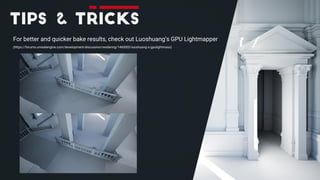
For better and quicker bake results, check out Luoshuang‘s GPU Lightmapper
(https://forums.unrealengine.com/development-discussion/rendering/1460002-luoshuang-s-gpulightmass)

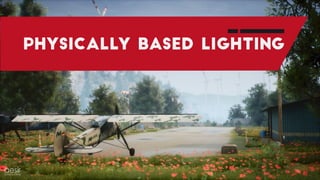
Physically Based Lighting in Unreal Engine 4

  • 2.
    we are expertsin UNREAL a great engine for our games we love the Unity engine 2nd best thing in life we have 40 talents on the team with international background we love to be healthy we support our team we are located in Munich the heart of Europe we create games and we love it Founded in 2013 25+ projects released Ostwind – Ari’s Ankunft Das Boot VR Ostwind – Das Spiel Coal Mine VR Quarantine Open World Efficient Tools Setup/ Automation Agile Project Management Virtual Reality Interactive Non-Game Applications
  • 3.
    We are arapidly growing independent developer with 42 employees and a proven track-record of delivering both internal and external IP’s from Conception through Release, and beyond. We have specialized in development using the Unreal Engine since 2014, and have already shipped more than 12 released products of various sizes for both corporate and entertainment applications. This has allowed us to build an efficient and state-of-the-art technology stack (including automated testing and open-world benchmarking) that allows us to improve our overall efficiency while reducing both cost and personnel overhead. We strongly value the importance of on-time and on-budget production and pride ourselves on our strong Project Management and External Collaboration skills. With our deep understanding of both open-world environments and performance, as well as our automated tool-chain built around fast and efficient iterative development, we feel we are a perfect fit for your project needs and are excited at the prospect of partnering to deliver an AAA Experience your players will love.
  • 5.
    • Physically BasedRendering • Physical light units • Light temperature • Measured light values • Brightness • Exposure Values • Auto Exposure/ Eye Adaption • Color Correction • Color Spaces • Display Device
  • 6.
  • 7.
  • 8.
  • 9.
  • 10.
    NAME UNIT NAMEUNIT SYMBOL RELATIONSHIP Steradian/ square radian sr Luminous flux/ power lumen lm cd * sr Luminous intensity candela cd lm / sr Luminance Nit nt cd / m² Illuminance lux lx lm / m² Converison of nit to lux : 1 lx = 1 nt * π (~ 3.14159)
  • 11.
  • 12.
    Illuminance (lux) Surfacesilluminated by 0.00013 Moonless, overcast night sky (starlight) 0.00022 Star light 0.001 Clear night sky (new moon) 0.002 Moonless clear night sky with airglow 0.02 Half moon in 45° height 0.05–0.36 Full moon on a clear night 0.27 Full moon in zenith 1 Deep twilight; candle at 1m distance 3.4 Dark limit of civil twilight under a clear sky 10 Twilight; street lights 20–50 Public areas with dark surroundings 50 Family living room lights (Australia, 1998) 80 Office building hallway/toilet lighting 100 Very dark overcast day; corridor lighting 150 Train station platforms 320–500 Office/ room lighting 400 Sunrise or sunset on a clear day. Source: https://en.wikipedia.org/wiki/Lux, https://de.m.wikipedia.org/wiki/Beleuchtungsstärke#Beispiele, http://stjarnhimlen.se/comp/radfaq.html#10 Illuminance (lux) Surfaces illuminated by 750 Dawn (sun just beneath horizon) 1000 Overcast day; typical TV studio lighting 1,400 Soccer stadium of category 4 (elite) 6,000 Overcast sky, sun height 16° (winter, midday) 10,000 In shadowed area during summer 10,000–25,000 Full daylight (not direct sun) 15,000 Minimum requirement for dental light 19,000 Overcast sky, sun height 60° (summer, midday) 20,000 Clear sky, sun height 16° (central Europe midday during winter) Contribution of sun: 8,000 Contribution of sky light: 12,000 90,000 Clear sky, sun height 60° (central Europe midday during summer) Contribution of sun: 70,000 Contribution of sky light: 20,000 32,000–100,000 Direct sunlight 105,000 5mW laserpointer, red (635nm), 3mm ray diameter 130,000 Sun overhead 160,000 Modern operating room light (3,500K) 427,000 5mW Laserpointer, green (532nm), 3mm ray diameter
  • 13.
    Source: https://en.wikipedia.org/wiki/Brightness • Visualperception! • Subjective • “Brightness is the perception elicited by the luminance of a visual target” • Photography uses EV (exposure value) to unify brightness
  • 14.
  • 15.
    EV Chart ofFull stops (ISO 100) EV f/1 f/1.4 f/2 f/2.8 f/4 f/5.6 f/8 f/11 f/16 f/22 f/32 EV -2 4" 8" 15" 30" 64" 128" 256" 512" -2 -1 2" 4" 8" 15" 30" 64" 128" 256" 512" -1 0 1 sec 2" 4" 8" 15" 30" 64" 128" 256" 512" 0 1 1/2 1 sec 2" 4" 8" 15" 30" 64" 128" 256" 512" 1 2 1/4 1/2 1 sec 2" 4" 8" 15" 30" 64" 128" 256" 2 3 1/8 1/4 1/2 1 sec 2" 4" 8" 15" 30" 64" 128" 3 4 1/15 1/8 1/4 1/2 1 sec 2" 4" 8" 15" 30" 64" 4 5 1/30 1/15 1/8 1/4 1/2 1 sec 2" 4" 8" 15" 30" 5 6 1/60 1/30 1/15 1/8 1/4 1/2 1 sec 2" 4" 8" 15" 6 7 1/125 1/60 1/30 1/15 1/8 1/4 1/2 1 sec 2" 4" 8" 7 8 1/250 1/125 1/60 1/30 1/15 1/8 1/4 1/2 1 sec 2" 4" 8 9 1/500 1/250 1/125 1/60 1/30 1/15 1/8 1/4 1/2 1 sec 2" 9 10 1/1000 1/500 1/250 1/125 1/60 1/30 1/15 1/8 1/4 1/2 1 sec 10 11 1/2000 1/1000 1/500 1/250 1/125 1/60 1/30 1/15 1/8 1/4 1/2 11 12 1/4000 1/2000 1/1000 1/500 1/250 1/125 1/60 1/30 1/15 1/8 1/4 12 13 1/8000 1/4000 1/2000 1/1000 1/500 1/250 1/125 1/60 1/30 1/15 1/8 13 14 1/8000 1/4000 1/2000 1/1000 1/500 1/250 1/125 1/60 1/30 1/15 14 15 1/8000 1/4000 1/2000 1/1000 1/500 1/250 1/125 1/60 1/30 15 16 1/8000 1/4000 1/2000 1/1000 1/500 1/250 1/125 1/60 16 17 1/8000 1/4000 1/2000 1/1000 1/500 1/250 1/125 17 18 1/8000 1/4000 1/2000 1/1000 1/500 1/250 18 19 1/8000 1/4000 1/2000 1/1000 1/500 19 20 1/8000 1/4000 1/2000 1/1000 20 21 1/8000 1/4000 1/2000 21 EV f/1 f/1.4 f/2 f/2.8 f/4 f/5.6 f/8 f/11 f/16 f/22 f/32 EV
  • 17.
    • UE4.19+, better4.21+ • Enable Pre-Exposure in Project Settings (Rendering/ Default Settings)
  • 18.
    Scene Setup •Properly valuedPBR Textures Light Setup •Sky •Sky Light •Directional Light •Post Process Sky Setup •HDR sky image •Manual exposure (PPV) •Camera settings use Sunny16 to match target scenery Sky Luminance •Depends on how HDR image was exposed, can be a mult of up to 100k •Needs to look properly exposed •Measure using Pixel Inspector Directional Light Intensity •Use lux charts as base line •125k lx for full bright sun Double check values •Use white, fully rough mat on sphere/ plane •Needs to measure lux values found in tables •Can be compared to self measured values Tweak •Use reference material to adjust light values •Eye balling •Artistic Style Convert to auto exposure •Look up matching EV values •Set Min/Max EV to same •Set exposure compensation to match previous settings (usually -1 to -1.5) •Vary Min/Max EV by 1-3 steps
  • 19.
    Check Base Colorvalues 2. Snip area 1. Enable Base Color Visualization 3. Compare with chart
  • 20.
    Fake bounce light(make sure to set value of color high enough) Might only make sense for fully dynamic lighting setup! Avoid for baked lighting. Lux Meter Material In Starter Content / Materials is a Color Checker
  • 21.
    Measure LUX valueson your own using a LUX meter! Use Eye Adaption node in materials to compensate for auto exposure (contains value auto exposure is outputting roughly between 0 [dark] – 64+ [very bright])
  • 22.
    Fix editor materialsto work with high light values range by adding Eye Adaption node Use fixed exposure quickly
  • 24.
    Source: https://academy.allegorithmic.com/courses/the-pbr-guide-part-2 • It‘seasy! • Normalized textures – can be reused in every project and work in every environment • Quick setup of base lighting for wanted scenario • No need to guess values • Realistic composition of lights (sun, artificial lights) • When lighting is setup that way, the only thing which is left is exposure and post • Ready for LDR and HDR display devices (just need to cut off values for LDR) (+ for whatever comes in future) • Ability to use known camera values (ISO, Aperture, Shutter Speed)
  • 25.
    Source: https://academy.allegorithmic.com/courses/the-pbr-guide-part-2 • Needfor newest engine version • Some engine materials won‘t render correctly (e.g. Landscape brush) if not fixed manually or in a later release • Planar reflections blow out when pre-exposure is enabled • It‘s a team effort – everyone should understand how it works to not break it
  • 26.
    l.lang@aesir-interactive.com Talk to meor apply via aesir-interactive.com/jobs PARTNER OF THE REMOTE CONTROL FAMILY
  • 27.
    Source: https://academy.allegorithmic.com/courses/the-pbr-guide-part-2 • Unrealby default uses Rec709/sRGB, D65 color gamut for output • PC monitors usually use sRGB color space • HDR display devices use more color rich color gamut Source: https://en.wikipedia.org/wiki/SRGB, https://docs.unrealengine.com/en-us/Engine/Rendering/HDRDisplayOutput, https://www.flickr.com/photos/jeanrouck/13262569773
  • 28.
    Source: https://en.m.wikipedia.org/wiki/Exposure_value#EV_as_a_measure_of_luminance_and_illuminance Lighting conditionEV100 Daylight Light sand or snow in full or slightly hazy sunlight (distinct shadows) 16 Typical scene in full or slightly hazy sunlight (distinct shadows) 15 Typical scene in hazy sunlight (soft shadows) 14 Typical scene, cloudy bright (no shadows) 13 Typical scene, heavy overcast 12 Areas in open shade, clear sunlight 12 Outdoor, natural light Rainbows Clear sky background 15 Cloudy sky background 14 Sunsets and skylines Just before sunset 12–14 At sunset 12 Just after sunset 9–11 The Moon altitude > 40° Full 15 Gibbous 14 Quarter 13 Crescent 12 Blood 0 to 3[6] Moonlight, Moon altitude > 40° Full −3 to −2 Gibbous −4 Quarter −6 Aurora borealis and australis Bright −4 to −3 Medium −6 to −5 Milky Way galactic center −11 to −9 Lighting condition EV100 Outdoor, artificial light Neon and other bright signs 9–10 Night sports 9 Fires and burning buildings 9 Bright street scenes 8 Night street scenes and window displays 7–8 Night vehicle traffic 5 Fairs and amusement parks 7 Christmas tree lights 4–5 Floodlit buildings, monuments, and fountains 3–5 Distant views of lighted buildings 2 Indoor, artificial light Galleries 8–11 Sports events, stage shows, and the like 8–9 Circuses, floodlit 8 Ice shows, floodlit 9 Offices and work areas 7–8 Home interiors 5–7 Christmas tree lights 4–5 Can be directly used for auto exposure or mapped using EV100 chart
  • 29.
    Source: https://en.m.wikipedia.org/wiki/Exposure_value#EV_as_a_measure_of_luminance_and_illuminance EV100 Luminance Illuminance cd/m2(nit) lx −4 0.008 0.156 −3 0.016 0.313 −2 0.031 0.625 −1 0.063 1.25 0 0.125 2.5 1 0.25 5 2 0.5 10 3 1 20 4 2 40 5 4 80 6 8 160 7 16 320 8 32 640 9 64 1280 10 128 2560 11 256 5120 12 512 10,240 13 1024 20,480 14 2048 40,960 15 4096 81,920 16 8192 163,840
  • 30.
    For better andquicker bake results, check out Luoshuang‘s GPU Lightmapper (https://forums.unrealengine.com/development-discussion/rendering/1460002-luoshuang-s-gpulightmass)