Lighting
Killzone : Shadow Fall
Michal Drobot
Senior Tech Programmer
Guerrilla Games
Intro
 Guerrilla Games is SCEE studio based in Amsterdam
 Working on two Playstation 4 titles:
 Killzone: Shadow Fall
 New IP
 Killzone: Shadow Fall is a launch tile
 Annouced during Playstation 4 reveal
 Running on target 1080p 30fps
Focus
 Physically Based Lighting
 Physically Based Area Lights
 Rendering Pipeline
Motivation
 Killzone 3
 Shipped in 2011
 Matured PS3 technology
 Considered one of generation visual benchmark titles
 Killzone : Shadow Fall
 Next generation launch title
 How does it compare?
Generation change
Motivation
 Physically Based Lighting
 Easier to achieve hyperrealism / photorealism
 Consistent look in different HDR environments
 Simple material interface for artists
 Easy troubleshooting and extension
Theory
Light Flux
 Irradiance = integrated light incoming from all directions (diffuse)
 Radiance = light incoming from one direction (specular reflection)
Irradiance (E)
Radiance (L)
Courtesy of ILM
Image Based Lighting (IBL)
Courtesy of ILM
Courtesy of ILM
Physically Based Lighting Model
 Physically Based Shading Model
 Responsible for surface response to incoming light depending on various
surface physical properties
 Physically Based Lights
 Responsible for light flux calculation in the scene depending on various lights
with physical properties
Physically Based Shading : Real life
examples
 Specular
 Dominant part of visible lighting
 Every material exhibits specular lighting
 Angle dependent
 Material type dependant
Real life lighting
Courtesy of John Hable
Diffuse Specular
Real life lighting
Courtesy of John Hable
Diffuse Specular
Real life lighting
Courtesy of John Hable
Diffuse Specular
Real life lighting
Diffuse Specular
+
Courtesy of John Hable
Diffuse Specular
BRDF
Diffuse
Specular
Eye
Fresnel
‘Rough’
Reflection
Refraction
Non metals
Metals
Roughness
‘Smooth’
‘Rough’
Roughness
‘Smooth’
Visibility / Self Shadowing
Energy Conservative
Non - Energy Conservative
Workflow
 3 main parameters
 Albedo (RGB8)
 Roughness (R8)
 Specular Reflectance (RGB8)
 Material response
 Decoupled from Lighting
 Works in any light environment
 Review assets in different IBL
lighting environments
Smooth
(1.0)
Rough
(0.0)
Diffuse
Material properties
 Measured values for most materials
 Available in physical tables
 Every material can be roughly defined
by those parameters
 We provided them as Photoshop
color swatches
 Base for hand painted textures
Use case
 Material
 Old iron plate
 Covered in paint
 Scratches
 Bullet holes
 Rust
Simplified Roughness texture
Thin old paint, scratched,
showing off iron underneath
Due weathering effects smoothened
R = High
Pure rust
R = very low
Rusting metal
R = mixed, sparkles of
medium smooth metal
Bullet hole
High temperature smoothens iron
(due to impact energy)
R = very high
Pure old paint
R = medium
Simplified Specular Reflectance texture
Thin old paint, scratched,
showing off iron underneath
SR = Low Iron
Pure rust, non metal
SR = Low, non metal
Rusting metal,
SR = Medium, non metal,
Sparkles of Low Iron
Bullet hole exposes pure Iron
SR = Iron
Pure paint
SR = Low, Medium, High non metal,
Depends on paint type
Old paint = Low
New paint = Medium / High
Simplified Albedo texture
White thin old paint, scratched,
showing off iron underneath
A = Dark gray (showing off metal)
Pure rust,
A = Rusty in range of old concrete
Bullet hole exposes pure Iron
A = Very dark (metal)
White old paint
A = White in albedo range of concrete
(light gray)
 Shadow Fall BRDF
 Based on Cook-Torrance
 Fresnel
 Smith Schlick Visiblity Function
 Normalization based on
Specular Reflectance
 Roughness as Specular
Importance Cone Angle
 Approximate translucency
 Density maps
 Translucency diffusion maps
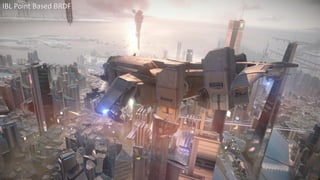
IBL Point Based BRDF
IBL Point Based BRDF – factor visualization
IBL Ambient BRDF – factor visualization
IBL Ambient BRDF
IBL Point Based BRDF
IBL Ambient BRDF
 Big step for the studio
 Artists had to adapt
 Training and workshops
 Production and Quality Win
Physically Based Lights
Blinn-Phong Point Light
Area Lights
 Every light source
 Size
 Shape
 Intensity
 Art
 Photography
 Light Direction
Spherical Light
Disc Light
Rectangular Light
Texture Rectangular Light
Area Size and Intensity
α
α
pC0
pC1
d0
d1
pC0 > pC1, due to d0 > d1
Result : pC0 blurier than pC1
Irradiance Integral
 DA : I(p,n) = Integrate(A) [L * cos(fi) * cos(fo) * dA / d^2]
 dA – differential area of the light
 L – luminance of light
 A – Area of the light
n
p’
p
d n’
fi
fo
n
p
Y
X
3D – Word Space
X , Y – set the light frame
Radiance Integral
2D – projected
on light frame
X
Y
2D – projected
on light frame
X
Y
Area of integration
X
Y
PDF to integrate
Over Area
IES Light Profiles
IES Light Profiles
IES Light Profiles
Lighting Pipeline Overview
IBL Reflection System
 3 Tier Reflection Raytrace system
 Realtime Glossy Reflections
 Localized Cubemaps
 Skybox
Localized Cubemaps
 Picture of pretty cubemap in cross with mips
IBL Render Pass
Breakdown
Render Pass Breakdown
Baked Lightmaps Diffuse + Dynamic Lights
Ambient BRDF
Cubemaps
Lightmap Diffuse + Dynamic Lights + Ambient BRDF * Cubemaps
Real Time Glossy Reflections
Real Time Glossy Reflections : Mask
Final composite of IBL based lighting
Render Pass Breakdown
Takeaway
 Physically Based Lighting
 Higher quality
 Faster asset production
 Asset reuse in different environments
 Physical Area Lights
 Time to say goodbye to point lights
 Easier workflow
 High quality results
 Real Time Reflections
 Important visual clue
We are hiring!
www.guerrilla-games.com/jobs
References
 Real Time Rendering 3rd Edition by Tomas Akenine-Moller, Eric
Haines, Naty Hoffman
 Physically Based Rendering, Second Edition: From Theory To
Implementation by Matt Pharr
 Industrial Light & Magic
 John Hable blog - http://filmicgames.com/

Lighting of Killzone: Shadow Fall