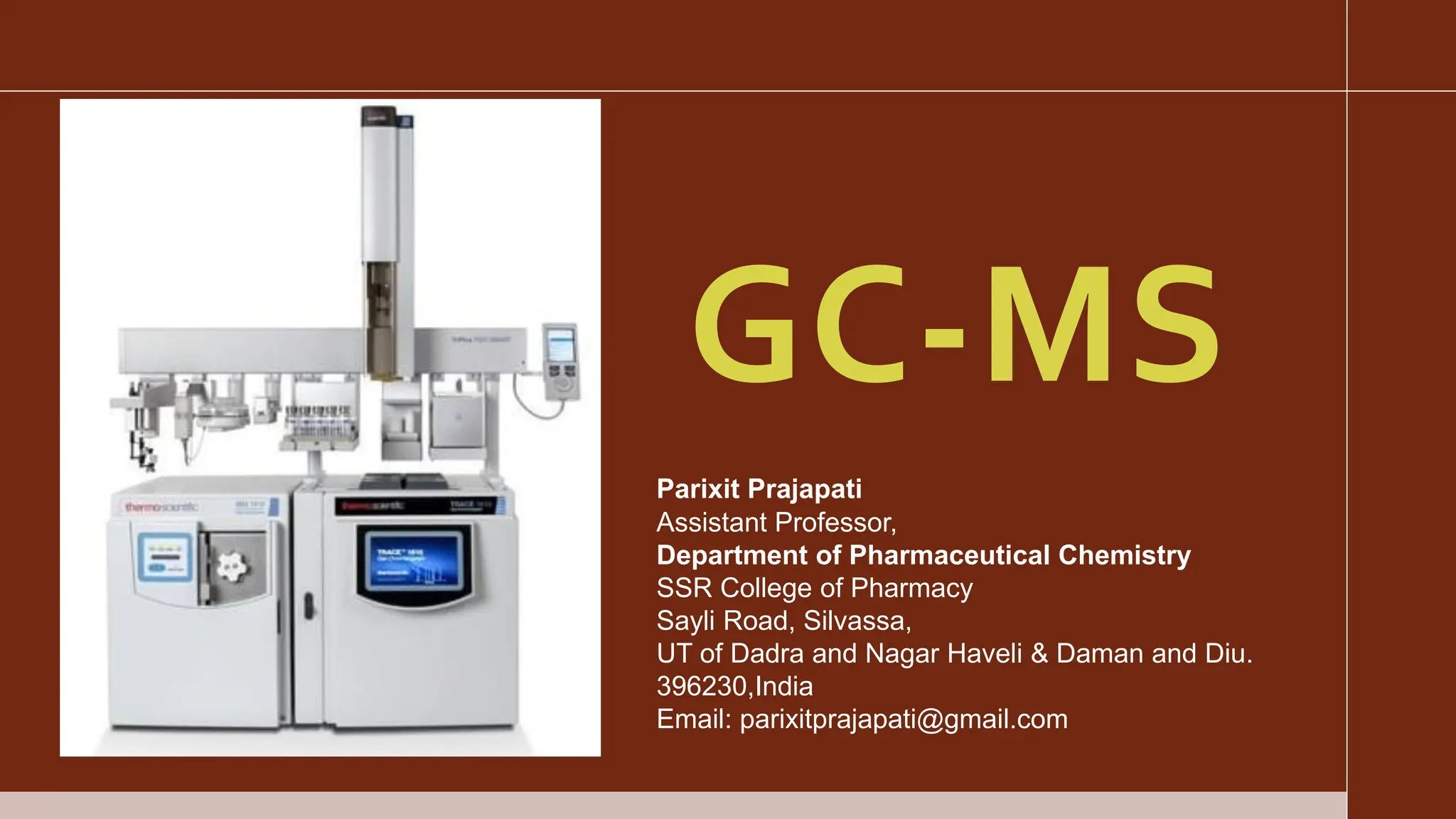
GC-MS
Parixit Prajapati
Assistant Professor,
Department of Pharmaceutical Chemistry
SSR College of Pharmacy
Sayli Road, Silvassa,
UT of Dadra and Nagar Haveli & Daman and Diu.
396230,India
Email: parixitprajapati@gmail.com
• Gas chromatography–mass spectrometry (GC-MS) is a hybrid analytical
technique that couples the separation capabilities of GC with the
detection properties of MS to provide a higher efficiency of sample
analyses. While GC can separate volatile components in a sample, MS
helps fragment the components and identify them on the basis of their
mass.
• GC-MS provides enhanced sample identification, higher sensitivity, an
increased range of analyzable samples, and faster results, which enable a
whole new range of applications for GC-MS in several areas.
2
P
a
r
i
x
i
t
P
r
a
j
a
p
a
t
i
,
S
S
R
C
o
l
l
e
g
e
o
f
P
h
a
r
m
a
c
y
,
S
i
l
v
a
s
s
a
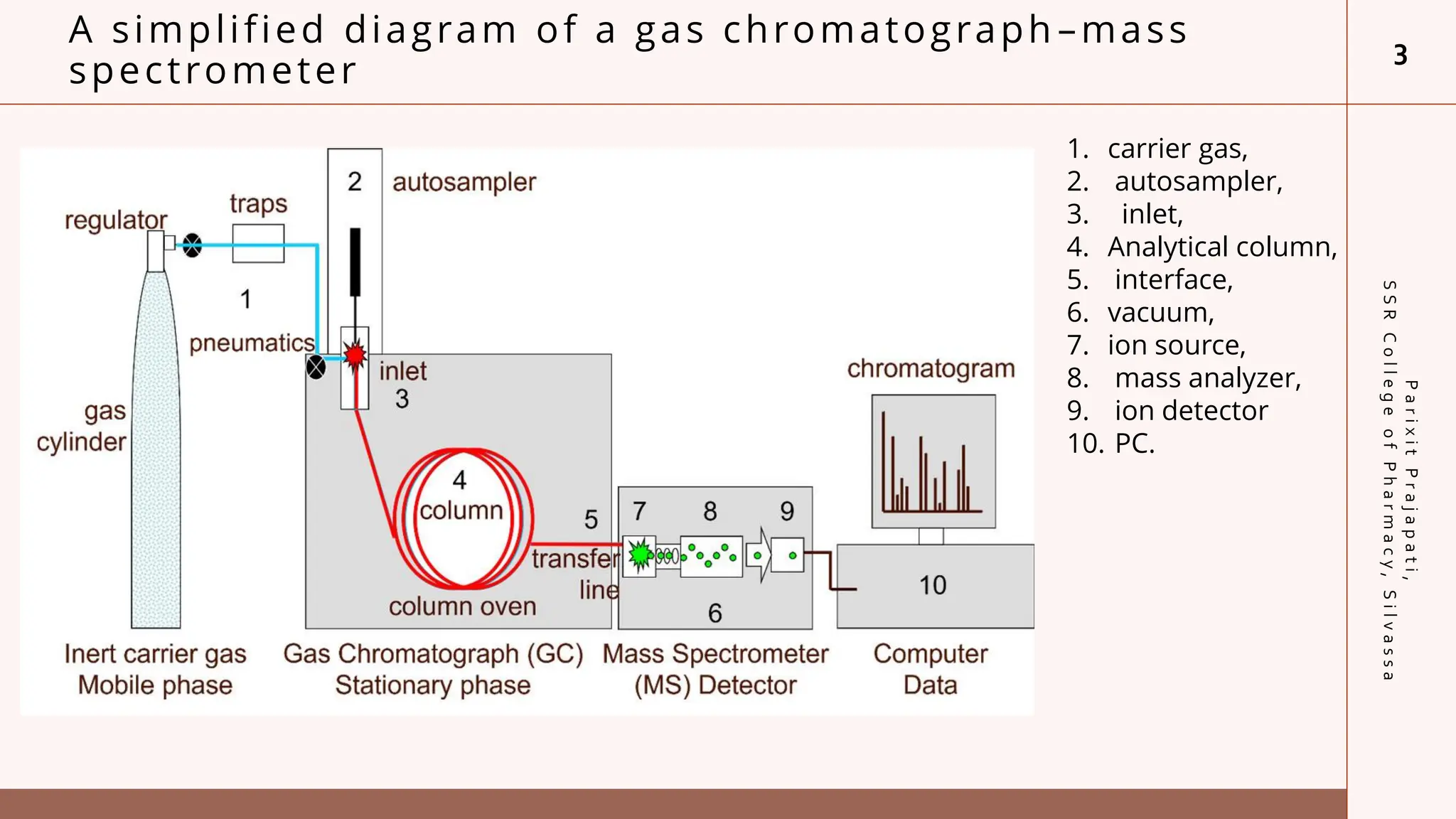
A simplified diagram of a gas chromatograph –mass
spectrometer
3
P
a
r
i
x
i
t
P
r
a
j
a
p
a
t
i
,
S
S
R
C
o
l
l
e
g
e
o
f
P
h
a
r
m
a
c
y
,
S
i
l
v
a
s
s
a
1. carrier gas,
2. autosampler,
3. inlet,
4. Analytical column,
5. interface,
6. vacuum,
7. ion source,
8. mass analyzer,
9. ion detector
10. PC.
Working of GC-MS instrument work
1. The sample is first introduced into the GC manually or by an
autosampler and enters the carrier gas via the GC inlet .
• If the sample is in the liquid form, it is vaporized in the heated
GC inlet and the sample vapor is transferred to the analytical
column
4
P
a
r
i
x
i
t
P
r
a
j
a
p
a
t
i
,
S
S
R
C
o
l
l
e
g
e
o
f
P
h
a
r
m
a
c
y
,
S
i
l
v
a
s
s
a
2. The sample components, the “analytes”, are separated by their
differences in partitioning between the mobile phase (carrier gas)
and the liquid stationary phase (held within the column), or for
more volatile gases their adsorption by a solid stationary phase.
• In GC-MS analyses, a liquid stationary phase held within a
narrow (0.1-0.25 mm internal diameter) and short (10-30 m
length) column is most common.
5
P
a
r
i
x
i
t
P
r
a
j
a
p
a
t
i
,
S
S
R
C
o
l
l
e
g
e
o
f
P
h
a
r
m
a
c
y
,
S
i
l
v
a
s
s
a
3. After separation, which for GC-MS analyses doesn’t require
total baseline resolution unless the analytes are isomers, the
neutral molecules elute through a heated transfer line into the
mass spectrometer.
6
P
a
r
i
x
i
t
P
r
a
j
a
p
a
t
i
,
S
S
R
C
o
l
l
e
g
e
o
f
P
h
a
r
m
a
c
y
,
S
i
l
v
a
s
s
a
4. Within the mass spectrometer, the neutral molecules are first ionized,
most commonly by electron ionization (EI).
Bond breakage(s) can lead to the loss of a radical or neutral molecule and
molecular rearrangements can also occur. This all results in a, sometimes
very large, number of ions of different masses, the heaviest being the
molecular ion with fragment ions of various lower masses, depending on:
• the molecular formula
• the molecular structure of the analyte
• where bond breakage has occurred
• which part has retained the charge
7
P
a
r
i
x
i
t
P
r
a
j
a
p
a
t
i
,
S
S
R
C
o
l
l
e
g
e
o
f
P
h
a
r
m
a
c
y
,
S
i
l
v
a
s
s
a
• 5.The next step is to separate the ions of different masses,
which is achieved based on their m/z by the mass analyzer .
• quadrupole
• ion trap .
• Time-of-flight (ToF)
8
P
a
r
i
x
i
t
P
r
a
j
a
p
a
t
i
,
S
S
R
C
o
l
l
e
g
e
o
f
P
h
a
r
m
a
c
y
,
S
i
l
v
a
s
s
a
• 6. After the ions have been separated by the mass analyzer
based on their m/z, they reach the ion detector .
• The signal is recorded by the acquisition software on a computer
to produce a chromatogram and a mass spectrum for each data
point.
9
P
a
r
i
x
i
t
P
r
a
j
a
p
a
t
i
,
S
S
R
C
o
l
l
e
g
e
o
f
P
h
a
r
m
a
c
y
,
S
i
l
v
a
s
s
a
3D GC-MS data 10
P
a
r
i
x
i
t
P
r
a
j
a
p
a
t
i
,
S
S
R
C
o
l
l
e
g
e
o
f
P
h
a
r
m
a
c
y
,
S
i
l
v
a
s
s
a
Total ion chromatogram (TIC) output from a GC -MS 11
P
a
r
i
x
i
t
P
r
a
j
a
p
a
t
i
,
S
S
R
C
o
l
l
e
g
e
o
f
P
h
a
r
m
a
c
y
,
S
i
l
v
a
s
s
a
Types of GC-MS
Single quadrupole GC-MS
• When gas chromatography is combined with a mass spectrometer that
includes just one quadrupole, it is often referred to simply as GC-MS.
• GC-MS is well suited to the everyday analysis of samples where either
targeted or untargeted analysis is required as these systems can be
operated using either targeted selected ion monitoring (SIM) or
untargeted full scan acquisition.
12
P
a
r
i
x
i
t
P
r
a
j
a
p
a
t
i
,
S
S
R
C
o
l
l
e
g
e
o
f
P
h
a
r
m
a
c
y
,
S
i
l
v
a
s
s
a
Triple quadrupole GC-MS/MS
• Gas chromatography combined with a triple quadrupole mass
spectrometry system is referred to as GC-MS/MS
• The triple quadrupole MS provides a higher level of selectivity and is best
suited to analyses where the highest sensitivity is required.
13
P
a
r
i
x
i
t
P
r
a
j
a
p
a
t
i
,
S
S
R
C
o
l
l
e
g
e
o
f
P
h
a
r
m
a
c
y
,
S
i
l
v
a
s
s
a
HRAM GC-MS/MS
• For comprehensive characterization of samples in a single analysis with
high-confidence compound discovery, identification and quantitation, a
GC system can be combined with a high resolution accurate mass
(HRAM) mass spectrometer.
• These GC-MS/MS systems offer the quantitative power of a triple
quadrupole GC-MS/MS combined with high-precision, full-scan HRAM
capabilities available only from the most sensitive and accurate mass
spectrometers.
14
P
a
r
i
x
i
t
P
r
a
j
a
p
a
t
i
,
S
S
R
C
o
l
l
e
g
e
o
f
P
h
a
r
m
a
c
y
,
S
i
l
v
a
s
s
a
Sample preparation
• Different manual and automated sample extraction processes are often
used prior to gas chromatography.
• These processes differ depending on the sample matrix, the degree of
selectivity required and the initial cleanliness of the samples.
• Automated on-line sample preparation with sample injection into a GC-
MS is possible through robotic autosamplers, which can replace many
basic and more complex manual sample handling operations.
15
P
a
r
i
x
i
t
P
r
a
j
a
p
a
t
i
,
S
S
R
C
o
l
l
e
g
e
o
f
P
h
a
r
m
a
c
y
,
S
i
l
v
a
s
s
a
• Headspace sampling
• Pyrolysis:
• Solid phase extraction (SPE):
• Solvent extraction:
16
P
a
r
i
x
i
t
P
r
a
j
a
p
a
t
i
,
S
S
R
C
o
l
l
e
g
e
o
f
P
h
a
r
m
a
c
y
,
S
i
l
v
a
s
s
a
GC-MS Applications
• Pharmaceutical Applications
• Food & beverage analysis
• Environmental analysis
• Metabolomics
• Oil and gas analysis
• Forensic Applications
17
P
a
r
i
x
i
t
P
r
a
j
a
p
a
t
i
,
S
S
R
C
o
l
l
e
g
e
o
f
P
h
a
r
m
a
c
y
,
S
i
l
v
a
s
s
a
• In the pharmaceutical industry, GC-MS is used in research and
development, production, and quality control.
• It is used in identification of impurities in active pharmaceutical
ingredients.
• In medicinal chemistry, GC-MS is used in the synthesis and
characterization of compounds and in pharmaceutical biotechnology.
18
P
a
r
i
x
i
t
P
r
a
j
a
p
a
t
i
,
S
S
R
C
o
l
l
e
g
e
o
f
P
h
a
r
m
a
c
y
,
S
i
l
v
a
s
s
a
• GC-MS is used in screening tests for the detection of several congenital
metabolic diseases.
• It detects trace levels of compounds present in the urine of patients with
genetic metabolic disorders.
• It can also detect the presence of oils in ointments, creams, and lotions.
19
P
a
r
i
x
i
t
P
r
a
j
a
p
a
t
i
,
S
S
R
C
o
l
l
e
g
e
o
f
P
h
a
r
m
a
c
y
,
S
i
l
v
a
s
s
a

GC-MS (Gas chromatography–mass spectrometry )

  • 1.
    GC-MS Parixit Prajapati Assistant Professor, Departmentof Pharmaceutical Chemistry SSR College of Pharmacy Sayli Road, Silvassa, UT of Dadra and Nagar Haveli & Daman and Diu. 396230,India Email: parixitprajapati@gmail.com
  • 2.
    • Gas chromatography–massspectrometry (GC-MS) is a hybrid analytical technique that couples the separation capabilities of GC with the detection properties of MS to provide a higher efficiency of sample analyses. While GC can separate volatile components in a sample, MS helps fragment the components and identify them on the basis of their mass. • GC-MS provides enhanced sample identification, higher sensitivity, an increased range of analyzable samples, and faster results, which enable a whole new range of applications for GC-MS in several areas. 2 P a r i x i t P r a j a p a t i , S S R C o l l e g e o f P h a r m a c y , S i l v a s s a
  • 3.
    A simplified diagramof a gas chromatograph –mass spectrometer 3 P a r i x i t P r a j a p a t i , S S R C o l l e g e o f P h a r m a c y , S i l v a s s a 1. carrier gas, 2. autosampler, 3. inlet, 4. Analytical column, 5. interface, 6. vacuum, 7. ion source, 8. mass analyzer, 9. ion detector 10. PC.
  • 4.
    Working of GC-MSinstrument work 1. The sample is first introduced into the GC manually or by an autosampler and enters the carrier gas via the GC inlet . • If the sample is in the liquid form, it is vaporized in the heated GC inlet and the sample vapor is transferred to the analytical column 4 P a r i x i t P r a j a p a t i , S S R C o l l e g e o f P h a r m a c y , S i l v a s s a
  • 5.
    2. The samplecomponents, the “analytes”, are separated by their differences in partitioning between the mobile phase (carrier gas) and the liquid stationary phase (held within the column), or for more volatile gases their adsorption by a solid stationary phase. • In GC-MS analyses, a liquid stationary phase held within a narrow (0.1-0.25 mm internal diameter) and short (10-30 m length) column is most common. 5 P a r i x i t P r a j a p a t i , S S R C o l l e g e o f P h a r m a c y , S i l v a s s a
  • 6.
    3. After separation,which for GC-MS analyses doesn’t require total baseline resolution unless the analytes are isomers, the neutral molecules elute through a heated transfer line into the mass spectrometer. 6 P a r i x i t P r a j a p a t i , S S R C o l l e g e o f P h a r m a c y , S i l v a s s a
  • 7.
    4. Within themass spectrometer, the neutral molecules are first ionized, most commonly by electron ionization (EI). Bond breakage(s) can lead to the loss of a radical or neutral molecule and molecular rearrangements can also occur. This all results in a, sometimes very large, number of ions of different masses, the heaviest being the molecular ion with fragment ions of various lower masses, depending on: • the molecular formula • the molecular structure of the analyte • where bond breakage has occurred • which part has retained the charge 7 P a r i x i t P r a j a p a t i , S S R C o l l e g e o f P h a r m a c y , S i l v a s s a
  • 8.
    • 5.The nextstep is to separate the ions of different masses, which is achieved based on their m/z by the mass analyzer . • quadrupole • ion trap . • Time-of-flight (ToF) 8 P a r i x i t P r a j a p a t i , S S R C o l l e g e o f P h a r m a c y , S i l v a s s a
  • 9.
    • 6. Afterthe ions have been separated by the mass analyzer based on their m/z, they reach the ion detector . • The signal is recorded by the acquisition software on a computer to produce a chromatogram and a mass spectrum for each data point. 9 P a r i x i t P r a j a p a t i , S S R C o l l e g e o f P h a r m a c y , S i l v a s s a
  • 10.
    3D GC-MS data10 P a r i x i t P r a j a p a t i , S S R C o l l e g e o f P h a r m a c y , S i l v a s s a
  • 11.
    Total ion chromatogram(TIC) output from a GC -MS 11 P a r i x i t P r a j a p a t i , S S R C o l l e g e o f P h a r m a c y , S i l v a s s a
  • 12.
    Types of GC-MS Singlequadrupole GC-MS • When gas chromatography is combined with a mass spectrometer that includes just one quadrupole, it is often referred to simply as GC-MS. • GC-MS is well suited to the everyday analysis of samples where either targeted or untargeted analysis is required as these systems can be operated using either targeted selected ion monitoring (SIM) or untargeted full scan acquisition. 12 P a r i x i t P r a j a p a t i , S S R C o l l e g e o f P h a r m a c y , S i l v a s s a
  • 13.
    Triple quadrupole GC-MS/MS •Gas chromatography combined with a triple quadrupole mass spectrometry system is referred to as GC-MS/MS • The triple quadrupole MS provides a higher level of selectivity and is best suited to analyses where the highest sensitivity is required. 13 P a r i x i t P r a j a p a t i , S S R C o l l e g e o f P h a r m a c y , S i l v a s s a
  • 14.
    HRAM GC-MS/MS • Forcomprehensive characterization of samples in a single analysis with high-confidence compound discovery, identification and quantitation, a GC system can be combined with a high resolution accurate mass (HRAM) mass spectrometer. • These GC-MS/MS systems offer the quantitative power of a triple quadrupole GC-MS/MS combined with high-precision, full-scan HRAM capabilities available only from the most sensitive and accurate mass spectrometers. 14 P a r i x i t P r a j a p a t i , S S R C o l l e g e o f P h a r m a c y , S i l v a s s a
  • 15.
    Sample preparation • Differentmanual and automated sample extraction processes are often used prior to gas chromatography. • These processes differ depending on the sample matrix, the degree of selectivity required and the initial cleanliness of the samples. • Automated on-line sample preparation with sample injection into a GC- MS is possible through robotic autosamplers, which can replace many basic and more complex manual sample handling operations. 15 P a r i x i t P r a j a p a t i , S S R C o l l e g e o f P h a r m a c y , S i l v a s s a
  • 16.
    • Headspace sampling •Pyrolysis: • Solid phase extraction (SPE): • Solvent extraction: 16 P a r i x i t P r a j a p a t i , S S R C o l l e g e o f P h a r m a c y , S i l v a s s a
  • 17.
    GC-MS Applications • PharmaceuticalApplications • Food & beverage analysis • Environmental analysis • Metabolomics • Oil and gas analysis • Forensic Applications 17 P a r i x i t P r a j a p a t i , S S R C o l l e g e o f P h a r m a c y , S i l v a s s a
  • 18.
    • In thepharmaceutical industry, GC-MS is used in research and development, production, and quality control. • It is used in identification of impurities in active pharmaceutical ingredients. • In medicinal chemistry, GC-MS is used in the synthesis and characterization of compounds and in pharmaceutical biotechnology. 18 P a r i x i t P r a j a p a t i , S S R C o l l e g e o f P h a r m a c y , S i l v a s s a
  • 19.
    • GC-MS isused in screening tests for the detection of several congenital metabolic diseases. • It detects trace levels of compounds present in the urine of patients with genetic metabolic disorders. • It can also detect the presence of oils in ointments, creams, and lotions. 19 P a r i x i t P r a j a p a t i , S S R C o l l e g e o f P h a r m a c y , S i l v a s s a