CITIES AND CLIMATECHANGE
Learning Objectives
After completing the module participants will be able to:
Describe the transformative role that cities can play in achieving
green and climate resilient development
CITIES AND CLIMATECHANGE
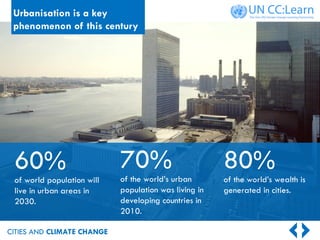
80%
of the world’s wealth is
generated in cities.
CITIES AND CLIMATE CHANGE
60%
of world population will
live in urban areas in
2030.
70%
of the world’s urban
population was living in
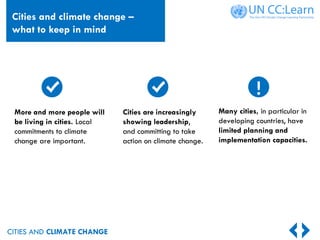
developing countries in
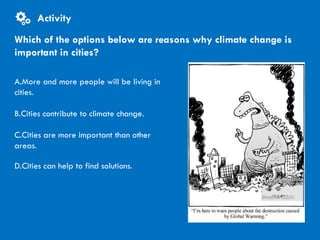
2010.
Urbanisation is a key
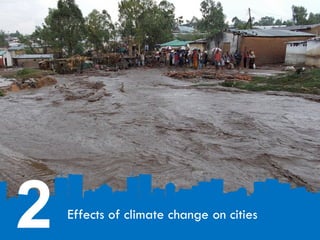
phenomenon of this century
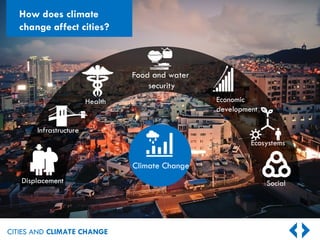
6.
CITIES AND CLIMATECHANGE
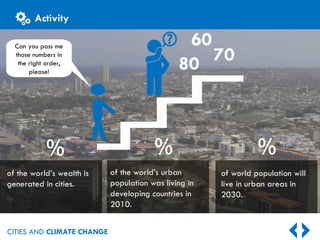
60
70
80
of the world’s urban
population was living in
developing countries in
2010.
of the world’s wealth is
generated in cities.
Can you pass me
those numbers in
the right order,
please!
% % %
of world population will
live in urban areas in
2030.
Activity
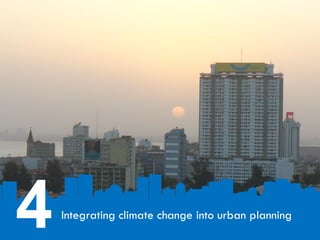
7.
CITIES AND CLIMATECHANGE
https://www.youtube.com/
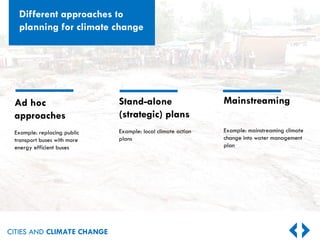
watch?v=-Bqx2BuFjik
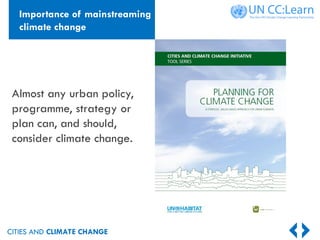
Source: UN-Habitat
CITIES AND CLIMATE CHANGE
Paper City –
a stop-motion video
animation portraying
today’s urban
challenges using a
paper and cardboard
mock city
Challenges for cities in
the 21st
century
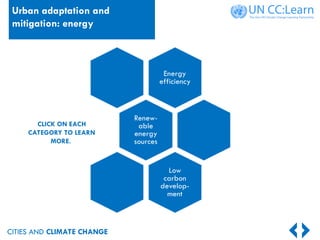
8.
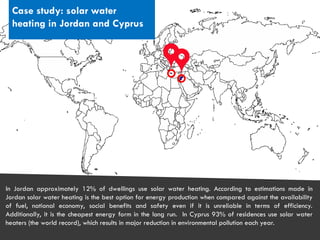
CITIES AND CLIMATECHANGE
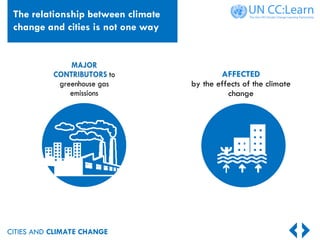
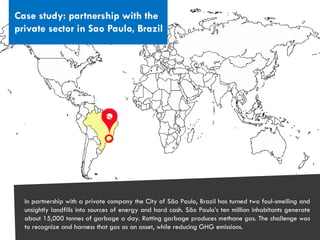
The relationship between climate
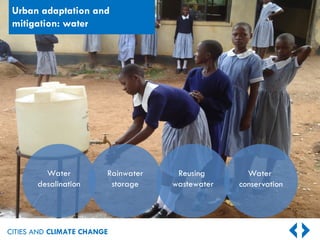
change and cities is not one way
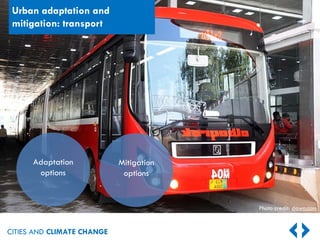
AFFECTED
by the effects of the climate
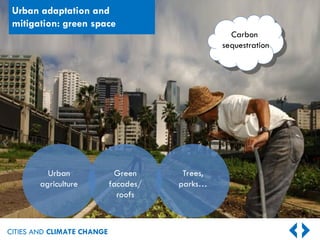
change
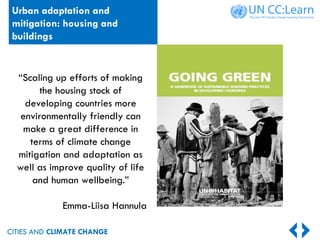
9.
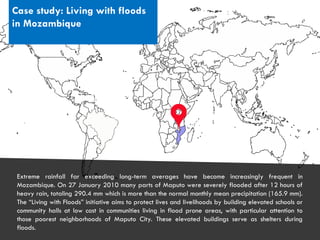
CITIES AND CLIMATECHANGE
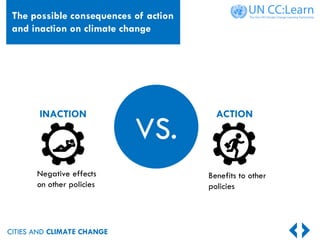
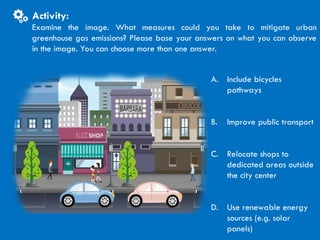
The possible consequences of action
and inaction on climate change
INACTION ACTION
Benefits to other
policies
Negative effects
on other policies
VS.
10.
CITIES AND CLIMATECHANGE
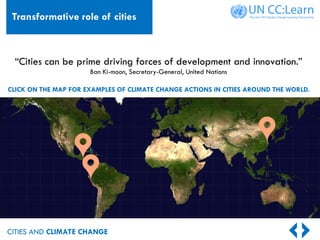
CLICK ON THE MAP FOR EXAMPLES OF CLIMATE CHANGE ACTIONS IN CITIES AROUND THE WORLD.
Transformative role of cities
“Cities can be prime driving forces of development and innovation.”
Ban Ki-moon, Secretary-General, United Nations
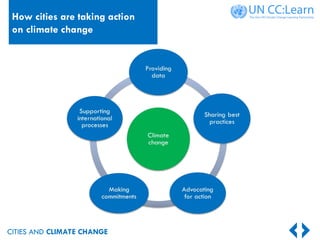
11.
CITIES AND CLIMATECHANGE
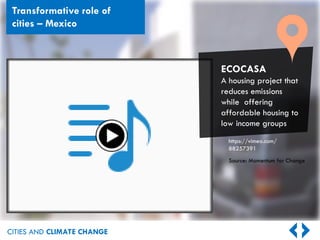
https://vimeo.com/
88257391
Source: Momentum for Change
ECOCASA
A housing project that
reduces emissions
while offering
affordable housing to
low income groups
Transformative role of
cities – Mexico
12.
CITIES AND CLIMATECHANGE
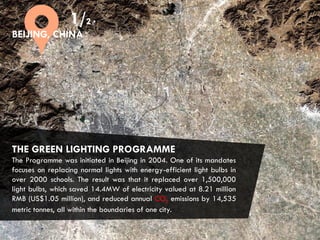
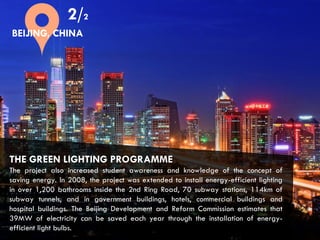
THE GREEN LIGHTING PROGRAMME
The Programme was initiated in Beijing in 2004. One of its mandates
focuses on replacing normal lights with energy-efficient light bulbs in
over 2000 schools. The result was that it replaced over 1,500,000
light bulbs, which saved 14.4MW of electricity valued at 8.21 million
RMB (US$1.05 million), and reduced annual CO2 emissions by 14,535
metric tonnes, all within the boundaries of one city.
1/2
BEIJING, CHINA
13.
CITIES AND CLIMATECHANGE
THE GREEN LIGHTING PROGRAMME
The project also increased student awareness and knowledge of the concept of
saving energy. In 2008, the project was extended to install energy-efficient lighting
in over 1,200 bathrooms inside the 2nd Ring Road, 70 subway stations, 114km of
subway tunnels, and in government buildings, hotels, commercial buildings and
hospital buildings. The Beijing Development and Reform Commission estimates that
39MW of electricity can be saved each year through the installation of energy-
efficient light bulbs.
2/2
BEIJING, CHINA
14.
CITIES AND CLIMATECHANGE
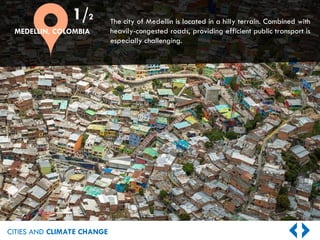
The city of Medellin is located in a hilly terrain. Combined with
heavily-congested roads, providing efficient public transport is
especially challenging.
1/2
MEDELLIN, COLOMBIA
15.
CITIES AND CLIMATECHANGE
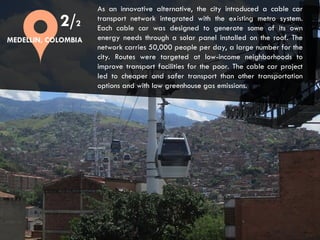
As an innovative alternative, the city introduced a cable car
transport network integrated with the existing metro system.
Each cable car was designed to generate some of its own
energy needs through a solar panel installed on the roof. The
network carries 50,000 people per day, a large number for the
city. Routes were targeted at low-income neighborhoods to
improve transport facilities for the poor. The cable car project
led to cheaper and safer transport than other transportation
options and with low greenhouse gas emissions.
2/2
MEDELLIN, COLOMBIA
16.
CITIES AND CLIMATECHANGE
https://www.youtube.com/
watch?v=L45EgI9mU48
Source: C40
An Introduction to
C40 –
Cycling through
5 megacities
C40: Cities sharing best practices
17.
CITIES AND CLIMATECHANGE
Many cities, in particular in
developing countries, have
limited planning and
implementation capacities.
More and more people will
be living in cities. Local
commitments to climate
change are important.
Cities are increasingly
showing leadership,
and committing to take
action on climate change.
!
Cities and climate change –
what to keep in mind
18.
CITIES AND CLIMATECHANGE
A.More and more people will be living in
cities.
B.Cities contribute to climate change.
C.Cities are more important than other
areas.
D.Cities can help to find solutions.
Which of the options below are reasons why climate change is
important in cities?
Activity
19.
CITIES AND CLIMATECHANGE
Section 2
Effects of climate change on cities
2
20.
CITIES AND CLIMATECHANGE
Climate Change
Displacement
Infrastructure
Health
Food and water
security
Economic
development
Ecosystems
Social
How does climate
change affect cities?
21.
CITIES AND CLIMATECHANGE
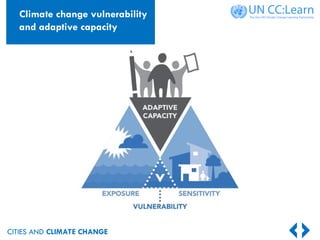
Climate change vulnerability
and adaptive capacity
22.
CITIES AND CLIMATECHANGE
UN-Habitat
supported the city of
Pakse, Laos in
conducting a
vulnerability
assessment
https://www.youtube.com/
watch?v=2BMyk9kUWHs
Source: UN-Habitat
A climate change vulnerability
assessment in practice
23.
CITIES AND CLIMATECHANGE
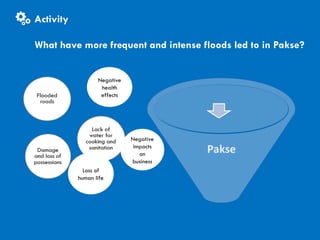
Negative
impacts
on
business
Negative
health
effects
Loss of
human life
What have more frequent and intense floods led to in Pakse?
Activity
24.
CITIES AND CLIMATECHANGE
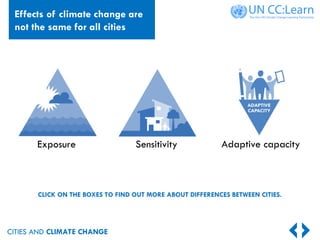
Adaptive capacity
Sensitivity
Exposure
CLICK ON THE BOXES TO FIND OUT MORE ABOUT DIFFERENCES BETWEEN CITIES.
Effects of climate change are
not the same for all cities
CITIES AND CLIMATECHANGE
1/2
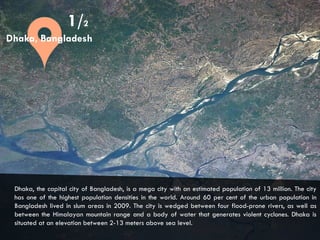
Dhaka, the capital city of Bangladesh, is a mega city with an estimated population of 13 million. The city
has one of the highest population densities in the world. Around 60 per cent of the urban population in
Bangladesh lived in slum areas in 2009. The city is wedged between four flood-prone rivers, as well as
between the Himalayan mountain range and a body of water that generates violent cyclones. Dhaka is
situated at an elevation between 2-13 meters above sea level.
Dhaka, Bangladesh
27.
CITIES AND CLIMATECHANGE
2/2
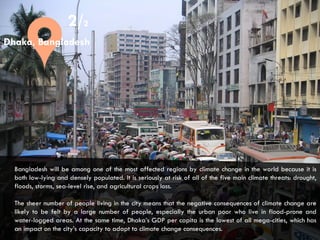
Bangladesh will be among one of the most affected regions by climate change in the world because it is
both low-lying and densely populated. It is seriously at risk of all of the five main climate threats: drought,
floods, storms, sea-level rise, and agricultural crops loss.
The sheer number of people living in the city means that the negative consequences of climate change are
likely to be felt by a large number of people, especially the urban poor who live in flood-prone and
water-logged areas. At the same time, Dhaka’s GDP per capita is the lowest of all mega-cities, which has
an impact on the city’s capacity to adapt to climate change consequences.
Dhaka, Bangladesh
CITIES AND CLIMATECHANGE
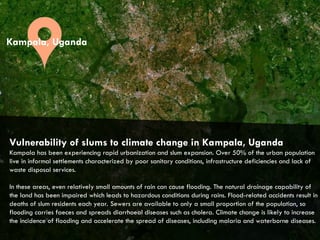
Vulnerability of slums to climate change in Kampala, Uganda
Kampala has been experiencing rapid urbanization and slum expansion. Over 50% of the urban population
live in informal settlements characterized by poor sanitary conditions, infrastructure deficiencies and lack of
waste disposal services.
In these areas, even relatively small amounts of rain can cause flooding. The natural drainage capability of
the land has been impaired which leads to hazardous conditions during rains. Flood-related accidents result in
deaths of slum residents each year. Sewers are available to only a small proportion of the population, so
flooding carries faeces and spreads diarrhoeal diseases such as cholera. Climate change is likely to increase
the incidence of flooding and accelerate the spread of diseases, including malaria and waterborne diseases.
Kampala, Uganda
30.
CITIES AND CLIMATECHANGE
Section 3
Cities as contributors to climate change
3
31.
CITIES AND CLIMATECHANGE
“The battle against climate change will
be fought in the cities. Cities can be the
problem or cities can be the solution.
But we need to know what is going on
in the cities.”
Andrew Steer, President and CEO, World Resources Institute
The crucial role of cities in
addressing climate change
32.
CITIES AND CLIMATECHANGE
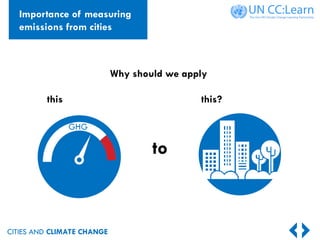
Why should we apply
this this?
to
Importance of measuring
emissions from cities
33.
CITIES AND CLIMATECHANGE
https://www.youtube.com/
watch?v=DtqSIplGXOA
New York City's
greenhouse gas
emissions as
1t spheres of
CO2 gas.
By CarbonVisuals
Cities are an important
contributor to emissions
34.
CITIES AND CLIMATECHANGE
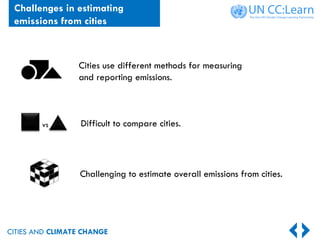
Cities use different methods for measuring
and reporting emissions.
Difficult to compare cities.
Challenging to estimate overall emissions from cities.
vs
Challenges in estimating
emissions from cities
35.
CITIES AND CLIMATECHANGE
https://vimeo.com/114001116
Global Protocol
for Community-
Scale Greenhouse
Gas Emission
Inventories (GPC)
By IISD Reporting
Services/ENB
Solutions for estimating
emissions from cities
36.
CITIES AND CLIMATECHANGE
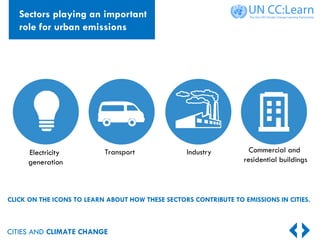
Electricity
generation
Transport Commercial and
residential buildings
Industry
CLICK ON THE ICONS TO LEARN ABOUT HOW THESE SECTORS CONTRIBUTE TO EMISSIONS IN CITIES.
Sectors playing an important
role for urban emissions
37.
CITIES AND CLIMATECHANGE
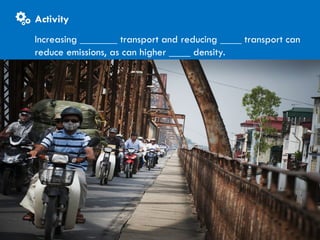
Increasing _______ transport and reducing ____ transport can
reduce emissions, as can higher ____ density.
Activity
38.
CITIES AND CLIMATECHANGE
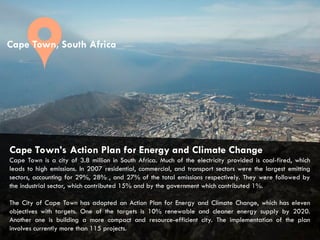
Cape Town’s Action Plan for Energy and Climate Change
Cape Town is a city of 3.8 million in South Africa. Much of the electricity provided is coal-fired, which
leads to high emissions. In 2007 residential, commercial, and transport sectors were the largest emitting
sectors, accounting for 29%, 28% , and 27% of the total emissions respectively. They were followed by
the industrial sector, which contributed 15% and by the government which contributed 1%.
The City of Cape Town has adopted an Action Plan for Energy and Climate Change, which has eleven
objectives with targets. One of the targets is 10% renewable and cleaner energy supply by 2020.
Another one is building a more compact and resource-efficient city. The implementation of the plan
involves currently more than 115 projects.
Cape Town, South Africa
39.
CITIES AND CLIMATECHANGE
If you were a member of a local council in Cape Town, South Africa, which of the
following sectors would you propose should be tackled first? Choose as many as you
consider fit.
Government sector 1%
Residential sector 29%
Commercial sector 28%
Industry sector 15%
Transport sector 27%
Activity
40.
CITIES AND CLIMATECHANGE
Demographic
composition
Location Types of economic
activities
Urban form
CLICK ON THE ICONS TO LEARN MORE ABOUT HOW THESE FACTORS INFLUENCE EMISSION LEVELS.
Factors influencing emissions
in cities
41.
CITIES AND CLIMATECHANGE
Section 4
Integrating climate change into urban planning
4
42.
CITIES AND CLIMATECHANGE
Fundamentally, good city planning practices
are, by their nature, also climate smart
planning practices.
UN-Habitat, Planning for Climate Change 2014
“
Urban planning and
climate change
43.
CITIES AND CLIMATECHANGE
Ad hoc
approaches
Example: replacing public
transport buses with more
energy efficient buses
Stand-alone
(strategic) plans
Example: local climate action
plans
Mainstreaming
Example: mainstreaming climate
change into water management
plan
Different approaches to
planning for climate change
44.
CITIES AND CLIMATECHANGE
Almost any urban policy,
programme, strategy or
plan can, and should,
consider climate change.
Importance of mainstreaming
climate change
45.
CITIES AND CLIMATECHANGE
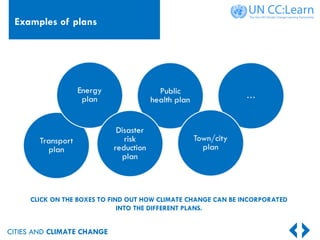
CLICK ON THE BOXES TO FIND OUT HOW CLIMATE CHANGE CAN BE INCORPORATED
INTO THE DIFFERENT PLANS.
Examples of plans
46.
CITIES AND CLIMATECHANGE
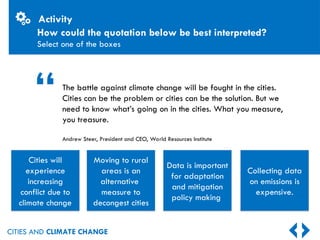
How could the quotation below be best interpreted?
Select one of the boxes
The battle against climate change will be fought in the cities.
Cities can be the problem or cities can be the solution. But we
need to know what’s going on in the cities. What you measure,
you treasure.
Andrew Steer, President and CEO, World Resources Institute
Moving to rural
areas is an
alternative
measure to
decongest cities
Data is important
for adaptation
and mitigation
policy making
Collecting data
on emissions is
expensive.
Cities will
experience
increasing
conflict due to
climate change
“
Activity
CITIES AND CLIMATECHANGE
Planning for climate change
in practice
https://www.youtube.com/watch?
v=vAoorDDRkoY
A Strategic Values-
Based Approach in
Sihanoukville
By UN-Habitat
53.
CITIES AND CLIMATECHANGE
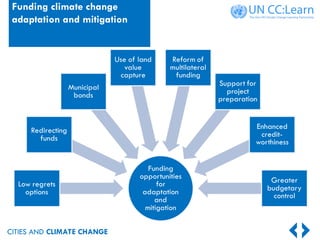
Funding climate change
adaptation and mitigation
54.
CITIES AND CLIMATECHANGE
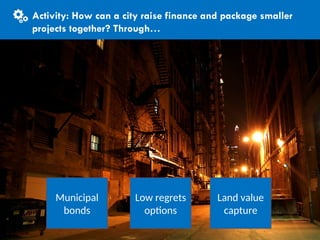
Activity
Municipal
bonds
Low regrets
options
Land value
capture
Activity: How can a city raise finance and package smaller
projects together? Through…
55.
CITIES AND CLIMATECHANGE
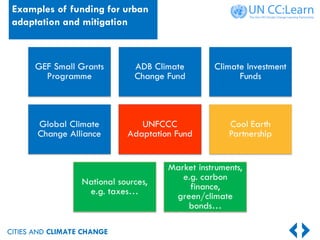
Examples of funding for urban
adaptation and mitigation
56.
CITIES AND CLIMATECHANGE
Section 5
Urban climate change adaptation and mitigation
in practice
5
57.
CITIES AND CLIMATECHANGE
Urban adaptation and
mitigation: energy
CLICK ON EACH
CATEGORY TO LEARN
MORE.
58.
CITIES AND CLIMATECHANGE
Case study: solar water
heating in Jordan and Cyprus
In Jordan approximately 12% of dwellings use solar water heating. According to estimations made in
Jordan solar water heating is the best option for energy production when compared against the availability
of fuel, national economy, social benefits and safety even if it is unreliable in terms of efficiency.
Additionally, it is the cheapest energy form in the long run. In Cyprus 93% of residences use solar water
heaters (the world record), which results in major reduction in environmental pollution each year.
59.
CITIES AND CLIMATECHANGE
Case study: partnership with the
private sector in Sao Paulo, Brazil
In partnership with a private company the City of São Paulo, Brazil has turned two foul-smelling and
unsightly landfills into sources of energy and hard cash. São Paulo’s ten million inhabitants generate
about 15,000 tonnes of garbage a day. Rotting garbage produces methane gas. The challenge was
to recognize and harness that gas as an asset, while reducing GHG emissions.
60.
CITIES AND CLIMATECHANGE
Urban adaptation and
mitigation: water
Water
desalination
Rainwater
storage
Reusing
wastewater
Water
conservation
61.
CITIES AND CLIMATECHANGE
Urban adaptation and
mitigation: transport
Adaptation
options
Mitigation
options
Photo credit: dawn.com
62.
CITIES AND CLIMATECHANGE
Urban adaptation and
mitigation: green space
Urban
agriculture
Green
facades/
roofs
Trees,
parks…
Carbon
sequestration
63.
CITIES AND CLIMATECHANGE
Urban adaptation and
mitigation: housing and
buildings
“Scaling up efforts of making
the housing stock of
developing countries more
environmentally friendly can
make a great difference in
terms of climate change
mitigation and adaptation as
well as improve quality of life
and human wellbeing.”
Emma-Liisa Hannula
64.
CITIES AND CLIMATECHANGE
Case study: Living with floods
in Mozambique
Extreme rainfall far exceeding long-term averages have become increasingly frequent in
Mozambique. On 27 January 2010 many parts of Maputo were severely flooded after 12 hours of
heavy rain, totaling 290.4 mm which is more than the normal monthly mean precipitation (165.9 mm).
The “Living with Floods” initiative aims to protect lives and livelihoods by building elevated schools or
community halls at low cost in communities living in flood prone areas, with particular attention to
those poorest neighborhoods of Maputo City. These elevated buildings serve as shelters during
floods.
65.
CITIES AND CLIMATECHANGE
Compact urban development
as the way forward
“While there are a range
of policies available to
reduce cities’ emissions,
one fundamental
approach involves
promoting compact urban
development.”
Dr. Clos, Executive Director of UN-Habitat
66.
CITIES AND CLIMATECHANGE
Activity
A. Include bicycles
pathways
B. Improve public transport
C. Relocate shops to
dedicated areas outside
the city center
D. Use renewable energy
sources (e.g. solar
panels)
Activity:
Examine the image. What measures could you take to mitigate urban
greenhouse gas emissions? Please base your answers on what you can observe
in the image. You can choose more than one answer.
67.
CITIES AND CLIMATECHANGE
Section 6
Major initiatives related to climate change
and cities
6
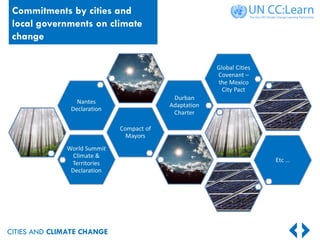
CITIES AND CLIMATECHANGE
Commitments by cities and
local governments on climate
change
71.
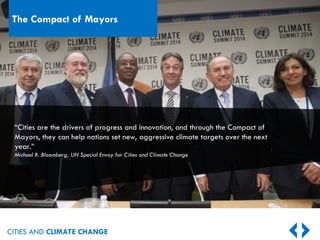
CITIES AND CLIMATECHANGE
“Cities are the drivers of progress and innovation, and through the Compact of
Mayors, they can help nations set new, aggressive climate targets over the next
year.”
Michael R. Bloomberg, UN Special Envoy for Cities and Climate Change
The Compact of Mayors
CITIES AND CLIMATECHANGE
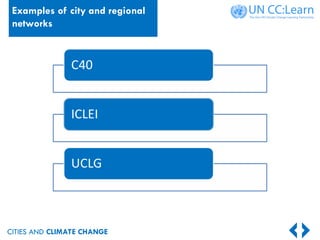
C40
Examples of action:
• 75 of the world’s largest cities
• 550 million people
• ¼ of global economy
C40 - Cities Climate
Leadership Group
74.
CITIES AND CLIMATECHANGE
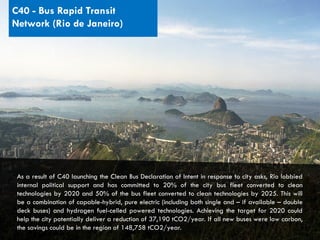
As a result of C40 launching the Clean Bus Declaration of Intent in response to city asks, Rio lobbied
internal political support and has committed to 20% of the city bus fleet converted to clean
technologies by 2020 and 50% of the bus fleet converted to clean technologies by 2025. This will
be a combination of capable-hybrid, pure electric (including both single and – if available – double
deck buses) and hydrogen fuel-celled powered technologies. Achieving the target for 2020 could
help the city potentially deliver a reduction of 37,190 tCO2/year. If all new buses were low carbon,
the savings could be in the region of 148,758 tCO2/year.
C40 - Bus Rapid Transit
Network (Rio de Janeiro)
75.
CITIES AND CLIMATECHANGE
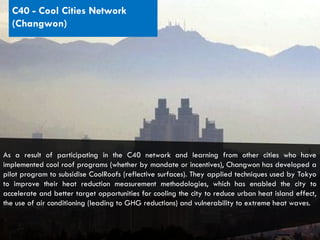
C40 - Cool Cities Network
(Changwon)
As a result of participating in the C40 network and learning from other cities who have
implemented cool roof programs (whether by mandate or incentives), Changwon has developed a
pilot program to subsidise CoolRoofs (reflective surfaces). They applied techniques used by Tokyo
to improve their heat reduction measurement methodologies, which has enabled the city to
accelerate and better target opportunities for cooling the city to reduce urban heat island effect,
the use of air conditioning (leading to GHG reductions) and vulnerability to extreme heat waves.
76.
CITIES AND CLIMATECHANGE
Examples of action:
ICLEI
A network of over 1000 cities,
towns and metropolises committed
to sustainable urban future
ICLEI – Local Governments for
Sustainability
77.
CITIES AND CLIMATECHANGE
524 reporting entities, representing
14% of world’s urban population
Committed GHG reductions by 2020
= approx. 1 billion tCO2e or the total
the total GHG reductions achieved by
the European Union between 1990-
2012
carbonn Climate Registry
What? World’s leading platform for
local and subnational governments
to report climate actions
How? Voluntary reporting on
commitments, mitigation and
adaptation actions, and action
plans
Who? By local governments to local
governments
78.
CITIES AND CLIMATECHANGE
Open to all cities, metropolises and
regions with transformative projects or
plans.
Advocates for better access to climate
finance for cities and regions, connects
subnational authorities with financial
bodies, and helps local leaders to
design bankable projects.
What? A 10-year initiative to
accelerate the implementation of
local action to tackle climate
change.
How? Showcasing of up to 100
transformative actions each year
online and at conferences, high-
level advocacy.
Who? Organized by local and
subnational governments.
Transformative Actions
Program (TAP)
79.
CITIES AND CLIMATECHANGE
UCLG
• 1000 member cities and regions
• 155 national member
associations
• Present in 140 countries
UCLG - United Cities and
Local Governments
80.
CITIES AND CLIMATECHANGE
Activity
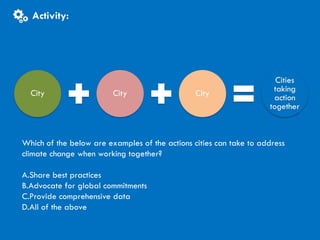
Activity:
Which of the below are examples of the actions cities can take to address
climate change when working together?
A.Share best practices
B.Advocate for global commitments
C.Provide comprehensive data
D.All of the above
81.
CITIES AND CLIMATECHANGE
Summary of the module
Cities play a key role in global transition towards climate resilient and
low-carbon development.
Cities are key contributors to greenhouse gas emissions and how cities
develop will have an important impact on emissions levels.
Climate change can have different impacts on different cities and groups
within cities. The urban poor are likely to be more affected.
Climate change mitigation and adaption should be integrated into urban
planning.
Cities are increasingly taking action on climate change.
CITIES AND CLIMATECHANGE
Recommended readings
UN-Habitat (2014). Planning for Climate Change
UN-Habitat (2011). Cities and Climate Change: Global Report on Human
Settlements 2011
UN-Habitat (2012). State of the World’s Cities 2012/2013
UN-Habitat (2011). Local Leadership for Climate Change Action
The Global Commission on the Economy and Climate (2014). Better
Growth Better Climate: The New Climate Economy Report
The World Bank (2010). Cities and Climate Change: An Urgent Agenda
84.
CITIES AND CLIMATECHANGE
Main references
UN-Habitat (2014). Planning for Climate Change
UN-Habitat (2011). Cities and Climate Change: Global Report on Human
Settlements 2011
The Global Commission on the Economy and Climate (2014). Better Growth
Better Climate: The New Climate Economy Report
UN-Habitat (2012). Going Green: A Handbook of Sustainable Housing
Practices in Developing Countries
UN-Habitat Cities and Climate Change Academy climate change modules for
universities
85.
CITIES AND CLIMATECHANGE
Credits
Credits
Resting icon, by Freepic from www.flaticon.com
Businessman running in a wheel icon, by Freepic from www.flaticon.com
Factory icon, by Steve Morris fron The Noun Project
Bridge, by Chris McDonnell from The Noun Project
Food icon, by Claire Jones from The Noun Project
Social icon, by Antonio Vicién Faure from The Noun Project
Immigrants icon, by Luis Prado from The Noun Project
Buildings trees and plants in citys icon, by Freepic from www.flaticon.com
Solar icon, by iconsmind.com from The Noun Project
Van, by Jonathan Li from The Noun Project
User, by Aha-Soft from The Noun Project
Location, by John Caserta from The Noun Project
Money Growth, by DesignNex from The Noun Project
Shapes, by Nick Abrams from The Noun Project
Rubiks Cube, by Ryan Beck from The Noun Project
Strategic icon, by Freepic from www.flaticon.com
Climate Change, Health, Graph, Ecosystem icons from The noun Project, Public Domain
Editor's Notes
#1 This module introduces the theme of climate change in urban areas. The world is becoming more and more urban and therefore cities are important actors in addressing climate change. The module will cover both how cities are affected by climate change and how cities are contributing to climate change. In addition, the module will look at how climate change adaptation and mitigation can be considered in urban planning and identify concrete measures. Several examples of how cities can play a transformational role in addressing climate change are presented.
#4 Section 1 highlights that cities hold the potential to play an essential role in the global transition towards green and climate resilient development. It sets the scene by looking at some key demographic, socio-economic and environmental trends. It illustrates the transformative role of cities, both in addressing the challenges and taking advantage of the opportunities presented by climate change.
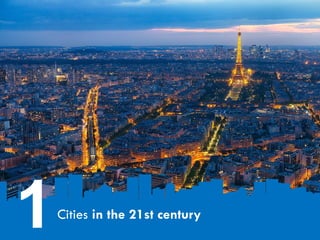
The photo on the slide shows Paris, the capital of the host of the 21st Session of the Conference of the Parties to the United Nations Framework Convention on Climate Change.
#5 The world has been urbanising rapidly and this trend will continue. However, different regions have very different rates of urbanisation. Africa was the least urbanised region in 2010, with less than 40% of its population residing in urban areas. Northern America, and Latin America and the Caribbean were the most urbanised regions, with around 80% of their population being urban. Most of the future population growth will take place in urban areas in developing countries.
Cities play an important role in the economic development of a country as many businesses are located in urban areas. Yet the prosperity generated by cities has not been equitably shared, and a sizeable proportion of the urban population remains without access to the benefits that cities produce.
Sources: UN-Habitat, Global Report on Human Settlements 2013 and UN-Habitat, State of the World’s Cities 2012/2013, and UN-Habitat, The Economic Role of Cities (2011).
#6 Activity
You can try as many times as you want. Your answers will not count towards the final assessment at the end of the module.
Correct order: 80%, 70%, 60%
#7 The video draws attention, in an animated format, to issues caused by rapid and uncontrolled city growth. It portrays urban challenges and suggests solutions that can be taken. Cities can be sources of innovation, solutions and opportunities to improve the lives of their populations.
The video sets out the vision of a holistic, all-inclusive approach to urban development that will lead to resilient cities, where citizens benefit from adequate housing, economic opportunities, public transport and non-motorised mobility, and access to basic services and public spaces in a clean and greener environment. The video also emphasises inclusivity and equal opportunities for all.
#8 Cities both contribute to and are affected by climate change. The world’s cities are responsible for up to 70 per cent of global greenhouse gas emissions while occupying just 2 per cent of the world’s land surface. This trend is likely to continue in the future with most population growth taking place in cities. At the same time, the effects of climate change, such as rising sea-levels and extreme weather events, can impact negatively on the urban infrastructure and people, and more broadly on economic growth.
#9 Not acting on climate change will hamper the effectiveness of other development policies, such as education, health and poverty. For example, climate change can lead to detrimental health effects in slums, loss of property and possessions, and ultimately more poverty.
On the other hand, climate change adaptation and mitigation can lead to benefits in other policy areas. For instance, climate change mitigation in the form of improving public transport in a city can both reduce greenhouse gas emissions and improve air quality. Similarly, investing in renewable energy is a climate change mitigation measure that can lead to the creation of new jobs. Building roads that better withstand the effects of climate change is an example of an adaptation measure that can stimulate economic growth.
Multiple development goals could be achieved by carefully designed climate change policies.
#10 Cities are centres of development and innovation thanks to diverse social and cultural networks, the presence of highly skilled labour, close exchange between science and industry, etc. Cities also benefit from economics of scale due to their higher density. This makes it cheaper and easier to take action. Cities are therefore ideally placed to test solutions for climate change mitigation and adaptation. There are many examples of cities implementing innovative solutions.
Source for the quote: UN-Habitat, State of the World’s Cities 2012/2013
#11 This video presents inter alia the Ecocasa project in Nuevo Leon, Mexico. Ecocasa is a project implemented by the Mexican government in partnership with international development banks, which encourages housing developers to build homes designed to minimize greenhouse gas emissions. The case is particularly interesting because it includes low income housing illustrating that sustainability is compatible with affordability.
#12 Source: UN-Habitat Cities and Climate Change Global Report on Human Settlements, 2011. Original source Zhao, J. (2010) ‘Climate change mitigation in Beijing, China’, Unpublished case study prepared for the Global Report on Human Settlements 2011, www.unhabitat.org/grhs/2011
#13 Photo: "北京国贸CBD夜景" by 网友的作品 - http://bbs.photofans.cn/thread-419083-1-1.html. Licensed under CC BY-SA 4.0 via Wikimedia Commons
Source: UN-Habitat Cities and Climate Change Global Report on Human Settlements, 2011. Original source Zhao, J. (2010) ‘Climate change mitigation in Beijing, China’, Unpublished case study prepared for the Global Report on Human Settlements 2011, www.unhabitat.org/grhs/2011
#14 Source: UN-Habitat, Local Leadership for Climate Change Action, 2011
#15 Source: UN-Habitat, Local Leadership for Climate Change Action, 2011
#16 C40 is a growing network of megacities taking action to reduce greenhouse gas emissions. This video illustrates the challenges cities are currently facing and how best practices can be exchanged in areas such as public transportation, sustainable lighting, housing, etc.
#17 The case studies have shown that cities are promoting innovative approaches to address the challenges posed by climate change and that they also taking advantage of the opportunities related to low-emission development. However, cities, in particular in developing countries, also encounter challenges when it comes to effective urban planning under changing climate conditions.
#18 Activity
This is a multiple choice activity. Select all the correct answers. You can try as many times as you want. Your answers will not count towards the final assessment at the end of the module.
Options A, B and D are correct.
#19 Hundreds of millions of people in urban areas across the world are already being affected by rising sea levels, increased precipitation, inland floods, more frequent and stronger cyclones and storms, and periods of more extreme heat and cold. Section 2 discusses the different ways in which cities are being affected by climate change, including effects on economic development, urban ecosystems, infrastructure, displacement, food and water security, social affairs and health. These effects are illustrated through three cases studies: Pakse in Laos, Dhaka in Bangladesh and Kampala in Uganda. The concept of vulnerability is introduced, in particular how the urban poor are the most vulnerable to the adverse effects of climate change.
Photo: UNDP
#20 Climate change affects different aspects of cities, such as economic development and infrastructure. The effects depend on the location, characteristics and adaptive capacity of cities. Hover over each of the icons to learn more about the impacts of climate change.
Ecosystems: Climate change impacts on ecosystems and the important services they provide which include oxygen production and protection from flooding. Climate change will reduce biodiversity and wetland area, and lead to loss of trees and soil among other effects. Ecosystems are already often affected by human activities such as urbanisation, deforestation, and the introduction of alien species. Poor and vulnerable communities are often relying the most on ecosystem services and are likely to be the most affected by the impacts of climate change.
Economic development: Climate change will have many impacts on economic development. There will be effects on industry through damage to buildings, infrastructure and other assets. Industry can also be impacted by effects of climate change on city infrastructure and transport networks which can cause delays and increase costs. Climate change will also affect tourism in some countries through changing temperatures, disruptions to transport networks, and sea-level rise in coastal areas, for instance in island countries. In addition, climate change will impact on the livelihoods of urban residents through, for example, affecting such means of production as social relationships or natural resources.
Food and water security: Climate change will result in reduced food production in some countries through changes in precipitation patterns and temperature. Some areas will no longer be suitable for agriculture and others will require irrigation for cultivation to be possible. Water resources will be impacted by factors such as increased demand and reduced groundwater recharge. Urbanisation and growing populations will put more pressure on food production and water resources. More land will be needed for urban expansion while at the same time demand for food and water is likely to increase in those growing urban areas.
Health: Climate change can affect human health negatively because it may alter the transmission of diseases such as malaria, cholera and meningitis, meaning that these diseases will affect more people or different areas. Health is also affected by urban heath waves, which can result to hospitalizations and heath-related mortality. More frequent and intense weather events such as storms or floods can also injure and kill people. In addition, climate change can lead to contaminated water supplies which can increase prevalence of certain diseases.
Infrastructure: Cities depend on different types of infrastructure such as power, water, waste removal and transportation infrastructure. Heavy rains, floods, droughts and landslides can damage roads, bridges and other transportation infrastructure. Water systems can be affected in various ways. For instance, saltwater intrusion can affect the quality of water supplies. Water supply infrastructure will also need to be able to cope with more frequent and intense storms or floods in some areas. Precipitation patterns can increase or decrease water supplies depending on location. Energy transmission infrastructure can be affected by storms and flooding. Homes and commercial buildings, especially in coastal areas, are vulnerable to flooding.
Displacement: Climate change impacts may also lead to displacement of people and therefore increased internal and international migration. There is evidence of impacts such as flooding or drought leading to migration (for example in the Philippines and in Brazil). In addition to the human cost, displacement will put strain on the communities accommodating the displaced people, for instance in terms of competition for jobs and resources.
Social: Climate change has social impacts. As will be discussed later in this module, climate change affects vulnerable groups more. It can exacerbate poverty and gender and racial inequalities.
Adapted from UN-Habitat Cities and Climate Change Academy modules for universities: http://unhabitat.org/urban-initiatives/initiatives-programmes/cities-and-climate-change-academy/ and from UN-Habitat (2011). Cities and Climate Change: Global Report on Human Settlements 2011.
#21 A vulnerability assessment helps policy makers to understand and prepare climate change vulnerability in their cities. There are different definitions of vulnerability to climate change. Here it is referred to as being a function of exposure, sensitivity and adaptive capacity. Exposure refers to the degree to which a city is exposed to changes in climate, including projected future changes. Sensitivity is the degree to which people, places, institutions and sectors are affected now and in the future by climate change. Finally, adaptive capacity refers to the degree to which people, places, institutions and sectors are able to adapt and become more resilient to climate change impacts.
Adapted from UN-Habitat (2014), Planning for Climate Change.
#22 This video presents a climate change vulnerability assessment that was conducted by UN-Habitat in the city of Pakse in Laos. Climate change intensifies the seasonal changes in the area, the dry season becoming much drier and the wet season much wetter, with more often and persistent floods. This has negative impacts on the town’s activities, endangering the lives of its inhabitants.
#23 The answers relate to both what can be seen on the video and the narrative. Drag the right answers to the funnel. You can listen to the video again by going to the previous slide.
Correct answers: flooded roads, loss of possessions, impact on business and lack of water for cooking and sanitation.
#24 While climate change has an impact on both developed and developing country cities, often developing country cities are more vulnerable to climate change. The images give some reasons for different effects based on the categories of exposure, sensitivity and adaptive capacity. Hover over each image to read more.
Exposure: Many of the world’s cities are located vulnerable areas such as in low-lying coastal areas, which are much more exposed to the effects of climate change. The case study in the next slide will go into more detail.
Sensitivity: The prevalence of unplanned urbanisation in the form of slums and informal settlements and lack of adequate infrastructure are making developing country cities more vulnerable.
Adaptive capacity: Developing country cities often have lower adaptive capacity, meaning that they do not have the same human, financial and other resources to adapt to the effects of the climate change as developed country cities generally do.
Adapted from UN-Habitat (2011). Cities and Climate Change: Global Report on Human Settlements 2011.
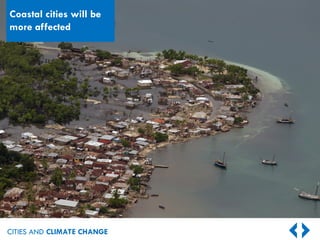
#25 Coastal urban areas will be particularly affected, especially those situated in low-elevation zones. The rise in sea level will make them more vulnerable to inundation and flooding. Saltwater will affect drinking water supplies and coastal erosion, and can reduce the land space. Damage to coastal cities also impacts on the levels of tourism. For instance, the coastal city of Mombasa in Kenya could lose around 17 per cent of its land, which will affect amenities and features that draw in tourism.
Coastal cities will also suffer more from the increased frequency, duration and intensity of storms. Many cities are located on coasts or near major rivers due to the advantages that these locations offered historically. The urban population in low-elevation coastal areas is still growing.
Photo: UN Photo, Hurricane Sandy Causes Heavy Rains and Floods in Haiti
Source: UN-Habitat, Cities and Climate Change: Global Report on Human Settlements 2011.
#27 Photo: „Dhakarushhour (54)“. Licensed under CC BY 2.5 on Wikimedia Commons –
Source: UN-Habitat, State of the World’s Cities 2008/2009: Harmonious Cities and UN-Habitat, State of the World’s Cities 2012/2013.
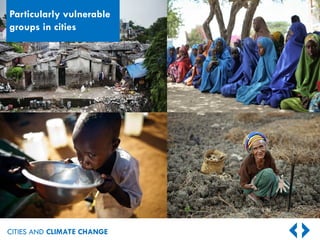
#28 While climate change will affect everyone, there are particularly vulnerable groups. For example, the elderly and children suffer more from extreme heat waves, and women may be more affected by disasters. In addition, the types of economic activities that women often undertake, such as small-scale agriculture, are more difficult to compensate for than those of men. The urban poor are most affected by climate change. According to UN-Habitat, around 30% of the urban population in developing regions was living in slums in 2012. The figure was over 60% in sub-Saharan Africa. These types of settlements are often built in areas that are more vulnerable to the effects of climate change because they are less expensive. In addition, houses and infrastructure are often poorly built with little capacity to resist events such as flooding. Losing their house and possessions can have a devastating effect on the urban poor. They often do not have insurance and such a loss can push them further into poverty.
Photos: UN Photo and UN-Habitat
Source: UN-Habitat, Cities and Climate Change: Global Report on Human Settlements 2011 and UN-Habitat, State of the World’s Cities 2012/2013.
#29 Source: Based on UN-Habitat, Global Report on Human Settlements, 2011. Original source: Mabasi, T. (2009) ‘Assessing the vulnerability, mitigation and adaptation to climate change in Kampala City’,
Paper presented at the Fifth Urban Research Symposium, Cities and Climate Change: Responding to an Urgent Agenda, 28–30 June, Marseille, France
#30 Section 3 discusses the role of cities as sources of greenhouse gas emissions, with a particular focus on some key sectors. Cities are key contributors to greenhouse gas emissions and therefore play a key part in climate change mitigation.
Section 3 also provides an introduction to the importance of measuring and monitoring greenhouse gas emissions in cities and presents one concrete method, the Global Protocol for Community-Scale Greenhouse Gas Emission Inventories.
#31 As mentioned in Section 1, cities contribute to about 70% of global greenhouse gas emissions. How cities develop therefore plays a crucial role in determining whether global temperature change can be kept below 2°C compared to pre-industrial levels.
Source for the quote: Global Protocol for Community-Scale Greenhouse Gas Emission Inventories (GPC) https://vimeo.com/114001116
#32 Data about different sources and levels of greenhouse gas emissions enables finding the most effective solutions and climate change mitigation measures. Measuring emissions of cities also helps us to better understand what contribution cities are making to climate change and to global and national mitigation efforts, and to establish a baseline against which cities can pledge emission reductions. Comparing the levels of emissions between different cities can encourage knowledge sharing and also attract investment.
#33 This video, produced by Carbon Visuals together with the Environmental Defense Fund, illustrates the carbon dioxide emissions of New York City, which added up to 54 million metric tons in 2010.
#34 The 2006 IPCC Guidelines for Greenhouse Gas Inventories are the international standard for reporting emissions at national level. At sub-national levels different approaches have been taken. For instance, City A may include some emitting sectors which City B does not include. How can we then compare the emissions from City A with the emissions from City B? Another key issue is how to set the boundaries for emissions. A city could include only those emissions originating from within the city boundaries or more widely those that are caused by activities undertaken within the city. Also, there is no universal definition of ‘a city’. Measuring greenhouse gas emissions from cities is therefore challenging and it is difficult to compare City A with City B. It is also difficult to estimate the overall emissions from cities because of differences in methodologies.
#35 Global Protocol for Community-Scale Greenhouse Gas Emission Inventories (GPC) is a partnership of the World Resources Institute, the C40 Cities Climate Leadership Group and Local Governments for Sustainability (ICLEI). The GPC aims to enable cities to have one method for measuring emissions, to account for all emissions, and to make it clear what the trajectory of emissions will be and consequently whether cities are on track to meet targets. The GPC also seeks to enable the measurement of city contributions to national efforts. The GPC is the first global standard for accounting and reporting greenhouse gas emissions from cities and has been widely used by cities across the world in its current and previous versions. It has also been adopted by the Compact of Mayors, which is an agreement by city networks to reduce emissions and take action on climate change.
More information: http://www.ghgprotocol.org/city-accounting
The Carbon Climate Registry at http://carbonn.org/climateregistry/ presents the greenhouse gas emissions commitments, emissions inventories and climate mitigation/adaptation actions reported by local governments.
#36 The contribution of different sectors to greenhouse gas emissions varies across cities. Important sectors typically include electricity generation, transport, industry, and commercial and residential buildings.
Energy supply for the generation of electricity: Fossil fuels continue to be the main fuels used for generating electricity. The choice of fuel greatly affects the levels of emissions in cities in addition to the actual amount of emissions generated.
Transport: The levels of emissions from transport are related to all types of transport modes and exacerbated by the prevalence of private transport infrastructure, as well as insufficient regulatory frameworks to encourage the use of clean technologies and fuels. The introduction of public transport and transit-oriented development can reduce the emissions of cities. In this type of development pedestrian-orientated development is concentrated near public transport, drawing people in to these areas.
Industry: Energy-intensive industrial activities within cities particularly contribute to emissions. Levels of emissions are also linked to the technologies used for production with cleaner technologies or energy efficiency measures having the potential to reduce emissions.
Commercial and residential buildings: This sector needs energy for, for example, the heating and cooling of buildings, for construction materials for buildings and for more indirect uses such as street lighting. Energy efficient construction is one way to reduce emissions.
Source: UN-Habitat Global Report on Human Settlements, 2011: Cities and Climate Change and UN-Habitat Global Report on Human Settlements 2013: Planning and Design for Sustainable Urban Mobility.
#37 Transport is one of the emitting sectors within cities. Fill in the blanks in the sentence with suitable words and click the SUBMIT button.
The correct answers are public, private and urban. Cities can use a combination of “pull” and “push” strategies to encourage the use of public transport and non-motorised transport, such as walking and cycling, and to discourage the use of private motorised transport. Density should be thought of as sustainable density. For example, slums may be so dense that providing public transport may be challenging. The concept of transit-orientated development, which is compact, mixed-use and pedestrian-friendly development concentrated around public transport nodes, is one model for influencing urban growth and considers mobility and urban development in a holistic way.
Photo: Hanoi, UN Photo.
#38 Source: Adapted from Moving Mountains, Cape Town’s Action Plan for Energy and Climate Change 2011.
Photo: Kristina Eisele
#39 Feedback for any response (no right or wrong):
The three highest GHG emissions sectors are residential, commercial and transport sectors. The potential contribution to reducing GHG emissions by tackling one or all of these three sectors is the greatest. However, one could also look at the lowest hanging fruit. That could be the industry sector, depending on the existent assets/methods that could be used to mitigate the emissions in this specific sector. The sector with the lowest emission is the government sector with only 1 %. In this case, the overall impact on emissions might be limited. However, the government might want to lead by example. That means there is no right or wrong answer but the selection of priority sectors will depend on various factors.
#40 The levels of greenhouse gas emissions are influenced by several factors. In general, cities in the developing world have lower emissions, but there is limited data and city-to-city variation. The rich in developing cities produce much higher emissions than the poor.
Hover over the icons to learn more about how these factors influence emission levels.
Demographic composition of a society: Smaller households can reduce economies of scale and increase energy consumption per capita. A society with a large proportion of aging population may experience lower emissions when people enter retirement.
Location: The climatic conditions and the altitude of the city affect its energy demands for cooling, heating and lighting. For instance, cities in colder climates would have a higher demand for heating. The location of the city in relation to natural resources, on the other hand, influences the choice of fuels. For example, in some areas wind energy is more feasible.
Types of economic activities: The types of economic activities undertaken in cities affect their levels of emissions. For example, energy-intensive manufacturing will increase emissions. However, it is important to note that cities also consume products and trade products which are produced elsewhere and therefore the emissions are registered elsewhere.
Urban form: More dense cities may have lower levels of emissions. For instance, in a denser city there is less need for motorised transport and it is cheaper to put in place public transport systems. Compact forms of housing also tend to have lower levels of energy consumption. However, higher densities can also lead to higher level of vulnerability to climate change, for example in the case of slums.
It is important to note that these relations do not always hold as emissions can also be affected by other factors, such as the level of income or political willingness.
Source: UN-Habitat Global Report on Human Settlements, 2011: Cities and Climate Change.
#41 Section 4 builds on the Introductory Learning Module 6: Planning for Climate Change, focusing on planning at the sub-national level. This type of planning is important because the effects of climate change are felt locally, planning and investment decisions are often taken at the sub-national level, there is increasing urbanisation, and climate change impacts the services local institutions provide.
Section 4 discusses the importance of integrating climate change into urban planning and describes what the different approaches for this are. Good urban planning and climate change adaptation and mitigation are connected. The previous sections have highlighted some of the ways in which urban planning can address climate change. For instance, transport planning that supports public transport can reduce emissions. This section will explain in more detail how urban planning can help to reduce greenhouse gas emissions and make cities more resilient.
The photo on the slide shows Maputo in Mozambique. Maputo is one of the cities featured in the UN-Habitat Guide on Planning for Climate Change (2014), which will be featured in this section 4.
#42 The quote in this slide refers to how good urban planning and planning for climate change are connected.
In fact, urban planners’ responsibilities are generally consistent with planning for climate change. The examples given by the UN-Habitat guide, Planning for Climate Change 2014, are:
Minimizing risk and improving land development activities occurring in areas that are in or near coastal, slope or flood areas;
Improving infrastructure, for example for storm water management and solid and liquid waste management, as well as access to safe drinking water;
Protecting ecosystems and environmentally sensitive areas in urban and peri-urban areas;
Improving disaster risk reduction; and
Encouraging local economic development.
#43 There are advantages and disadvantages to the different approaches. However, mainstreaming helps to ensure continuous consideration of climate change and is not limited to one-off interventions.
Ad hoc approaches focus on a specific issue to be addressed and are sometimes retroactive (responding to an existing issue). In addition, these approaches do not use a complete planning process, but rather focus on one opportunity at a time.
Stand-alone plans focus on climate change and can address either adaptation or mitigation or both. A specific plan is written, which often also includes an implementation strategy.
Mainstreaming means incorporating climate change into existing plans, policies and programmes.
There are advantages and disadvantages to the different approaches. However, mainstreaming helps to ensure continuous consideration of climate change that is not limited to one-off interventions.
Source: UN-Habitat Cities and Climate Change Academy climate change modules for universities, Module 3 Planning for Climate Change.
#44 Climate change affects many different aspects of cities and people’s lives. Consequently, climate change should be considered in almost any type of urban policy, plan or programme. Incorporating climate change considerations can improve the effectiveness of these plans as well as ensuring that the city is prepared for climate change and takes measures to mitigate its contribution to climate change. Mainstreaming helps to ensure that climate change considerations are not only taken into account for a specific amount of time.
The UN-Habitat guide, Planning for Climate Change (2014), provides guidance to city planners and other professionals on how to plan for climate change and mainstream climate change actions into physical, spatial, sectoral and broader development plans at the local level.
#45 This is not an exhaustive list of the types of plans in which climate change can be mainstreamed. In fact climate change can be included in almost any type of plan.
Hover over each example to learn more.
Transport plan: This type of plan improves infrastructure and connections related to transport. Mainstreaming climate change can mean, for example, identifying the potential climate change impacts on transport networks and the improvements that are needed, and undertaking climate change mitigation efforts such as reducing emissions through supporting public transport.
Town/city plan: This plan identifies different zones for different types of development, such as commercial or housing. Climate change can be mainstreamed in different ways. For example, the plan can identify zones which are particularly affected by climate change. These types of plans can also increase awareness of the impacts of climate change on the city and the contribution to climate change of the city, and can give policy direction.
Public health plan: It focuses on disease prevention and public safety improvements. Mainstreaming climate change into this type of plan could include identifying health risks related to climate change and facilitating mitigating those.
Energy management plan: This plan improves energy generation options, distribution and conservation. Mainstreaming climate change into this plan could involve identifying risks to energy generation and distribution facilities, and supporting climate change mitigation, for instance through energy efficiency measures.
Disaster risk reduction plan: This plan examines how prepared the city is for disasters, and improves early warning systems and capacities. Disaster risk reduction and climate change adaptation and mitigation have some overlaps. Disaster risk reduction plan can examine climate change related disaster risks and adaptive capacity.
#46 Activity
Click on the boxes you think are correct answers.
Correct answers: 3rd box. It is important to gather reliable data that will then be used in the urban planing process aiming at adaptation to and mitigation of the impact of climate change.
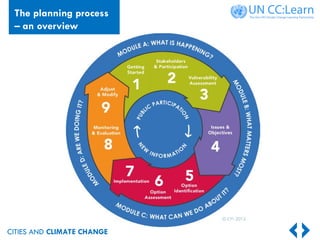
#47 This slide shows the modules of the planning process for climate change presented in the UN-Habitat guide, Planning for Climate Change (2014). Each of the modules will be addressed in turn. The modules are supported by planning tools that are contained in a Toolkit accompanying the guide.
The planning process is flexible and non-linear. Cities may be in different stages of climate change planning, use the Planning for Climate Change guide for different purposes, have different planning structures, processes, and authorities, and have different resources and capacities.
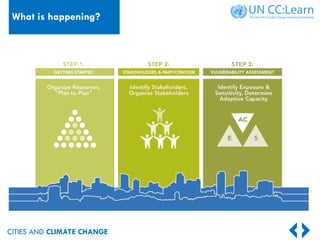
#48 The three steps of this module help planners to address the following key questions:
Step 1: Are we ready to undertake a climate change planning process?
Step 2: Who needs to be involved in the city and in the community and how can
they be engaged?
Step 3: How is climate change affecting the city and who is most vulnerable to these
changes?
Each of the steps contain a number of tasks and the Guide provides valuable tools to support the completion of tasks.
This first module will enable planners and other stakeholders to:
Have a shared, clear awareness of the need to address climate change in their city.
Know which city, community and local stakeholders to involve and how to do it by completing their Stakeholder and Engagement Plan.
Understand what is happening with climate change in the city through the creation of a Vulnerability Assessment (including where to source the information required for it).
#49 Module B contains one step:
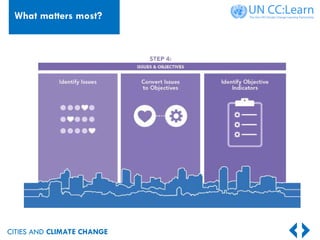
Step 4: What community and local stakeholder issues must be considered in addition to any existing city objectives when selecting and prioritizing climate change options, and how can they be identified?
This module will enable planners and stakeholders to have:
A clear list of existing city development objectives, from other plans and strategies, that must also be considered and used as part of the climate change planning initiative.
A clear understanding of local community issues and objectives, which may or may not be addressed by city planning objectives, and which ones matter most to the community.
An understanding of which objectives, at city-level and local community-level, are most affected by, and relevant to, climate change adaptation planning.
Indicators with which to compare and measure the objectives so they can be used to evaluate and prioritize climate change adaptation options.
Source: UN-Habitat, Planning for Climate Change, p.83
#50 Module C has the following three planning steps:
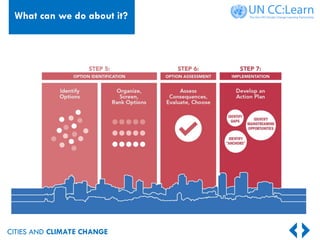
Step 5: What options are there to respond to climate change in our city?
Step 6: How can we assess, screen and choose the best options to ensure resources,
time and capacity are used most effectively and efficiently?
Step 7 How can we best implement the prioritized climate change options
and assemble a Climate Change Action Plan?
This module leads to an achievable, comprehensive and integrated Climate Change Action Plan. After completing Module C, planners and stakeholders will have:
Identified, screened, assessed and prioritized climate change adaptation actions, such as projects, policies, programmes and actions, according to local objectives and vulnerabilities;
Developed a stand-alone Climate Change Action Plan with a clear implementation framework; and/or
Mainstreamed and integrated climate actions into existing policy instruments, plans and programmes, where practical and feasible.
Source: UN-Habitat, Planning for Climate Change, p.95.
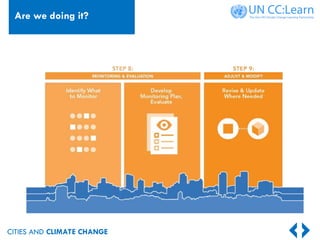
#51 Module D, “Are we doing it?”, is a fundamental part of measuring the success of climate change planning processes and the Climate Change Action Plan. This last module contains two planning steps:
Step 8: How can the progress of the Climate Change Action Plan be tracked to ensure it is having the anticipated impact and that stakeholders are doing what they agreed to do?
Step 9: How should new information be incorporated in to the Climate Change Action Plan and how should other changes be made?
After this module, planners and stakeholders will have:
A clear understanding of what monitoring and evaluation are and why they are critical to the successful implementation of a Climate Change Action Plan
Developed a monitoring and evaluation programme for the Climate Change Action Plan to monitor implementation progress, evaluate actions against plan objectives (i.e. is it making a difference?), and share results with stakeholders.
Developed a clear timeline for formal Climate Change Action Plan reviews.
Source: UN-Habitat, Planning for Climate Change, p.127
#52 This video by UN-Habitat shows how Cambodia's coastal city of Preah Sihanouk is planning for climate change and how climate change should be mainstreamed into existing planning processes. Consider the following quote from the video: ‘Local government is a capable and important implementing partner’. This highlights the fact that local governments are and should be central actors in taking action on climate change and that urban adaptation and mitigation are key issues.
#53 Funding is a key part of action on climate change and on deciding which mitigation and adaptation measures to take. However, new funding may need to be mobilised and existing resources may need to be redirected in order to fund mitigation and adaptation efforts. There are a number of efforts to increase the availability of financial resources for local climate action. For example, the Cities Climate Finance Leadership Alliance was launched at the UN Secretary-General’s Climate Change Summit in 2014 with the aim of accelerating investments in climate-smart urban infrastructure.
This slide features some of the different options for increasing funding for local adaptation and mitigation efforts. Click on the options to learn about each one. The first option is from the UN-Habitat’s guide, Planning for Climate Change. The other options are based on the chapter on cities in the New Climate Economy 2014 report, which discusses a number of options for increasing city financing, focusing on smarter infrastructure.
Click on each box to learn more.
Low regrets options: UN-Habitat’s Planning for Climate Change publication encourages planners to consider low regrets adaptation options. These options, also known as no regrets options, contribute to wider development objectives than climate change. The benefits from those wider development objectives are worthwhile even before considering climate change related benefits.
Redirecting funds: Funding can be redirected from business-as-usual urban infrastructure development. For example, the Bus Rapid Transit system in Bogota, Colombia benefitted from redirecting funds from urban highway programmes.
Municipal bonds: Large institutional investors are generally not interested in investing in small, individual projects. Municipal bonds allow cities to finance a group of projects. The collective assets of these projects underwrite the bond. For example, Johannesburg has issued four municipal bonds to finance capital expenditure. In addition to municipal bonds, there are other ways to package smaller projects, for examples cities can establish pooled financial mechanisms between cities or exchanges or vehicles to match infrastructure projects with investors/financing. The Chicago Infrastructure Trust is an example of the latter: http://shapechicago.org/about/how-it-works/
Use of land value capture: Land value capture refers to financing the construction of new transport infrastructure through the increase in land values that this new infrastructure would promote. There are several different types of use of land value capture, for example development impact fees, public land leasing and land readjustment programmes.
Reform of multilateral funding: Multilateral funding could be reformed. At the moment multilateral development banks often offer support cities on a sector-by-sector basis rather than through more comprehensive holistic approaches. Cities could also be given greater access to multilateral development bank funding.
Support for project preparation: International support for project preparation and financing deals can be useful as cities may not have the expertise to prepare projects that are attractive for private sector investors.
Enhanced creditworthiness: Poor credit ratings are an important factor contributing to lack of financing for large-scale urban infrastructure. The City Creditworthiness Initiative of the World Bank works with cities to improve their creditworthiness by strengthening financial performance, developing an enabling legal, regulatory, institutional and policy framework, developing sound climate-smart projects, and by engaging with private sector investors. Read more at: http://www.worldbank.org/en/topic/urbandevelopment/brief/city-creditworthiness-initiative
Greater budgetary control: Greater budgetary control for cities could enable them to leverage the co-financing that is often required for large-scale urban infrastructure investment projects.
#54 Click on the option you consider to be correct.
Correct answer: municipal bonds
#55 This slide features some of the funds available for urban adaptation and mitigation. Examples of multilateral sources are in blue, UNFCCC in red and bilateral in orange. National sources and market instruments are in green. Click on the boxes to go directly to the websites for examples in blue, yellow and red.
The multilateral and bilateral sources are from www.climatefinanceoptions.org and from UNFCCC’s adaptation funding interface on funding for adaptation and mitigation in urban areas. These funds include urban populations and human settlements as specific sectors of interest. The list is not exhaustive but rather shows examples of funding options.
Funds can also be mobilised from national sources, such as through tax revenues, use of land value capture and redirecting funds. Market instruments include green municipal bonds mentioned in the previous slide and carbon finance. Carbon finance refers to the use of market-based mechanisms under the Kyoto Protocol; the Clean Development Mechanism (CDM) and Joint Implementation (JI), or other mechanisms such as the regional EU Emissions Trading Scheme (EU ETS). Few CDM projects in cities have been registered. (The World Bank, A City-Wide Approach to Carbon Finance, 2010).
(Links: https://sgp.undp.org/, http://www.adb.org/site/funds/funds/climate-change-fund, http://www.climateinvestmentfunds.org/cif/home, http://www.gcca.eu/, http://unfccc.int/cooperation_and_support/financial_mechanism/adaptation_fund/items/3659.php, http://www.mofa.go.jp/policy/economy/wef/2008/mechanism.html)
#56 The previous section discussed the importance of integrating climate change adaptation and mitigation into urban planning. Section 5 discusses practical measures for urban climate change adaptation and mitigation with respect to key areas, including energy, water, green spaces and housing. Concrete examples are given around the world to illustrate the measures. These will highlight the multitude of different ways climate change adaptation and mitigation is undertaken in urban areas.
Photo: Port Moresby, UN-Habitat
#57 Low carbon development, use of renewable energy sources and taking energy efficiency measures are some examples of urban adaptation and mitigation in the context of energy.
Hover over each category to learn more
Renewable energy sources: The use of renewable energy sources, such as wind energy, lowers greenhouse gas emissions and therefore contributes to climate change mitigation.
Energy efficiency measures: Energy efficiency measures, such as light bulbs that use less energy or more energy efficient public transport, are sometimes called the low-hanging fruit of mitigation because they are generally less costly than other options. Energy efficiency measures also have co-benefits, for example better air quality from the lower emissions of energy efficient cars and buses. The case study on green lighting in Beijing in section 1 is an example of an energy efficiency measure.
Low carbon development: Low carbon development is generally taken to mean adopting low-carbon development strategies. Definitions vary but this would involve cities re-thinking their development trajectories and taking a trajectory with lower emissions.
Source: UN-Habitat Cities and Climate Change Academy climate change modules for universities, Module 2: The Practice of Urban Climate Change Adaptation and Mitigation
#58 Sources: Mousa S. Mohsen and Bilal A. Akash (1997), Evaluation of domestic solar water heating system in Jordan using analytic hierarchy process, Energy Conrrrs. Mgntt Vol. 38; Issue 2, p. 18l5~l822.
Soteris A. Kalogirou, Environmental Benefits of Domestic Solar Water Heating Systems, Higher Technical Institute, Cyprus.
Reproduced from UN-Habitat, Going Green: A Handbook of Sustainable Housing Practices in Developing Countries, 2012
#59 The City of São Paulo entered into agreements with the Brazilian company Biogás. Biogás constructed facilities at two landfill sites for a total investment of US$ 90 million. At the Bandeirantes site a system captures the methane gas and channels it in to a combined heat and power plant. The two landfills together now generate 10% of the city’s electricity requirements. To date, the credits generated by reduced emissions have yielded some Euros 48 million, which the city splits 50/50 with Biogás. The City Council of São Paulo has used its share of the revenues to develop parks and squares in the poor neighbourhoods surrounding these landfills.
Source: UN-Habitat, Local Leadership for Climate Change Action, 2011
#60 Climate change can affect water resources in many different ways. The rise of sea levels can lead to intrusion of saline water into urban coastal aquifers, increased rainfall can decrease water quality, and droughts and decreased rainfall can lead to reduced water supplies.
Climate-resilient water management is important as is strategic long-term planning. Climate concerns should be considered in water management plans but also in other types of city plans. The water management plan could identify and address climate-related risks to water supplies, treatment and distribution, as well as identifying water conservation measures. Drought-prone areas can have drought management plans.
Adaptation measures include water desalination from sea water, storing rainwater and reusing waste water for other purposes such as irrigation of parks. Water conservation is important, especially in drought prone areas. This can be encouraged by measures such as water metres or by installing toilets that use less water.
Photo: UN-Habitat/Julius Mwelu.
Sources: UN-Habitat Cities and Climate Change Academy climate change modules for universities, Module 4 and UN-Habitat (2014)., Planning for Climate Change.
#61 The photo shows bus rapid transit (BRT) in Lahore, Pakistan. BRT operates on its own lane, often making it a fast mode of public transport.
Hover over the boxes to learn more about adaptation and mitigation in the context of urban transport.
Adaptation: Transport infrastructure can be vulnerable to extreme weather events such as heavy rainfall or heat. For instance, roads and bridges can get flooded and damaged. Measures such as storm drainage or building roads in more elevated areas are examples of adaptation to such events.
Mitigation: Transport is a significant emitter of greenhouse gases in cities. Investment in public transport networks and disincentives for the use of private vehicles, for example, congestion charges or taxes on vehicles, can reduce emissions from transport. Private vehicles and public transport can also be made more energy efficient, leading to lower levels of emissions. Other examples of mitigation measures include promoting car sharing and building bicycle lanes. The case study on the cable car transport network in Medellin in section 1 is an example of mitigating emissions from the transport sector.
Photo: https://www.dawn.com/news/1186130
Photo credit: dawn.com
Source: UN-Habitat Cities and Climate Change Academy climate change modules for universities, Module 6: Climate Change and Urban Mobility
#62 Planning for green spaces in urban areas affects climate change adaptation and mitigation. The boxes on the slide show some of the actions that can be taken.
Hover over each of them to learn more.
Carbon sequestration is listed in the white cloud. Vegetation in cities can contribute to carbon sequestration, that is to the removal of carbon from the atmosphere and its storage in carbon sinks such as forests or oceans. Urban vegetation, such as trees, can store carbon. Urban agriculture, that is farming in cities or nearby areas, also provides green spaces and carbon sequestration benefits.
Green spaces can have numerous benefits relating to a wide range of issues from cooling temperatures to important co-benefits. Green facades and roofs can cool buildings during the summer and provide insulation during the winter, reducing energy use. Trees also provide shade for buildings. Urban agriculture also reduces the urban heat island effect. Green roofs and green spaces can improve drainage of rainwater and thus reduce rainwater run-off in case of extreme weather events.
Planning for green spaces can have important co-benefits. For instance, trees can reduce air and noise pollution in cities. Public green areas, such as parks, improve the quality of life of urban dwellers and be an easily accessible public area for all. Urban agriculture can have a positive impact on food security and reduce urban poverty.
Source: UN-Habitat Cities and Climate Change Academy climate change modules for universities, Module 5: Climate Change and Urban Energy
#63 This slide shows the UN-Habitat publication Going Green: A Handbook of Sustainable Housing Practices in Developing Countries. The quote highlights the importance of housing and buildings in climate change mitigation and adaptation. Naturally, this is not only an important issue in developing countries. According to the handbook, this sector is a major user of the world’s electricity supplies and has great potential for reducing its use.
The way buildings are designed and constructed affects their energy needs, and hence their levels of emissions. For instance, the design of the building can reduce the need for air conditioning or heating. Design and construction also impact on how buildings can withstand extreme weather events and other changes due to climate change. For instance, some materials and designs are cooler and thus better in areas with rising temperatures. Adaptation to extreme weather events, such as storms and floods, may involve using more robust materials or locating buildings at higher or more stable ground or on stilts. Sewage systems and storm water run-off systems are also important.
Source: UN-Habitat (2012)., Going Green: A Handbook of Sustainable Housing Practices in Developing Countries
#64 Source: UN-Habitat, Local Leadership for Climate Change Action, 2011
#65 Some of the previous examples of climate change action in this section have highlighted density. This quote from the UN-Habitat Cities and Climate Change Initiative Newsletter, March 2014, summarises the importance of promoting compact urban development.
For instance, urban sprawl increases distances people must travel and generates higher emissions. A more compact city makes investments in public transport infrastructure more viable. Urban sprawl also encroaches into the surrounding green areas that can act as carbon sinks.
#66 All options are correct except for C. Bicycle pathways can be included on the sidewalks which are considerably wide. This is one of the different strategies to encourage the use of bicycles. Only private cars can be seen in the image. At best you can improve the public transport making it reliable and efficient so it encourages people giving up the excessive use of private cars. The roofs of the buildings can be used for solar panels. Of course there are many more measures that can be taken if we extend our imagination further from what can be seen in the image. What other measures could you suggest?
Photo: Shutterstock
#67 In the previous sections of this module the importance of local action on climate change has been highlighted. Section 6 of the module focuses on initiatives undertaken by networks and alliances of cities, as well as those undertaken by local and sub-national governments. Cities are increasingly forming networks to act on climate change by making emissions reduction commitments, by adapting to the effects of climate change, and by advocating for national and international action.
This module also features an initiative, Non-State Actor Zone for Climate Action,that records commitments made by cities, regions, companies and investors.
Photo: Accra, Ghana, Shutterstock.
#68 Cities are working together to address climate change in many different ways and through different mechanisms and organisations. They are providing data on emissions and reduction targets, sharing best practices on mitigation and adaptation, making city-level commitments, and advocating for action at national and international levels, amongst others. Cities are also actively participating in international processes and negotiations. Cities are undertaking these actions through existing city networks, by forming new alliances and by supporting international processes.
The rest of this last section of the module will focus on giving examples of the different types of initiatives undertaken by cities.
The rest of this last section of the module will focus on giving examples of the different types of initiatives undertaken by cities.
#69 Before looking into specific joint city initiatives, this section presents some statistics on recorded city commitments.
NAZCA is the Non-State Actor Zone for Climate Action. NAZCA was launched by the government of Peru in December 2014 and developed with the support of the UNFCCC. Its aim is to showcase commitments by cities, regions, companies and investors. This slide shows that on the 4th August 2015, 411 city commitments were recorded in NAZCA. This includes both individual actions by cities and cooperative actions taken by cities.
Data for NAZCA is provided by CDP, the carbonn Climate Registry, the Climate Group and Investors on Climate Change.
#70 Cities, and local and sub-national governments have become active participants in international climate change negotiation processes and in advocating for action on climate change. This slide shows some examples of the different compacts, declarations and pacts undertaken. The list is not exhaustive. In the next slide more information is given on a recent initiative called the Compact of Mayors.
Hover over the examples provided.
The World Summit Climate & Territories Declaration in 2015 is the most widely supported climate declaration to date. Its signatories, 50 networks of subnational and local governments, as well as civil society organisations, represent over two thirds of the world population. In addition to affirming commitment to taking action on climate change, signatories called for greater access to financial resources for local and subnational governments to address climate change.
The signatories of The Nantes Declaration of Mayors and Subnational Leaders on Climate Change in September 2013 committed to advocate for a new strong global climate regime, urged for increased funding for local climate action and for national governments to adopt a global climate regime at the United Nations Framework Convention on Climate Change Conference of the Parties in Paris in 2015.
The Durban Adaptation Charter has over 1000 signatories and was launched at the United Nations Framework Convention on Climate Change Conference of the Parties in Durban in 2011. Local governments committed to local climate action in adaptation to climate change risks.
The Global Cities Covenant on Climate - the Mexico City Pact in 2010 established voluntary commitments for mitigation and adaptation and promised to register commitments, actions, inventories and measures. Signatories also committed to cooperation and looking for ways to enhance funding for local climate actions.
Photos: UN/Ariane Rummery, UN Photo/Kibae Park and UN Photo/R Kollar.
#71 The Compact of Mayors was launched in September 2014 at the Climate Summit by the UN Secretary-General Ban Ki-moon and the UN Special Envoy for Cities and Climate Change, Michael R. Bloomberg. Major city networks, Local Governments for Sustainability (ICLEI), United Cities and Local Governments (UCLG) and the C40 Cities Climate Leadership Group are the founding partners of the Compact of Mayors, with support from UN-Habitat. In addition to the founding partners, there are a large number of other partners such as the World Wildlife Fund (WWF) and the World Resources Institute.
The Compact is the world’s largest coalition of city leaders. Cities will take action by registering their mitigation and adaptation commitments, taking inventories, setting reduction targets and creating action plans. The data on commitments and actions will be available to the public.
Learn more about the Compact of Mayors at http://www.compactofmayors.org/
Photo: UN Photo/ Zach Krahmer. The quote is from the website of the Compact of Mayors.
#72 This slide shows some examples of city and regional networks. This is not an exhaustive list as many more exist. In this section we focus on networks that are managed by cities themselves. Other types of networks of cities working on addressing climate change also exist. One example of such a network is the Asian Cities Climate Resilience Network (ACCRN), which was launched by the Rockefeller Foundation and works on building climate change resilience capacity in over 50 cities in Asia. Please note that there are also regional networks, such as the Networks of Regional Governments for Sustainable Development (nrg4DS) and R20, which also focus on sustainable development.
Click on each box to learn more.
#73 C40, a network of the world’s megacities, is committed to addressing climate change. Bus rapid transit, municipal building efficiency, green growth and climate risk assessment are examples of some of their networks that connect cities on specific topics. C40 is a founding partner of the Compact of Mayors, partner to the Global Protocol for Community-Scale Greenhouse Gas Emission Inventories, discussed earlier in this module, and to the carbonn Climate Registry, to be covered later.
Click on each example on the slide to learn about concrete examples where C40 cities have worked together to address climate change.
Learn more at http://www.c40.org/cities and check if your city forms part of this network.
#76 ICLEI was founded in 1990 and today has over 1000 members. ICLEI works on climate change through networks, tools and services, advocacy and public commitments. Its programmes include the GreenClimateCities Program and the Urban-LEDS project. ICLEI is also a partner of the Global Protocol for Community-Scale Greenhouse Gas Emission Inventories, covered earlier in this module, and a founding partner of the Compact of Mayors.
Click on each example to learn more about two initiatives managed or facilitated by ICLEI.
Find out more about ICLEI at http://www.iclei.org and check if your city is part of ICLEI.
#77 The carbonn Climate Registry is a global registry for greenhouse gas emissions reduction commitments, emissions inventories, adaptation and mitigation actions, and action plans. Its 524 reporting cities and regions from 50 countries represent 14% of the world’s urban population.
Local governments can report on commitments, such as targets for reduction of CO2 emissions and renewable energy targets. 376 jurisdictions have reported energy or climate commitments and 81% of the jurisdictions have set climate targets to be reached by 2020. The committed greenhouse gas reductions by 2020 are equivalent to 1 billion tCO2e.
Local governments also report on mitigation and adaptation actions. So far, 4,013 mitigation and 1,188 adaptation actions have been reported with most focusing on policies, strategies and actions plans, and on technical and infrastructure investments.
The bottom-up and disaggregated reporting of the carbonn Climate Registry enhances transparency, accountability and credibility of local and sub-national governments’ climate action. It also showcases the importance of local action and commitments.
The carbonn Climate Registry is the reporting platform for the Compact of Mayors, the core data partner for NAZCA, the Non-State Actor Zone for Climate Action of the UNFCCC, and supports reporting to the Compact of States and Regions.
Find out more at http://carbonn.org/
Find out more about NAZCA at http://climateaction.unfccc.int/
#78 The TAP programme will be officially launched at the COP21 in Paris in December 2015. The TAP has four action pillars: TAP Project Pipeline; TAP Platform; TAP Advocacy for Accelerated Climate Action; and TAP Pavillion. The TAP Project Pipeline is a collection of the projects selected every year, the TAP Platform is a depository of projects and action plans and a global facilitation platform, the TAP Advocacy for Accelerated Climate Action helps to raise awareness, and the TAP Pavillion is a physical space where TAP projects can be presented at UNFCCC COPs.
The TAP programme is launched and managed by ICLEI. Partners include C40, EUROCITIES, UCLG and WWF.
#79 UCLG represents interests of local governments and is actively involved in advocating for global climate regimes and the active role of local governments. UCLG is a partner to the Local Government Climate Roadmap, the carbonn Climate Registry and is also a founding partner of the Compact of Mayors.
Find out more about UCLG at http://www.uclg.org and check if your city is part of UCLG.
#80 This section has covered some of the initiatives and actions cities and local governments have taken on climate change, working together in networks, alliances, and through joint projects and declarations.
Please select the answer you think is correct to the question on actions cities can take on climate change when working together.
Correct answer: D
This slide marks the end of the module on cities and climate change. Having completed the module, find out how your city is being impacted by climate change, how it contributes to climate change, and what kinds of actions it is undertaking to mitigate and to adapt.