Canada and Climate Change
Expectations for the Future
Turn Down the Heat – Final Project
Climate Change
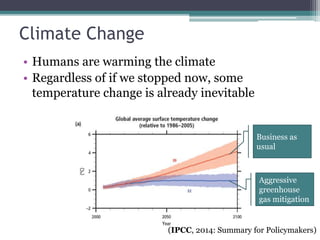
• Humans are warming the climate
• Regardless of if we stopped now, some
temperature change is already inevitable
(IPCC, 2014: Summary for Policymakers)
Business as
usual
Aggressive
greenhouse
gas mitigation
Climate Change
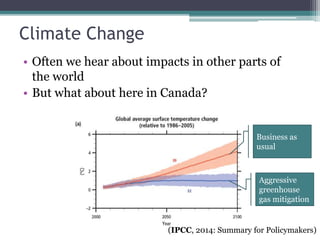
• Often we hear about impacts in other parts of
the world
• But what about here in Canada?
(IPCC, 2014: Summary for Policymakers)
Business as
usual
Aggressive
greenhouse
gas mitigation
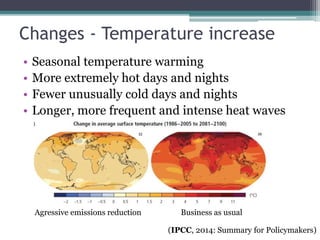
Changes - Temperature increase
• Seasonal temperature warming
• More extremely hot days and nights
• Fewer unusually cold days and nights
• Longer, more frequent and intense heat waves
Aggressive emissions reduction Business as usual
(IPCC, 2014: Summary for Policymakers)
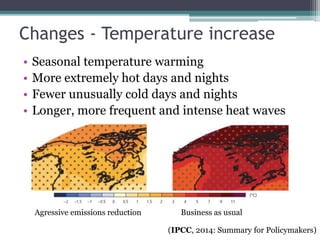
Changes - Temperature increase
• Seasonal temperature warming
• More extremely hot days and nights
• Fewer unusually cold days and nights
• Longer, more frequent and intense heat waves
Aggressive emissions reduction Business as usual
(IPCC, 2014: Summary for Policymakers)
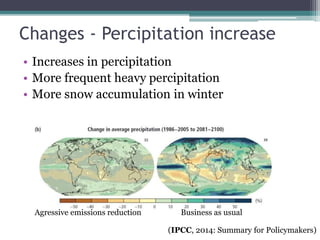
Changes - Percipitation increase
• Increases in percipitation
• More frequent heavy percipitation
• More snow accumulation in winter
Aggressive emissions reduction Business as usual
(IPCC, 2014: Summary for Policymakers)
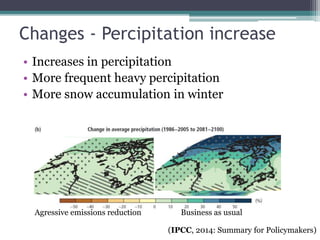
Changes - Percipitation increase
• Increases in percipitation
• More frequent heavy percipitation
• More snow accumulation in winter
Aggressive emissions reduction Business as usual
(IPCC, 2014: Summary for Policymakers)
Changes – Snow, Ice, Permafrost
• Increases in snow depth with more percipitation
• But snow cover duration will decrease
• Ice free Arctic summer could happen by mid-
century
• Lake ice duration may decrease by up to a month
by mid-century
• Permafrost is warming, though the coldest
permafrost could still last for centuries
▫ For more about permafrost, check out an interview with Prof.
Antoni Lewkowicz, expert in permafrost science
▫ http://www.youtube.com/watch?v=PmTfqLOmNXc
Changes – Oceans and Sea Level
• Sea Level
▫ Global rise in sea level (may be over 1 m by the
end of the next century)
▫ Due to land uplift along Canadian coastlines
relative sea rise also depends on location
• Hypoxia
▫ Less desolved oxygen in water
• Increased acidity
▫ Ocean water is becoming “corrosive” to some
species and desolving their shells/skeletons
Effects - Extreme weather events
• Extreme weather events and the damage they
cause are likely to occur with increasing
frequency
Effects - Extreme weather events
• Extreme weather events and the damage they
cause are likely to occur with increasing
frequency
• What kind of damage can we expect?
Effects - Extreme weather events
• Extreme weather events and the damage they
cause are likely to occur with increasing
frequency
• What kind of damage can we expect?
▫ Let’s look at the past to predict the future...
Effects - Extreme weather events
(adapted from Warren & Lemmen, 2014)
Storm (including
snow)
Wildfire
Tornado
Hurricane
Flooding
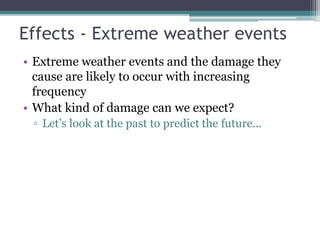
Example losses from extreme weather in the last 15 years
Effects - Extreme weather events
(adapted from Warren & Lemmen, 2014)
Storm (including
snow)
Wildfire
Tornado
Hurricane
Flooding
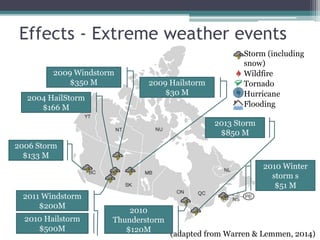
2006 Storm
$133 M
2011 Windstorm
$200M
2010 Hailstorm
$500M
2004 HailStorm
$166 M
2009 Windstorm
$350 M 2009 Hailstorm
$30 M
2013 Storm
$850 M
2010
Thunderstorm
$120M
2010 Winter
storm s
$51 M
Effects - Extreme weather events
(adapted from Warren & Lemmen, 2014)
Storm (including
snow)
Wildfire
Tornado
Hurricane
Flooding
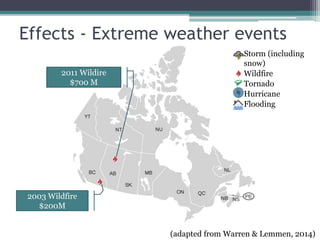
2003 Wildfire
$200M
2011 Wildire
$700 M
Effects - Extreme weather events
(adapted from Warren & Lemmen, 2014)
Storm (including
snow)
Wildfire
Tornado
Hurricane
Flooding
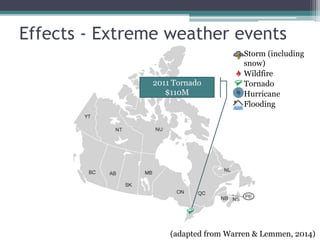
2011 Tornado
$110M
Effects - Extreme weather events
(adapted from Warren & Lemmen, 2014)
Storm (including
snow)
Wildfire
Tornado
Hurricane
Flooding
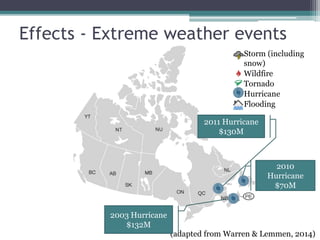
2011 Hurricane
$130M
2003 Hurricane
$132M
2010
Hurricane
$70M
Effects - Extreme weather events
(adapted from Warren & Lemmen, 2014)
Storm (including
snow)
Wildfire
Tornado
Hurricane
Flooding
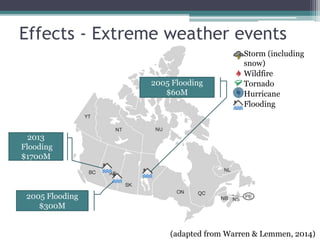
2013
Flooding
$1700M
2005 Flooding
$300M
2005 Flooding
$60M
Effects - Extreme weather events
(adapted from Warren & Lemmen, 2014)
Storm (including
snow)
Wildfire
Tornado
Hurricane
Flooding
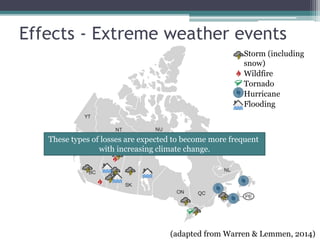
These types of losses are expected to become more frequent
with increasing climate change.
Effects - Biodiversity
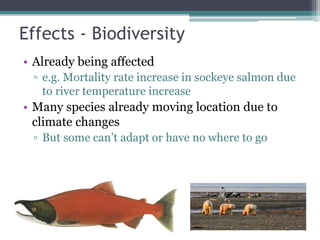
• Already being affected
▫ e.g. Mortality rate increase in sockeye salmon due
to river temperature increase
• Many species already moving location due to
climate changes
▫ But some can’t adapt or have no where to go
Effects - Agriculture
• Canada may get an increase in growing season
and have increased production
• But we will also have increased pests
• And damage from extreme weather events
▫ E.g. Early warming in 2012 followed by frost
caused 80% reduction in apple blossoms in
Ontario for $100M in damage
• And many places we import food from will be
adversely affected by this global problem
Effects – Human Health
• Expect increase in diseases carried by pests
▫ E.g. lyme disease
• Air pollution issues exacerbated
• Increased heat wave deaths
• Allergy season length increasing
Adaptation
• There are many adaptations that will be
necessary in the coming years due to climate
change
• Some examples:
▫ Northern infrastructure must be prepared for melting
permafrost
▫ Communities must prepare responses to heat waves to
prevent negative health impacts
▫ Health tools for dealing with increases in climate
related diseases must be developed for communities
▫ Protecting habitat zones for moving aminal species
▫ Moving vulnerable coastal roads inland
Mitigation
• What about prevention?
• While some climate change is inevitable, there
are multiple end results if we act now
• Canada is a high greenhouse gas emitter per
capita – something we can act on
• Federally, not a lot has been done
• On provincial and municiple levels, however, we
can still move forward
▫ E.g. British Columbia’s revenue neutral carbon tax
is being looked on as an example globally and has
proven effective in reducing emissions
Other links of interest
• http://www.climatechange.gc.ca/
• http://www.ipcc.ch/report/ar5/wg3/
• http://www.nrcan.gc.ca/forests/climate-
change/13083
• http://www.nrcan.gc.ca/environment/impacts-
adaptation/10761
• http://www.fin.gov.bc.ca/tbs/tp/climate/carbon
_tax.htm
References
• IPCC, 2014: Summary for Policymakers. In: Climate Change 2014: Impacts, Adaptation, and Vulnerability. Part
A: Global and Sectoral Aspects. Contribution of Working Group II to the Fifth Assessment Report of the
Intergovernmental Panel on Climate Change [Field, C.B., V.R. Barros, D.J. Dokken, K.J. Mach, M.D.
Mastrandrea, T.E. Bilir, M. Chatterjee, K.L. Ebi, Y.O. Estrada, R.C. Genova, B. Girma, E.S. Kissel, A.N. Levy, S.
MacCracken, P.R. Mastrandrea, and L.L. White (eds.)]. Cambridge University Press, Cambridge, United Kingdom
and New York, NY, USA, pp. 1-32.
• Warren, F.J. and Lemmen, D.S., editors (2014): Canada in a Changing Climate: Sector Perspectives on Impacts
and Adaptation; Government of Canada, Ottawa, ON, 286p.
Additional Image Credits
• USFWS, Three polar bears on the Beaufort Sea coast, Arctic National Wildlife Refuge, 2005 available at
http://digitalmedia.fws.gov/
• Page 5 of U.S. Government Printing Office Pamphlet 1996-792-501: Lake Washington Ship Canal Fish Ladder -
Drawing of male freshwater phase Sockeye (red) salmon available at
http://commons.wikimedia.org/wiki/File:Lake_Washington_Ship_Canal_Fish_Ladder_pamphlet_-
_male_freshwater_phase_Sockeye.jpg

Canada and climate change

  • 1.
    Canada and ClimateChange Expectations for the Future Turn Down the Heat – Final Project
  • 2.
    Climate Change • Humansare warming the climate • Regardless of if we stopped now, some temperature change is already inevitable (IPCC, 2014: Summary for Policymakers) Business as usual Aggressive greenhouse gas mitigation
  • 3.
    Climate Change • Oftenwe hear about impacts in other parts of the world • But what about here in Canada? (IPCC, 2014: Summary for Policymakers) Business as usual Aggressive greenhouse gas mitigation
  • 4.
    Changes - Temperatureincrease • Seasonal temperature warming • More extremely hot days and nights • Fewer unusually cold days and nights • Longer, more frequent and intense heat waves Aggressive emissions reduction Business as usual (IPCC, 2014: Summary for Policymakers)
  • 5.
    Changes - Temperatureincrease • Seasonal temperature warming • More extremely hot days and nights • Fewer unusually cold days and nights • Longer, more frequent and intense heat waves Aggressive emissions reduction Business as usual (IPCC, 2014: Summary for Policymakers)
  • 6.
    Changes - Percipitationincrease • Increases in percipitation • More frequent heavy percipitation • More snow accumulation in winter Aggressive emissions reduction Business as usual (IPCC, 2014: Summary for Policymakers)
  • 7.
    Changes - Percipitationincrease • Increases in percipitation • More frequent heavy percipitation • More snow accumulation in winter Aggressive emissions reduction Business as usual (IPCC, 2014: Summary for Policymakers)
  • 8.
    Changes – Snow,Ice, Permafrost • Increases in snow depth with more percipitation • But snow cover duration will decrease • Ice free Arctic summer could happen by mid- century • Lake ice duration may decrease by up to a month by mid-century • Permafrost is warming, though the coldest permafrost could still last for centuries ▫ For more about permafrost, check out an interview with Prof. Antoni Lewkowicz, expert in permafrost science ▫ http://www.youtube.com/watch?v=PmTfqLOmNXc
  • 9.
    Changes – Oceansand Sea Level • Sea Level ▫ Global rise in sea level (may be over 1 m by the end of the next century) ▫ Due to land uplift along Canadian coastlines relative sea rise also depends on location • Hypoxia ▫ Less desolved oxygen in water • Increased acidity ▫ Ocean water is becoming “corrosive” to some species and desolving their shells/skeletons
  • 10.
    Effects - Extremeweather events • Extreme weather events and the damage they cause are likely to occur with increasing frequency
  • 11.
    Effects - Extremeweather events • Extreme weather events and the damage they cause are likely to occur with increasing frequency • What kind of damage can we expect?
  • 12.
    Effects - Extremeweather events • Extreme weather events and the damage they cause are likely to occur with increasing frequency • What kind of damage can we expect? ▫ Let’s look at the past to predict the future...
  • 13.
    Effects - Extremeweather events (adapted from Warren & Lemmen, 2014) Storm (including snow) Wildfire Tornado Hurricane Flooding Example losses from extreme weather in the last 15 years
  • 14.
    Effects - Extremeweather events (adapted from Warren & Lemmen, 2014) Storm (including snow) Wildfire Tornado Hurricane Flooding 2006 Storm $133 M 2011 Windstorm $200M 2010 Hailstorm $500M 2004 HailStorm $166 M 2009 Windstorm $350 M 2009 Hailstorm $30 M 2013 Storm $850 M 2010 Thunderstorm $120M 2010 Winter storm s $51 M
  • 15.
    Effects - Extremeweather events (adapted from Warren & Lemmen, 2014) Storm (including snow) Wildfire Tornado Hurricane Flooding 2003 Wildfire $200M 2011 Wildire $700 M
  • 16.
    Effects - Extremeweather events (adapted from Warren & Lemmen, 2014) Storm (including snow) Wildfire Tornado Hurricane Flooding 2011 Tornado $110M
  • 17.
    Effects - Extremeweather events (adapted from Warren & Lemmen, 2014) Storm (including snow) Wildfire Tornado Hurricane Flooding 2011 Hurricane $130M 2003 Hurricane $132M 2010 Hurricane $70M
  • 18.
    Effects - Extremeweather events (adapted from Warren & Lemmen, 2014) Storm (including snow) Wildfire Tornado Hurricane Flooding 2013 Flooding $1700M 2005 Flooding $300M 2005 Flooding $60M
  • 19.
    Effects - Extremeweather events (adapted from Warren & Lemmen, 2014) Storm (including snow) Wildfire Tornado Hurricane Flooding These types of losses are expected to become more frequent with increasing climate change.
  • 20.
    Effects - Biodiversity •Already being affected ▫ e.g. Mortality rate increase in sockeye salmon due to river temperature increase • Many species already moving location due to climate changes ▫ But some can’t adapt or have no where to go
  • 21.
    Effects - Agriculture •Canada may get an increase in growing season and have increased production • But we will also have increased pests • And damage from extreme weather events ▫ E.g. Early warming in 2012 followed by frost caused 80% reduction in apple blossoms in Ontario for $100M in damage • And many places we import food from will be adversely affected by this global problem
  • 22.
    Effects – HumanHealth • Expect increase in diseases carried by pests ▫ E.g. lyme disease • Air pollution issues exacerbated • Increased heat wave deaths • Allergy season length increasing
  • 23.
    Adaptation • There aremany adaptations that will be necessary in the coming years due to climate change • Some examples: ▫ Northern infrastructure must be prepared for melting permafrost ▫ Communities must prepare responses to heat waves to prevent negative health impacts ▫ Health tools for dealing with increases in climate related diseases must be developed for communities ▫ Protecting habitat zones for moving aminal species ▫ Moving vulnerable coastal roads inland
  • 24.
    Mitigation • What aboutprevention? • While some climate change is inevitable, there are multiple end results if we act now • Canada is a high greenhouse gas emitter per capita – something we can act on • Federally, not a lot has been done • On provincial and municiple levels, however, we can still move forward ▫ E.g. British Columbia’s revenue neutral carbon tax is being looked on as an example globally and has proven effective in reducing emissions
  • 25.
    Other links ofinterest • http://www.climatechange.gc.ca/ • http://www.ipcc.ch/report/ar5/wg3/ • http://www.nrcan.gc.ca/forests/climate- change/13083 • http://www.nrcan.gc.ca/environment/impacts- adaptation/10761 • http://www.fin.gov.bc.ca/tbs/tp/climate/carbon _tax.htm
  • 26.
    References • IPCC, 2014:Summary for Policymakers. In: Climate Change 2014: Impacts, Adaptation, and Vulnerability. Part A: Global and Sectoral Aspects. Contribution of Working Group II to the Fifth Assessment Report of the Intergovernmental Panel on Climate Change [Field, C.B., V.R. Barros, D.J. Dokken, K.J. Mach, M.D. Mastrandrea, T.E. Bilir, M. Chatterjee, K.L. Ebi, Y.O. Estrada, R.C. Genova, B. Girma, E.S. Kissel, A.N. Levy, S. MacCracken, P.R. Mastrandrea, and L.L. White (eds.)]. Cambridge University Press, Cambridge, United Kingdom and New York, NY, USA, pp. 1-32. • Warren, F.J. and Lemmen, D.S., editors (2014): Canada in a Changing Climate: Sector Perspectives on Impacts and Adaptation; Government of Canada, Ottawa, ON, 286p.
  • 27.
    Additional Image Credits •USFWS, Three polar bears on the Beaufort Sea coast, Arctic National Wildlife Refuge, 2005 available at http://digitalmedia.fws.gov/ • Page 5 of U.S. Government Printing Office Pamphlet 1996-792-501: Lake Washington Ship Canal Fish Ladder - Drawing of male freshwater phase Sockeye (red) salmon available at http://commons.wikimedia.org/wiki/File:Lake_Washington_Ship_Canal_Fish_Ladder_pamphlet_- _male_freshwater_phase_Sockeye.jpg