By: Arbaaz Khan Atif Khan Annam Khan Suhail Khan
Originally set up in 1947 as the General Agreement on Tariffs and Trade (GATT) GATT was replaced by the WTO in 1995 128 signing members Governed 90% of world trade Currently, there are 153 member countries in the WTO
Set of multilateral trade agreements aimed at the abolition of quotas and the reduction of tariffs among member countries. Established after WWII to promote world trade. Created as an interim agency that would be replaced by a specialized agency of the United Nations to be called the International Trade Organization (ITO) ITO was never created because the U.S. did not ratify the agreement
Signed on October 30, 1947, by 23 countries in Geneva (to take effect on January 1, 1948) Consisted of 8 Rounds – rounds of trade negotiations
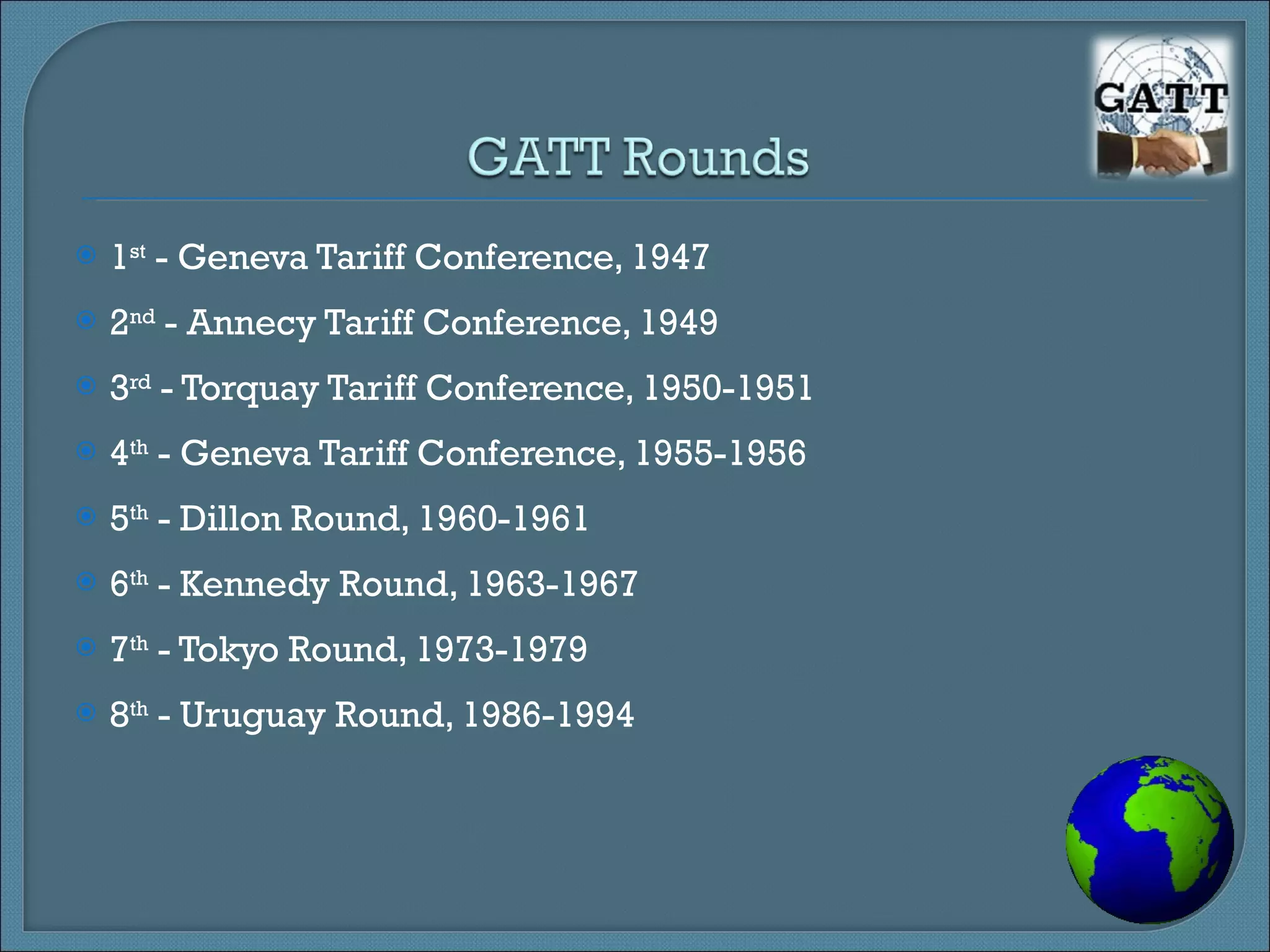
1 st  - Geneva Tariff Conference, 1947 2 nd  - Annecy Tariff Conference, 1949 3 rd  - Torquay Tariff Conference, 1950-1951 4 th  - Geneva Tariff Conference, 1955-1956 5 th  - Dillon Round, 1960-1961 6 th  - Kennedy Round, 1963-1967 7 th  - Tokyo Round, 1973-1979 8 th  - Uruguay Round, 1986-1994
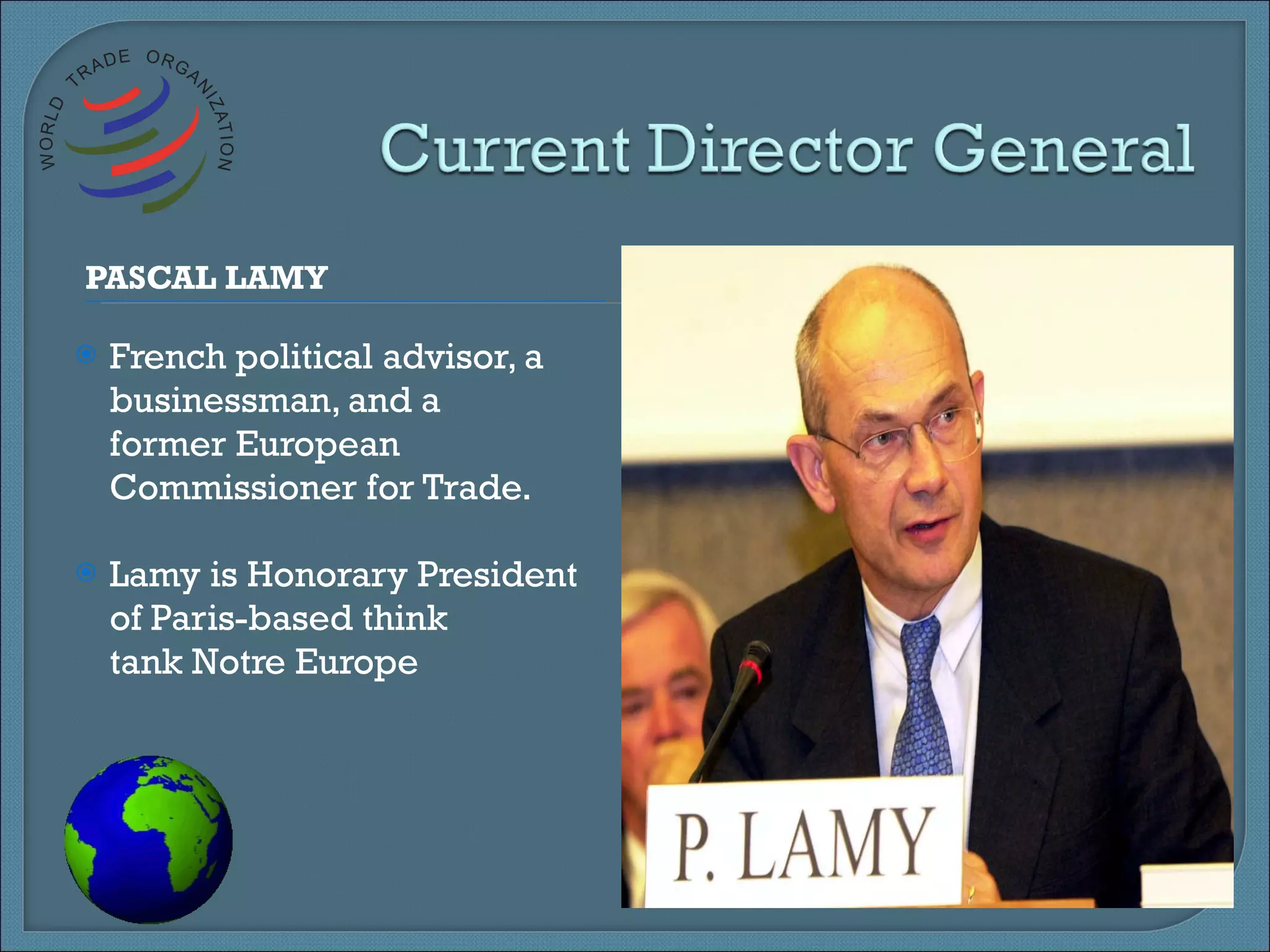
PASCAL LAMY French political advisor, a businessman, and a former European Commissioner for Trade.  Lamy is Honorary President of Paris-based think tank Notre Europe
Trade Negotiations Cover goods, services, and intellectual property Set procedures for settling disputes Several trade agreements are currently being negotiated under the Doha Development Agenda
Implementation and Monitoring Require governments to make their trade policies transparent by notifying the WTO WTO councils and committees ensure policies are being followed WTO members are periodically scrutinized on their trade policies and practices
Dispute Settlement Resolves trade quarrels under the Dispute Settlement Understanding to ensure trading runs smoothly Countries petition the WTO if they believe their rights are being infringed
Building Trade Capacity WTO specifically tries to aid developing countries to build their trading capacity and try to help establish trading standards Organizes technical cooperation missions, numerous courses for government officials, and the Aid for Trade tries to help develop a country’s skills and infrastructure to expand their trade capacity
Outreach WTO maintains dialogue with various organizations non-government related to enhance cooperation and increase awareness of WTO activities around the world
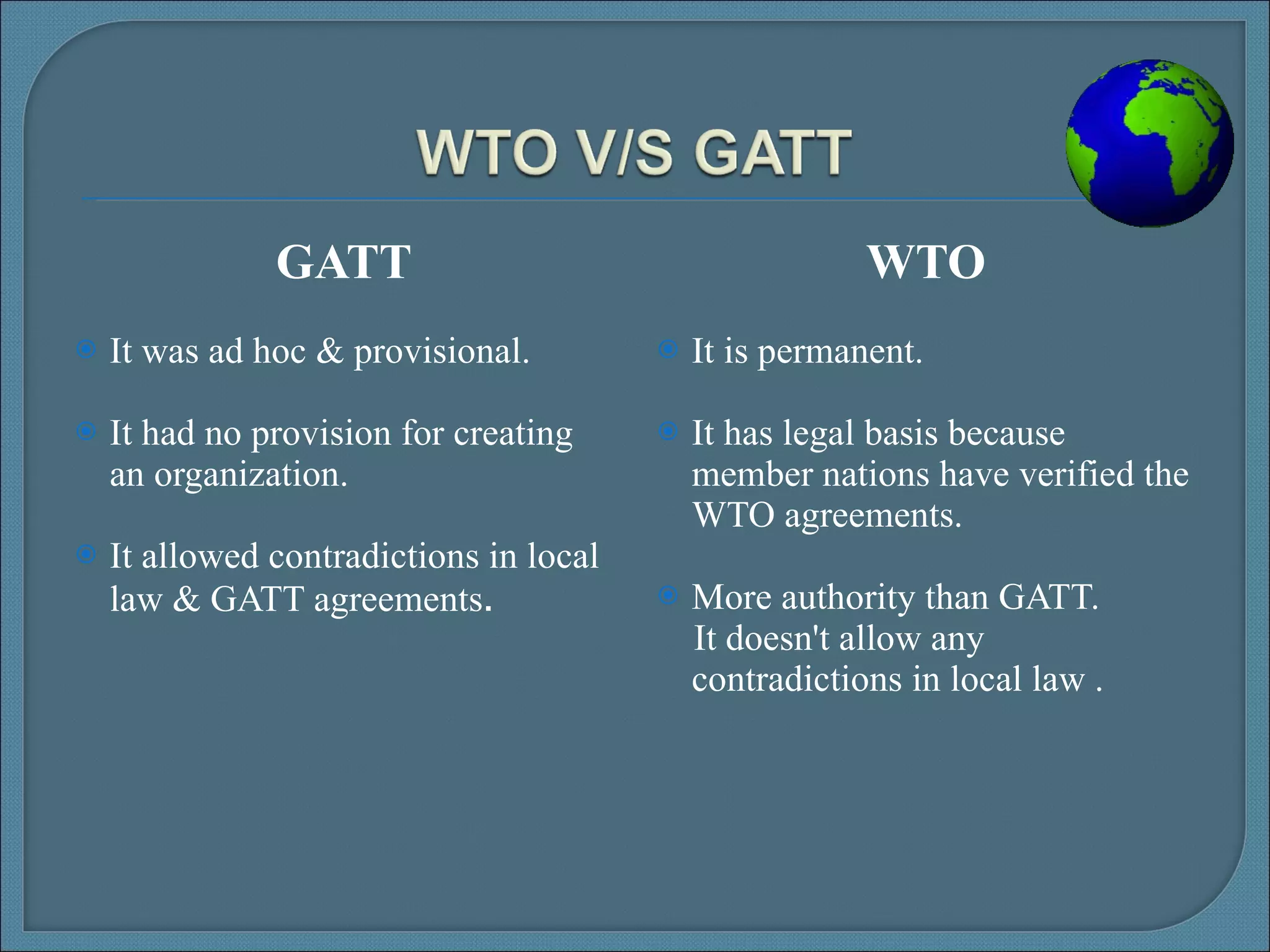
GATT It was ad hoc & provisional. It had no provision for creating an organization.  It allowed contradictions in local law & GATT agreements . WTO It is permanent. It has legal basis because member nations have verified the WTO agreements. More authority than GATT. It doesn't allow any contradictions in local law .
1. Without Discrimination:  A country should not discriminate between its trading partners Most-Favoured-Nation/MFN Status:  The contracting nations binds itself to grant to the other in certain stipulated matters the same terms as are then, or may be thereafter, granted to the nation which receives from it the most favorable terms in respect of those matters National Treatment : Treating foreigners and locals equally . 2. Freer: Barriers coming down through negotiation Progressive Liberalization
3. Predictable:  Foreign companies, investors, and governments should be confident that trade barriers (including tariffs and non-tariff barriers) should not be raised arbitrarily; tariff rates and market-opening commitments are “bound” in the WTO 4. More Competitive:  Discouraging “unfair” practices such as export subsidies and dumping products at below cost to gain market share   5. More Beneficial for Less Developed Countries:  Giving them more time to adjust, greater flexibility, and special privileges.    Ex: Uruguay Round
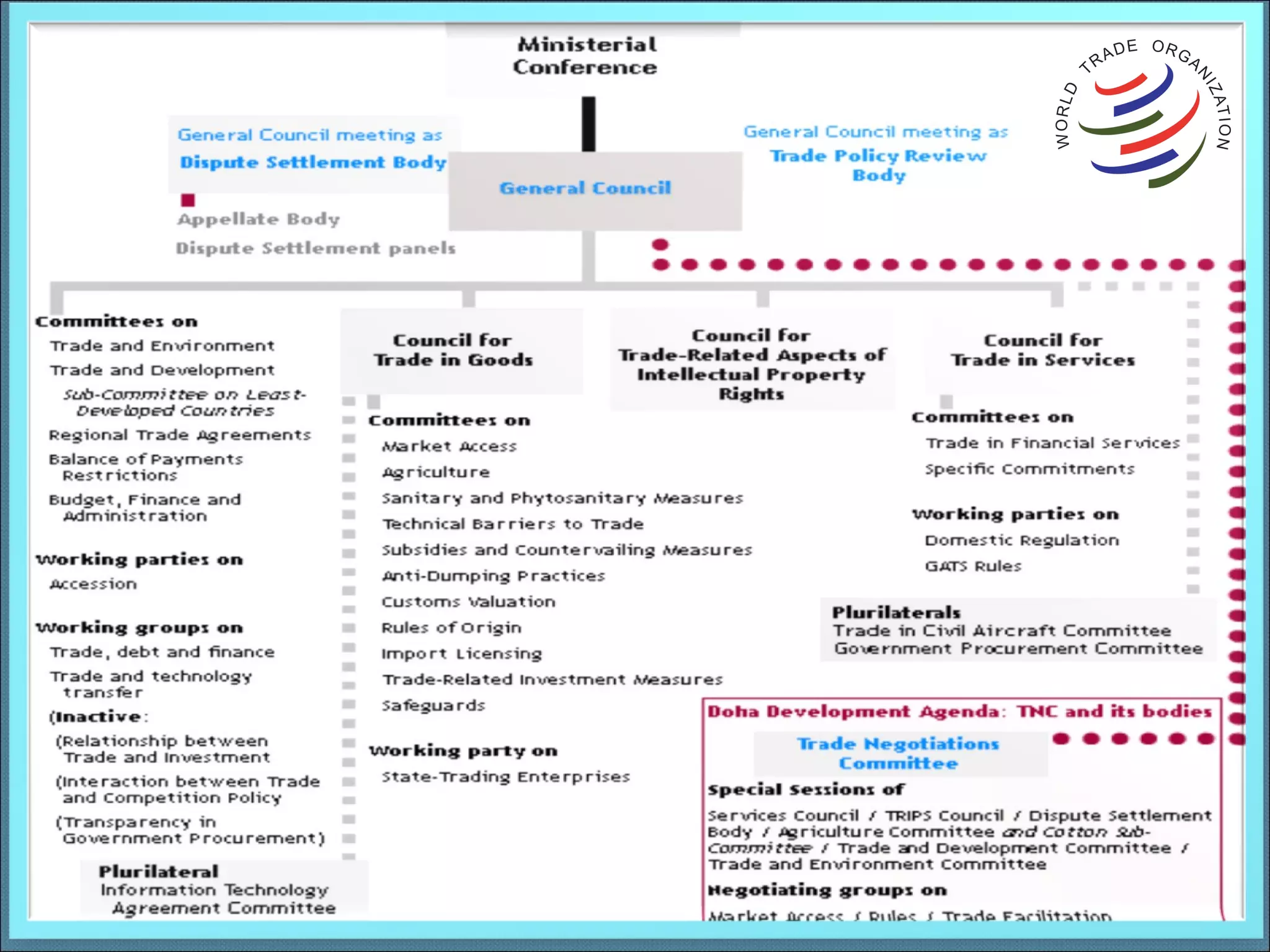
Council for Trade in Goods All members of the WTO participate in the committees The body has its own chairman and only 10 members. Council for Trade-Related Aspects of Intellectual Property Rights Information on intellectual property in the WTO
Council for Trade in Services Operates under the guidance of the General Council Responsible for overseeing the functioning of GATT Trade Negotiations Committee Deals with the current trade talks The chairperson is WTO’s director-general Doha Development Round
 
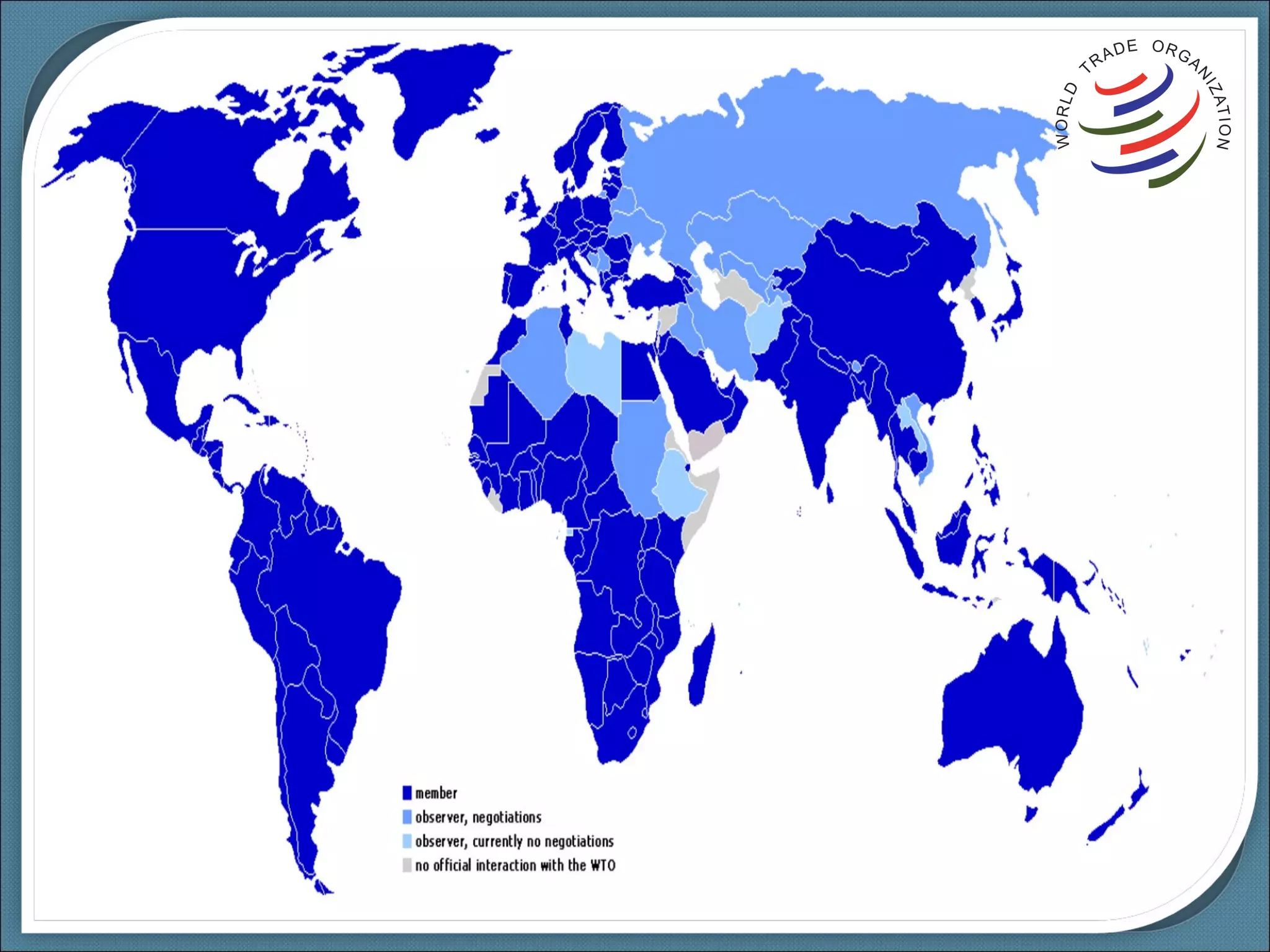
The World Trade Organization is composed of 153 countries Of these, 123 were signed during the Uruguay round WTO members do not have to be full-sovereign nation members Instead, they must be a custom territory with full autonomy in their external relations Example: Hong Kong, China is considered a member
United States United Kingdom France Italy China Brazil Germany Japan Canada  Mexico
There are 30 countries that are not members known as observers These countries are currently negotiating membership The biggest of these non-members is currently Russia, however, they are in the process of accession  Accession negotiations must begin within 5 years of becoming an observer


Wto final group

  • 1.
    By: Arbaaz KhanAtif Khan Annam Khan Suhail Khan
  • 2.
    Originally set upin 1947 as the General Agreement on Tariffs and Trade (GATT) GATT was replaced by the WTO in 1995 128 signing members Governed 90% of world trade Currently, there are 153 member countries in the WTO
  • 3.
    Set of multilateraltrade agreements aimed at the abolition of quotas and the reduction of tariffs among member countries. Established after WWII to promote world trade. Created as an interim agency that would be replaced by a specialized agency of the United Nations to be called the International Trade Organization (ITO) ITO was never created because the U.S. did not ratify the agreement
  • 4.
    Signed on October30, 1947, by 23 countries in Geneva (to take effect on January 1, 1948) Consisted of 8 Rounds – rounds of trade negotiations
  • 5.
    1 st - Geneva Tariff Conference, 1947 2 nd - Annecy Tariff Conference, 1949 3 rd - Torquay Tariff Conference, 1950-1951 4 th - Geneva Tariff Conference, 1955-1956 5 th - Dillon Round, 1960-1961 6 th - Kennedy Round, 1963-1967 7 th - Tokyo Round, 1973-1979 8 th - Uruguay Round, 1986-1994
  • 6.
    PASCAL LAMY Frenchpolitical advisor, a businessman, and a former European Commissioner for Trade. Lamy is Honorary President of Paris-based think tank Notre Europe
  • 7.
    Trade Negotiations Covergoods, services, and intellectual property Set procedures for settling disputes Several trade agreements are currently being negotiated under the Doha Development Agenda
  • 8.
    Implementation and MonitoringRequire governments to make their trade policies transparent by notifying the WTO WTO councils and committees ensure policies are being followed WTO members are periodically scrutinized on their trade policies and practices
  • 9.
    Dispute Settlement Resolvestrade quarrels under the Dispute Settlement Understanding to ensure trading runs smoothly Countries petition the WTO if they believe their rights are being infringed
  • 10.
    Building Trade CapacityWTO specifically tries to aid developing countries to build their trading capacity and try to help establish trading standards Organizes technical cooperation missions, numerous courses for government officials, and the Aid for Trade tries to help develop a country’s skills and infrastructure to expand their trade capacity
  • 11.
    Outreach WTO maintainsdialogue with various organizations non-government related to enhance cooperation and increase awareness of WTO activities around the world
  • 12.
    GATT It wasad hoc & provisional. It had no provision for creating an organization. It allowed contradictions in local law & GATT agreements . WTO It is permanent. It has legal basis because member nations have verified the WTO agreements. More authority than GATT. It doesn't allow any contradictions in local law .
  • 13.
    1. Without Discrimination: A country should not discriminate between its trading partners Most-Favoured-Nation/MFN Status:  The contracting nations binds itself to grant to the other in certain stipulated matters the same terms as are then, or may be thereafter, granted to the nation which receives from it the most favorable terms in respect of those matters National Treatment : Treating foreigners and locals equally . 2. Freer: Barriers coming down through negotiation Progressive Liberalization
  • 14.
    3. Predictable:  Foreigncompanies, investors, and governments should be confident that trade barriers (including tariffs and non-tariff barriers) should not be raised arbitrarily; tariff rates and market-opening commitments are “bound” in the WTO 4. More Competitive:  Discouraging “unfair” practices such as export subsidies and dumping products at below cost to gain market share   5. More Beneficial for Less Developed Countries:  Giving them more time to adjust, greater flexibility, and special privileges.    Ex: Uruguay Round
  • 15.
    Council for Tradein Goods All members of the WTO participate in the committees The body has its own chairman and only 10 members. Council for Trade-Related Aspects of Intellectual Property Rights Information on intellectual property in the WTO
  • 16.
    Council for Tradein Services Operates under the guidance of the General Council Responsible for overseeing the functioning of GATT Trade Negotiations Committee Deals with the current trade talks The chairperson is WTO’s director-general Doha Development Round
  • 17.
  • 18.
    The World TradeOrganization is composed of 153 countries Of these, 123 were signed during the Uruguay round WTO members do not have to be full-sovereign nation members Instead, they must be a custom territory with full autonomy in their external relations Example: Hong Kong, China is considered a member
  • 19.
    United States UnitedKingdom France Italy China Brazil Germany Japan Canada Mexico
  • 20.
    There are 30countries that are not members known as observers These countries are currently negotiating membership The biggest of these non-members is currently Russia, however, they are in the process of accession Accession negotiations must begin within 5 years of becoming an observer
  • 21.
  • 22.